Commercial Auto Insurance in Gastonia, NC: Comprehensive Coverage Overview
Commercial auto insurance in Gastonia, North Carolina, protects businesses against financial losses resulting from vehicle accidents, property damage, bodily injuries, and related legal liabilities. Whether operating a single delivery...
Commercial auto insurance in Gastonia, North Carolina, protects businesses against financial losses resulting from vehicle accidents, property damage, bodily injuries, and related legal liabilities. Whether operating a single delivery van along Franklin Boulevard or managing a fleet of service trucks traversing the Interstate 85 corridor, commercial auto coverage ensures legal compliance under North Carolina law while safeguarding business assets.
Contents
Disclaimer: This guide is provided for informational purposes only and does not constitute formal legal, tax, or financial advice. Coverage requirements vary based on business operations, vehicle weight, and operational radius. Business owners should consult a licensed North Carolina insurance agent to review specific risk profiles.
Understanding North Carolina Commercial Auto Insurance Requirements
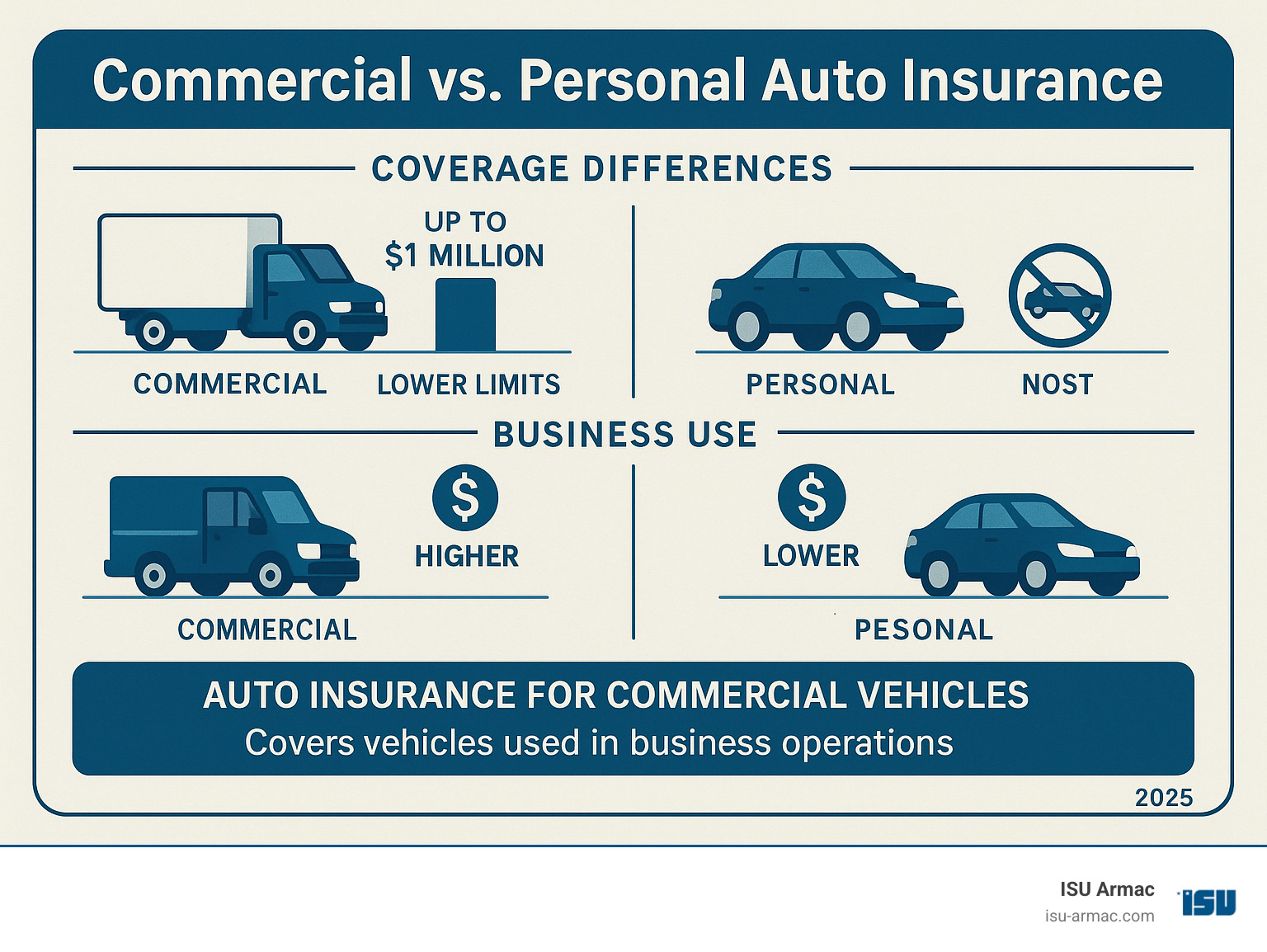
Commercial vehicle operations in Gastonia and throughout Gaston County must adhere to mandatory financial responsibility laws governed by the state. North Carolina requires every registered motor vehicle to carry minimum liability limits. However, standard personal auto policies explicitly exclude vehicles used primarily for commercial purposes, business transportation, or transporting goods for fee.
Under North Carolina law (N.C. Gen. Stat. § 20-279.21), minimum liability limits established for standard motor vehicle policies are set at:
- $50,000 for bodily injury per person
- $100,000 for total bodily injury per accident involving multiple people
- $50,000 for property damage per accident
While these statutory minimums fulfill basic state registration criteria, they are rarely sufficient for commercial enterprises. A single multi-vehicle collision on I-85 or Highway 321 can easily result in medical expenditures, vehicle repairs, and legal expenses far exceeding statutory baselines. Consequently, most commercial entities in Gastonia carry Combined Single Limit (CSL) policies starting at $500,000 or $1,000,000 per occurrence.
Federal Regulations for Interstate and Heavy Commercial Operations
Businesses operating heavier commercial vehicles, transporting hazardous goods, or moving freight across state lines into South Carolina or neighboring states must comply with federal standards enforced by the Federal Motor Carrier Safety Administration (FMCSA).
Federal financial responsibility mandates depend on Gross Vehicle Weight Rating (GVWR) and cargo type:
- Freight vehicles over 10,000 lbs. GVWR (non-hazardous): Minimum $750,000 public liability coverage.
- Oil transportation and select hazardous materials: Minimum $1,000,000 public liability coverage.
- Certain hazardous materials and explosives: Minimum $5,000,000 public liability coverage.
Core Coverage Components of a Business Auto Policy (BAP)
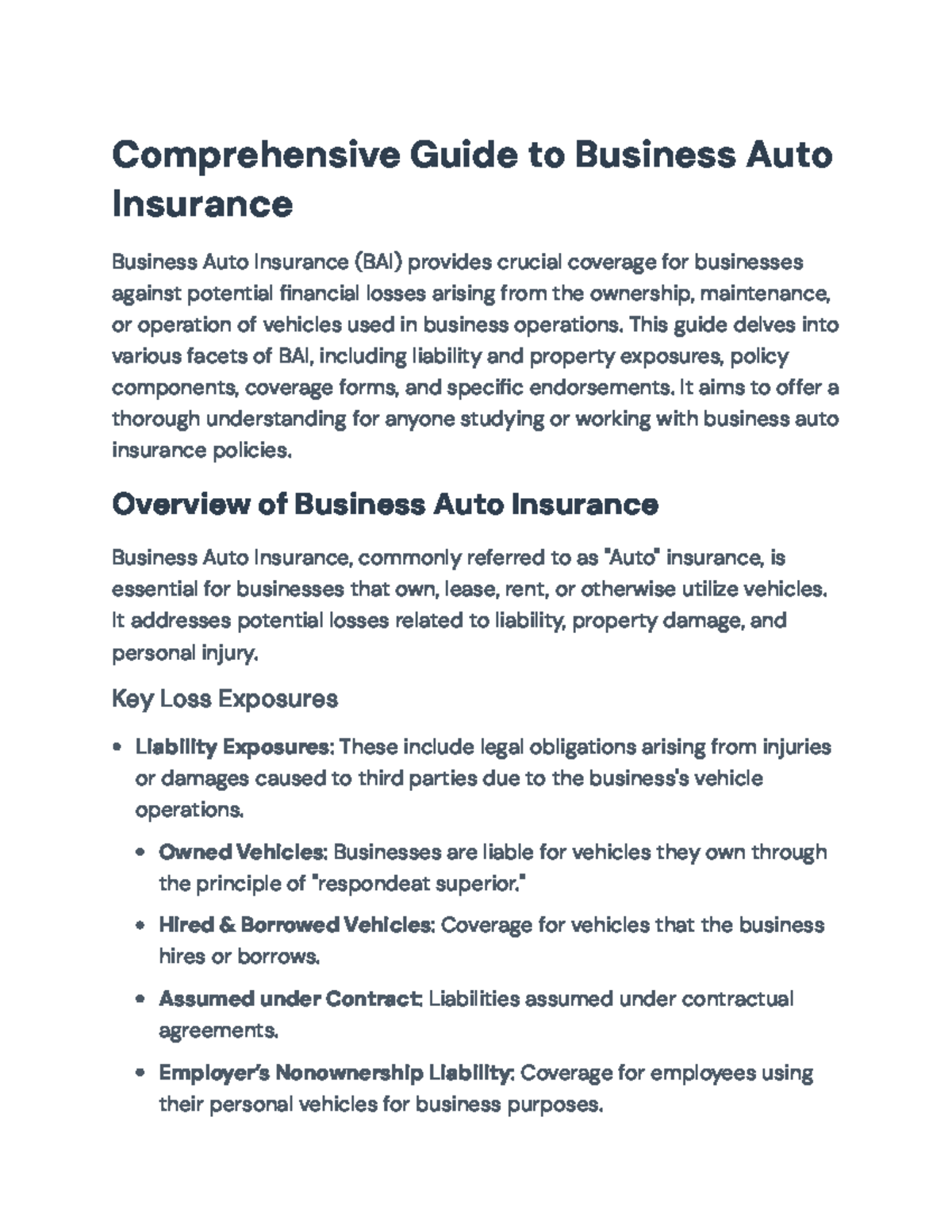
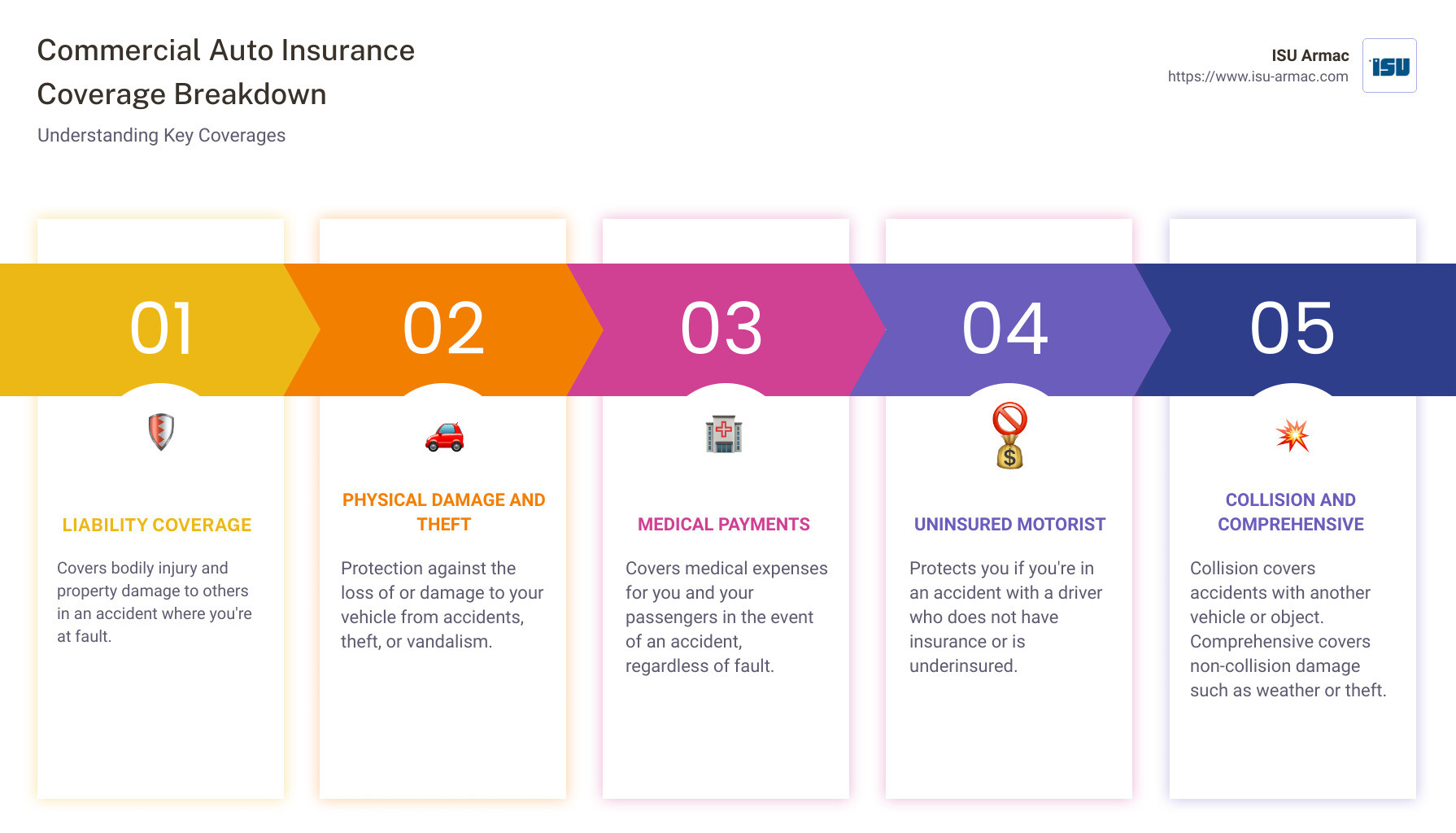
A standard Business Auto Policy (BAP) consists of several distinct coverage modules. Business owners in Gastonia can structure these modules to align with their specific operational exposure.
| Liability Coverage | Physical Damage Coverage |
|---|---|
| • Bodily Injury Liability• Property Damage Liability• Combined Single Limit (CSL) | • Comprehensive Coverage• Collision Coverage• Specified Causes of Loss |
| Protection Modules | Specialized Endorsements |
| • Medical Payments (MedPay)• Uninsured Motorist (UM)• Underinsured Motorist (UIM) | • Hired & Non-Owned Auto (HNOA)• Motor Truck Cargo / On-Hook• Mobile Tools & Equipment Rider |
1. Auto Liability Coverage
Auto liability forms the core foundation of any commercial policy. It covers legal obligations when an owner or designated employee causes an accident resulting in bodily injury or property damage to third parties.
- Bodily Injury Liability: Pays for medical bills, emergency transport, ongoing rehabilitation, loss of income, and legal defense costs for injured third parties.
- Property Damage Liability: Pays for repairs or replacement of third-party vehicles, structures, guardrails, utility poles, or other damaged physical property.
2. Physical Damage Coverage
Physical damage protection covers losses to company-owned, leased, or operated vehicles regardless of fault.
- Collision Coverage: Pays for structural repairs or actual cash value (ACV) replacement if a business vehicle collides with another vehicle, building, or object, or experiences a rollover.
- Comprehensive Coverage: Covers non-collision events, including theft, vandalism, fire, falling objects, severe hail, animal strikes, and weather-related flooding common to low-lying areas near the South Fork Catawba River.
3. Medical Payments (MedPay)
Medical Payments coverage reimburses medical and funeral expenses for the driver and passengers within the insured business vehicle following an accident, regardless of who caused the incident. MedPay operates independently of fault and can supplement employee health insurance or bridge gaps before workers' compensation claims clear.
4. Uninsured and Underinsured Motorist Coverage (UM/UIM)
Uninsured Motorist (UM) and Underinsured Motorist (UIM) coverages protect business drivers and occupants if they are hit by a driver who lacks valid auto insurance or carries liability limits inadequate to cover total damages. In North Carolina, UM/UIM coverage must be offered on commercial auto policies, providing a financial safety net against negligent drivers.
Specialized Commercial Auto Endorsements
Standard commercial auto policies may leave coverage gaps for specialized business models. Gastonia business owners often attach endorsements (policy modifications) to tailor protection to their operational needs.
Hired and Non-Owned Auto Liability (HNOA)
HNOA coverage is essential for businesses whose employees drive personal vehicles for company errands or rent vehicles for business travel.
- Non-Owned Auto Coverage: Protects the business if an employee causes an accident while driving their personal vehicle to deliver documents, pick up supplies along Cox Road, or attend a client meeting.
- Hired Auto Coverage: Extends liability protection to vehicles rented, leased, or borrowed by the business for short-term operational use.
Motor Truck Cargo and On-Hook Towing
For logistics firms, courier services, and auto recovery operators across Gaston County, physical damage coverage on the vehicle itself does not extend to the cargo or towed vehicles. Motor Truck Cargo coverage protects goods in transit against theft, fire, or collision damage. On-Hook Towing coverage specifically protects passenger or commercial vehicles while being towed or transported by a wrecker.
Inland Marine and Equipment Riders
Contractors, electricians, plumbers, and HVAC operators carrying valuable tools, diagnostic equipment, or machinery in service vans require Inland Marine policies or tool endorsements. Standard commercial auto physical damage covers fixed vehicle components, not loose tools or materials stored in cargo beds.
Factors Influencing Commercial Auto Insurance Premiums in Gastonia
Insurance underwriters calculate commercial auto premiums by evaluating combined risk factors related to geography, vehicle type, human capital, and operational history.
- Commercial Auto Premium Factors
- Territory & Radius
- Vehicle Type/GVWR
- Driver Records
- Business Use Case
- Loss History
1. Operating Territory and Fleet Radius
Gastonia’s geographic location within the Charlotte metropolitan area presents specific traffic density risks. Frequent travel along major arteries—such as I-85, US-29/74, and NC-277—exposes fleet vehicles to higher collision rates than rural rural zones. Policies defining a local radius (under 50 miles) generally carry lower premiums than intermediate (50 to 200 miles) or long-haul regional routes.
2. Vehicle Weight Classification and Usage
Heavy-duty vehicles generate larger impact forces in collisions, causing greater bodily harm and property damage. An enterprise operating a fleet of Class 8 dump trucks or box trucks will pay higher liability base rates than a firm operating Class 1 passenger sedans or compact cargo vans.
3. Driver Motor Vehicle Records (MVRs)
Driver history directly impacts commercial premium calculations. Insurers require routine screening of Motor Vehicle Records (MVRs) for all designated drivers. Drivers with records containing speeding violations, reckless driving convictions, or suspensions increase fleet policy costs significantly.
4. Loss History and Loss Ratio
Insurance providers analyze a business’s loss runs over a three-to-five-year window. A high frequency of small claims or a single large loss elevates the company's loss ratio, leading to higher experience modifiers and elevated renewal rates.
Industry Coverage Profiles for Gastonia Businesses
Coverage structures vary based on trade classification. The table below illustrates typical coverage profiles for common business sectors in Gastonia.
| Business Sector | Primary Fleet Vehicles | Key Risk Factors | Recommended Coverage Structure | Typical Liability Limits |
|---|---|---|---|---|
| Trade Contractors (HVAC, Electrical, Plumbing) | Service Vans, Pickup Trucks, Utility Trailers | Heavy tool transport, employee transit, jobsite travel along urban corridors | Business Auto Policy + Physical Damage + Tool/Equipment Endorsement + HNOA | $1,000,000 CSL |
| Local Logistics & Freight | Box Trucks, Straight Trucks, Tractor-Trailers | Highway driving, cargo damage risk, strict delivery deadlines | BAP + Comprehensive/Collision + Motor Truck Cargo + Interstate FMCSA filings | $750,000 - $1,000,000 CSL |
| Food Service & Delivery | Passenger Cars, Cargo Vans | High trip frequency, tight delivery windows, frequent stopping | BAP or HNOA Endorsement + Physical Damage + Uninsured Motorist | $500,000 - $1,000,000 CSL |
| Professional Services | Sedans, SUVs | Employee errand driving, client transport, low vehicle frequency | Commercial Auto Policy or General Liability with Hired/Non-Owned Auto rider | $500,000 - $1,000,000 CSL |
| Towing & Recovery | Flatbeds, Wreckers | Vehicle loading risk, highway roadside exposure, high vehicle weight | BAP + On-Hook Towing + Garagekeepers Liability + Physical Damage | $1,000,000 CSL |
Steps to Select and Maintain Commercial Auto Insurance
Designing a commercial auto program requires systematic risk evaluation, policy selection, and ongoing administrative oversight.
- Complete Fleet and Driver Inventory
- Catalog VINs, GVWRs, modifications, and driver licenses.
- Evaluate Operating Radius and Contract Requirements
- Review client contracts for minimum liability limits.
- Implement Strict Driver Screening Controls
- Pull MVRs annually and establish formal safety rules.
- Request Comparative Commercial Quotes
- Evaluate CSL options, deductibles, and endorsements.
- Conduct Annual Risk and Coverage Audits
- Adjust vehicle schedules, values, and endorsements.
Step 1: Inventory Vehicles and Drivers
Compile an accurate registry of all vehicles owned, leased, or operated by the business. Document Vehicle Identification Numbers (VINs), purchase prices, actual values, gross vehicle weight ratings, and customized equipment modifications (such as shelving, racks, or hydraulic lifts). Collect driver license details for all prospective operators.
Step 2: Establish Risk and Contractual Limits
Review customer contracts, municipal permits, and vendor agreements. Many commercial clients in North Carolina require general contractors or service vendors to maintain at least $1,000,000 in auto liability limits and list them as an Additional Insured on the certificate of insurance (COI).
Step 3: Implement Formal Driver Safety Policies
Maintain strict hiring guidelines by reviewing MVRs before assigning drivers to company vehicles. Establish clear rules prohibiting mobile device usage while driving, mandating seatbelt compliance, and enforcing protocol for reporting incidents immediately.
Step 4: Compare Quotes from Commercial Carriers
Work with an independent commercial agent licensed by the North Carolina Department of Insurance. Compare terms across multiple carriers, reviewing policy exclusions, physical damage deductibles ($500 vs. $1,000 vs. $2,500), liability limits, and premium payment structures.
Step 5: Perform Periodic Policy Reviews
Update insurance schedules whenever vehicles are purchased, sold, or modified. Failing to add a new vehicle to the policy schedule promptly can result in denied claims if an accident occurs before coverage is bound.
Frequently Asked Questions
Can I use personal auto insurance for my small business in Gastonia?
Personal auto insurance policies generally contain business-use exclusions. If you use a vehicle to transport commercial goods, deliver food, haul tools to jobsites, or carry paying passengers, your personal insurer can deny coverage following an accident. A dedicated commercial auto policy or business-use endorsement is required to ensure valid coverage.
What is the difference between Split Limits and Combined Single Limits (CSL)?
Split limits divide coverage into separate caps for bodily injury per person, total bodily injury per accident, and property damage (e.g., 100/300/50). A Combined Single Limit (CSL) provides one lump-sum limit (e.g., $1,000,000) for all bodily injury and property damage expenses resulting from a single accident, offering greater flexibility when paying large individual claims.
Does commercial auto insurance cover tools and equipment inside the vehicle?
No. Standard commercial auto physical damage coverage only applies to the vehicle itself and permanently attached fixtures. Portable tools, materials, diagnostic machinery, and inventory stored in the cargo area require a separate Inland Marine policy or an Equipment and Tool Rider.
What happens if an employee causes an accident while driving their own car for business?
If an employee causes an accident in their personal vehicle while performing work-related duties, their personal auto policy acts as primary insurance. However, if damages exceed their personal policy limits, the injured party can sue your business. Hired and Non-Owned Auto (HNOA) liability coverage protects your business against excess legal claims in these situations.
How does vehicle weight affect commercial auto rates?
Insurers classify vehicles by Gross Vehicle Weight Rating (GVWR), ranging from Light Duty (Classes 1–2) to Heavy/Extra-Heavy Duty (Classes 7–8). Heavier vehicles cause more extensive damage during collisions and carry higher risk profiles, resulting in higher base premiums than standard passenger vehicles.
Actionable Next Steps for Gastonia Business Owners
To secure adequate protection while managing operational overhead, Gastonia business owners should systematically review their commercial transport exposure:
- Gather Policy Documentation: Collect current vehicle registrations, vehicle values, driver license numbers, and existing policy declaration pages.
- Audit Driver Qualification Files: Order updated North Carolina MVR reports for all employees authorized to drive for company business.
- Review Contractual Obligations: Verify whether primary clients or government contracts require specific liability limits or endorsements.
- Consult a Licensed Local Broker: Work with an experienced North Carolina commercial insurance agent to structure a Business Auto Policy that protects your fleet across Gastonia and the surrounding Charlotte region.
Image Gallery