Top White-Collar Criminals: Major Cases, Financial Schemes, and Regulatory Impacts
White-collar criminals execute complex financial frauds, accounting manipulations, and deceptive investment schemes that cause billions of dollars in losses across international markets. From massive Ponzi schemes to corporate accounti...
White-collar criminals execute complex financial frauds, accounting manipulations, and deceptive investment schemes that cause billions of dollars in losses across international markets. From massive Ponzi schemes to corporate accounting scandals and cryptocurrency misappropriation, these cases have exposed systemic vulnerabilities, reshaped federal securities law, and led to strict regulatory compliance frameworks worldwide.
Contents
Disclaimer: This article provides historical and regulatory analysis of corporate fraud and legal enforcement. It does not constitute formal legal or financial advice.
Defining White-Collar Crime: Legal Mechanics and Typologies
The term "white-collar crime" was first coined by sociologist Edwin Sutherland in 1939, who defined it as a non-violent crime committed by a person of respectability and high social status in the course of their occupation. In modern legal and regulatory frameworks, white-collar crime encompasses a wide array of deceptive practices aimed at securing illicit financial gain, defrauding investors, or misrepresenting financial health to public markets.
Federal enforcement agencies, including the U.S. Department of Justice (DOJ) and the Securities and Exchange Commission (SEC), classify white-collar offenses into distinct legal typologies based on the mechanism of deceit:
- Investment and Securities Fraud: Deceptive practices in stock markets or private placement investments, including insider trading, pump-and-dump microcap schemes, and Ponzi schemes where returns to earlier investors are paid using capital from newer investors.
- Corporate Accounting Fraud: Deliberate misstatement or omission of financial performance metrics—such as prematurely recognizing revenue, concealing liabilities, or misclassifying operating expenses as capital expenditures—to artificially inflate valuation.
- Wire Fraud and Mail Fraud: Broad federal statutory offenses under 18 U.S.C. § 1341 and § 1343 involving the intentional use of electronic communications or postal services to carry out fraudulent schemes.
- Embezzlement and Misappropriation: The unlawful appropriation of funds or assets entrusted to a fiduciary, corporate officer, or custodial institution.
- Money Laundering: The legal process of passing illegally obtained funds through legitimate businesses or banking channels to obscure the original criminal source, regulated under the Bank Secrecy Act and Anti-Money Laundering (AML) statutes.
High-Profile Cases in Financial History
Examining the most significant white-collar offenses provides insight into how individual misconduct, organizational governance failures, and regulatory blind spots intersect to produce catastrophic investor losses.
- Corporate / Individual Fraud Scheme
- Financial Misrepresentation
- Mark-to-Market Abuse
- Capitalizing Expenses
- Off-Balance-Sheet SPEs
- Asset Misappropriation
- Ponzi Capital Recycling
- Uncollateralized Loans
- Misuse of Customer Deposits
- Financial Misrepresentation
- Discovery & Regulatory Intervention
- Criminal Prosecution (DOJ)
- Wire/Securities Fraud Convictions
- Prison Terms & Forfeiture Orders
- Legislative & Regulatory Reform
- Sarbanes-Oxley Act (SOX)
- Dodd-Frank & Whistleblower Rules
- Criminal Prosecution (DOJ)
1. Bernard Madoff: The Largest Ponzi Scheme in History
Bernard L. Madoff, founder of Bernard L. Madoff Investment Securities LLC, orchestrated the largest investment fraud in history. For decades, Madoff built a reputation as a trusted Wall Street market maker and former chairman of the NASDAQ. Behind his wealth management division, however, lay a massive Ponzi scheme.
Madoff claimed to utilize a sophisticated "split-strike conversion" strategy to deliver consistent, single-digit annual returns regardless of market volatility. In reality, no securities transactions took place for his investment advisory accounts. Instead, funds deposited by new clients paid redemptions for existing clients, while fabricated trade confirmations were generated to maintain the illusion of legitimacy.
The fraud collapsed during the 2008 financial crisis when widespread liquidity demands forced client withdrawal requests totaling $7 billion—capital Madoff did not possess. In December 2008, Madoff confessed to his family and was arrested by federal authorities. The total paper wealth listed on client statements reached approximately $64.8 billion, with actual cash principal losses estimated around $17 billion to $20 billion. In June 2009, Madoff was sentenced to 150 years in federal prison.
2. Sam Bankman-Fried: Cryptocurrency Misappropriation at FTX
Sam Bankman-Fried founded FTX, which rapidly grew into one of the world's largest centralized cryptocurrency exchanges, alongside Alameda Research, a quantitative crypto trading fund. Bankman-Fried projected an image of regulatory compliance and financial stability, securing billions in venture capital backing.
In late 2022, financial reporting revealed that Alameda held an unsustainable concentration of FTX’s native token, FTT, as collateral for massive loans. Subsequent investigations revealed that Bankman-Fried had secretly modified FTX's internal codebase to grant Alameda an unlimited credit line funded directly by FTX customer deposits. Alameda utilized billions in customer assets to fund speculative trades, venture capital investments, political contributions, and real estate purchases.
When a run on FTX occurred in November 2022, the exchange suffered a liquidity shortfall of several billion dollars and filed for Chapter 11 bankruptcy. Bankman-Fried was extradited from the Bahamas and indicted on multiple counts of wire fraud, securities fraud, and money laundering. Following a jury trial in late 2023, he was convicted on all counts and sentenced in March 2024 to 25 years in federal prison, alongside orders to forfeit over $11 billion.
3. Elizabeth Holmes: Theranos and Healthcare Innovation Fraud
Elizabeth Holmes founded Theranos in 2003, claiming to have developed groundbreaking technology capable of running hundreds of blood tests from a single finger-prick of blood. The company achieved a peak private valuation of $9 billion, attracting investment from high-profile individuals and securing corporate partnerships with major pharmacy chains.
Investigations by investigative journalists and federal regulators revealed that Theranos' proprietary devices, named "Edison," yielded inaccurate and unreliable results. To sustain operations and preserve commercial deals, Theranos secretly diluted patient samples and ran them on modified, commercially available third-party laboratory analyzers. Holmes actively deceived investors, media, and board members regarding the technological readiness, military adoption, and financial projections of the company.
In 2018, federal prosecutors charged Holmes with wire fraud and conspiracy. She was convicted in January 2022 on four counts of wire fraud and sentenced to 11.25 years (135 months) in federal prison, illustrating that white-collar enforcement extends into technological and medical claims.
4. Kenneth Lay and Jeffrey Skilling: The Enron Accounting Scandal
Enron Corporation, once the seventh-largest public company in the United States, collapsed in 2001 due to complex corporate accounting fraud directed by CEO Kenneth Lay, CEO Jeffrey Skilling, and Chief Financial Officer Andrew Fastow.
Enron utilized mark-to-market accounting to book anticipated future revenues from long-term contracts as immediate realized income. When projects failed to yield estimated returns, Enron transferred toxic assets and unrecorded liabilities to off-balance-sheet entities known as Special Purpose Entities (SPEs), controlled by company insiders. These structures concealed billions in debt, artificially inflated earnings, and allowed Enron to maintain an investment-grade credit rating.
When whistleblowers exposed the off-balance-sheet obligations in 2001, Enron was forced to restate years of earnings, wiping out billions in shareholder equity and pension funds. Skilling was convicted of multiple counts of fraud, conspiracy, and insider trading, receiving a 24-year sentence (later reduced). Lay was convicted of fraud and conspiracy but died prior to sentencing.
5. Bernard Ebbers: WorldCom Capitalization Scandal
Telecommunications giant WorldCom engaged in one of the largest corporate accounting frauds in U.S. history under CEO Bernard Ebbers. Facing declining revenues and intense pressure to meet Wall Street quarterly earnings targets, WorldCom management engaged in systemic accounting manipulation between 1999 and 2002.
The core mechanism of the fraud involved misclassifying routine operating expenses—specifically "line costs" paid to third-party telecommunications network providers—as capital expenditures. By spreading these costs across decades of future depreciation rather than recognizing them immediately on income statements, WorldCom falsely inflated its reported net income by over $11 billion.
Following an internal audit that discovered the fraudulent entries, WorldCom filed for bankruptcy protection in July 2002. Ebbers was indicted, convicted of securities fraud and filing false regulatory reports, and sentenced to 25 years in federal prison.
Structural Matrix of Key White-Collar Fraud Cases
The following comparative table summarizes the operational structures, financial impacts, and legal consequences of major historical white-collar cases:
| Perpetrator / Organization | Primary Scheme Type | Peak Valuation / Fraud Volume | Core Deceptive Mechanism | Regulatory & Legal Outcome |
|---|---|---|---|---|
| Bernie Madoff (BMIS) | Ponzi Scheme | ~$64.8 Billion (Paper Statement Value) | Fabricated trading statements; paid returns to existing clients using new investor funds | 150-year sentence; multi-billion dollar asset forfeiture through DOJ Asset Forfeiture Program |
| Sam Bankman-Fried (FTX / Alameda) | Misappropriation & Wire Fraud | ~$8+ Billion Customer Deficit | Secret code modifications allowing Alameda Research to spend FTX client deposits | 25-year sentence; $11 billion forfeiture order |
| Elizabeth Holmes (Theranos) | Wire Fraud & Misrepresentation | $9 Billion Corporate Valuation | False claims regarding proprietary blood-testing capabilities while using modified commercial machines | 11.25-year sentence; joint restitution orders |
| Kenneth Lay & Jeffrey Skilling (Enron) | Accounting Fraud & SPE Abuse | $60+ Billion Market Cap Loss | Abuse of mark-to-market accounting and off-balance-sheet Special Purpose Entities | Multiple convictions; catalyst for the passage of the Sarbanes-Oxley Act of 2002 |
| Bernard Ebbers (WorldCom) | Financial Statement Falsification | $11 Billion Accounting Inflation | Capitalizing operational line-cost expenses to artificially inflate net income | 25-year sentence; led to enhanced corporate disclosure reforms |
| Jordan Belfort (Stratton Oakmont) | Microcap "Pump-and-Dump" | ~$200+ Million Investor Losses | Artificial price inflation of low-liquidity penny stocks followed by insider sell-offs | 22-month sentence; ordered to pay investor restitution |
Regulatory and Legal Evolution: How Scandals Shaped Financial Law
High-profile white-collar crimes have historically served as catalyst events, leading directly to legislative reforms designed to plug regulatory loopholes, expand oversight, and increase penal sanctions for corporate officers.
Historical Enforcement Milestones:
- 2001: Enron & WorldCom Scandals
- Leads to: Sarbanes-Oxley Act (SOX) of 2002
- Establishes PCAOB oversight
- Mandatory CEO/CFO financial certification (§ 302/906)
- Leads to: Sarbanes-Oxley Act (SOX) of 2002
- 2008: Global Financial Crisis & Madoff Ponzi Scheme
- Leads to: Dodd-Frank Wall Street Reform Act of 2010
- Establishes SEC Whistleblower Office
- Institutionalized bounty rewards (10% to 30% of recovery)
- Leads to: Dodd-Frank Wall Street Reform Act of 2010
- 2021-2024: Corporate Transparency & Digital Asset Offenses
- Leads to: Corporate Transparency Act & Crypto Prosecutions
- Mandatory Beneficial Ownership Information (BOI) disclosures
- Increased DOJ enforcement on centralized crypto entities
- Leads to: Corporate Transparency Act & Crypto Prosecutions
The Sarbanes-Oxley Act (SOX) of 2002
Enacted directly in response to the accounting failures at Enron and WorldCom, the Sarbanes-Oxley Act fundamentally transformed U.S. corporate governance and auditing standards:
- Section 302 & 906 Certification: Requires Chief Executive Officers and Chief Financial Officers to personally certify the accuracy of financial reports, establishing direct criminal liability for knowingly signing false disclosures.
- Section 404 Internal Controls: Mandates that public companies establish, maintain, and annually audit internal financial reporting controls to prevent unauthorized transactions.
- Creation of the PCAOB: Established the Public Company Accounting Oversight Board to independently audit and regulate audit firms, eliminating self-regulation within the accounting industry.
The Dodd-Frank Wall Street Reform Act of 2010
Following the 2008 financial crisis and the Madoff scandal, Congress passed the Dodd-Frank Act, which expanded regulatory enforcement powers and created formal incentives for reporting misconduct:
- SEC Whistleblower Program: Created financial bounty rewards for corporate insiders who provide high-quality, original information leading to successful enforcement actions resulting in monetary sanctions exceeding $1 Million. Detailed program guidelines are administered by the SEC Office of the Whistleblower.
- Anti-Retaliation Protections: Enhanced statutory protections shielding employees from termination, demotion, or harassment for reporting financial irregularities to federal authorities.
Corporate Transparency Act and Modern AML Standards
Recent legal evolutions target the misuse of shell companies and complex ownership structures designed to hide illicit funds. Under the Corporate Transparency Act, reporting companies operating in the U.S. must submit Beneficial Ownership Information (BOI) to the Financial Crimes Enforcement Network (FinCEN), lowering the anonymity traditional fraudsters relied upon to move capital globally.
Corporate Red Flags and Institutional Risk Mitigation
Preventing financial fraud requires institutional controls, clear compliance monitoring, and an understanding of operational red flags. Both retail investors and institutional compliance departments monitor specific indicators that often precede the exposure of white-collar misconduct.
Critical Red Flags in Corporate and Investment Operations
- Unusual or Unusually Consistent Returns: Investment strategies that yield positive, non-volatile returns regardless of broader market downcycles warrant heightened scrutiny.
- Lack of Independent Third-Party Audits: Fraudulent operations frequently rely on unknown, related-party, or under-resourced audit firms that lack the capacity to independently verify asset balances.
- Complex, Opaque Corporate Structures: Excessive use of off-balance-sheet entities, multi-tiered subsidiary holdings in non-cooperative jurisdictions, or reluctance to disclose ownership hierarchies.
- Dominance of Management by a Single Individual: Executive team structures lacking checks and balances, where a single founder or executive exercises control over operations, finance, and oversight functions.
- Unwillingness to Provide Documentation: Inability or refusal to provide clear, audited financial statements, custodial verification, or technological code audits.
Institutional Prevention Practices
- Dual-Authorization Payment Controls: Requiring multi-signature approvals for corporate fund transfers above designated risk thresholds.
- Independent Board Governance: Maintaining fully independent audit committees composed of financial experts who meet regularly without executive management present.
- Routine Independent Custody Verification: Ensuring third-party custodians hold assets directly, rather than relying on self-clearing broker-dealer arms operated by the investment advisor.
Frequently Asked Questions
What defines a white-collar crime under federal law?
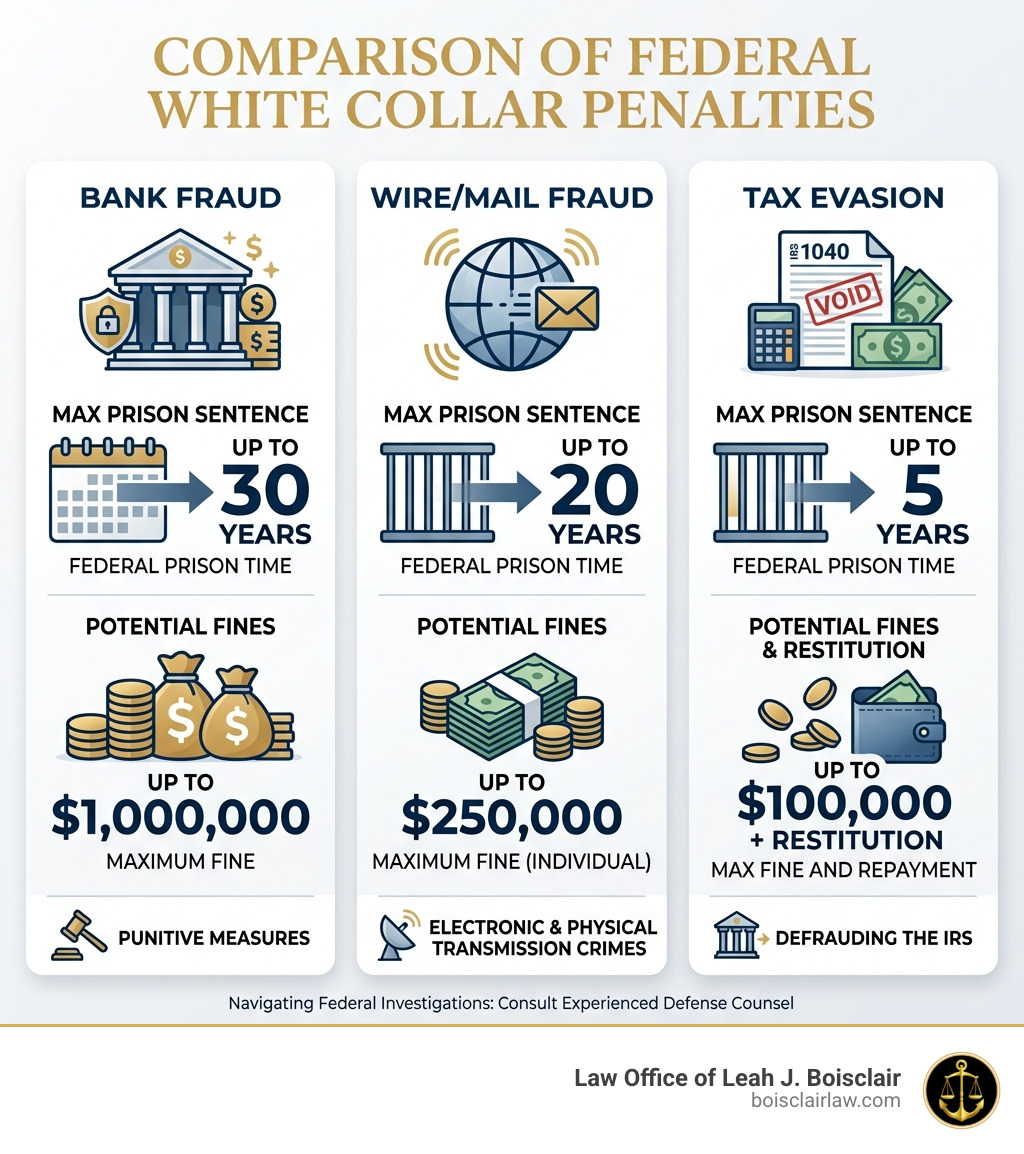
Under federal law, a white-collar crime refers to a non-violent financial offense committed through deceit, concealment, or violation of trust to obtain money, property, or business advantage. Common federal statutes applied in these prosecutions include wire fraud (18 U.S.C. § 1343), mail fraud (18 U.S.C. § 1341), securities fraud (18 U.S.C. § 1348), and bank fraud (18 U.S.C. § 1344).
Who committed the largest white-collar financial fraud in history?
Bernard L. Madoff committed the largest known white-collar financial fraud in history. His Ponzi scheme, which collapsed in December 2008, involved reported paper account assets totaling approximately $64.8 billion across thousands of individual, institutional, and charitable accounts, with actual lost principal capital estimated near $20 billion.
How did the Enron scandal alter public accounting practices?
The Enron scandal resulted in the complete dissolution of Arthur Andersen LLP, then one of the "Big Five" accounting firms, due to its role in destroying audit documents. Legally, Enron’s collapse catalyzed the passage of the Sarbanes-Oxley Act of 2002, which prohibited accounting firms from offering non-audit consulting services to their public audit clients to eliminate conflicts of interest.
What is the legal distinction between a Ponzi scheme and a pyramid scheme?
A Ponzi scheme centers around a centralized operator who solicits funds from investors, promises high returns, and uses capital from newer participants to pay off earlier investors without running a legitimate business. A pyramid scheme relies on a decentralized multi-level recruitment structure, where participants earn money primarily by recruiting new members who pay upfront entry fees, rather than selling actual products or services.
How do federal whistleblower programs incentivize reporting of corporate fraud?
Under statutes managed by the SEC and DOJ, whistleblowers who voluntarily provide original, timely, and credible information regarding financial misconduct can receive financial awards ranging from 10% to 30% of total monetary sanctions collected when those sanctions exceed $1 million. The programs also offer confidentiality protections and statutory remedies against workplace retaliation.
Next Steps for Compliance and Due Diligence
Organizations, board members, and compliance professionals must establish robust operational frameworks to defend against internal fraud and external financial schemes. Recommended institutional actions include:
- Conduct Independent Compliance Audits: Periodically engage external legal and forensic accounting specialists to evaluate internal controls, financial reporting systems, and anti-money laundering (AML) protocols.
- Establish Secure Reporting Channels: Implement anonymous internal reporting systems and clear whistleblower policies to encourage employees to raise operational concerns without fear of reprisal.
- Verify Custodial Relationships: Ensure clear segregation of corporate assets by working exclusively with independent, qualified third-party financial custodians subject to regulatory supervision.
- Review Executive Oversight Controls: Audit corporate governance structures to verify that board audit committees operate independently of executive management and possess direct oversight of accounting controls.
Image Gallery