Sole Proprietorship Florida Workers' Compensation: Rules, Exemptions, and Compliance Guide
In Florida, a sole proprietor in a non-construction industry is automatically exempt from workers' compensation requirements and is not counted as an employee. However, sole proprietors operating in the construction industry are legall...
In Florida, a sole proprietor in a non-construction industry is automatically exempt from workers' compensation requirements and is not counted as an employee. However, sole proprietors operating in the construction industry are legally defined as employees under Florida law and must either carry workers' compensation coverage or obtain an official state exemption.
Contents
Understanding how workers' compensation laws apply to a sole proprietorship in Florida is essential for remaining compliant with state regulators, securing commercial contracts, and avoiding steep administrative fines. Managed under Florida Statutes Chapter 440, the Division of Workers' Compensation within the Florida Department of Financial Services enforces distinct coverage rules based on business industry, employee count, and legal entity structure.
This guide provides a comprehensive breakdown of Florida workers' compensation regulations for sole proprietors, detailing industry-specific requirements, the step-by-step process for filing exemptions, options for electing coverage, and key strategies to avoid stop-work orders.
How Florida Workers' Compensation Law Defines Sole Proprietors
Under Florida Department of Financial Services regulations, a sole proprietorship is an unincorporated business owned and operated by a single individual. For workers' compensation purposes, Florida law evaluates sole proprietors differently from corporate officers, members of Limited Liability Companies (LLCs), or general employees.
The fundamental legal baseline depends on whether your business operates in a non-construction industry, the construction industry, or agriculture:
- Non-Construction Sole Proprietors: By default, sole proprietors and partners in non-construction businesses are excluded from the definition of "employee" under Florida Statute § 440.02. You do not need to file an exemption to exclude yourself, nor do you count toward the four-employee threshold that mandates coverage in non-construction trades.
- Construction Sole Proprietors: Unlike non-construction sole proprietors, individuals operating in the construction trade are explicitly classified as employees under the statute. As a result, even a solo operator with no additional workers must either purchase a valid workers' compensation insurance policy or apply for an official Certificate of Election to be Exempt.
- Agricultural Sole Proprietors: Agricultural operations follow a separate employee threshold based on regular and seasonal staffing levels rather than individual owner classification.
Industry Requirements: Construction vs. Non-Construction
The distinction between construction and non-construction classification dictates your mandatory reporting obligations, insurance costs, and state filing prerequisites.
- Is the Sole Proprietorship in Construction?
- YES: Statutory "Employee" Coverage Required from 1st Worker
- Buy Policy: Covers Owner
- File Exemption: Form DWC-250; $50
- NO: Automatically Excluded; No Coverage Needed for Owner (Unless Elected)
- Under 4 Staff: No Policy Needed
- 4+ Employees: Policy Mandatory
- YES: Statutory "Employee" Coverage Required from 1st Worker
1. Construction Industry Rules
Florida defines construction broadly to include any trade involved in building, altering, repairing, renovating, or demolishing structures, as well as specialized sub-trades such as roofing, plumbing, electrical work, HVAC installation, painting, and masonry.
- Employee Threshold: If you employ 1 or more persons (including yourself as the sole proprietor), you must maintain workers' compensation insurance or hold a valid exemption certificate.
- Contractor Obligations: General contractors in Florida are legally responsible for ensuring that all sub-contractors on a job site maintain valid coverage or exemptions. If a sole proprietor sub-contractor lacks verified coverage or an active exemption certificate, the general contractor's insurer will assess premium charges for that sub-contractor or face liability for any workplace injuries that occur on-site.
2. Non-Construction Industry Rules
Non-construction businesses encompass retail stores, professional consulting services, digital agencies, beauty salons, and general service providers.
- Employee Threshold: Insurance becomes mandatory when the business employs 4 or more full-time or part-time workers.
- Exclusion of Owner: The sole proprietor is not counted among the four employees. For example, if a sole proprietor hires three full-time employees, the business still has only three statutory employees and is not legally required to buy workers' compensation insurance. If a fourth employee is hired, coverage must be secured for all four employees.
3. Agriculture Industry Rules
Agricultural operations—including crop farming, livestock production, and commercial horticulture—operate under distinct statutory limits:
- Threshold: Coverage is mandatory if the business employs 6 or more regular employees or 12 or more seasonal employees who work more than 30 days in a calendar year (or more than 45 days in a 60-day period).
Worker Classification and Exemption Standards
The following table summarizes coverage rules, exemption options, statutory definitions, and compliance costs for sole proprietors across business categories in Florida:
| Parameter | Construction Industry | Non-Construction Industry | Agricultural Industry |
|---|---|---|---|
| Mandatory Coverage Threshold | 1 or more employees (including sole proprietor) | 4 or more employees (excluding sole proprietor) | 6 regular OR 12 seasonal employees |
| Default Legal Status of Sole Proprietor | Statutory Employee | Automatically Excluded | Automatically Excluded |
| Exemption Eligibility | Yes (Must apply via DWC-250) | Not Required (Excluded by default; optional Form DWC-251 to elect in) | Not Required (Excluded by default) |
| Exemption Filing Fee | $50 | Free / Not Applicable | Not Applicable |
| Exemption Renewal Frequency | Every 2 Years | Not Applicable | Not Applicable |
| Primary Regulatory Body | FL Division of Workers' Compensation | FL Division of Workers' Compensation | FL Division of Workers' Compensation |
| Enforcement Penalty | Stop-Work Order + 2x Premium Assessment | Stop-Work Order + 2x Premium Assessment | Stop-Work Order + 2x Premium Assessment |
How to Apply for a Workers' Compensation Exemption in Florida
Sole proprietors operating in the construction industry who choose not to carry workers' compensation coverage on themselves must obtain a Certificate of Election to be Exempt. This document proves to project owners, general contractors, and state inspectors that you are legally excused from carrying policy benefits for your own work.
Eligibility Prerequisites
To qualify for a construction workers' compensation exemption as a sole proprietor in Florida, you must meet the following statutory criteria:
- Ownership Verification: You must actively own and operate the sole proprietorship.
- Trade Licensure: If your specific trade requires state or local licensing (such as a Certified General Contractor, Electrical Contractor, or Master Plumber license issued by the Florida Department of Business and Professional Regulation), your license must be active and in good standing.
- Federal Identification: You must possess a valid Social Security Number (SSN) or Federal Employer Identification Number (FEIN).
Step-by-Step Exemption Application Process
- Access the DWC Portal: Visit the official online application portal maintained by the Florida Division of Workers' Compensation.
- Complete Form DWC-250: Select the option to submit a Notice of Election to be Exempt (Form DWC-250).
- Enter Business & License Details: Provide your sole proprietorship name, primary business address, FEIN or SSN, and relevant DBPR contractor license numbers.
- Submit the Application Fee: Pay the statutory $50 processing fee using an accepted credit card or electronic payment method. (Note: Non-construction exemptions, when filed by corporate officers, carry no fee, but construction-related sole proprietor applications require the $50 fee).
- Print and Retain the Certificate: Once approved, the state issues an electronic Certificate of Election to be Exempt. You must save a copy and provide printouts to any hiring contractors before beginning work on a job site.
- Track Exemption Expiration: Construction exemption certificates are valid for two years from the date of issuance. You must renew the exemption online before it expires to prevent compliance gaps.
Electing Coverage: When a Sole Proprietor Should Buy a Policy
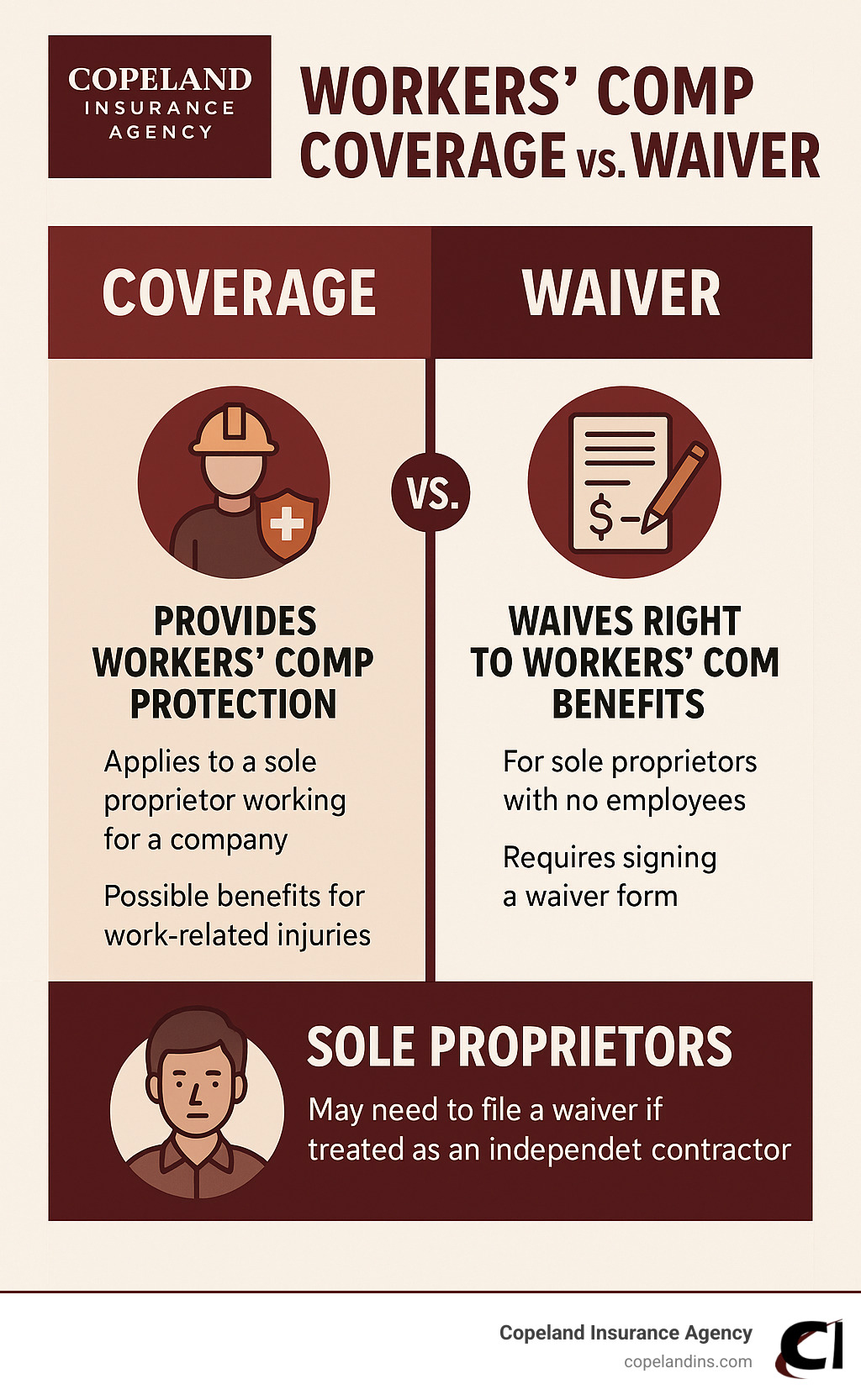
Although non-construction sole proprietors are automatically excluded from coverage—and construction sole proprietors can legally exempt themselves—opting to purchase a workers' compensation insurance policy is often a prudent business decision.
- Should a Sole Proprietor Buy Workers' Comp?
- FINANCIAL RISK MANAGEMENT
- Health insurance often excludes work-related injuries.
- Covers medical bills, rehabilitation, and lost wages.
- COMMERCIAL & CONTRACTUAL
- Commercial clients & GCs frequently require active policies.
- Exemptions may disqualify you from bidding on major projects.
- FINANCIAL RISK MANAGEMENT
1. Health Insurance Limitations
Most personal health insurance plans explicitly exclude medical expenses resulting from occupational injuries or work-related illnesses. If an exempt sole proprietor suffers a serious fall, equipment injury, or repetitive strain while on the job, personal health coverage may deny the claim entirely, leaving the business owner personally responsible for medical bills and lost income.
2. Contractual and Client Requirements
Many general contractors, commercial property managers, and government entities refuse to hire sub-contractors who hold worker's compensation exemptions. Hiring entities often enforce strict risk management standards that demand all individuals on site be covered by a primary workers' compensation policy. Securing a policy allows sole proprietors to bid on larger contracts that exclude exempt operators.
3. How to Elect Coverage (Form DWC-251)
If a non-construction sole proprietor (or an exempt construction sole proprietor) chooses to be included under a workers' compensation policy:
- You must file Form DWC-251 (Election of Coverage) with the Florida Division of Workers' Compensation.
- You must secure an active policy through a licensed insurance agent or the state's insurer of last resort, the Florida Workers' Compensation Joint Underwriting Association (FWCJUA).
- Once filed, the sole proprietor is legally classified as an employee under the policy and is entitled to full statutory medical and wage-loss benefits in the event of an injury.
Calculating Workers' Compensation Costs for Sole Proprietors
Workers' compensation premiums in Florida are determined by multiplying an industry risk classification rate by the business's total payroll, divided by 100, and adjusted by experience modifications or policy fees:
$$\text{Premium} = \left( \frac{\text{Payroll}}{100} \right) \times \text{Classification Rate} \times \text{Experience Modifier}$$
Sole Proprietor Payroll Attribution (Payroll Minimums/Maximums)
When a sole proprietor elects to be included on a commercial insurance policy, state insurance rules do not calculate premiums based on unpredictable monthly draws. Instead, the National Council on Compensation Insurance (NCCI) sets standard annual payroll caps and minimums for sole proprietors in Florida.
- Statutory State Minimum/Maximum Payroll: For premium calculation purposes, state rules assign a predetermined annual income figure to the sole proprietor regardless of actual net profit. Insurance carriers calculate your premium based on this fixed payroll value.
- Classification Codes: Construction trades (e.g., roofing, structural steel erection) carry substantially higher rate multipliers per $100 of payroll than low-risk office classifications (e.g., accounting, graphic design, clerical work).
Ghost Policies
A "Ghost Policy" is a term used in the insurance industry for a zero-employee workers' compensation policy. It is designed for sole proprietors who have no employees and want coverage for themselves, or for sole proprietors who need a certificate of insurance to satisfy contract requirements without covering an active payroll. Availability and underwriting parameters for ghost policies vary by carrier in Florida, and many insurers require minimum earned premiums.
Compliance Enforcement and Financial Penalties
The Bureau of Enforcement within the Florida Division of Workers' Compensation conducts unannounced site visits across the state to verify compliance with statutory insurance requirements.
Stop-Work Orders (SWO)
If a state investigator discovers that a sole proprietorship is operating without mandatory coverage or a valid exemption certificate:
- Immediate Cessation of Work: Investigators issue a Stop-Work Order (SWO), requiring all business operations at the job site to cease immediately.
- Financial Penalty Assessment: By statute, the Division assesses a penalty equal to 2 times the amount the employer would have paid in workers' compensation premiums for all periods of non-compliance during the preceding two years, or $1,000, whichever is greater.
- Criminal Sanctions: Failing to comply with a Stop-Work Order or misrepresenting payroll or worker classifications to avoid premiums constitutes a felony offense under Florida Statute § 440.105.
FLORIDA DWC ENFORCEMENT PROCESS
- Unannounced Site Visit / Inspection
- Non-Compliance Identified: No Coverage/Exemption
- STOP-WORK ORDER (SWO) ISSUED: All operations cease immediately
- Financial Penalty Calculation:
- 2x Premium for up to past 2 years
- OR $1,000 (Whichever is greater)
- Full Payment + Proof of Policy/Exemption Required
- SWO Released / Resumed Work
Frequently Asked Questions
Does a sole proprietor in Florida need workers' comp if they have no employees?
If you operate in a non-construction trade, no. You are automatically excluded from statutory requirements. However, if you operate in the construction industry, yes. Even with zero employees, a construction sole proprietor must either purchase a workers' compensation policy or apply for an official state exemption (Form DWC-250).
How much does a workers' compensation exemption cost for a sole proprietor in Florida?
For sole proprietors operating in the construction industry, the application fee for a Certificate of Election to be Exempt is $50, payable to the Florida Division of Workers' Compensation. The exemption certificate remains valid for two years. Non-construction sole proprietors are automatically excluded by law and generally do not need to file or pay a fee.
How long does it take for a Florida workers' comp exemption to become active?
When submitted online through the Florida Division of Workers' Compensation portal with valid details and instant payment, exemptions are typically processed and issued within 24 to 48 hours. Incomplete applications or manual license verifications by the Department of Business and Professional Regulation may take longer.
Can a sole proprietor use a workers' compensation exemption to cover sub-contractors?
No. An exemption certificate applies strictly to the individual sole proprietor named on the document. It does not cover hired workers, temporary help, day laborers, or sub-contractors. If an exempt sole proprietor hires employees or unexempt sub-contractors, the sole proprietor becomes legally responsible for securing a workers' compensation insurance policy to cover those workers.
What happens if an exempt sole proprietor gets injured on the job?
An exempt sole proprietor has formally elected to opt out of the state workers' compensation system. If an injury occurs on the job, the sole proprietor cannot collect workers' compensation wage-loss or medical benefits under Florida law. Furthermore, standard personal health insurance policies frequently exclude coverage for work-related injuries, leaving the individual personally responsible for medical costs.
Next Steps for Florida Sole Proprietors
To ensure your business remains fully compliant with Florida law while minimizing operational liability, take the following actions:
- Verify Your Industry Classification: Determine whether your business activities fall under the state's legal definition of "construction" or "non-construction" under Florida Statute § 440.02.
- Audit Your Coverage or File an Exemption:
- If you are a construction sole proprietor, submit your Form DWC-250 online and pay the $50 fee, or secure a valid commercial policy before starting work.
- If you are a non-construction sole proprietor, review your employee count to ensure you remain below the four-employee threshold (excluding yourself).
- Confirm Sub-Contractor Compliance: If you hire sub-contractors, use the state's online database to verify that every sub-contractor holds an active workers' compensation policy or a valid exemption certificate before they enter your job site.
- Consult a Licensed Insurance Agent: If you choose to elect coverage for yourself, consult an insurance broker licensed in Florida to evaluate NCCI classification codes, minimum payroll rules, and policy costs tailored to your operational risk.
Image Gallery