Why the Right Medi-Cal Health Plan Matters for Your Coverage and Care
Selecting the right Medi-Cal health plan ensures seamless access to your preferred doctors, regional hospital networks, and essential specialists. The right plan maximizes your available coverage by connecting you with tailored care ma...
Selecting the right Medi-Cal health plan ensures seamless access to your preferred doctors, regional hospital networks, and essential specialists. The right plan maximizes your available coverage by connecting you with tailored care management, county-specific community supports, and extra vision or dental benefits, directly impacting your overall quality of care and daily health outcomes.
Contents
Understanding Medi-Cal Managed Care
Medi-Cal is California’s Medicaid program, providing comprehensive health coverage to millions of low-income adults, children, pregnant individuals, seniors, and people with disabilities. While the California Department of Health Care Services (DHCS) establishes overall program guidelines and eligibility criteria, the day-to-day delivery of healthcare for most beneficiaries occurs through Medi-Cal Managed Care Plans (MCPs).
When you qualify for Medi-Cal, you generally do not receive medical care through a single, static statewide system. Instead, depending on the county in which you reside, you choose or are assigned to a specific managed care health plan. These health plans function similarly to private health maintenance organizations (HMOs). They partner with specific networks of doctors, clinics, hospitals, pharmacies, and specialists to deliver your covered benefits.
Because each health plan maintains its own contracted provider network, administrative procedures, and supplemental member programs, your choice of plan dictates how easily you can obtain care. Understanding how managed care operates is the first step in recognizing why selecting an optimal plan matters for your long-term health and well-being.
Disclaimer: Medi-Cal program guidelines, county plan availability, and administrative rules are managed by state regulatory authorities. This article provides general educational information. For personalized assistance or official plan enrollment, contact California Health Care Options or your local county social services office.
Key Reasons Your Choice of Medi-Cal Plan Matters
The health plan you select determines the practical reality of your healthcare experience. While state law mandates that all Medi-Cal plans cover a core set of essential health benefits—including doctor visits, emergency care, maternity care, and mental health treatment—the actual delivery of those services varies significantly between plans.
1. Doctor, Specialist, and Hospital Network Access
The primary difference between Medi-Cal health plans is their network of contracted providers. Every managed care plan contracts with a specific group of primary care physicians (PCPs), specialists, community health centers, and regional hospital systems.
- Primary Care Continuity: If you already have a trusted primary care doctor or local clinic, you must choose a Medi-Cal plan that includes that provider in its network. Selecting a plan without your doctor means you will likely have to switch providers.
- Specialist Access: Patients managing complex health conditions—such as diabetes, heart disease, oncology needs, or autoimmune disorders—require regular access to specialists. Certain health plans maintain broader specialist networks or partner with prestigious academic medical centers, whereas others rely on smaller regional networks.
- Hospital Networks: If emergency or inpatient care is required, your plan dictates which hospitals are in-network. In-network facilities ensure streamlined admissions, pre-authorization processing, and follow-up care coordination.
2. Specialized Care Management and CalAIM Programs
California’s CalAIM (California Advancing and Innovating Medi-Cal) initiative significantly expanded the support services available to Medi-Cal members. However, how these services are coordinated depends heavily on your specific health plan.
Under CalAIM, managed care plans offer Enhanced Care Management (ECM) to high-need individuals, including seniors, individuals experiencing homelessness, and people with complex chronic conditions or serious mental illness. ECM provides a dedicated care manager who helps coordinate medical appointments, specialist referrals, social services, and transportation.
Additionally, plans offer Community Supports (also known as In-Lieu-of Services). These non-medical services address social determinants of health and can include:
- Medically tailored meals or grocery deliveries
- Housing transition and tenancy sustaining services
- Environmental accessibility adaptations (such as home ramps or grab bars)
- Asthma remediation in the home
- Day habilitation and nursing facility transition programs
While all plans are encouraged to offer these services, the exact scope, regional availability, and ease of approval for Community Supports differ across managed care organizations. Choosing a plan with robust community programs ensures superior support if you or a family member face complex health challenges.
3. Extra Benefits and Member Value-Added Services
Beyond basic Medi-Cal benefits mandated by state law, individual health plans frequently provide value-added benefits to attract and support members. These supplemental perks vary between plans and can offer meaningful financial and operational assistance.
Common extra benefits include:
- Enhanced Vision Services: Additional coverage for eye exams, frames, or replacement lenses beyond basic Medi-Cal limits.
- Wellness Rewards: Gift cards or financial incentives for completing annual wellness exams, prenatal visits, or child immunizations.
- Transportation Assistance: Supplemental non-medical transportation options for pharmacy visits, WIC appointments, or social service meetings.
- Health Education: Free access to weight management classes, smoking cessation programs, diabetes self-management tools, and online fitness apps.
Evaluating these additional benefits allows you to choose a plan that aligns directly with your household’s specific preventive care and wellness needs.
4. Administrative Efficiency and Customer Service Quality
Navigating healthcare administration can be challenging. The plan you select governs how smoothly administrative tasks are handled, including prior authorization requests, grievance processing, and customer support.
Higher-performing health plans maintain streamlined authorization workflows, reducing wait times for specialist appointments and diagnostic tests. They also offer robust digital tools, such as mobile apps and online member portals, that allow you to track claims, request new member ID cards, change your primary care physician, and message your care team electronically.
Medi-Cal Managed Care Models Across California Counties
California uses distinct managed care models across its 58 counties. The number and type of health plans available to you depend entirely on where you reside.
California Managed Care Models
Single Plan Model / County-Organized Health Systems (COHS)
- One public plan covers all Medi-Cal members in the county.
Two-Plan Model
- Choice between a Local Initiative and a Mainstream Plan.
Regional / Geographic Managed Care (GMC) Models
- Multiple commercial plans compete within the county.
County-Organized Health Systems (COHS): In COHS counties, the local government operates a single, public managed care plan for all Medi-Cal beneficiaries in that county. Examples include CalOptima Health in Orange County and Alliance for Health in Santa Cruz and surrounding areas. In these counties, all eligible residents are automatically enrolled in the designated single plan.
Two-Plan Model: In Two-Plan counties, beneficiaries choose between two main health plans: a public Local Initiative (a non-profit plan created by the county) and a commercial Mainstream Plan contracted by the state.
Regional and Geographic Managed Care (GMC) Models: In heavily populated urban areas or multi-county regions, DHCS contracts with multiple commercial health plans, giving beneficiaries a choice among several competing managed care organizations.
Knowing your county's model helps you understand whether you have a choice of plans and, if so, which specific organizations operate in your area.
Comparing Medi-Cal Health Plan Selection Factors
When evaluating available health plans in your county, compare key plan attributes systematically to determine the best fit for your medical needs.
| Selection Factor | Why It Matters | What to Look For |
|---|---|---|
| Provider Network | Determines which doctors and hospitals you can visit without out-of-network penalties. | Verify that your current primary care doctor, preferred pediatricians, and specialists are listed in the plan's direct directory. |
| Hospital Partnerships | Dictates where you will be admitted for non-emergency inpatient procedures. | Ensure major regional medical centers and specialized children's hospitals are contracted. |
| CalAIM Supports | Offers non-medical aid like home-delivered meals, housing services, or home modifications. | Check the specific list of approved Community Supports offered by the plan in your county. |
| Customer Service Rating | Indicates member satisfaction, authorization speed, and resolution of grievances. | Review annual DHCS Managed Care Quality Ratings and NCQA accreditation scores. |
| Specialty Clinics & Mental Health | Affects access to outpatient behavioral health, therapy, and chronic disease clinics. | Confirm integration with county mental health departments and local health centers. |
| Digital Tools & Portals | Enhances ease of tracking authorizations, changing doctors, and viewing digital ID cards. | Look for mobile app availability, online scheduling, and 24/7 nurse advice phone lines. |
How to Select or Change Your Medi-Cal Plan
If you live in a county with multiple health plan choices, state policy allows you to select your plan upon initial enrollment or switch plans at any time during the year if your current plan is not meeting your needs.
Step 1: Review Available Options in Your County
Visit the official Health Care Options (HCO) website managed by DHCS or call the HCO customer service center. Input your zip code to generate a complete list of licensed Medi-Cal managed care plans operating in your county.
Step 2: Verify Doctor and Facility Participation
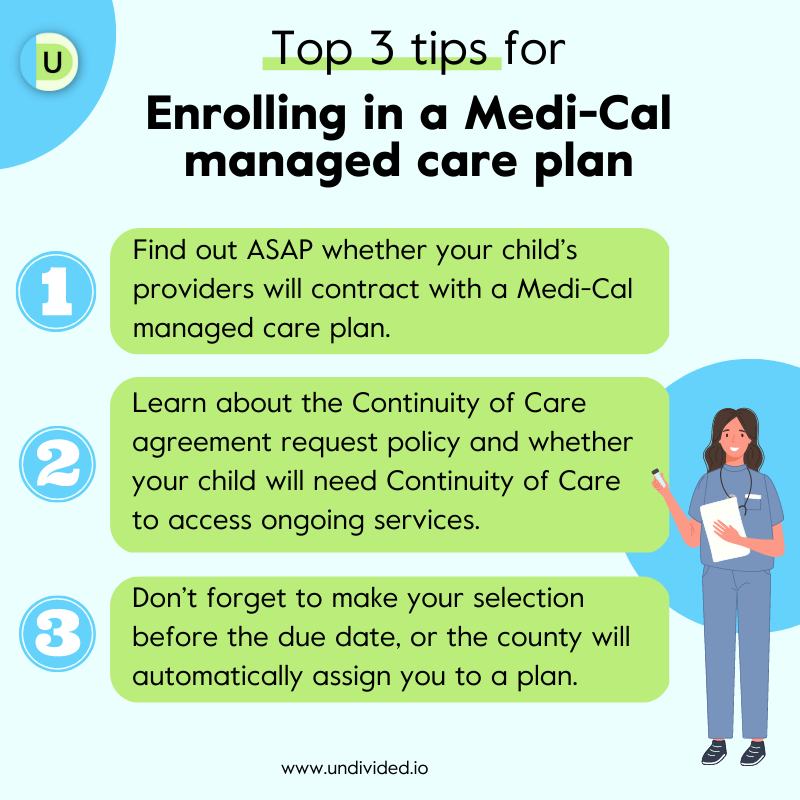
Do not rely solely on general summary brochures. Cross-reference the plan’s online provider directory or call your primary care provider's office directly. Ask the office administrative staff: "Which Medi-Cal managed care plan network do you currently participate in?"
Step 3: Compare Quality Ratings
DHCS publishes annual quality report cards for Medi-Cal managed care plans. These report cards grade plans on critical healthcare metrics, including preventive care screenings, diabetes management, childhood immunizations, and patient care satisfaction.
Step 4: Submit Your Plan Choice
Once you select a plan, you can enroll through one of the following methods:
- Online: Submit your choice through the secure Health Care Options online portal.
- Phone: Call Health Care Options to state your choice directly to a representative.
- Mail or Fax: Complete and mail the enrollment form included in your official Medi-Cal welcome package.
After submitting your selection, plan changes typically take effect on the first day of the following month or the month immediately after processing, depending on submission timing.
Common Mistakes to Avoid When Choosing a Plan
Navigating plan choices requires careful attention to detail. Avoiding common selection errors ensures uninterrupted access to medical services:
- Assuming All Plans Have the Same Doctors: A frequent misconception is that all Medi-Cal doctors accept every Medi-Cal plan. Participating providers sign contracts with specific managed care organizations, meaning a doctor may accept Plan A but not Plan B.
- Ignoring Prescription and Pharmacy Workflows: While standard prescription drug coverage for Medi-Cal is managed statewide through Medi-CalRx, specialty clinics and pharmacy delivery workflows can still vary based on your plan's care management protocols.
- Failing to Update Contact Information: If you move to a new county, you must report your address change to your county social services office promptly. Medi-Cal managed care plans are county-specific; moving without updating your record can lead to coverage gaps or delays in receiving medical services.
- Overlooking Continuity of Care Protections: If your plan changes or your doctor leaves your plan's network, state law provides Continuity of Care rights. Under these rules, you may be eligible to keep seeing your existing doctor for up to 12 months while transition arrangements are made, provided the doctor agrees to the plan’s payment rates.
Frequently Asked Questions
Can I change my Medi-Cal health plan at any time?
Yes. In counties where multiple Medi-Cal managed care plans are available, you can change your health plan at any time during the year by contacting Health Care Options. Unlike private commercial insurance, you do not have to wait for an annual open enrollment period to make a change.
What happens if I do not choose a Medi-Cal plan when enrolling?
If you qualify for Medi-Cal in a county with multiple plan options and do not select a plan within the designated timeframe, the state will automatically assign a plan to you. Automatic assignment uses an algorithm designed to balance enrollment across plans and, where possible, match you with providers you have previously visited.
Does my Medi-Cal plan affect my prescription drug benefits?
Prescription drug coverage for all Medi-Cal beneficiaries is administered statewide through a centralized program called Medi-CalRx. This means drug coverage rules, copays, and covered drug lists (formularies) are standardized across the state regardless of which managed care plan you belong to. However, your health plan still manages non-pharmacy medical supplies and physician-administered drugs.
How do I know if my primary care doctor accepts my Medi-Cal plan?
You can confirm doctor participation by searching the online provider directory on your health plan's website or by contacting your doctor’s administrative office directly. Always specify the exact name of the Medi-Cal managed care plan when asking, as medical practices may accept some plans while declining others.
Are dental benefits included in my Medi-Cal managed care plan?
For most beneficiaries, dental services are provided separately through the Medi-Cal Dental Program (formerly known as Denti-Cal) rather than through your medical health plan. However, a small number of specialized county plans integrate dental care directly. You can access covered dental services using your Medi-Cal Benefits Identification Card (BIC).
Actionable Next Steps for Medi-Cal Beneficiaries
Taking control of your healthcare coverage starts with evaluating your current health plan performance and ensuring your access to care remains secure.
- Audit Your Current Provider Network: Check that your primary care physician, pediatricians, and specialists remain active in your plan’s network for the current year.
- Review CalAIM Support Services: If you manage long-term medical conditions or require social support, contact your health plan member services department to ask about Enhanced Care Management and Community Supports eligibility.
- Contact Health Care Options for Adjustments: If your existing plan fails to offer adequate network coverage or customer support, visit the Health Care Options portal to review alternative plans in your county and initiate a plan transfer.
Image Gallery