Pay-As-You-Go Workers’ Compensation Insurance Explained: A 2026 Guide for Businesses
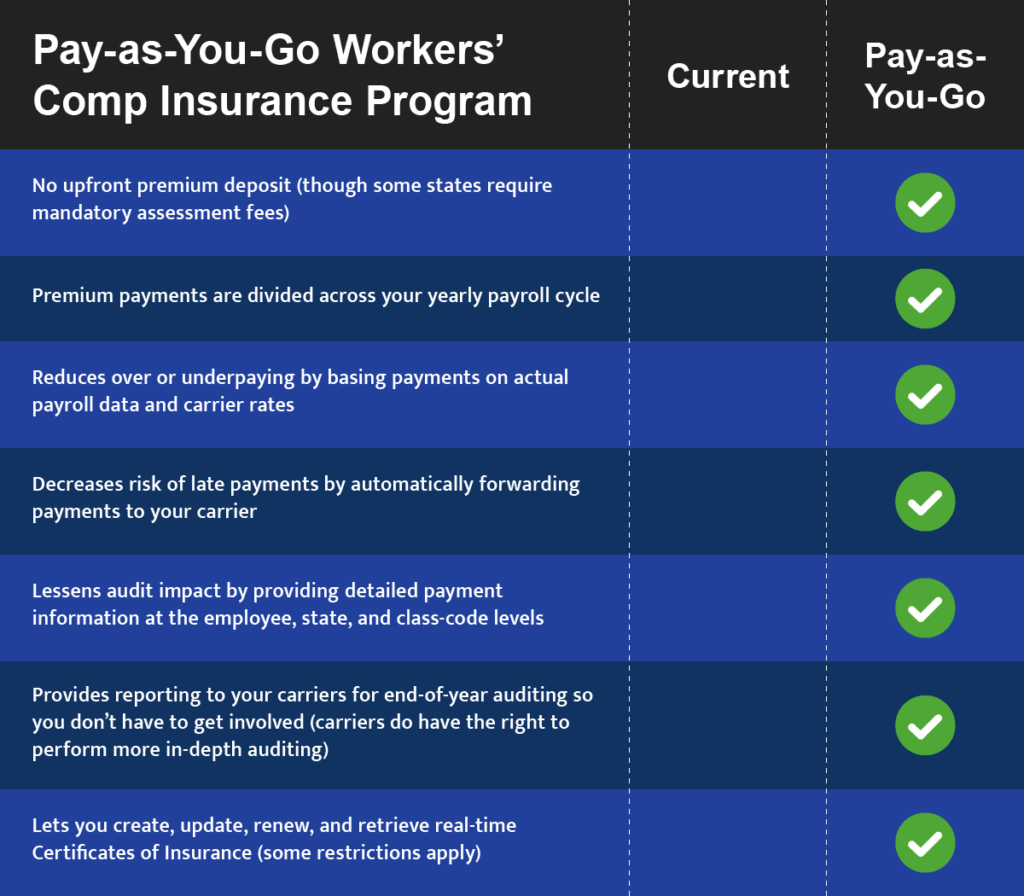
Pay-as-you-go workers’ compensation is a billing method where premiums are calculated and paid based on actual payroll data during each pay period, rather than on annual estimates. This real-time approach eliminates large upfront depos...
Pay-as-you-go workers’ compensation is a billing method where premiums are calculated and paid based on actual payroll data during each pay period, rather than on annual estimates. This real-time approach eliminates large upfront deposits and minimizes year-end audit surprises by ensuring premium payments accurately reflect current staffing levels and wages.
Contents
Understanding the Mechanics of Pay-As-You-Go Workers' Comp
For decades, the standard for workers' compensation insurance involved a "fixed-estimate" model. Business owners would estimate their total annual payroll, pay a significant down payment (often 15% to 25%), and then settle the difference after an intensive year-end audit. In 2026, the shift toward digital-first financial management has made pay-as-you-go the preferred standard for small to mid-sized enterprises (SMEs) and seasonal businesses.
This model is not a different type of insurance policy; the coverage remains the same, dictated by state laws and the National Council on Compensation Insurance (NCCI) guidelines. The distinction lies entirely in the billing and cash flow management. Instead of paying for a year's worth of coverage based on a guess, the employer pays as they generate payroll.
The Integration of Payroll and Insurance
The efficiency of this system relies on the "handshake" between your payroll provider and your insurance carrier. When payroll is processed—whether weekly, bi-weekly, or monthly—the payroll software automatically transmits the specific wage data and class codes to the insurance company.
The carrier then applies the assigned rates to those actual numbers, calculates the premium for that specific period, and withdraws the funds via Electronic Funds Transfer (EFT). This automated cycle ensures that the premium is always in sync with the actual risk exposure of the business at that moment.
The Core Differences: Traditional vs. Pay-As-You-Go
To decide which model fits a business, one must understand how the administrative and financial burdens differ. Traditional policies often create a "lumpy" cash flow, while pay-as-you-go creates a "smoothed" expense line.
| Feature | Traditional Estimated Policy | Pay-As-You-Go Billing |
|---|---|---|
| Down Payment | Typically 15%–25% of annual premium | Small setup fee or $0 down |
| Payment Frequency | Monthly, Quarterly, or Annually | Per Payroll Cycle (e.g., Weekly) |
| Data Accuracy | Based on projected annual payroll | Based on actual real-time payroll |
| Cash Flow Impact | High upfront cost; potential large audit bill | Low impact; spreads costs over 12 months |
| Year-End Audit | Often results in large "True-up" payments | Simplified; minimal adjustments needed |
| Administrative Effort | Manual reporting and estimation | Automated via payroll integration |
Key Benefits of the Pay-As-You-Go Model in 2026
The transition to real-time billing offers several strategic advantages that extend beyond simple convenience. In the current economic landscape of 2026, where liquidity is vital, these benefits can significantly impact a company’s bottom line.
1. Improved Cash Flow Management
In a traditional model, a business might pay a $5,000 down payment in January for a policy that covers the whole year. With pay-as-you-go, that $5,000 stays in the business's operating account. For startups and growing firms, capital is better spent on inventory, marketing, or hiring rather than sitting in an insurance carrier’s escrow account.
2. Elimination of Large Down Payments
Many traditional carriers require a substantial percentage of the total estimated premium upfront. For businesses with high premiums—such as construction firms or healthcare facilities—this can amount to tens of thousands of dollars. Pay-as-you-go typically requires little to no down payment, making it much easier to initiate or renew coverage without a massive cash outlay.
3. Mitigation of Audit "Sticker Shock"
The annual workers' compensation audit is a standard requirement where the carrier verifies that the payroll you reported matches your actual books. In a traditional plan, if you hired more people than expected, you could be hit with a massive "additional premium" bill at the end of the year. Because pay-as-you-go uses actual numbers throughout the year, the audit usually results in a "zero-balance" or a very small adjustment.
4. Precision for Seasonal Businesses
Businesses like landscaping, retail during the holidays, or summer resorts experience significant fluctuations in staff. Under a traditional plan, they pay a flat rate regardless of whether they have 5 employees or 50. With pay-as-you-go, their insurance costs drop to near zero during the off-season and only rise when they are actively generating revenue and employing staff.
Technical Prerequisites and Implementation
Implementing a pay-as-you-go system requires specific technological and administrative alignments. It is not as simple as checking a box; it requires a reliable data bridge between your financial systems.
Choosing a Compatible Payroll Provider
Most modern payroll platforms (such as ADP, Gusto, or Paychex) have built-in integrations with major workers' compensation carriers. If you use a localized or manual payroll system, you may need to upload a CSV file to the carrier’s portal every pay period, which negates some of the automation benefits.
Correct Class Code Mapping
Workers' compensation rates are determined by class codes, which categorize the risk level of different jobs. A clerical worker has a lower rate than a roofing contractor. In a pay-as-you-go system, it is critical that your payroll software correctly maps each employee to the right class code. If an employee is misclassified, the real-time payments will be incorrect, leading to complications during the final audit.
State-Specific Regulations
While pay-as-you-go is available in most of the United States, employers in "monopolistic states"—Ohio, Washington, North Dakota, and Wyoming—must purchase insurance through state-operated funds. These states have their own specific reporting and billing cycles, which may not always align perfectly with private pay-as-you-go software integrations. You can find more details on state-specific requirements through the International Association of Industrial Accident Boards and Commissions (IAIABC).
Potential Drawbacks and Considerations
While the benefits are significant, pay-as-you-go is not a universal panacea. There are specific scenarios where a traditional policy might be more advantageous.
- Service Fees: Some payroll providers or insurance agents charge a small "per-payroll" service fee to manage the integration. Over a year, these fees can add up, though they are usually offset by the interest a business earns by keeping its cash longer.
- Constant Activity: Because payments are tied to payroll, a business with a very high frequency of payroll runs (e.g., daily or multiple times a week) may find the constant stream of small EFT withdrawals difficult to track in their bank reconciliation.
- Loss of "Float": In a traditional policy, if your payroll decreases mid-year, you might have overpaid. While you eventually get that money back after an audit, pay-as-you-go ensures the insurance company gets exactly what they are owed immediately.
The Role of the Annual Audit
It is a common misconception that pay-as-you-go eliminates the annual audit. According to the National Council on Compensation Insurance (NCCI), audits remain a regulatory requirement to ensure that employees are classified correctly and that "non-payroll" compensation (like bonuses or specific benefits) is accounted for.
However, the audit process for pay-as-you-go policyholders is significantly less painful. Since the carrier already has the payroll data, the auditor typically only needs to verify the 941 tax forms and ensure no new job functions were added that require a different class code.
How to Switch to Pay-As-You-Go
If you are currently on a traditional estimated policy, the best time to switch is at your policy renewal date. Switching mid-term can be complicated because you may have already paid a large deposit that the carrier needs to refund, and you must ensure there is no gap in coverage.
- Consult your agent: Ask if your current carrier offers a "Pay-As-You-Go" or "Self-Reported" billing option.
- Verify Payroll Compatibility: Check with your payroll processor to see which insurance carriers they have a direct API integration with.
- Review Class Codes: Ensure your employee classifications are up to date before the first payroll run under the new system.
- Monitor the First Run: Check your bank statement after the first payroll to ensure the premium withdrawal matches your expectations based on your rates.
Frequently Asked Questions
Is pay-as-you-go workers' comp more expensive?
The insurance rates themselves are the same. The "cost" difference usually comes down to administrative fees. However, because you avoid a large upfront deposit, most businesses find it to be more "cost-effective" from a cash-flow perspective.
What happens if I miss a payroll report?
If your payroll data is not transmitted, the insurance carrier cannot calculate the premium. Most carriers provide a grace period, but consistent failure to report actual payroll can lead to the policy being cancelled or converted back to a traditional estimated billing model with a required deposit.
Does pay-as-you-go cover subcontractors?
Generally, no. Workers' compensation is for W2 employees. If you hire 1099 independent contractors, you should ensure they have their own insurance. If they don't, and they are legally determined to be "de facto" employees, you may owe premium for them at the end of the year, regardless of your pay-as-you-go status.
Can I use pay-as-you-go if I don't use a payroll service?
Yes, but it is more labor-intensive. Most carriers offer a "self-reporting" portal where you can manually enter your payroll totals each period. This still provides the cash flow benefits but requires more administrative work than an automated integration.
What are "true-up" payments?
A "true-up" is the final adjustment made after an annual audit. Even with pay-as-you-go, a true-up might occur if there were small discrepancies in how bonuses or overtime were calculated versus the premium rates.
Final Recommendation for 2026
For the vast majority of small and medium businesses in 2026, pay-as-you-go workers’ compensation is the superior choice. The combination of cash flow preservation, reduced administrative burden, and the virtual elimination of audit-related financial shocks aligns perfectly with modern lean business practices.
If your business experiences any level of payroll volatility or if you prefer to keep your working capital accessible rather than tied up in insurance deposits, you should transition to a pay-as-you-go model at your next renewal. Always verify that your payroll provider and insurance carrier have a verified, automated data link to maximize the benefits of this billing method.
Financial/Legal Disclaimer: Workers' compensation laws and insurance regulations vary by jurisdiction. This guide provides general information and should not be construed as legal or financial advice. Always consult with a licensed insurance professional or legal counsel regarding specific state mandates and policy requirements.
Image Gallery