Understanding the Role of an AC Circuit Capacitor
In an AC circuit, a capacitor serves as a reactive component that stores and releases energy within an electric field. Unlike its behavior in DC circuits where it blocks current flow once charged, a capacitor in an AC environment allow...
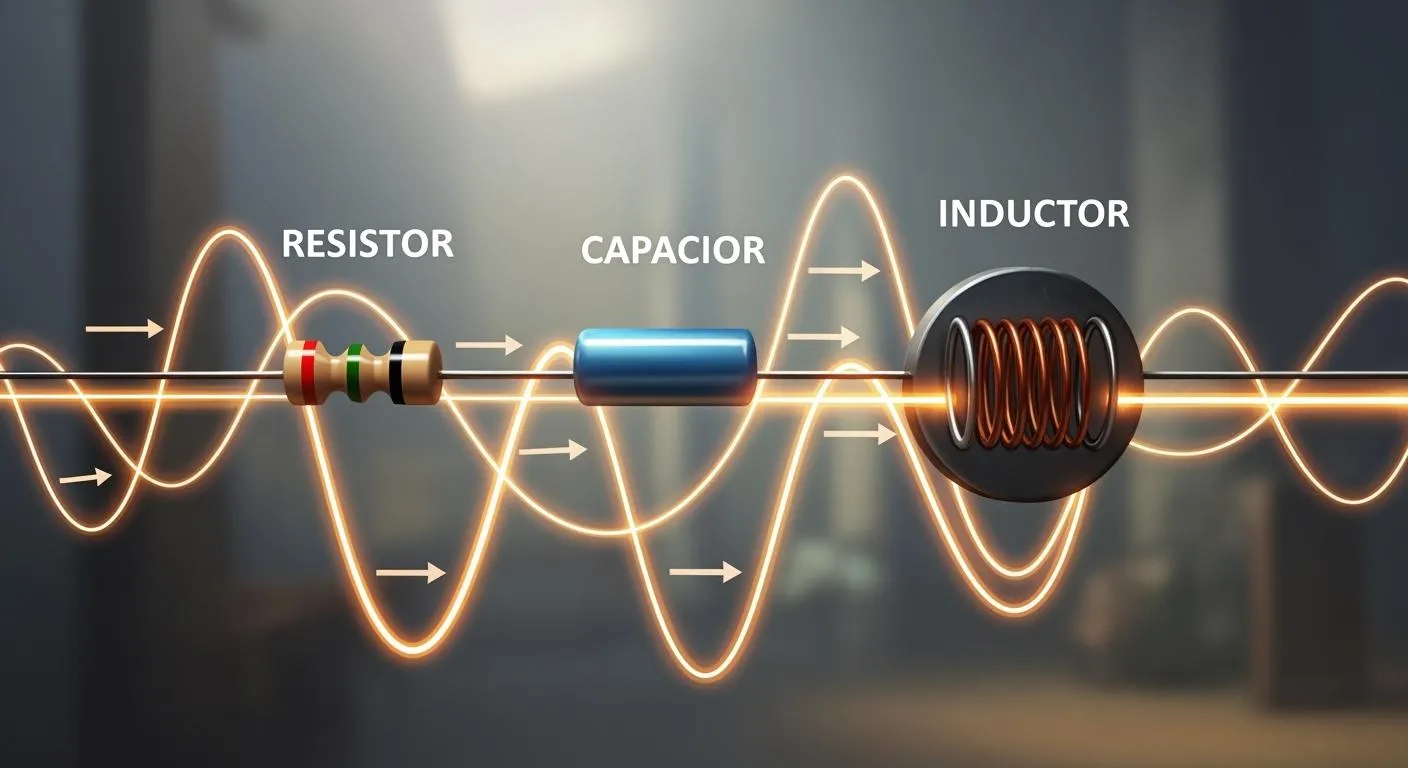
In an AC circuit, a capacitor serves as a reactive component that stores and releases energy within an electric field. Unlike its behavior in DC circuits where it blocks current flow once charged, a capacitor in an AC environment allows current to pass by continuously charging and discharging in response to the oscillating voltage, a property known as capacitive reactance. Its primary roles include phase shifting, filtering signals, and correcting the power factor in industrial systems.
Contents
The Fundamental Mechanics of Capacitance in AC
To understand the role of a capacitor in an alternating current (AC) circuit, one must first recognize the physical nature of the component. A capacitor consists of two conductive plates separated by an insulating material known as a dielectric. When an AC voltage is applied, the direction of the electrical flow reverses periodically (typically 50 or 60 times per second, measured in Hertz).
In a DC circuit, a capacitor eventually reaches the same voltage as the source and the flow of electrons stops. However, because AC voltage is constantly changing its magnitude and direction, the capacitor never reaches a steady state of "fullness." Instead, it spends half the cycle storing energy from the source and the other half returning that energy to the circuit. This creates the illusion that current is flowing "through" the capacitor, even though electrons do not actually cross the dielectric barrier.
This continuous exchange of energy introduces a unique resistance-like property called capacitive reactance ($X_c$). Unlike standard resistance, which dissipates energy as heat, reactance stores energy temporarily. The value of $X_c$ is inversely proportional to both the frequency of the AC signal and the capacitance of the component. As the frequency increases, the capacitor offers less opposition to the current flow.
The Critical Role of Phase Shifting
One of the most significant roles of an AC capacitor is its ability to shift the phase relationship between voltage and current. In a purely resistive circuit (like a heater), voltage and current reach their peak values at the exact same time. However, in a capacitive circuit, the current leads the voltage.
This occurs because the current must flow onto the plates to build up the electric field (voltage) across the capacitor. Therefore, the current peaks before the voltage does. In a theoretical, purely capacitive circuit, the current leads the voltage by exactly 90 degrees. In practical applications, this "leading" current is used to counteract the "lagging" current caused by inductive loads, such as electric motors and transformers.
Why Phase Shifting Matters
Engineers utilize this phase-shifting property to create "split-phase" environments. For example, in single-phase induction motors, a capacitor is used to create a second, artificial phase of electricity. By shifting the phase of the current in one of the motor's windings, a rotating magnetic field is generated, which is necessary to start the motor spinning from a standstill. Without the capacitor's role in phase shifting, many household appliances—from air conditioners to washing machines—would fail to start.
Power Factor Correction in Industrial Systems
In 2026, energy efficiency remains a primary concern for industrial grid management. Most industrial machinery consists of inductive loads (coils, motors, and magnets). These inductors cause the current to lag behind the voltage, resulting in a low Power Factor. A low power factor means the system is drawing more current from the utility than it actually converts into useful work, leading to wasted energy and higher utility penalties.
The role of the AC capacitor here is "Power Factor Correction" (PFC). By adding a capacitor bank in parallel with inductive loads, the leading current of the capacitors cancels out the lagging current of the inductors.
- Reduction in Current Demand: Because the capacitor provides the reactive power locally, the utility lines don't have to carry as much wasted current.
- Voltage Stabilization: Proper PFC reduces voltage drops in long cable runs, ensuring machinery operates at its rated efficiency.
- Cost Savings: By aligning voltage and current more closely, facilities avoid the "reactive power charges" that utilities impose on inefficient consumers.
Filtering and Signal Processing
In electronics and power supply design, AC capacitors act as vital filters. Because their reactance changes with frequency, they can be configured to allow certain frequencies to pass while blocking others.
Coupling and Decoupling
In many AC-coupled circuits, a capacitor is used to block the DC component of a signal while allowing the AC component to pass to the next stage. This is known as coupling. Conversely, decoupling capacitors are used to protect sensitive components from high-frequency noise or voltage spikes. They provide a low-impedance path to ground for high-frequency interference, effectively "cleaning" the power line.
Smoothing and Rectification
While many focus on purely AC roles, capacitors are essential in the transition from AC to DC. In a bridge rectifier circuit, the output is a "pulsating" DC. A large capacitor (often called a reservoir or smoothing capacitor) charges during the peaks of the AC wave and discharges when the voltage drops, filling in the gaps to create a steady, smooth DC voltage.
Comparison of Capacitor Types in AC Applications
Not all capacitors are suitable for AC circuits. Selecting the wrong type can lead to overheating, dielectric breakdown, or catastrophic failure.
| Capacitor Type | Common AC Application | Strengths | Limitations |
|---|---|---|---|
| Film Capacitors | Power Factor Correction, Snubbers | High voltage tolerance, self-healing properties | Physically larger than electrolytic types |
| Ceramic Capacitors | RF Filtering, EMI suppression | Excellent high-frequency performance | Low capacitance values; fragile |
| Electrolytic (Non-Polarized) | Motor Start Circuits | Very high capacitance in a small package | Limited lifespan; cannot handle continuous high AC heat |
| Paper/Oil Filled | Heavy Industrial Grids | Extreme durability and heat dissipation | Expensive and bulky; often replaced by dry film |
Safety and Operational Considerations
By 2026, modern capacitor designs have integrated more advanced safety features, but the fundamental risks of handling these components remain. Because capacitors store energy, they can hold a lethal charge long after the power to a circuit has been disconnected.
Discharge Requirements
In AC circuits, especially those involving high-voltage banks, "bleeder resistors" are typically installed across the capacitor terminals. These resistors provide a slow path for the stored energy to dissipate when the system is powered down. Technicians must always verify the voltage state with a calibrated meter before servicing any AC circuit containing capacitors.
Dielectric Stress and Temperature
AC capacitors are subject to constant internal heating due to the repeated charging and discharging cycles. This is often referred to as the "dissipation factor." If a capacitor is operated above its rated temperature or voltage, the dielectric material can degrade, leading to a short circuit. In 2026, many smart systems utilize thermal sensors to monitor capacitor bank health in real-time to prevent fires or system-wide failures.
Troubleshooting Common Capacitor Issues
Understanding the role of a capacitor also involves knowing when it is failing. In AC systems, failure often manifests in specific ways:
- Motor "Humming": If a motor hums but does not spin, the start capacitor has likely failed and can no longer provide the necessary phase shift.
- Voltage Fluctuations: In power supplies, "rippling" voltage or increased noise often points to a failing smoothing capacitor that can no longer hold its charge effectively.
- Physical Deformation: Capacitors that are bulging, leaking fluid, or showing charred terminals have undergone internal dielectric breakdown and must be replaced immediately.
- Low Capacitance Readings: Using a multimeter with a capacitance setting ($µF$) can reveal if a component has "dried out" or lost its ability to store energy, even if it looks physically intact.
Frequently Asked Questions
Why does an AC capacitor not block current like a DC capacitor?
An AC capacitor does not technically allow electrons to flow through the dielectric. However, because AC voltage changes direction constantly, the capacitor is in a perpetual state of charging and discharging. This movement of electrons on and off the plates creates an alternating current in the rest of the circuit, effectively "passing" the AC signal.
What is the difference between a start capacitor and a run capacitor?
A start capacitor provides a high burst of capacitance to create a significant phase shift to get a motor moving; it is usually disconnected by a centrifugal switch once the motor reaches speed. A run capacitor stays in the circuit continuously to optimize the motor's efficiency and power factor while it is operating.
Can I use a DC-rated capacitor in an AC circuit?
Generally, no. Most DC capacitors (like standard polarized electrolytics) have a positive and negative terminal. If the polarity is reversed—which happens 60 times a second in an AC circuit—the capacitor will likely overheat and explode. Only non-polarized or specifically rated "AC" capacitors should be used in AC applications.
What does "Capacitive Reactance" mean in simple terms?
Capacitive reactance is the opposition a capacitor offers to alternating current. Unlike resistance, which stays constant regardless of frequency, reactance changes. The higher the frequency or the larger the capacitor, the lower the reactance (opposition) becomes.
How do I know if my AC capacitor is the right size?
The size (capacitance in microfarads, $µF$) must match the manufacturer’s specifications for the equipment. If the capacitance is too low, the motor may not start or may run inefficiently. If it is too high, it can cause excessive current draw and lead to motor winding damage.
Practical Recommendation
When working with or designing AC circuits, always prioritize the voltage rating of the capacitor. An AC voltage rating (VAC) is typically an RMS (Root Mean Square) value. If you are replacing a capacitor, ensure the new unit has a voltage rating equal to or higher than the original, and that it is specifically rated for AC use. For industrial applications, consider implementing a regular maintenance schedule to test capacitance values, as these components are often the first to fail in power distribution systems due to thermal and electrical stress.
Image Gallery