Best Super Nintendo RPG Games: The Definitive 16-Bit Collection
The Super Nintendo Entertainment System (SNES) is widely regarded as the birthplace of the modern role-playing game, offering a library that defined storytelling, combat mechanics, and musical scores for generations. From the multi-lin...
The Super Nintendo Entertainment System (SNES) is widely regarded as the birthplace of the modern role-playing game, offering a library that defined storytelling, combat mechanics, and musical scores for generations. From the multi-linear narrative of Chrono Trigger to the operatic scale of Final Fantasy VI, these titles represent the absolute pinnacle of 16-bit interactive art.
Contents
The Golden Age of the 16-Bit Role-Playing Game
As we look back from 2026, the Super Nintendo’s influence on the RPG genre remains unparalleled. During the early to mid-1990s, a unique convergence of hardware capability and creative ambition allowed developers—primarily Square (now Square Enix), Enix, and Nintendo—to move beyond simple dungeon crawling into the realm of complex character studies and philosophical narratives.
The SNES hardware provided the Sony SPC700 sound chip, which allowed for orchestral-quality soundtracks, and the Mode 7 graphics transition, which simulated 3D environments. These technical milestones were essential for creating the sense of "world-spanning adventure" that RPG fans crave. Unlike the 8-bit era, where narratives were often restricted by memory limits, the SNES era introduced deep dialogue trees, multiple endings, and cinematic cutscenes using in-engine sprites.
Chrono Trigger: The Perfection of the Formula
Released in 1995, Chrono Trigger is frequently cited not just as the best SNES RPG, but as one of the greatest video games of all time. Developed by a "Dream Team" consisting of Hironobu Sakaguchi (creator of Final Fantasy), Yuji Horii (creator of Dragon Quest), and Akira Toriyama (creator of Dragon Ball), the game achieved a level of polish that few modern titles can match.
Innovative Time-Travel Mechanics
Chrono Trigger’s core hook is its time-travel narrative, which takes the player from the prehistoric past to a post-apocalyptic future. Unlike many of its contemporaries, the game avoided the frustration of random encounters by showing enemies on the field map, allowing players to engage or avoid combat strategically.
The Active Time Battle (ATB) 2.0 system introduced "Techs"—special moves that changed based on the physical positioning of enemies. This added a layer of spatial strategy to the standard menu-based combat. Furthermore, the inclusion of Dual and Triple Techs encouraged players to experiment with different party compositions to discover powerful cinematic attacks.
Multiple Endings and Replayability
With over a dozen unique endings, Chrono Trigger pioneered the "New Game+" mode. This feature allowed players to restart the game with their endgame stats, making it possible to challenge the final boss at different points in the story. This design choice fundamentally changed how players perceived value in RPGs, turning a 25-hour adventure into a multi-hundred-hour exploration of "what if" scenarios.
Final Fantasy VI: A Narrative Masterpiece
Originally released in North America as Final Fantasy III, Final Fantasy VI (1994) pushed the boundaries of what a video game narrative could achieve. Moving away from the traditional "four heroes of light" trope, FFVI featured an ensemble cast of 14 playable characters, each with their own distinct motivations, backstories, and unique gameplay mechanics.
Mature Themes and World-Building
FFVI is notable for its shift from high fantasy to a "steampunk" aesthetic, blending magic with industrial technology. The game deals with heavy themes, including loss, teenage pregnancy, suicide, and the consequences of total war. The antagonist, Kefka Palazzo, remains one of the most iconic villains in gaming history, largely because—unlike most villains—he actually succeeds in his plan to destroy the world halfway through the game.
The Magicite System
Mechanically, the game introduced the Magicite System, which allowed any character to learn magic by equipping the remains of fallen summons (Espers). This provided immense customization, letting players turn a heavy hitter like Sabin into a powerful healer or a thief like Locke into a primary damage dealer. The second half of the game, the World of Ruin, offered a non-linear experience where players were tasked with finding their lost companions across a devastated landscape, setting a precedent for open-world exploration.
EarthBound: The Quirky Subversion of Genre
While Square was perfecting the high-fantasy epic, HAL Laboratory and Nintendo were busy subverting every RPG trope imaginable with EarthBound (known as Mother 2 in Japan). Set in a satirical version of 1990s America called Eagleland, the game replaces swords with baseball bats and magic spells with psychic powers (PSI).
A Unique Visual and Auditory Identity
EarthBound’s art style is deceptively simple, utilizing bright colors and pop-art influences that mask a surprisingly deep and sometimes unsettling story. The game is famous for its "Rolling HP" meter, a combat mechanic where health ticks down slowly after a mortal blow. If the player can finish the battle or heal the character before the meter hits zero, the character survives—a mechanic that adds intense tension to boss fights.
Cultural Legacy and Satire
The game’s writing is its strongest suit, blending laugh-out-loud humor with profound observations on childhood and suburban life. From fighting "New Age Retro Hippies" to the psychedelic and terrifying final encounter with Giygas, EarthBound offers an experience that feels personal and handcrafted. Though it was a commercial failure in the West upon its 1995 release, it has since achieved legendary cult status and influenced modern hits like Undertale.
Action-RPGs and Hybrid Systems
The SNES was also a pioneer in the Action-RPG subgenre, which traded turn-based menus for real-time combat. These games appealed to players who wanted the depth of an RPG with the kinetic energy of an action title.
Secret of Mana
Developed by Square, Secret of Mana is best remembered for its innovative Ring Command menu system and its support for three-player local co-op. The game features a lush, vibrant world and a soundtrack by Hiroki Kikuta that pushed the SNES audio hardware to its limits. The combat required timing and stamina management, ensuring that players couldn't just "button-mash" their way to victory.
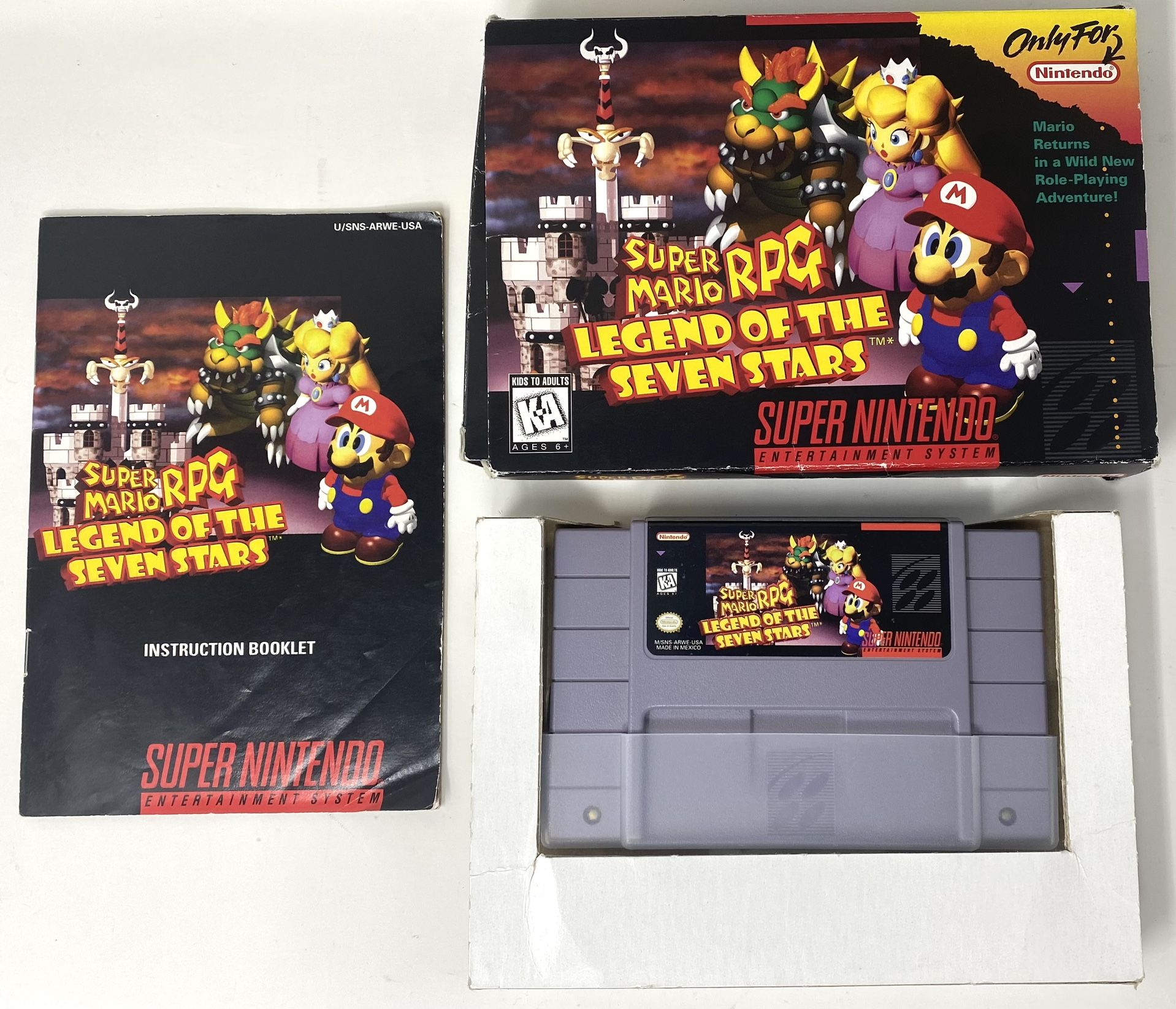
Super Mario RPG: Legend of the Seven Stars
A collaboration between Nintendo and Square, this title proved that the Mario universe could sustain a deep narrative. It introduced Timed Hits, a mechanic where pressing a button at the moment of impact would increase damage dealt or decrease damage received. This "active" turn-based system became the blueprint for the Paper Mario and Mario & Luigi series.
Technical Comparison of Top SNES RPGs
The following table compares the key attributes of the most influential RPGs on the platform.
| Game Title | Developer | Release Year | Primary Combat Style | Unique Feature |
|---|---|---|---|---|
| Chrono Trigger | Square | 1995 | ATB 2.0 (Visible Encounters) | Multiple Endings / New Game+ |
| Final Fantasy VI | Square | 1994 | Active Time Battle (ATB) | Magicite Customization / Ensemble Cast |
| EarthBound | HAL / Nintendo | 1994 | Turn-Based (Rolling HP) | Satirical Modern Setting |
| Secret of Mana | Square | 1993 | Real-Time Action | 3-Player Local Co-op |
| Super Mario RPG | Square / Nintendo | 1996 | Timed-Hit Turn-Based | Isometric Graphics / Platforming Elements |
| Lufia II: Rise of the Sinistrals | Neverland | 1995 | Turn-Based / Puzzle | Ancient Cave (Roguelike Dungeon) |
| Terranigma | Quintet | 1995 | Action-RPG | World-Rebuilding Narrative |
Late-Era Technical Marvels and Hidden Gems
Toward the end of the SNES life cycle, developers were extracting every bit of power from the 16-bit processor. This led to games that visually rivaled early 32-bit PlayStation titles.
- Star Ocean: Utilizing a special compression chip (the SDD-1), this game featured digitized voice acting and sprawling environments that were unheard of on a cartridge. Its real-time combat was a precursor to the "Tales" series' style.
- Tales of Phantasia: Released in late 1995 in Japan, this game featured a full vocal opening song. It used the "Linear Motion Battle System," which played like a 2D fighting game combined with RPG stats.
- Lufia II: Rise of the Sinistrals: Often overlooked, Lufia II integrated Zelda-style environmental puzzles into a traditional RPG framework. Its "Ancient Cave" is a 99-floor procedurally generated dungeon that serves as an early example of the "Roguelike" genre within a console RPG.
How to Access These Classics in 2026
For modern players looking to experience these titles, there are several legal and high-quality methods available as of 2026.
- Nintendo Switch Online + Expansion Pack: This subscription service remains the most accessible way to play EarthBound, Breath of Fire, and Super Mario RPG. The service includes "Rewind" features and save states, which help mitigate some of the "grinding" required in older titles.
- Square Enix Modern Ports: Square Enix has released "Pixel Remaster" versions of the Final Fantasy series across PC, consoles, and mobile. These versions feature updated fonts, rearranged soundtracks, and "Quality of Life" toggles like 4x EXP or turning off random encounters.
- SNES Classic Edition: Although discontinued, this mini-console remains a popular collector's item and includes Chrono Trigger, Final Fantasy VI, and Secret of Mana in a plug-and-play format.
- Original Hardware: For purists, playing on an original SNES with a CRT television is still considered the "gold standard" for reducing input lag and experiencing the intended visual aesthetic of pixel art. However, original cartridges for games like EarthBound or Chrono Trigger can now cost several hundred dollars on the secondary market.
Frequently Asked Questions
Which SNES RPG is best for beginners?
Super Mario RPG: Legend of the Seven Stars is generally considered the best starting point. Its mechanics are intuitive, the tone is lighthearted, and the "Timed Hits" system keeps the gameplay engaging without the complexity of deep menu management found in games like Final Fantasy.
Are SNES RPGs difficult by modern standards?
Most SNES RPGs are moderately difficult due to "random encounters" and limited save points. However, the core mechanics are usually fair. Games like Lufia II and 7th Saga are known for being significantly more challenging, while Chrono Trigger is praised for having a very smooth difficulty curve that rarely requires grinding for levels.
Why are these games so expensive to buy today?
The high cost of original SNES RPG cartridges is due to their limited production runs and the fact that many utilized "battery-backed saves," which were expensive to manufacture. Additionally, the RPG genre had a smaller (but dedicated) audience in the West during the 90s compared to platformers, leading to a lower supply of physical copies today.
What is the difference between Final Fantasy III and Final Fantasy VI?
This is a common point of confusion. In the 1990s, Square skipped the release of the Japanese Final Fantasy II, III, and V in North America. To keep the numbering consistent for US audiences, they rebranded the Japanese Final Fantasy IV as "Final Fantasy II" and the Japanese Final Fantasy VI as "Final Fantasy III." Modern releases now use the original Japanese numbering (I through XVI) globally.
Recommendation for Next Actions
If you are new to the era, start with Chrono Trigger. It remains the most modern-feeling game of the 16-bit generation, with a brisk pace and no random encounters. For those who prefer a deep, emotional story and don't mind a bit of "grinding," Final Fantasy VI is the essential choice. Regardless of your pick, these games represent a period of unbridled creativity that laid the foundation for every RPG that followed.
Image Gallery