Navigating Illinois Workers’ Compensation Benefits for Occupational Disability
The Illinois Workers’ Compensation Act provides a legal framework for employees to receive benefits when they sustain an injury or develop a medical condition arising out of and in the course of their employment. When an employee exper...
The Illinois Workers’ Compensation Act provides a legal framework for employees to receive benefits when they sustain an injury or develop a medical condition arising out of and in the course of their employment. When an employee experiences an occupational disability—whether through a sudden traumatic accident or a condition that develops over time due to work-related stress or exposure—the system is designed to provide medical coverage, temporary total disability payments, and potential permanent disability settlements to offset lost earning capacity.
Contents
Understanding Occupational Disability in Illinois
In the context of the Illinois Workers’ Compensation Commission (IWCC), "occupational disability" is generally categorized into two distinct types: injuries resulting from a specific, identifiable accident (like a fall or a machinery malfunction) and occupational diseases that result from repetitive trauma or prolonged exposure to harmful conditions at the workplace.
Under the Illinois Workers’ Compensation Act, the burden of proof rests on the employee to demonstrate that the disability is "work-related." This means the condition must have arisen "out of and in the course of employment." Even if you have a pre-existing condition, you may still be eligible for compensation if you can prove that your work activities aggravated, accelerated, or worsened that condition to the point of disabling you.
Types of Disability Benefits
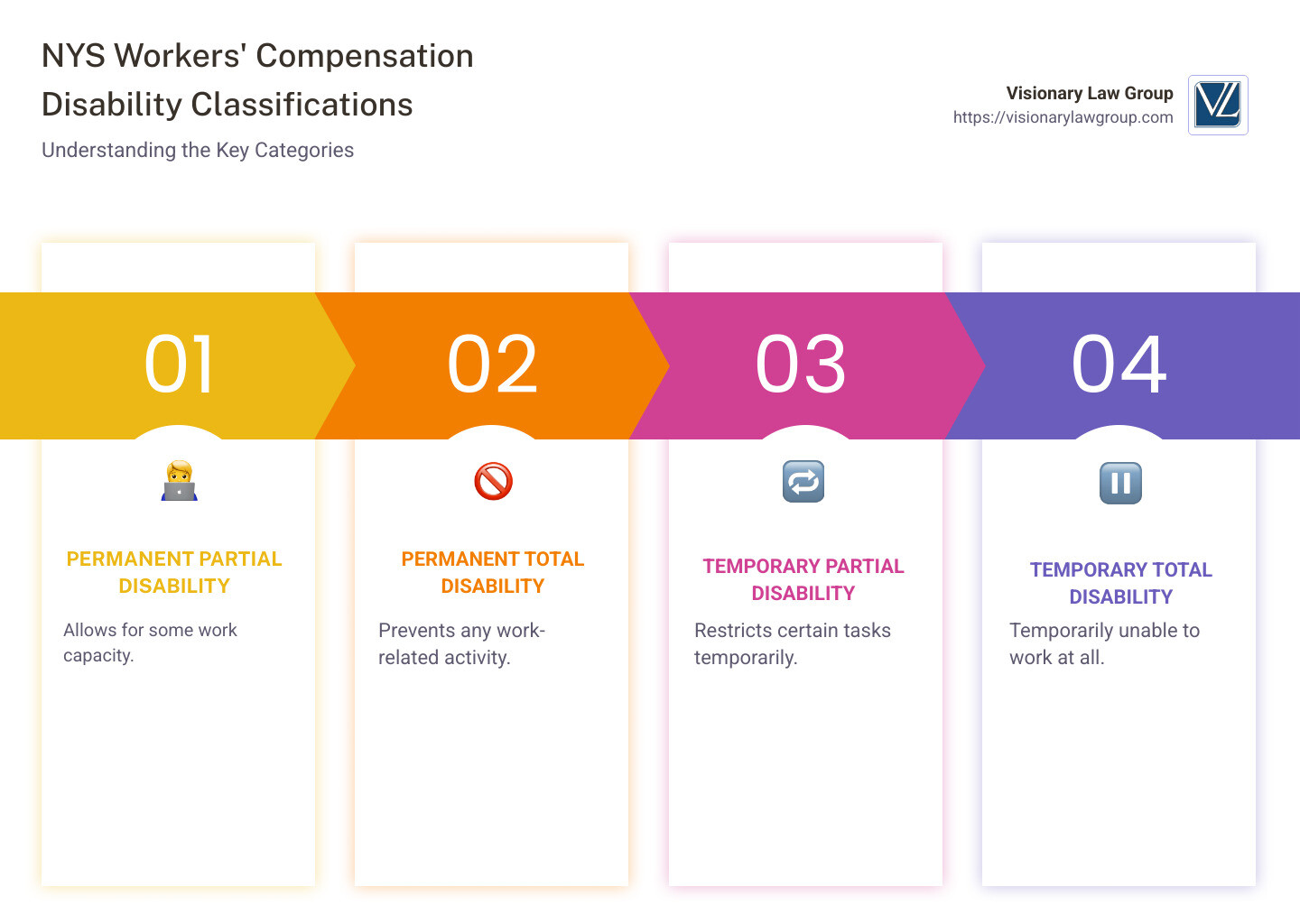
The Illinois system breaks down disability into four primary categories. Each category serves a different purpose in replacing lost wages and addressing the physical impact of the injury.
- Temporary Total Disability (TTD): This is the most common benefit provided while you are unable to work at all while recovering from your injury. TTD payments are generally two-thirds of your average weekly wage, subject to state-mandated minimum and maximum limits.
- Temporary Partial Disability (TPD): If you are released to work on light duty but earn less than you did before your injury, TPD provides two-thirds of the difference between your current lower wages and your pre-injury average weekly wage.
- Permanent Partial Disability (PPD): If your injury results in a permanent loss of function or a permanent restriction (such as the loss of use of a limb or reduced range of motion in the spine), you may be entitled to PPD benefits. These are calculated based on the specific body part affected and the severity of the permanent impairment.
- Permanent Total Disability (PTD): This is reserved for the most severe cases where an employee is rendered completely unable to return to any form of gainful employment. PTD is typically paid for the remainder of the employee’s life.
The Procedural Workflow for Filing a Claim
Securing benefits is a structured process that requires strict adherence to timelines. Failure to follow these steps can jeopardize your claim.
- Immediate Notification: You must notify your employer of the injury as soon as possible. Under Illinois law, you generally have 45 days to provide notice. If you fail to provide timely notice, you may be barred from receiving benefits.
- Medical Treatment: Your employer has the right to designate medical providers in some circumstances. However, Illinois law allows employees to choose two different chains of medical providers. Seeking timely, documented medical care is critical for establishing the "causal connection" between your work and your disability.
- Application for Adjustment of Claim: If the insurance company denies your claim or fails to pay benefits, you must file an Application for Adjustment of Claim with the IWCC. This initiates the formal legal process before an arbitrator.
- Arbitration and Review: If the parties cannot reach a settlement, the case moves to an arbitration hearing. An arbitrator will hear testimony and review medical evidence before issuing a decision. Either party has the right to appeal the arbitrator’s decision to the Commission, and subsequently to the Circuit Court.
Comparison of Disability Classifications
| Disability Type | Status | Primary Purpose |
|---|---|---|
| Temporary Total (TTD) | Healing phase | Replaces lost wages while temporarily unable to work. |
| Temporary Partial (TPD) | Healing phase | Supplements wages if working light duty for less pay. |
| Permanent Partial (PPD) | Maximum Medical Improvement | Compensates for permanent impairment/loss of body function. |
| Permanent Total (PTD) | Maximum Medical Improvement | Provides lifetime support for those unable to perform any work. |
The Role of Maximum Medical Improvement (MMI)
A critical milestone in any Illinois workers’ compensation case is reaching "Maximum Medical Improvement." MMI is a medical determination made by your physician indicating that your condition has plateaued—meaning it is not expected to improve significantly with further medical treatment.
Once you reach MMI, your TTD payments will typically cease. At this stage, your medical provider will assess whether you have any permanent restrictions or lasting impairments. This assessment is the foundation for negotiating a PPD settlement. If you are unable to return to your previous job due to these permanent restrictions, you may be entitled to additional vocational rehabilitation benefits, which may include job training or placement services funded by the employer’s insurance carrier.
Common Pitfalls and Challenges
Many claimants encounter difficulty when insurance adjusters dispute the "causal connection." Insurance carriers often argue that a disability is the result of aging, a non-work-related hobby, or a pre-existing degenerative condition rather than the workplace environment.
To overcome this, you must ensure your medical records explicitly state the cause of the injury. Phrases in medical reports such as "within a reasonable degree of medical certainty" are highly valuable. Additionally, keeping a detailed log of all interactions with your employer, supervisor, and insurance adjuster is essential. If you are denied, do not assume the process is over. The Illinois workers’ compensation system provides for appeals precisely because disputes regarding the nature and extent of a disability are common.
Frequently Asked Questions
Can I choose my own doctor? Yes. In Illinois, you are allowed to choose two different physicians or medical "chains" for your treatment. If your employer has a preferred provider program (PPO), you may be required to choose from their network for the first choice, but you generally retain the right to seek a second opinion or secondary treatment from a provider of your choosing.
What if my injury is a repetitive stress injury (RSI)? Repetitive trauma injuries, such as carpal tunnel syndrome or chronic back pain, are compensable under Illinois law. However, they are often harder to prove than sudden accidents. You must provide evidence that the specific, repetitive nature of your job duties caused the gradual breakdown of the body part in question.
Are my disability benefits taxable? Generally, workers’ compensation benefits are considered non-taxable income at both the state and federal levels. However, if you are receiving Social Security Disability Insurance (SSDI) simultaneously, there may be "offsets" that impact the total amount you receive. It is advisable to consult a tax professional regarding how these benefits interact with other government programs.
How long do I have to file a claim? The statute of limitations for filing an application for adjustment of claim with the IWCC is generally three years from the date of the accident, or two years from the date of the last compensation payment, whichever is later.
What happens if my employer fires me for filing a claim? Illinois is an "at-will" state, but it is strictly illegal to terminate an employee in retaliation for filing a workers' compensation claim. If you believe your discharge was retaliatory, you may have grounds for a separate civil lawsuit against the employer for retaliatory discharge.
Next Steps for Claimants
If you believe you have an occupational disability, your immediate priority should be medical documentation. Ensure your primary care physician or specialist is aware that your symptoms are work-related. Keep copies of all bills, diagnostic reports, and correspondence with your employer’s HR department. If you encounter a denial of benefits, consult with a qualified Illinois workers’ compensation attorney who can help navigate the IWCC hearing process. Establishing your case early with clear evidence is the most effective way to secure the benefits to which you are entitled under the law.
Image Gallery