Understanding What a Dental Crown Post Does in Restorative Dentistry
A dental crown post provides essential internal support and retention for a dental crown when a tooth has lost too much natural structure from decay or root canal treatment. Placed deep within the rooted canal, it anchors a core buildu...
A dental crown post provides essential internal support and retention for a dental crown when a tooth has lost too much natural structure from decay or root canal treatment. Placed deep within the rooted canal, it anchors a core buildup material, creating a stable foundation to secure the final restoration.
Contents
When a tooth undergoes extensive damage, whether from severe decay, trauma, or a root canal procedure, its long-term survival depends heavily on how well it can support a future restoration. Patients and dental professionals frequently encounter scenarios where a simple filling is no longer sufficient, yet the remaining root is strong enough to save. In these instances, understanding what a dental crown post does is critical for evaluating restorative options. Far from being a magical anchor that single-handedly holds a crown in place, a post serves a very specific mechanical function within modern restorative dentistry.
The Anatomical and Structural Context of Damaged Teeth
To understand the purpose of a post, one must first look at the anatomy of a compromised tooth. A healthy tooth consists of a visible crown above the gumline and one or more roots anchored in the jawbone. Inside the tooth lies the pulp chamber and root canals, which contain nerves and blood vessels.
When a tooth suffers from deep caries or irreversible pulpitis, endodontic therapy (a root canal) becomes necessary. During this procedure, the infected or dead pulp tissue is removed, the canals are cleaned and shaped, and a biocompatible material—typically gutta-percha—is packed inside to seal the space.
However, a root-treated tooth is often structurally compromised. The access opening required for the root canal, combined with the initial decay or fracture that necessitated the treatment, leaves behind a hollowed-out shell. Chewing forces exert immense pressure on teeth. Without adequate remaining dentin (the hard layer beneath the enamel), the remaining tooth walls can easily fracture under normal occlusal (bite) loads.
Defining the Dental Crown Post and Its Mechanical Role
A dental crown post is a thin, rod-like device made of metal or non-metal materials that is inserted directly into the root canal of a tooth that has already undergone root canal treatment.
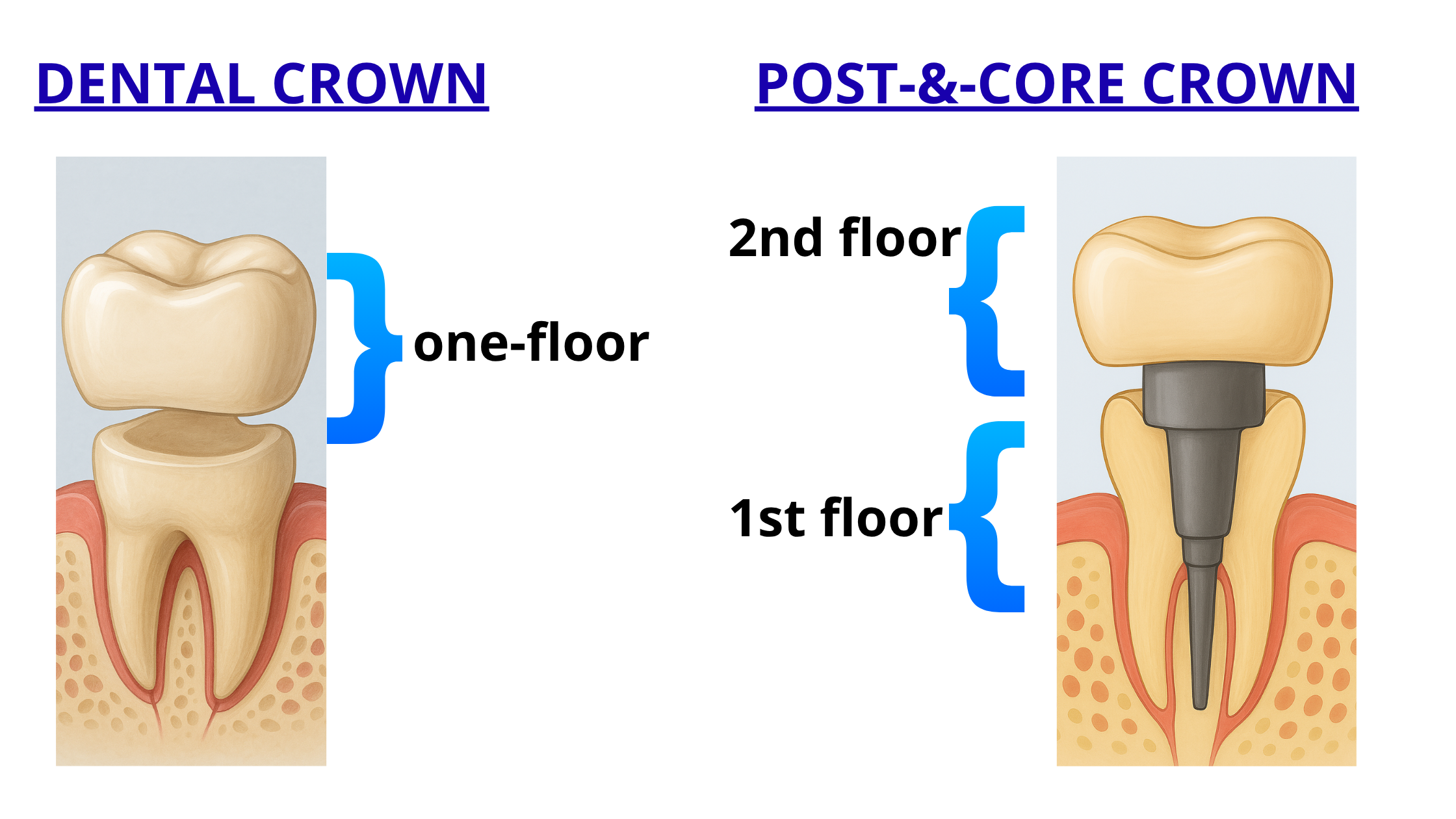
It is vital to correct a common misconception: a post does not strengthen the root of the tooth. In fact, placing a post often requires removing a portion of the root canal filling material, which can slightly weaken the root structure itself. Instead, the primary function of a post is retention. It acts as an anchor or peg to retain the core buildup material—the synthetic material placed on top of the root—which in turn supports and retains the actual dental crown.
If a tooth has lost so much natural crown structure that there is nothing left for a filling or core buildup to grip onto, the post provides the necessary mechanical tether. It reaches down into the stabilized root canal space, giving the dentist a secure foundation to build upward.
Types of Dental Crown Posts
Dental posts are categorized primarily by their material composition and design. Choosing the correct type depends on the tooth's location in the mouth, the amount of remaining structure, and aesthetic requirements.
1. Prefabricated Posts
Prefabricated posts are manufactured in standardized sizes and shapes. Dentists select the post that best matches the prepared root canal dimensions during the chairside visit.
- Metal Posts: Usually made of stainless steel, titanium, or titanium alloys. They offer high tensile strength and rigidity but can sometimes be visible through translucent all-ceramic crowns, and their high rigidity occasionally increases the risk of root fracture.
- Fiber Posts: Composed of carbon, glass, or quartz fibers embedded in a resin matrix. These have become increasingly popular because their flexibility (modulus of elasticity) is similar to natural dentin, reducing the risk of root fractures. They also offer superior aesthetics under modern ceramic restorations.
2. Custom Cast Posts
Custom cast posts are fabricated in a dental laboratory specifically for an individual patient.
- The dentist takes an impression of the prepared root canal.
- A laboratory technician creates a custom metal post and core as a single, cohesive unit that fits the exact contours of the patient’s unique root canal geometry.
- These are typically reserved for teeth with irregularly shaped canals or extremely heavy bite forces where prefabricated options might fail.
| Post Type | Primary Material | Flexibility vs. Dentin | Main Aesthetic Advantage | Best Suited For |
|---|---|---|---|---|
| Fiber Post | Glass/Quartz/Carbon in Resin | Similar elasticity | Excellent (translucent) | Anterior teeth and compromised roots |
| Metal Prefab | Titanium / Stainless Steel | Much stiffer | Poor (can show through) | Posterior teeth with heavy load requirements |
| Custom Cast | Gold alloy / Base metals | Varies (generally stiff) | Moderate to Poor | Irregular root canals, heavily damaged teeth |
The Clinical Procedure: How a Post is Placed
The placement of a dental crown post is a multi-step clinical process that requires precision and careful planning. It is never performed on a vital (living) tooth; a successful root canal treatment must be completed and evaluated first.
Step 1: Canal Preparation and Gutta-Percha Removal
After confirming that the root canal treatment is successful and free of infection, the dentist uses specialized instruments (such as Gates-Glidden drills or specialized burs) to remove a predetermined length of the gutta-percha filling from the canal. Typically, at least half of the root length is left filled at the apex to maintain an adequate apical seal against bacteria.
Step 2: Fitting and Cementing the Post
The dentist selects the appropriate post size, tries it in the canal to ensure proper depth and fit, and then cleans the canal. Using specialized dental cements or resin adhesives, the post is bonded securely into place. Modern adhesive resin cements create a strong micro-mechanical bond between the post, the root dentin, and the core material.
Step 3: Core Buildup
Once the post is firmly cemented and any excess length is trimmed, the dentist builds up the missing coronal tooth structure using a composite resin or glass ionomer core material. This material surrounds the exposed portion of the post, sculpting it into the shape of a stubby, prepared tooth.
Step 4: Crown Preparation and Final Restoration
With the core buildup providing a solid foundation, the dentist shapes the entire assembly much like a naturally prepared tooth. An impression or digital scan is taken, and a dental laboratory fabricates the final custom crown, which is later cemented over the post-and-core structure.
When Is a Post Actually Necessary?
One of the most important principles in modern restorative dentistry is conservation of tooth structure. Consequently, posts are not routinely placed in every root-canaled tooth.
Deciding whether a post is required involves evaluating several clinical factors:
- Amount of Remaining Natural Tooth Structure: If a tooth retains at least two or three walls of healthy dentin above the gumline, a post is usually unnecessary. The remaining walls provide sufficient "ferrule effect"—a collar of healthy tooth tissue that encircles the base of the crown, protecting the tooth from splitting.
- Tooth Position in the Mouth: Anterior teeth (incisors and canines) endure shearing forces and have narrow roots, making them prone to specific types of stress. Posterior teeth (molars and premolars) endure heavy vertical crushing forces. Molars often have multiple roots, meaning the natural pulp chamber floor can support a core buildup without needing individual posts in every canal.
- Occlusal Forces and Parafunctional Habits: Patients who grind or clench their teeth (bruxism) place extreme horizontal and vertical loads on their restorations, sometimes shifting the structural requirements for post-retained crowns.
Risks, Complications, and Potential Failures
While posts are invaluable tools for saving badly damaged teeth, they are not without risks. Understanding these potential complications helps patients and clinicians make informed decisions.
- Root Fracture: The most severe complication associated with posts—particularly rigid metal ones—is a vertical root fracture. If a post is too stiff or too wide, it can act as a wedge inside the root, causing the root to split under bite pressure. A fractured root cannot be saved and typically requires extraction.
- Post Dislodgement (Decementation): Over time, repetitive chewing forces can break the adhesive bond holding the post inside the canal. If a post loosens, the core buildup and crown will also become mobile or detach entirely.
- Perforation: During the preparation phase when gutta-percha is removed, a misdirected drill can accidentally pierce through the side of the root wall. This structural breach complicates treatment and can jeopardize the tooth's prognosis.
- Recurrent Decay: If the seal between the crown, core, and tooth margin degrades, bacteria can seep underneath the restoration, causing hidden decay around the post space.
Frequently Asked Questions
Does getting a dental crown post hurt?
The post placement procedure itself is generally painless. Because a dental crown post is placed inside a tooth that has already undergone a root canal, the nerve inside that tooth has been removed. Patients may feel mild pressure or vibration during the preparation of the canal space, but local anesthetic is rarely necessary just for the post insertion.
Can a post be placed in any tooth that needs a crown?
No. A post can only be placed in a tooth that has successfully undergone root canal therapy and has sufficient root length and bone support remaining. If a root is too short, curved, thin, or structurally compromised by fractures or severe internal resorption, a post cannot be safely placed, and extraction may be the only viable alternative.
How long does a post-supported crown last?
With proper oral hygiene, regular dental checkups, and a well-designed bite, a post and crown restoration can last anywhere from 10 to 15 years or even longer. Longevity depends heavily on the amount of natural tooth structure left to support the system and the patient's habits, such as avoiding chewing on hard objects.
What is the difference between a post and a dental implant?
A dental crown post is placed inside the root of an existing, natural tooth that has a compromised crown. A dental implant, by contrast, is a titanium or zirconia screw surgically placed directly into the jawbone to entirely replace a missing tooth root when the natural tooth has been extracted.
Are metal posts safer than fiber posts?
Neither is universally "safer," but they serve different clinical indications. Modern dentistry heavily favors fiber posts in many cases because their flexibility closely mimics natural dentin, significantly lowering the incidence of catastrophic root fractures compared to rigid metal posts. However, metal or custom cast posts may still be selected for specific structural demands in heavy-load areas.
Practical Next Steps for Patients
If your dentist has recommended a post and crown following a root canal, the best course of action is to discuss the specific structural condition of your tooth. Ask your dentist how much natural tooth structure (and ferrule) remains and whether a fiber post or alternative buildup method is planned. Maintaining meticulous oral hygiene—including daily flossing around the crown margin and routine professional cleanings—is essential to protect your investment and prevent secondary decay from compromising the remaining tooth structure.
Image Gallery