Understanding the Federal Employee Assistance Program (EAP) in 2026
The Federal Employee Assistance Program (EAP) is a voluntary, confidential service designed to help federal employees and their immediate family members manage personal and professional challenges. Managed by individual agencies under...
The Federal Employee Assistance Program (EAP) is a voluntary, confidential service designed to help federal employees and their immediate family members manage personal and professional challenges. Managed by individual agencies under OPM guidelines, it provides short-term counseling, financial and legal referrals, and crisis intervention at no cost to the employee.
Contents
The Federal Employee Assistance Program (EAP) serves as a critical safety net within the United States civil service infrastructure. Established to promote a healthy and productive workforce, the EAP offers a suite of professional services that address a broad range of life issues. As we navigate the complex work environments of 2026, where the lines between professional duties and personal well-being are increasingly blurred, the EAP remains a primary resource for federal personnel.
The Statutory Basis and Purpose of the Federal EAP
The EAP is not merely a discretionary benefit; it is a program rooted in federal law. Under 5 U.S.C. § 7901, the head of each executive agency is authorized to establish programs to promote the health of their employees. This statutory authority provides the framework for agencies to offer services ranging from mental health counseling to substance abuse prevention and treatment.
The primary objective of the program is two-fold: to assist employees in resolving personal problems that may adversely affect their job performance and to provide management with a tool for maintaining a high-functioning workforce. By addressing issues such as stress, grief, family conflict, and addiction early, the federal government reduces absenteeism, lowers healthcare costs, and improves overall morale and retention.
In 2026, the program has evolved to reflect modern challenges, incorporating expanded digital access and a greater emphasis on "whole-person" wellness. While each agency manages its own EAP—either through internal staff or by contracting with external vendors—they all adhere to core principles of confidentiality and accessibility.
Who Is Eligible for EAP Services?
Eligibility for the Federal EAP is generally broad, ensuring that those in the federal ecosystem have a point of contact for support. While specific agency policies can vary slightly, the following groups are typically eligible:
- Full-Time and Part-Time Federal Employees: All permanent civil service employees are covered from their first day of employment.
- Immediate Family Members: Most EAP models extend services to the employee’s spouse and legal dependents. This recognition acknowledges that a crisis at home significantly impacts an employee's ability to function at work.
- Retirees: Some agencies offer "grace period" access for a limited time following retirement to assist with the transition out of the workforce.
- Contractors (Limited): While most federal contractors are served by their private employers’ EAPs, some agencies provide limited emergency crisis support to contractors working on-site.
It is important to note that EAP services are available regardless of whether an employee is enrolled in a Federal Employees Health Benefits (FEHB) plan. The EAP operates independently of insurance, serving as a first-line resource rather than a long-term medical provider.
Core Services and Support Categories
The Federal EAP is designed as a "short-term, solution-focused" model. It is not intended for long-term clinical therapy but rather as a bridge to identify problems and find immediate coping strategies or appropriate long-term referrals.
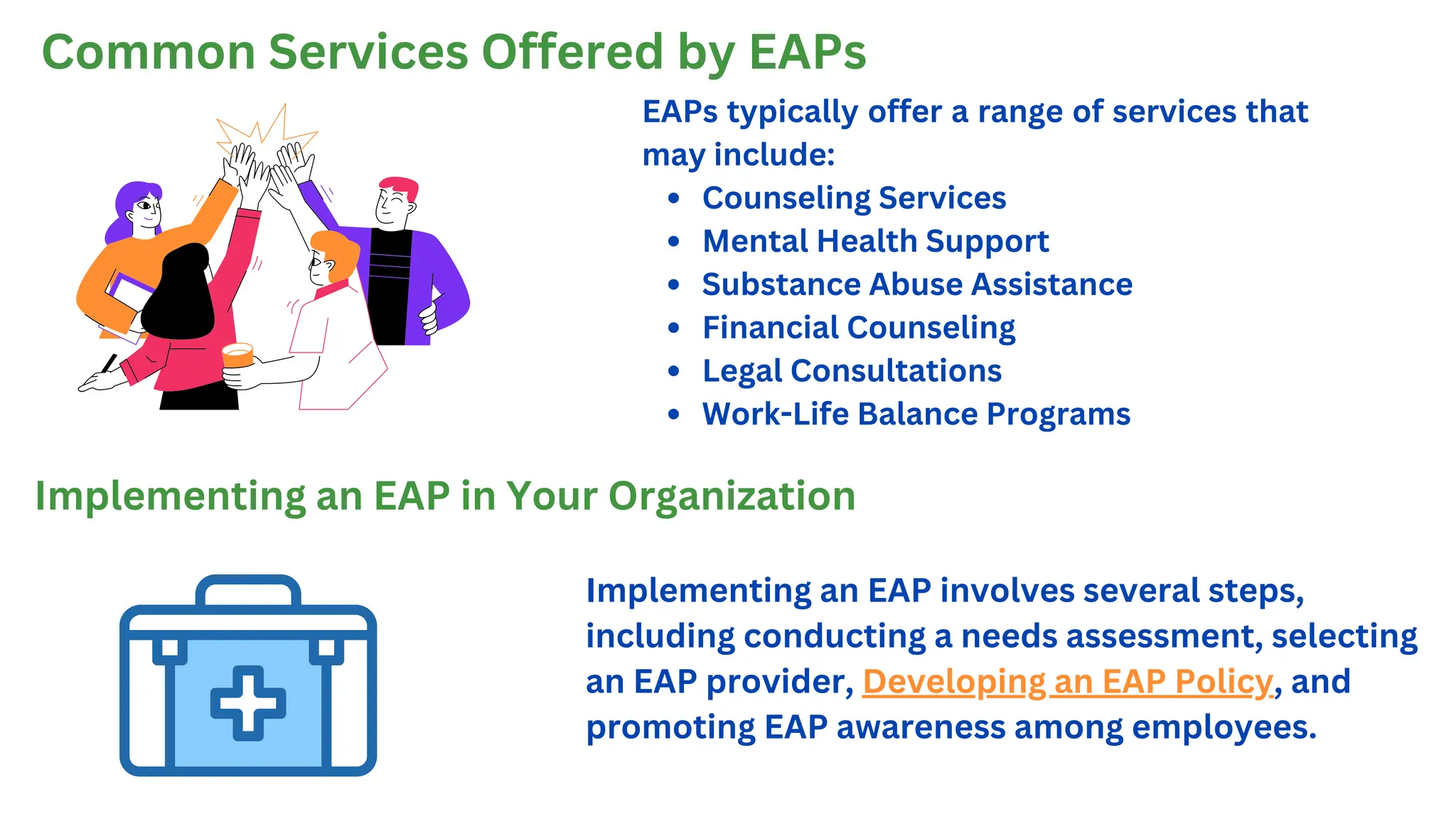
Mental Health and Emotional Well-being
This is the most utilized facet of the EAP. Licensed clinical social workers or professional counselors provide confidential sessions to address anxiety, depression, workplace stress, and interpersonal conflicts. In 2026, these services are frequently delivered via secure telehealth platforms, allowing employees in remote or rural locations the same level of access as those in major metropolitan hubs.
Substance Use and Addiction
The EAP plays a vital role in the Drug-Free Federal Workplace initiative. Counselors provide assessments for alcohol and drug dependency, offer short-term stabilization, and refer employees to intensive outpatient or inpatient programs. Because the EAP is confidential, employees are encouraged to seek help voluntarily before their substance use results in a disciplinary or performance-based action.
Financial and Legal Consultations
Recognizing that financial instability is a major stressor, the EAP provides access to financial experts who can assist with budgeting, debt consolidation, and retirement planning. Similarly, legal services—typically involving a free initial consultation and a discounted rate for subsequent work—help employees navigate issues like divorce, adoption, estate planning, and landlord-tenant disputes.
Work-Life Balance and Dependent Care
Modern EAP services include "concierge-style" referrals for child care, elder care, and even pet care. Employees can request a specialist to research local providers, verify licensing, and check availability, saving the employee hours of personal research time.
Management Consultations and Crisis Response
The EAP is also a resource for supervisors. Managers can consult with EAP experts on how to handle a declining employee performance issue or how to support a team after a workplace tragedy. In the event of a national emergency or a localized traumatic event, EAP "Go Teams" provide Critical Incident Stress Management (CISM) to help stabilize the workforce.
Confidentiality: The Cornerstone of the Program
For any employee assistance program to be effective, participants must trust that their privacy is protected. The Federal EAP is governed by strict confidentiality regulations, specifically 42 CFR Part 2 (for substance abuse records) and the HIPAA Privacy Rule.
Protection of Records
EAP records are maintained separately from the Official Personnel Folder (OPF). A supervisor does not have access to an employee's EAP files, nor will they even know that an employee has contacted the EAP unless the employee chooses to disclose that information.
Legal Exceptions to Confidentiality
There are very specific, legally mandated exceptions where an EAP counselor must break confidentiality:
- Threat to Self or Others: If an employee expresses a credible intent to harm themselves or someone else.
- Child or Elder Abuse: Mandatory reporting laws require counselors to report suspected abuse or neglect of vulnerable populations.
- Court Orders: In rare legal proceedings, a judge may issue a subpoena for records, though EAP providers often fight to maintain privilege.
- National Security: In certain high-clearance positions, specific behaviors that impact security eligibility may have different reporting requirements, though these are clearly briefed to the employee beforehand.
Comparing EAP and FEHB (Health Insurance)
Many employees confuse the EAP with their health insurance. While they are complementary, they serve different functions. The following table highlights the primary differences:
| Feature | Employee Assistance Program (EAP) | Federal Employees Health Benefits (FEHB) |
|---|---|---|
| Cost | Free to the employee and family. | Monthly premiums; requires co-pays/deductibles. |
| Focus | Short-term assessment and referral. | Long-term treatment and chronic care. |
| Access | Immediate (often 24/7 intake). | May require specialist referrals and wait times. |
| Provider Choice | Limited to agency-contracted network. | Broad choice of doctors within a plan network. |
| Confidentiality | Highly confidential; no insurance claim generated. | Claims are processed through insurance carriers. |
| Services | Counseling, legal, financial, work-life. | Medical, surgical, pharmacy, clinical therapy. |
How to Access the Program in 2026
Accessing the EAP is straightforward. Employees do not need a referral from a supervisor or a doctor to begin. Most federal agencies provide an EAP website or a toll-free number that is accessible 24 hours a day, 365 days a year.
- Identification: Locate your agency’s EAP provider. This information is typically found on the internal agency portal, on posters in common areas, or by contacting the Human Resources department.
- Intake: Call the provider or use their secure portal. You will be asked for your agency name and basic contact information to verify eligibility.
- Assessment: You will be matched with a counselor for an initial assessment. This usually happens within a few days, or immediately in a crisis.
- Action Plan: After 1-6 sessions (depending on the agency’s contract), the counselor will either help you resolve the issue or provide a warm hand-off to a long-term provider covered by your FEHB plan.
Common Misconceptions and Barriers
Despite the benefits, some employees hesitate to use the EAP. One common fear is that using the program will "red flag" their security clearance. On the contrary, the Office of Personnel Management (OPM) and security clearance adjudicators generally view seeking help for mental health or stress as a sign of good judgment and high reliability.
Another misconception is that the EAP is only for people in "crisis." In reality, the program is most effective when used early. Whether it is a question about a complex legal document or navigating the stress of a new promotion, the EAP is a preventive tool rather than just an emergency one.
Frequently Asked Questions
1. Is the EAP truly free for federal employees?
Yes. The services provided directly by the EAP (the initial counseling sessions, the legal/financial consultations, and the referral services) are fully funded by your agency. However, if you are referred to a long-term therapist or a specialized lawyer outside of the EAP network, you would then be responsible for those costs, which may be covered by your health insurance.
2. Can my supervisor mandate that I attend the EAP?
A supervisor can make a "formal referral" if they notice a decline in your job performance. While they can strongly encourage you to attend, you are generally not legally required to participate unless the referral is part of a formal disciplinary agreement or "last-chance" contract. Even in a formal referral, the EAP only informs the supervisor whether you attended; they do not share the content of your sessions.
3. How many counseling sessions am I allowed?
Most federal agencies offer between 3 and 8 sessions per issue, per year. For example, you might use 4 sessions for grief counseling and later in the year use 3 sessions for workplace stress. If your issue requires ongoing, long-term care, the EAP counselor will facilitate a transition to a provider within your FEHB network.
4. Can I use the EAP for my spouse or children?
Yes. Nearly all Federal EAP contracts extend eligibility to immediate family members living in your household. This is particularly helpful for families dealing with a child’s behavioral issues or a spouse's career transition, which can indirectly impact the federal employee’s focus and productivity.
5. Does the EAP offer help with my taxes?
The EAP typically offers financial "consultation," which includes general tax information and budgeting for tax season. However, they generally do not provide tax preparation services or file returns for you. They can, however, provide referrals to certified public accountants (CPAs) who may offer a discount to federal employees.
6. Is the EAP available if I am working OCONUS (Outside the Continental United States)?
Yes. Agencies with overseas footprints, such as the Department of State or DoD, provide EAP services to employees stationed abroad. In 2026, this is primarily facilitated through advanced telehealth and international provider networks to ensure that those serving in remote locations have the same level of support as domestic employees.
Final Recommendation
If you are a federal employee or a family member, your first step should be to locate your agency's specific EAP contact information before you actually need it. Save the phone number in your contacts or bookmark the portal on your personal device. Because the EAP is a "short-term" resource, it is most effective when used at the first sign of stress, rather than waiting for a situation to escalate into a crisis. Using the program is a private, professional, and proactive way to ensure that you remain resilient and effective in both your personal life and your public service career.
Image Gallery