Comprehensive Guide to Police Radio Codes: Deciphering 10 Codes, Phonetic Alphabets, and Signals in 2026
Police radio codes are standardized shorthand systems used by law enforcement agencies to communicate efficiently, securely, and concisely over congested radio frequencies. Developed primarily through the Association of Public-Safety C...
Police radio codes are standardized shorthand systems used by law enforcement agencies to communicate efficiently, securely, and concisely over congested radio frequencies. Developed primarily through the Association of Public-Safety Communications Officials (APCO), these systems—most notably the APCO 10-codes—along with phonetic alphabets and numerical signals, allow officers to transmit vital information instantly without tying up open channels during critical incidents.
Contents
Understanding the Evolution and Purpose of Police Radio Codes
Law enforcement communication has relied on brevity since the inception of mobile radio systems in the 1920s and 1930s. When radio spectrum was severely limited and voice transmissions were prone to static, interference, and eavesdropping, standardizing messages became a public safety necessity.
The introduction of the "10-code" system by the Illinois State Police in 1937 revolutionized dispatch operations. By replacing lengthy sentences with numbers starting with the digit 10, departments drastically reduced airtime. For example, instead of broadcasting "We have an ongoing emergency situation at this location and require immediate backup," an officer could simply state a "10-33," reserving precious seconds during active threats.
In modern operations, while many agencies have transitioned toward plain English—or "clear text"—mandated by the National Incident Management System (NIMS) for multi-agency interoperability, thousands of municipal, county, and state agencies still heavily rely on traditional 10-codes, 11-codes, and local signals. Mastery of these codes remains essential for dispatchers, field personnel, journalists, and public safety researchers alike.
The Structure of APCO 10-Codes
The APCO 10-code system is structured logically, though regional variations exist between different state and local jurisdictions. The number 10 acts as an attention-getter or prefix, while the second digit (or numbers following the hyphen) indicates the specific status, action, or inquiry.
Below is a detailed breakdown of widely recognized standard APCO 10-codes used across many North American law enforcement jurisdictions.
| Code | Standard Meaning | Operational Context |
|---|---|---|
| 10-4 | Affirmative / OK / Message Received | Acknowledging receipt of instructions or confirming status. |
| 10-9 | Repeat Please / Message Not Clear | Requesting dispatch or another unit to re-transmit a broken or unreadable broadcast. |
| 10-20 | Location | Requesting or stating the current physical position (e.g., "What is your 10-20?"). |
| 10-41 | Beginning Tour of Duty / On Duty | Officer logging onto the system at the start of a shift. |
| 10-42 | Ending Tour of Duty / Off Duty | Officer logging off at the end of a shift. |
| 10-78 | Need Assistance / Backup Required | Urgent request for backup units to respond to a potentially dangerous scene. |
| 10-99 | Wanted / Stolen Record on Subject or Vehicle | Indicates that a database query returned an active warrant or stolen flag. |
Regional Variations: Why 10-Codes Are Not Universal
A common misconception among the public is that police radio codes are entirely uniform nationwide. In reality, a 10-code in one county or state can mean something completely different across state lines.
For instance, while "10-4" universally means affirmative or understood, "10-10" might signify an out-of-service meal break in one municipal department, but represent a fight in progress or a domestic disturbance in a neighboring county's specialized signal manual.
Because of these discrepancies, federal disaster response frameworks and major multi-agency task forces encourage the use of clear text. However, intra-agency communication at the local level preserves legacy codes due to institutional memory, typing speed on computer-aided dispatch (CAD) terminals, and the ingrained habits of veteran dispatchers and patrol officers.
The NATO Phonetic Alphabet in Law Enforcement Communications
When transmitting license plate numbers, vehicle identification numbers (VINs), suspect names, or street addresses over the radio, static or poor pronunciation can lead to catastrophic transcription errors. To eliminate ambiguity between similar-sounding letters (such as "B," "P," "T," and "V"), law enforcement agencies utilize the NATO Phonetic Alphabet.
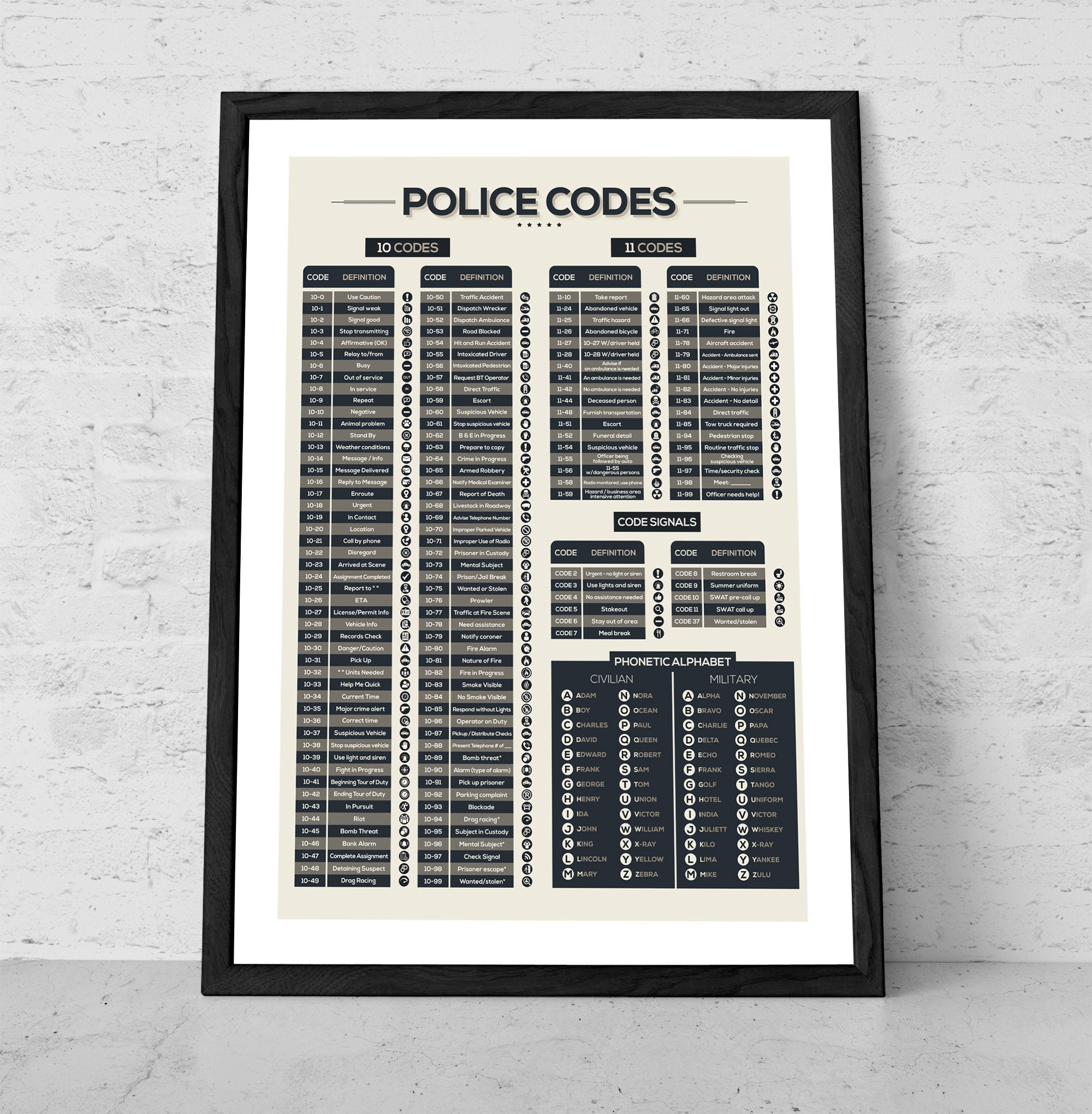
Phonetic Standards: A - Alpha | B - Bravo | C - Charlie | D - Delta | E - Echo | F - Foxtrot | G - Golf | H - Hotel | I - India | J - Juliett | K - Kilo | L - Lima | M - Mike | N - November | O - Oscar | P - Papa | Q - Quebec | R - Romeo | S - Sierra | T - Tango | U - Uniform | V - Victor | W - Whiskey | X - X-ray | Y - Yankee | Z - Zulu
When an officer reads a license plate like "3XYZ123," they transmit it clearly as: "Three - X-ray - Yankee - Zulu - One - Two - Three." This eliminates confusion even when signals are broken by geographical interference or physical barriers like concrete buildings.
Signals and Numeric Codes Beyond the 10-Code System
In addition to 10-codes, many departments utilize "Signal Codes" or numeric/alphanumeric designators to categorize specific criminal offenses, administrative tasks, or tactical situations. While 10-codes typically denote officer status and administrative inquiries, signals frequently denote criminal activity or immediate hazards.
- Signal 30: Often used to denote a robbery or holdup alarm activation.
- Signal 45: Commonly indicates a dead body or death investigation.
- Code 3: Not a 10-code, but a widespread operational term designating an emergency response requiring lights and sirens.
- Code 6: Frequently designates that an officer has arrived at a location and is investigating independently (out of the vehicle).
The Ongoing Debate: 10-Codes vs. Clear Text
As public safety communications modernized, a significant operational debate emerged regarding the efficiency of coded speech versus plain language.
Pros and Cons of Traditional 10-Codes
- Pros: Highly concise; reduces airtime on busy channels; provides a level of basic operational privacy from casual scanner listeners.
- Cons: Prone to misinterpretation during mutual aid operations involving multiple jurisdictions; requires extensive training and continuous memorization for new personnel.
Pros and Cons of Plain English (Clear Text)
- Pros: Eliminates confusion during multi-agency responses (such as natural disasters or joint task force operations); complies with federal NIMS mandates; easier for civilian partners and allied agencies to understand immediately.
- Cons: Sentences take longer to speak over the radio, potentially clogging frequencies during critical incidents.
Frequently Asked Questions
What does "10-4" actually mean?
"10-4" is a standard APCO radio code meaning "Affirmative," "Understood," or "OK." It signifies that the receiving party has heard and comprehended the transmission. Originally popularized by truck drivers and police dramas, it remains one of the few universally recognized radio codes in public use.
Are police radio codes the same in every state?
No, police radio codes vary significantly by jurisdiction. While agencies often adopt the foundational APCO 10-code framework, individual state police, county sheriff's offices, and city police departments frequently modify definitions or maintain proprietary local signal books.
Why do police use the phonetic alphabet?
Law enforcement officers use the phonetic alphabet to spell out critical identifiers—such as license plates, street names, and suspect names—without error. It prevents confusion caused by static, background noise, or letters that sound alike (such as M and N, or B and V).
What does "Code 3" mean on a police radio?
"Code 3" is an operational designator used by many law enforcement agencies to indicate an emergency response. When an officer is dispatched "Code 3," they are authorized to operate their vehicle with emergency lights and sirens activated to reach a high-priority scene quickly.
Can civilians legally listen to police radio frequencies?
In most jurisdictions, civilians are legally permitted to listen to public safety radio transmissions using digital scanners or online streaming feeds, provided they are not using intercepted information to commit a crime, evade law enforcement, or interfere with active police operations.
Practical Recommendations for Learning Police Radio Codes
For individuals studying public safety, journalism, or emergency management, memorizing radio codes requires consistent practice. Start by mastering the foundational 10-codes (such as 10-4, 10-9, and 10-20) and the NATO phonetic alphabet. Always consult the specific general orders or public reference guides of the local agency you are studying, as regional differences dictate true operational fluency.
Image Gallery