Federal Verification Worksheet Explained: A Comprehensive Guide for Students and Parents
A federal verification worksheet is a document used by college financial aid offices to confirm the accuracy of the information provided on a student’s FAFSA. Being selected for verification is a routine administrative review—not an au...
A federal verification worksheet is a document used by college financial aid offices to confirm the accuracy of the information provided on a student’s FAFSA. Being selected for verification is a routine administrative review—not an audit—designed to ensure that federal grants, work-study funds, and loans are distributed to eligible students according to federal guidelines.
Contents
The verification process is a standard part of the federal student aid cycle. Approximately one-third of all Free Application for Federal Student Aid (FAFSA) submissions are selected for this review. In 2026, the process remains a critical bridge between filing the application and receiving a finalized financial aid offer. If your application is flagged, your school’s financial aid office will provide a specific worksheet that you must complete and return, often alongside supporting tax documentation.
What is the Federal Verification Worksheet?
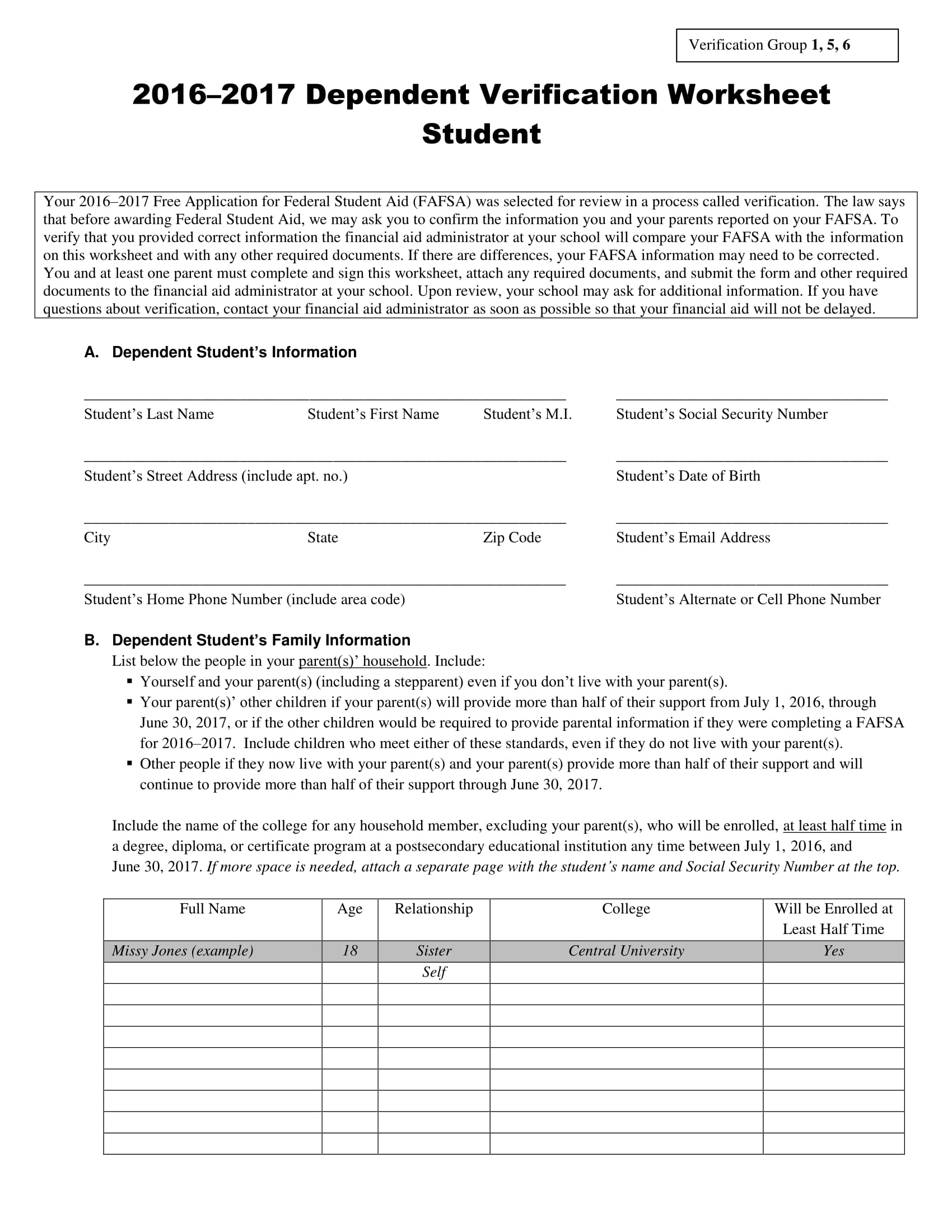
The federal verification worksheet is the primary tool used by institutional financial aid officers to cross-reference the data on your FAFSA with official records. While the U.S. Department of Education sets the standards for what information must be verified, the physical or digital worksheet you fill out is typically created and branded by your specific college or university.
This worksheet serves as a legal statement. When you and your parents (if you are a dependent student) sign it, you are certifying that the reported household size, number of family members in college, and financial details are true and correct. In 2026, many institutions have transitioned to secure digital portals where these worksheets are completed and signed electronically, though some schools still require physical paper copies or PDF uploads.
The core purpose of the worksheet is to resolve any "conflicting information." For example, if your FAFSA indicates a household of five, but your parent’s tax return only lists two dependents, the worksheet provides the space to explain that discrepancy—perhaps an older sibling or a grandparent lives in the home and receives more than half of their support from your parents.
Why Was Your FAFSA Selected for Verification?
Receiving a notice that you have been selected for verification can be stressful, but it rarely indicates that you have done something wrong. There are four primary reasons why a student is selected:
- Random Selection: The Central Processing System (CPS) or the FAFSA Submission Summary (FSS) flags a certain percentage of applications at random to ensure the integrity of the federal aid system.
- Incomplete Data: If certain fields were left blank or if the information provided was statistically "out of range" (such as a very high income with very low assets), the system may trigger a manual review.
- Inconsistencies: If the information on the current year’s FAFSA differs significantly from the previous year’s application without a clear reason, the school may require verification to confirm the change in circumstances.
- IRS Direct Data Exchange (DDX) Issues: While the IRS DDX tool simplifies the process by pulling tax data directly into the FAFSA, students who manually enter their tax information or who have filing statuses that prevent the use of the tool are much more likely to be selected for verification.
Understanding the Verification Tracking Groups
In 2026, the Department of Education categorizes verified students into "Tracking Groups." Each group requires a different version of the verification worksheet or different levels of documentation. Knowing which group you fall into will save time when gathering your records.
V1: Standard Verification Group
This is the most common group. Students in V1 must verify items such as household size, the number of people in the household attending college at least half-time, and adjusted gross income (AGI). If you used the IRS Direct Data Exchange and did not change any of the pulled data, you may only need to complete the household section of the worksheet.
V4: Custom Verification Group
This group focuses on identity and high school completion. Students in V4 must sign a Statement of Educational Purpose, certifying that the federal aid received will only be used for educational expenses. This often requires the student to appear in person at the financial aid office with a valid government-issued ID or to have the form notarized if they are distance learners.
V5: Aggregate Verification Group
The V5 group is a combination of V1 and V4. Students must verify their financial data, household information, and identity/educational purpose. This is the most comprehensive form of verification and requires the most documentation.
| Verification Group | Primary Focus | Required Documents (Typical) |
|---|---|---|
| V1 (Standard) | Income and Household | Verification Worksheet, Tax Transcripts (if DDX not used), W-2s |
| V4 (Custom) | Identity and Purpose | Statement of Educational Purpose, Government ID, High School Diploma/GED |
| V5 (Aggregate) | Financial and Identity | All V1 documents + All V4 documents |
Step-by-Step Instructions for Completing the Worksheet
Completing the federal verification worksheet requires precision. Errors on this form can lead to further delays in your financial aid disbursement.
Step 1: Identify Your Dependency Status
The worksheet will ask if you are a dependent or independent student. This is determined by your answers on the FAFSA, not by whether your parents "claim" you on their taxes. If you are a dependent student, at least one parent must also sign the worksheet. If you are independent, only you (and your spouse, if applicable) are responsible for the data.
Step 2: Define the Household
This is where many families make mistakes. You must include:
- Yourself and your parents (even if you don't live with them).
- Your parents' other children, if your parents provide more than half of their support or if the children would be required to provide parental information when applying for Federal Student Aid.
- Other people, if they currently live with your parents and your parents provide more than half of their support and will continue to do so through June 30, 2027.
Step 3: Reporting Income for Non-Filers
If you or your parents did not file taxes for the relevant tax year (which, for the 2026-2027 school year, is the 2024 tax year), you must indicate this on the worksheet. You will likely be required to provide a "Verification of Non-Filing Letter" from the IRS. Additionally, you must list any income earned from work, even if you weren't required to file a return, and provide the W-2 forms for those earnings.
Step 4: Signatures and Submission
In 2026, most worksheets allow for "wet signatures" (ink on paper) or secure electronic signatures through the school’s authenticated portal. Typed names in a standard font are generally not accepted as valid signatures for federal aid purposes.
Essential Documentation to Accompany the Worksheet
The worksheet itself is rarely enough. To satisfy the federal requirements, you will likely need to provide secondary evidence of the numbers you have written down.
IRS Tax Return Transcripts
If you did not use the IRS Direct Data Exchange on your FAFSA, or if you changed the data after it was imported, the financial aid office cannot accept a simple photocopy of your 1040 tax return in most cases. Instead, they require an IRS Tax Return Transcript. You can request this for free from the IRS website. It provides a line-by-line summary of your tax return as it was processed by the government.
W-2 Statements
Even if you provide a tax transcript, schools often ask for W-2s to verify "Income Earned from Working." This is particularly important for calculating the Social Security tax allowance in the Student Aid Index (SAI) formula. If you lost your W-2s, you can request a "Wage and Income Transcript" from the IRS.
Verification of High School Completion
For those in the V4 or V5 groups, you may need to provide a final high school transcript, a GED certificate, or a document certifying that you were homeschooled in accordance with state law.
Common Mistakes and How to Avoid Them
The verification process is often the "bottleneck" of financial aid. Avoiding these common errors can speed up your results:
- Leaving Blank Boxes: If a question does not apply to you (such as "Child Support Received"), enter a "0" rather than leaving it blank. Blank boxes often cause the form to be returned as "incomplete."
- Incorrect Household Members: Do not include roommates or extended family members unless your parents provide more than 50% of their financial support.
- Conflicting Signatures: Ensure the parent who signed the FAFSA is the same parent who signs the verification worksheet.
- Mismatched Marital Status: If your parents have divorced or remarried since the tax year in question, the worksheet must reflect their status on the day the FAFSA was filed. This can be complex, and you should contact your financial aid counselor for specific guidance on which income to report.
Deadlines and the Impact on Your Financial Aid
In 2026, deadlines are strictly enforced due to the high volume of applicants and the automated nature of modern aid systems. Each college sets its own priority deadline for verification. If you miss this window, you may lose out on "campus-based" aid, such as certain institutional grants or the Federal Supplemental Educational Opportunity Grant (FSEOG).
While the absolute federal deadline for submitting verification documentation is usually 120 days after the student's last day of enrollment (or a specific date in September, whichever is earlier), waiting this long is dangerous. Your financial aid will not disburse to your student account until verification is complete. This means you could face late fees on your tuition bill or be dropped from classes for non-payment while your paperwork is being processed.
How Long Does Processing Take?
Once you submit your worksheet and all required documents, the financial aid office typically takes two to four weeks to review the file. During peak seasons (July and August), this can stretch to six weeks. If the counselor finds further discrepancies, they may ask for additional clarification, which restarts the clock.
FAQs About Federal Verification Worksheets
Does being selected for verification mean I will get less money?
Not necessarily. In some cases, correcting errors during verification can actually increase your eligibility for aid (for example, if you forgot to report a sibling in college). However, if your income was underreported on the FAFSA, your Student Aid Index (SAI) may increase, which could result in a lower Pell Grant or less subsidized loan eligibility.
What if my parents refuse to provide their tax information for verification?
If you are a dependent student, parental information is mandatory for federal aid. If your parents refuse to help with verification, you will likely be ineligible for all federal grants and subsidized loans. You may still be eligible for an Unsubsidized Stafford Loan, but you will need to provide documentation to the financial aid office regarding your parents' refusal to support you.
Can I receive a financial aid offer before verification is finished?
Some schools will send a "provisional" or "estimated" financial aid offer based on your unverified FAFSA data. However, these funds will not be credited to your account or paid out to you until the verification process is successfully closed.
What happens if I make a mistake on the verification worksheet?
If you realize you made a mistake after submitting the form, contact your financial aid office immediately. Do not try to file a new FAFSA. The financial aid officer can make the necessary "corrections" on your behalf once they have the correct information from you.
Is the verification worksheet the same as a tax return?
No. The worksheet is a school-specific document that summarizes various data points, including non-financial information like household size. A tax return is a document filed with the IRS. You often need both to complete the process.
Final Recommendation
If you see a notification in your student portal or FAFSA Submission Summary indicating you have been selected for verification, act immediately. Download the worksheet provided by your school, read the instructions for your specific tracking group (V1, V4, or V5), and begin gathering your 2024 tax transcripts and W-2s. Consistent communication with your financial aid counselor is the most effective way to ensure your aid is processed in time for the 2026 academic year. Do not wait for the school to remind you; proactive submission is the key to avoiding tuition payment delays.
Image Gallery