What Are the Top Ten Largest Companies in 2026?
As of 2026, the largest companies in the world are primarily measured by their market capitalization (total market value of outstanding shares) or their annual revenue. Currently, tech giants like Apple, Microsoft, and NVIDIA dominate...
As of 2026, the largest companies in the world are primarily measured by their market capitalization (total market value of outstanding shares) or their annual revenue. Currently, tech giants like Apple, Microsoft, and NVIDIA dominate the market valuation rankings, while retail and energy titans like Walmart and Saudi Aramco lead in total revenue.
Contents
Determining which company is "largest" depends entirely on the metric used for evaluation. Investors typically look at Market Capitalization, which reflects the market's collective consensus on a company's future earnings potential and perceived value. In contrast, economists and industry analysts often look at Revenue, which measures the sheer volume of business a company conducts regardless of its stock price.
Understanding the Metrics: Market Cap vs. Revenue
Before identifying the top ten, it is essential to distinguish between the two primary ways global organizations are ranked.
Market Capitalization is calculated by multiplying the current stock price by the total number of outstanding shares. This figure fluctuates daily based on investor sentiment, quarterly earnings reports, and macroeconomic trends. In 2026, the "Trillion Dollar Club" has expanded, with the top tier of companies frequently crossing the $3 trillion threshold. This metric highlights companies that the market expects will dominate the future, particularly those involved in Artificial Intelligence (AI), cloud computing, and semiconductors.
Revenue (Total Sales) reflects the actual dollars a company brings in through the sale of goods and services. A company like Walmart may have a lower market cap than Apple, but it typically generates significantly more revenue because its business model relies on high-volume, lower-margin retail sales. High-revenue companies are often found in the energy, retail, and healthcare sectors, representing the "infrastructure" of daily global life.
The Top 10 Largest Companies by Market Capitalization (2026)
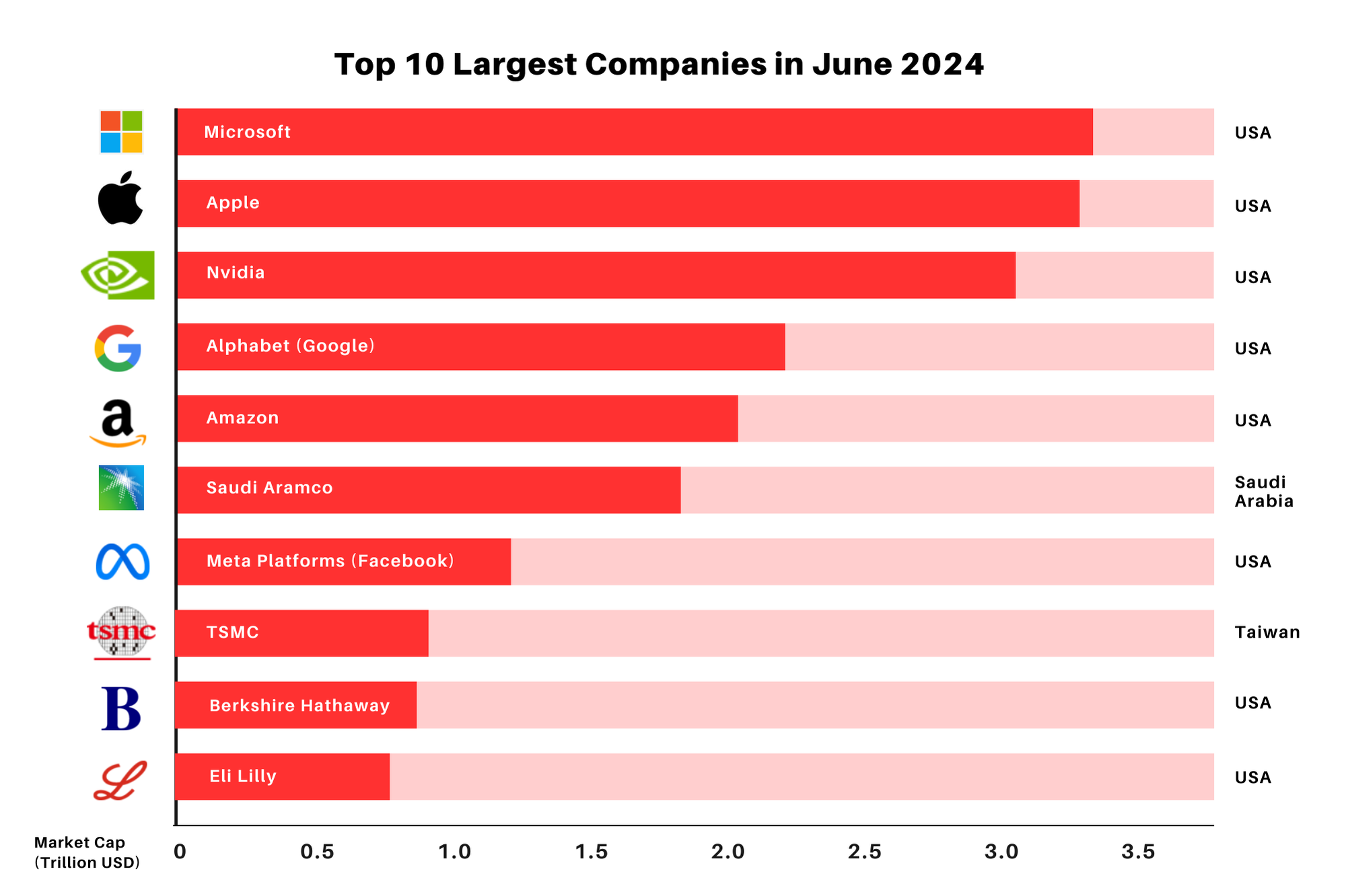
The following list represents the world’s most valuable public entities by market valuation as of the first half of 2026.
| Rank | Company Name | Industry | Primary Headquarters |
|---|---|---|---|
| 1 | Apple Inc. | Technology/Consumer Electronics | United States |
| 2 | Microsoft Corporation | Software/Cloud Computing | United States |
| 3 | NVIDIA Corporation | Semiconductors/AI Hardware | United States |
| 4 | Alphabet Inc. (Google) | Internet Services/AI | United States |
| 5 | Amazon.com Inc. | E-commerce/Cloud Services | United States |
| 6 | Saudi Aramco | Oil & Gas | Saudi Arabia |
| 7 | Meta Platforms Inc. | Social Media/Metaverse | United States |
| 8 | TSMC | Semiconductors | Taiwan |
| 9 | Berkshire Hathaway | Conglomerate/Insurance | United States |
| 10 | Eli Lilly and Company | Pharmaceuticals/Biotech | United States |
1. Apple Inc.
Apple remains a perennial leader in global valuation. By 2026, the company has successfully transitioned from being primarily a hardware manufacturer to a services powerhouse. While the iPhone remains a significant revenue driver, Apple’s ecosystem—including the App Store, iCloud, Apple Pay, and its expansion into spatial computing with the Vision Pro line—creates high-margin recurring revenue. Its vertical integration, designing its own silicon (M-series and A-series chips), allows for profit margins that are the envy of the hardware world.
2. Microsoft Corporation
Microsoft’s second-place position is fueled by its early and aggressive integration of generative AI across its entire software stack. Through its partnership with OpenAI and the deployment of "Copilot" in Windows and Office 365, Microsoft has redefined productivity software. Additionally, Azure, its cloud computing platform, continues to capture market share from competitors as enterprises migrate their AI training and deployment needs to the Microsoft cloud.
3. NVIDIA Corporation
NVIDIA’s ascent is one of the most significant stories of the mid-2020s. Once known primarily for gaming GPUs, NVIDIA is now the indispensable backbone of the global AI economy. Its H100 and newer Blackwell architecture chips are the gold standard for data centers and large language model (LLM) training. As of 2026, NVIDIA’s valuation reflects its near-monopoly on the hardware required for the AI revolution.
4. Alphabet Inc. (Google)
Alphabet continues to dominate the global advertising market through Google Search and YouTube. However, its 2026 valuation is increasingly tied to Google Cloud and its proprietary AI models, such as Gemini. Alphabet’s deep-seated integration into the Android ecosystem and its vast data moats make it a resilient giant, even as it faces increased regulatory scrutiny and competition in the AI search space.
5. Amazon.com Inc.
Amazon operates a dual-engine growth model. While its retail arm handles billions of packages annually, its real value lies in Amazon Web Services (AWS). AWS provides the infrastructure for a vast portion of the internet. By 2026, Amazon has also become a major player in digital advertising and satellite internet (Project Kuiper), further diversifying its massive valuation.
6. Saudi Aramco
As the world’s largest oil producer, Saudi Aramco is often the only non-tech company in the top five. Its valuation is heavily influenced by global oil prices and production levels set by OPEC+. While the world is shifting toward renewable energy, the sheer scale of Aramco’s reserves and its low extraction costs ensure its position as a global financial heavyweight for the foreseeable future.
7. Meta Platforms Inc.
After a volatile period in the early 2020s, Meta (formerly Facebook) has seen a resurgence. By 2026, the company has successfully integrated AI-driven content discovery across Instagram and WhatsApp. Its massive user base—billions of daily active users—provides a level of advertising targeting that few can match. Meta’s long-term bets on augmented reality (AR) hardware are also beginning to contribute to its multi-trillion-dollar valuation.
8. TSMC (Taiwan Semiconductor Manufacturing Company)
TSMC is perhaps the most important company that the average consumer never interacts with directly. As the world’s largest dedicated independent semiconductor foundry, TSMC manufactures the chips for Apple, NVIDIA, and AMD. Its 2026 valuation reflects its technological lead in 2nm and 1.4nm process nodes, making it essential to global supply chains and national security.
9. Berkshire Hathaway
Led for decades by Warren Buffett, Berkshire Hathaway is a massive conglomerate that owns diverse businesses like Geico, BNSF Railway, and Dairy Queen, while also holding significant stakes in companies like Apple and Coca-Cola. Its presence in the top ten is a testament to the power of value investing and long-term capital compounding.
10. Eli Lilly and Company
Eli Lilly’s entry into the top ten in 2026 is driven by the pharmaceutical revolution in metabolic health. The massive success of GLP-1 drugs (used for diabetes and obesity) has transformed the company into a healthcare titan. With an aging global population and rising rates of chronic disease, Eli Lilly’s pipeline of innovative medicines has made it the world’s most valuable pharmaceutical entity.
The Top 10 Largest Companies by Revenue
While market cap shows what investors think of a company, revenue shows the actual scale of operations. The Fortune Global 500 list is the standard for these rankings.
- Walmart: The American retail giant remains the world's largest employer and revenue generator, consistently reporting over $600 billion in annual sales.
- Amazon: Catching up to Walmart, Amazon’s mix of retail and high-margin cloud services places it firmly at the top of the revenue charts.
- Saudi Aramco: When oil prices are high, Aramco’s revenue can rival or exceed any retail company.
- State Grid Corporation of China: The world’s largest utility company, providing power to the vast majority of China.
- China National Petroleum: A state-owned energy giant representing the scale of Chinese industrial demand.
- Sinopec Group: Another Chinese energy titan involved in oil and gas exploration and refining.
- UnitedHealth Group: The largest healthcare company in the U.S., reflecting the massive scale of the American medical insurance and services market.
- CVS Health: Beyond its retail pharmacies, CVS’s acquisition of Aetna has made it a vertically integrated healthcare behemoth.
- ExxonMobil: The largest U.S.-based oil company, benefiting from global energy demand and diversified chemical operations.
- Volkswagen Group / Toyota: These two automotive giants compete for the top spot in the manufacturing sector, producing millions of vehicles annually.
Why Tech Companies Dominate the Valuations
The shift toward technology companies in the top ten reflects the "capital-light" nature of digital businesses. Unlike an oil company that must spend billions on rigs and pipelines, a software company can scale its product to millions of new users with relatively low incremental costs.
Furthermore, data has become a primary commodity. The companies at the top—Apple, Alphabet, Microsoft, and Meta—all control massive amounts of user data, which they use to refine AI models, target advertising, and lock users into ecosystems. This "moat" makes it extremely difficult for new competitors to displace them, leading to the massive valuations seen in 2026.
Frequently Asked Questions
Which company was the first to reach a $3 trillion market cap?
Apple Inc. was the first publicly traded company to hit the $3 trillion market capitalization milestone, achieving this briefly in early 2022 and more consistently throughout 2023 and 2024. By 2026, several other companies, including Microsoft and NVIDIA, have also joined or approached this elite valuation level.
How often do the top ten rankings change?
The rankings for market capitalization change daily based on stock market fluctuations. However, the constituents of the top ten are relatively stable, with major shifts usually occurring over years rather than days. For example, NVIDIA’s rise into the top three took several years of consistent growth in the AI sector.
Are there any private companies larger than the public ones?
It is difficult to say with certainty because private companies do not have to disclose their financials publicly. However, companies like ByteDance (the parent company of TikTok) and SpaceX are estimated to have valuations in the hundreds of billions, which would put them in the top 50 globally, though not necessarily the top ten.
Why aren't more European or Japanese companies in the top ten?
While Europe and Japan have many massive companies (like Volkswagen, Toyota, and ASML), their stock markets have not seen the same aggressive valuation multiples as the U.S. tech sector. Additionally, the U.S. has been the epicenter of the software and AI revolutions, which are the primary drivers of trillion-dollar valuations in 2026.
Does being the "largest" company mean it is the best to invest in?
Not necessarily. A company being "largest" means it is already highly valued by the market. Smaller, "mid-cap" companies often have more room for explosive growth. Investing in the top ten is often seen as a "blue-chip" strategy, prioritizing stability and consistent returns over high-risk growth.
Summary and Next Actions
The landscape of the world’s largest companies in 2026 is a blend of traditional energy and retail giants and high-growth technology leaders. If you are tracking these companies for investment purposes, it is vital to look beyond the "Rank" and analyze the Price-to-Earnings (P/E) ratio and debt-to-equity levels to understand if the valuation is justified. For a broader view, consider monitoring the S&P 100 or the Fortune Global 500 lists annually to see how global economic shifts—such as the transition to green energy or the advancement of AI—impact which companies rise to the top.
Image Gallery