Oklahoma Annual Certificate Requirements for LLCs and Corporations: 2026 Filing Guide
To maintain legal standing in Oklahoma, Limited Liability Companies (LLCs) and Corporations must file an Annual Certificate with the Secretary of State. LLCs file on the anniversary of their formation, while Corporations must file by J...
To maintain legal standing in Oklahoma, Limited Liability Companies (LLCs) and Corporations must file an Annual Certificate with the Secretary of State. LLCs file on the anniversary of their formation, while Corporations must file by July 1st each year. Both typically require a $25 fee to ensure the business remains active and compliant.
Contents
The process of maintaining a business entity in Oklahoma involves more than just the initial registration. As of 2026, state regulations continue to emphasize the importance of the Annual Certificate as the primary mechanism for keeping corporate records current. This document serves as a formal verification of the entity’s address, registered agent, and management structure. Neglecting this requirement does not merely result in a minor fine; it can lead to the administrative dissolution of the business, which strips the owners of liability protection and the right to conduct business under the company name.
Understanding the Oklahoma Annual Certificate
In many jurisdictions, this requirement is referred to as an "Annual Report." However, under Oklahoma law, specifically within the framework of the Oklahoma Secretary of State (SOS) Business Services, it is officially termed the Annual Certificate. This distinction is important for business owners when searching for the correct forms or navigating the state's online portal.
The purpose of the Annual Certificate is purely administrative. It is not a tax return, and it does not require the disclosure of sensitive financial data, such as gross revenue or profit margins. Instead, the State of Oklahoma uses this filing to ensure that the public and the government have a reliable way to contact the business. This includes maintaining an accurate record of the Registered Agent, the individual or entity designated to receive service of process and official legal correspondence on behalf of the company.
For 2026, the Oklahoma Secretary of State continues to mandate electronic filings for most entities to improve efficiency. Physical paper filings are still technically possible but are discouraged due to longer processing times and a higher likelihood of administrative errors.
Annual Certificate Requirements for Limited Liability Companies (LLCs)
Oklahoma LLCs, whether domestic or foreign, are subject to specific timeline requirements that differ significantly from those of corporations. If you operate an LLC, your compliance calendar is dictated by the date the company was originally formed or authorized to do business in Oklahoma.
The Anniversary Filing Deadline
The deadline for an LLC to file its Annual Certificate is the anniversary date of its formation. For example, if your LLC was formed on October 15th, your filing is due on or before October 15th every year thereafter. The Secretary of State typically sends a courtesy reminder to the registered agent on file approximately 60 days before the deadline. However, the legal responsibility to file remains with the business owner, regardless of whether a reminder was received.
Fees and Late Penalties
As of 2026, the standard filing fee for a domestic or foreign LLC Annual Certificate is $25. If the filing is not completed within 60 days after the anniversary date, the state imposes a $50 late penalty in addition to the original fee. Failure to rectify a delinquent status will eventually lead to the LLC being marked as "Not in Good Standing." If the delinquency persists, the Secretary of State will administratively dissolve the LLC, which can have catastrophic consequences for the business's contracts, bank accounts, and liability protections.
Annual Certificate Requirements for Corporations
Corporations in Oklahoma operate under a fixed-date system rather than an anniversary-based system. This applies to both profit-driven corporations and non-profit organizations, though the specific requirements for information disclosure may vary slightly.
The July 1st Deadline
All domestic and foreign corporations authorized to do business in Oklahoma must file their Annual Certificate on or before July 1st of each year. This centralized deadline makes it easier for multi-entity corporate structures to manage their compliance, as all corporate entities will share the same due date regardless of when they were incorporated.
Corporate Information Disclosure
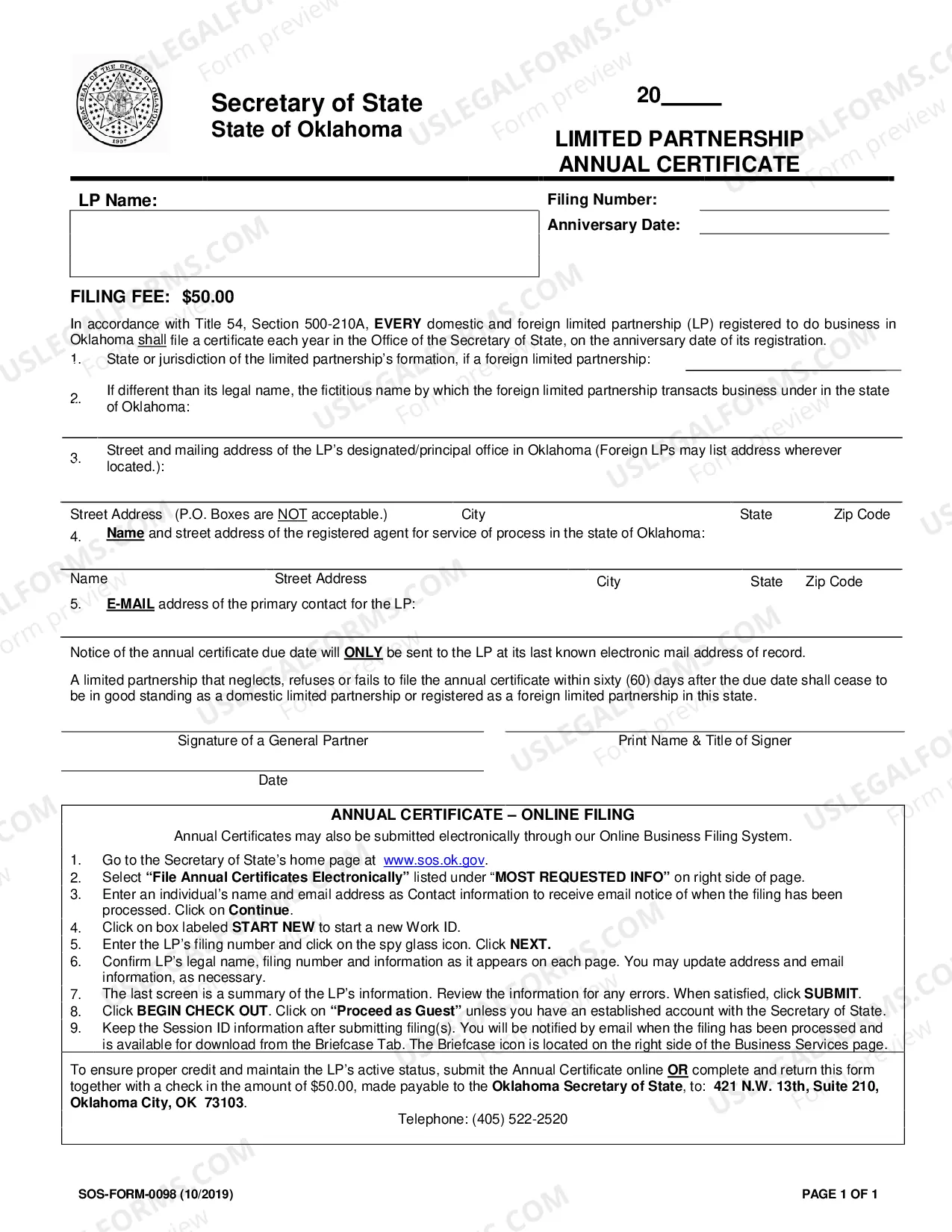
When filing the Annual Certificate, corporations must verify or update the following information:
- The exact legal name of the corporation.
- The state or country of incorporation (for foreign entities).
- The address of the principal place of business.
- The name and address of the registered agent in Oklahoma.
- The names and addresses of the current officers and directors.
Filing Fees for Corporations
The filing fee for a standard domestic corporation remains $25 in 2026. For Foreign Corporations (those incorporated in another state but registered to do business in Oklahoma), the fee is also generally $25, provided the corporation is not involved in specific regulated industries that might carry different fee schedules. Unlike LLCs, corporations that fail to file by the July 1st deadline do not just face a flat late fee; they risk immediate suspension of their corporate powers, which can prevent the entity from legally executing contracts or defending itself in court.
Oklahoma Filing Requirements Comparison Table
| Entity Type | Filing Deadline | Standard Fee | Late Penalty | Filing Method |
|---|---|---|---|---|
| Domestic LLC | Anniversary Date | $25 | $50 (after 60 days) | Online / Mail |
| Foreign LLC | Anniversary Date | $25 | $50 (after 60 days) | Online / Mail |
| Domestic Corp | July 1st | $25 | Possible Suspension | Online / Mail |
| Foreign Corp | July 1st | $25 | Possible Suspension | Online / Mail |
| Non-Profit Corp | July 1st | $25 | Possible Suspension | Online / Mail |
The Step-by-Step Online Filing Process
The Oklahoma Secretary of State Business Services portal is the most efficient way to handle annual requirements. Following these steps ensures that the record is updated in real-time.
- Search for Your Entity: Use the "Business Search" function on the SOS website to find your company by name or filing number.
- Select the Annual Certificate Link: Once your entity's record is open, look for the option to file the Annual Certificate. If it is too early to file (usually more than 60 days before the deadline), this link may not be active.
- Review and Update Information: The system will display the current information on file. You must confirm the principal office address and the registered agent's details. If the registered agent has changed, you may need to file a separate "Change of Registered Agent" form, though some updates can be handled within the certificate workflow.
- Authorized Signature: An authorized person (member/manager for LLCs or an officer for Corporations) must electronically sign the document.
- Payment: Payments can be made via credit card (Visa, MasterCard, American Express, or Discover) or through a pre-funded SOS account.
- Confirmation: Upon successful payment, the system will generate a receipt and a confirmation copy of the filed certificate. It is vital to save these for your corporate records.
The Importance of the Registered Agent
A common point of failure in Oklahoma business compliance is an outdated registered agent. The registered agent is the bridge between the state and the business. If the agent moves or the business changes agent services without notifying the Secretary of State, the Annual Certificate reminders will be sent to the wrong address.
In Oklahoma, the registered agent must have a physical street address within the state where they can be found during normal business hours. Using a P.O. Box alone is not permitted for the registered agent’s location. If the state attempts to contact a business and the registered agent is unreachable, the state may initiate proceedings to dissolve the entity for failure to maintain a valid agent, regardless of whether the Annual Certificate was paid.
Consequences of Non-Compliance
Maintaining "Good Standing" is not just a bureaucratic formality; it has tangible impacts on business operations.
Loss of Liability Protection
If an LLC or Corporation is administratively dissolved because it failed to file its Annual Certificate, the "corporate veil" may be compromised. In some legal interpretations, if the entity no longer exists in the eyes of the state, the owners could potentially be held personally liable for debts or legal judgments incurred during the period of dissolution.
Financial and Operational Roadblocks
Most banks and financial institutions conduct periodic audits of their business clients. If a bank discovers that a company is "Not in Good Standing" or has been dissolved, they may freeze the business bank accounts or decline to renew lines of credit. Similarly, to obtain a "Certificate of Good Standing" (often required for real estate transactions, government contracts, or out-of-state expansion), all Annual Certificates must be filed and up to date.
Reinstatement Process
If your entity is dissolved or suspended, you must go through the Reinstatement Process. This involves filing all delinquent Annual Certificates, paying all back fees and penalties, and often filing a formal Application for Reinstatement. In 2026, the administrative burden of reinstatement far outweighs the simple $25 annual maintenance cost.
Frequently Asked Questions
What is the difference between an Annual Certificate and an Annual Report?
In Oklahoma, there is no functional difference; they are the same requirement. While most states use the term "Annual Report," the Oklahoma Statutes (Title 18) use the term "Annual Certificate." When navigating the Oklahoma Secretary of State website, you should look for "Annual Certificate" to satisfy your yearly filing requirement.
Can I file my Oklahoma Annual Certificate by mail?
Yes, you can download the appropriate form from the Secretary of State's website and mail it with a check. However, mail-in filings typically take 7–10 business days to process, whereas online filings are processed almost instantly. For businesses nearing their deadline, online filing is the only way to guarantee an immediate update to their status.
Do I need to report my company's income on the Annual Certificate?
No. The Oklahoma Annual Certificate is an information update, not a financial disclosure. You do not need to provide tax information, profit and loss statements, or balance sheets. Financial reporting is handled separately through the Oklahoma Tax Commission (OTC) and the IRS.
What happens if I miss the LLC filing deadline by just one day?
For LLCs, there is a 60-day grace period before the $50 late penalty is applied. However, your entity status may show as "Delinquent" immediately following the anniversary date. It is best to file at least 30 days before the deadline to ensure there are no issues with payment processing or system downtime.
Is the Annual Certificate required for non-profit corporations?
Yes. Non-profit corporations in Oklahoma are required to file an Annual Certificate by July 1st of each year, similar to for-profit corporations. The fee is generally the same, and failure to file can result in the loss of the entity's corporate status, which could jeopardize its tax-exempt standing with the IRS.
Final Recommendation for 2026 Compliance
To ensure your Oklahoma business remains in good standing throughout 2026, do not wait for a physical reminder. LLC owners should set a recurring calendar alert for 30 days prior to their anniversary date, and Corporation officers should mark June 1st as their internal deadline for the July 1st filing. Utilizing the Oklahoma Secretary of State’s online portal is the most reliable method to avoid late fees and maintain the legal protections afforded by your business structure. If you have recently changed your business address or registered agent, update those records immediately to ensure you receive all future compliance notifications.
Image Gallery