The History of Big Bird in Brazil: Understanding the Garibaldo Connection
Garibaldo is the official Brazilian counterpart to Big Bird, originating in the 1972 co-production of Sesame Street titled Vila Sésamo. While they share the same biological "species" within the Muppet canon, Garibaldo is a distinct cha...
Garibaldo is the official Brazilian counterpart to Big Bird, originating in the 1972 co-production of Sesame Street titled Vila Sésamo. While they share the same biological "species" within the Muppet canon, Garibaldo is a distinct character who famously appeared as a blue-toned bird in the 1970s before transitioning to yellow in 2007.
Contents
The relationship between Big Bird and Garibaldo is one of the most fascinating chapters in international television history. For many Brazilians who grew up in the 1970s, the giant, somewhat somber-looking blue bird is a cornerstone of childhood nostalgia. For fans of the American Sesame Street, seeing a "blue Big Bird" often sparks confusion or curiosity about whether the character was a localized adaptation or a separate entity entirely.
By 2026, Vila Sésamo has maintained its status as a landmark in educational broadcasting. To understand the "Garibaldo connection," one must look at the technical, cultural, and branding decisions that shaped this iconic character over the last five decades.
The Origins of Vila Sésamo and the Birth of Garibaldo
In the early 1970s, Children’s Television Workshop (now Sesame Workshop) began expanding its educational mission globally. Brazil was one of the first countries to develop a localized version of the show. Vila Sésamo debuted in 1972 as a partnership between TV Globo and TV Cultura.
Unlike a simple dubbing of the American show, Vila Sésamo was a "co-production." This meant that while it followed the pedagogical framework of the original, it featured Brazilian actors, a Brazilian set (resembling a local neighborhood plaza rather than a New York brownstone), and a localized "Big Bird" character.
This character was named Garibaldo. From the outset, the goal was to create a figure that resonated with Brazilian children. While the puppet’s physical structure was based on the Big Bird design provided by Jim Henson’s Creature Shop, the Brazilian team made several modifications that would define the character’s legacy for thirty years.
Why Garibaldo Wasn't Yellow: The Technical and Aesthetic Choices
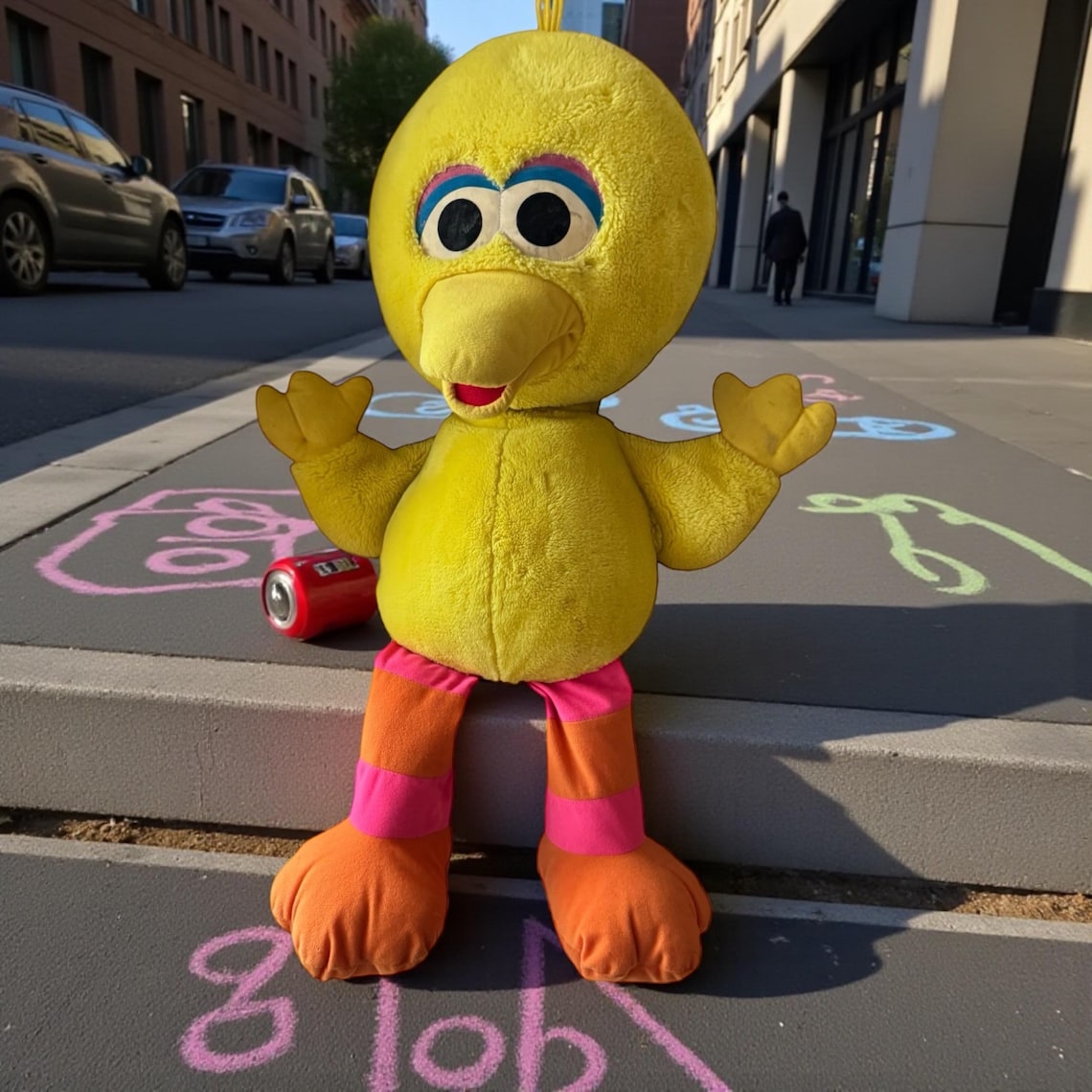
The most striking difference between the original Big Bird and the 1972 Garibaldo was the color. While Big Bird is famously bright yellow, the original Garibaldo was a dark, purplish-blue or brownish-gray, depending on the lighting and the specific feathers used.
Several factors contributed to this drastic color change:
- Black and White Television Constraints: In 1972, color television was just beginning to be implemented in Brazil. Many households still owned black-and-white sets. Technical tests suggested that a bright yellow bird did not provide sufficient contrast or "popped" incorrectly on the monochrome screens of the era. The darker hue was chosen to ensure the character remained visually distinct and clear for all viewers.
- Local Material Availability: The construction of the original Garibaldo was handled locally in Brazil using designs from the US. The specific shade of yellow feathers used for Big Bird (which were often dyed turkey feathers) was difficult to replicate with the materials available to the Brazilian production team at the time.
- Creative Identity: There was a desire to give the Brazilian show its own unique identity. By changing the color, the producers signaled that Vila Sésamo was a local product, not just a carbon copy of an American program.
Garibaldo’s personality also differed slightly. While Big Bird is often portrayed as a perpetual six-year-old—innocent and sometimes prone to confusion—the early Garibaldo was often seen as a bit more melancholic or "clumsy-intellectual," though he remained a protector and friend to the children of the Vila.
The 2007 Revival and the Transformation of Garibaldo
After a long hiatus following the end of the original run in 1977, Vila Sésamo returned to Brazilian airwaves in 2007 through TV Cultura. This revival brought significant changes to Garibaldo to align him with the modern global brand of Sesame Street.
In the 2007 version, Garibaldo finally turned yellow. This change was controversial among older fans who remembered the blue bird of their youth, but it was a strategic move by Sesame Workshop to create brand consistency. By the 2020s and continuing into 2026, the yellow Garibaldo has become the standard version for the current generation of Brazilian children.
The modern Garibaldo also wears a striped scarf or vest on occasion, further distinguishing him from the US Big Bird while acknowledging their shared lineage. He is officially characterized as Big Bird’s "cousin," a narrative device used by Sesame Workshop to explain why there are different giant birds in various international versions of the show (such as Abelardo Montoya in Mexico or Pino in the Netherlands).
Comparing Big Bird and Garibaldo: A Technical Breakdown
To understand the connection more deeply, it is helpful to compare the two characters across their historical and modern iterations.
| Feature | Big Bird (USA) | Garibaldo (Brazil - Original) | Garibaldo (Brazil - Modern) |
|---|---|---|---|
| Primary Color | Bright Yellow | Blue / Brownish-Gray | Bright Yellow |
| Height | 8 feet 2 inches | Approx. 8 feet | 8 feet 2 inches |
| Debut Year | 1969 | 1972 | 2007 (Revival) |
| Primary Performer | Caroll Spinney / Matt Vogel | Laerte Morrone | Fernando Gomes |
| Key Accessory | None (usually) | None | Often wears a scarf |
| Personality | Innocent, inquisitive | Friendly, slightly clumsy | Energetic, educational |
Behind the Feathers: The Performers Who Brought Garibaldo to Life
The "Garibaldo connection" isn't just about the costume; it’s about the puppeteers who gave the character its soul. In the United States, the legendary Caroll Spinney performed Big Bird for nearly 50 years, establishing the character's voice and movement.
In Brazil, the original Garibaldo was performed by Laerte Morrone. Morrone was a highly respected actor who brought a specific physical comedy and warmth to the role. Because the costume is a "full-body" puppet, the performer must use their right arm to control the head and mouth, while their left arm controls the bird’s left wing. The right wing is typically moved via a "live hand" or a transparent string attached to the left hand.
When the show was revived in 2007, Fernando Gomes took over the role. Gomes, a veteran puppeteer and director in Brazil (known for his work on Cocoricó), updated Garibaldo’s movements to be more fluid and aligned with modern puppetry standards while maintaining the character’s localized charm.
The "Cousin" Logic: How Sesame Workshop Manages International Characters
A common question among fans is: "Is Garibaldo actually Big Bird?" The official answer from Sesame Workshop is that they are different characters who belong to the same family.
This "cousin" logic allows for several benefits:
- Cultural Specificity: It allows Garibaldo to talk about Brazilian holidays (like Carnival or Festa Junina), eat Brazilian food, and use local slang without contradicting the established lore of the American Big Bird.
- Merchandising and Branding: It allows for unique local merchandise while still fitting under the global Sesame Street umbrella.
- Cross-overs: On rare occasions, international "cousins" have appeared together or acknowledged each other, reinforcing the idea of a global community of Muppets.
In Brazil, this connection is vital for educational purposes. Garibaldo serves as a relatable figure for Brazilian children, reflecting their environment and social norms in a way that a dubbed American character might not.
Common Misconceptions About the Brazilian Big Bird
Despite the clarity provided by historians, several myths persist about the Garibaldo connection.
Myth 1: Garibaldo was a "knock-off" or unlicensed version.
This is entirely false. Vila Sésamo was an official, licensed co-production of Children’s Television Workshop. The character of Garibaldo was developed with the full cooperation and technical support of the American creators.
Myth 2: He was blue because of a manufacturing error.
While it is true that material availability was a challenge, the blue/gray color was a deliberate choice made after screen testing for the Brazilian television market of the early 1970s. It was a solution to a technical problem, not an accident.
Myth 3: Garibaldo is no longer on TV.
Garibaldo remains a central figure in Brazilian children's media. In 2026, he continues to appear in new content for TV Cultura and various digital platforms, serving as the face of Sésamo (the shortened title currently used in Brazil) for a new generation.
The Pedagogical Role of Garibaldo in 2026
As of 2026, Garibaldo’s role has evolved beyond simple television entertainment. He is a key component of the Sésamo educational curriculum in Brazil, which focuses on:
- Socio-emotional learning: Helping children manage their emotions and develop empathy.
- Digital Literacy: Navigating the internet safely, a topic that has become increasingly important in the mid-2020s.
- Environmental Awareness: Promoting sustainability and the protection of Brazil's natural resources, such as the Amazon.
Garibaldo often acts as the "older child" or the "student" in these segments, asking the questions that the children watching at home might have. His connection to Big Bird provides a foundation of global expertise, but his Brazilian roots allow him to deliver these lessons in a culturally relevant context.
FAQs
Why was the original Garibaldo blue?
The original Garibaldo was a brownish-blue color primarily because of the limitations of black-and-white television in Brazil in 1972. The darker color provided better contrast on monochrome screens. Additionally, the production team wanted to give the Brazilian character a unique visual identity separate from the US Big Bird.
Is Garibaldo still blue today?
No. Since the 2007 revival of Vila Sésamo, Garibaldo has been yellow. This change was made to align the character with the global branding of Big Bird, although he remains a distinct character with his own name and personality.
How is Garibaldo related to Big Bird?
In the official Sesame Street lore, Garibaldo is considered a "cousin" of Big Bird. This explains their similar appearance while allowing them to exist as separate characters in different parts of the world.
Who is the actor inside the Garibaldo suit?
The original performer from 1972 to 1977 was Laerte Morrone. In the modern era (since 2007), the character has been performed by Fernando Gomes, a renowned Brazilian puppeteer.
Does Garibaldo have other friends in Brazil?
Yes. Just as Big Bird has Snuffleupagus and Elmo, Garibaldo has his own set of friends. In the original series, he interacted with characters like Juca and Ana. In the modern version, he is often seen with Bel, a pink monster unique to the Brazilian production, and localized versions of Grover and Elmo.
Practical Guidance for Fans and Historians
For those looking to explore the Garibaldo connection further, several resources are available:
- TV Cultura Archives: Many clips of the 1970s blue Garibaldo are preserved in the archives of TV Cultura in São Paulo.
- Sesame Workshop Official Site: Information regarding international co-productions often highlights the "cousin" relationship between characters.
- Memória Globo: This digital archive provides historical context on the early years of Vila Sésamo and the production challenges of the 1970s.
If you are a collector or researcher, ensure you distinguish between "Vila Sésamo" (the 1970s era) and "Sésamo" (the modern era), as the character designs and pedagogical focuses shifted significantly between these two periods. Understanding Garibaldo is not just about a bird; it is about understanding how global education can be successfully adapted to local cultures.
Image Gallery