What Are Presbyopia Contacts and How Do They Work?
Presbyopia contact lenses—primarily known as multifocal contact lenses—are specialized lenses engineered to correct age-related near-vision loss while maintaining distance clarity. They work by combining multiple prescription strengths...
Presbyopia contact lenses—primarily known as multifocal contact lenses—are specialized lenses engineered to correct age-related near-vision loss while maintaining distance clarity. They work by combining multiple prescription strengths across the optic zone, allowing the eye and brain to select the focused image automatically whether viewing distant objects, computer screens, or fine text.
Contents
Understanding Presbyopia and the Need for Multi-Distance Correction
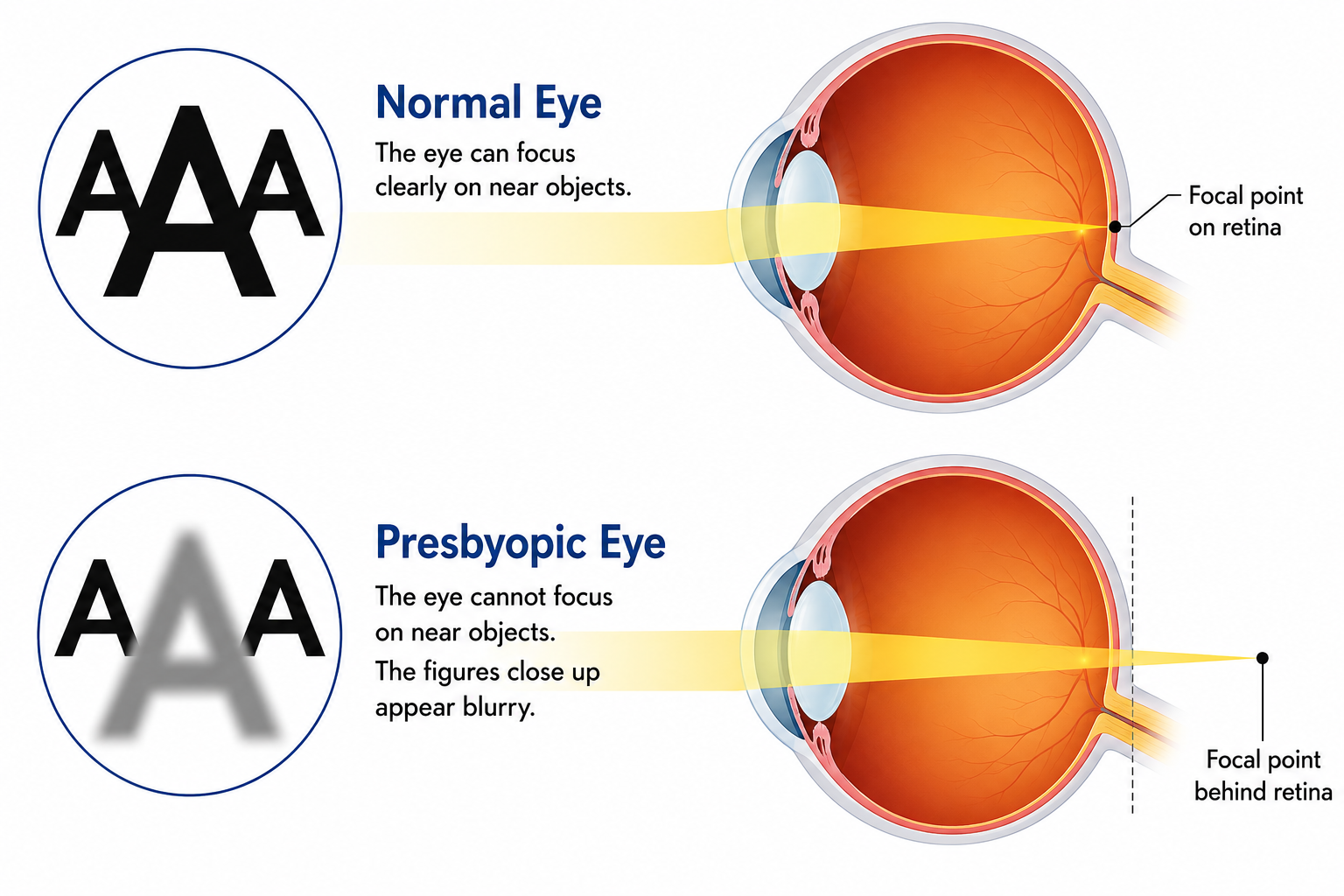
Presbyopia is a naturally occurring refractive change that affects virtually everyone starting between the ages of 40 and 45. Inside the human eye, directly behind the pupil, sits the crystalline lens. In youth, this lens is highly flexible, changing shape effortlessly via the ciliary muscle to shift focus between distant landscapes and close-up text—a process known as ocular accommodation.
As the body ages, proteins within the crystalline lens gradually harden, and the lens loses its elasticity. Consequently, the eye can no longer steepen its curvature to focus light from near objects directly onto the retina. Instead, the focal point falls behind the retina, causing near tasks—such as reading a text message, reviewing printed documents, or looking at a smartwatch—to appear blurry.
- Uncorrected Presbyopic Eye:
- Light from near object
- Rigid Crystalline Lens
- Focus falls BEHIND Retina (Blurry)
- Presbyopia Contact Lens Corrected:
- Light from near object
- Multifocal Contact Lens
- Focus falls ON Retina (Clear)
Historically, the standard solution for presbyopia was single-vision reading glasses perched on the end of the nose or progressive spectacle lenses. However, modern ophthalmic optics permit contact lens wearers to correct presbyopia directly on the ocular surface. Presbyopia contact lenses provide a continuous field of view without spectacle frames, eliminating visual field distortion and allowing active individuals to maintain clear vision across all distances.
The Optical Science: How Presbyopia Contact Lenses Work
Unlike standard single-vision contact lenses, which feature a uniform optical power across the entire surface, presbyopia contact lenses incorporate multiple optical zones. The mechanics of how these lenses deliver clear vision depend on the optical design used: simultaneous vision optics or translating optics.
1. Simultaneous Vision Optics
The overwhelming majority of soft presbyopia contact lenses rely on simultaneous vision optics. In this optical arrangement, light passing through both near and distance correction zones enters the pupil at the exact same time. The lens places two or more distinct images onto the retina simultaneously.
While this sounds like it would create double vision, the human brain utilizes a cognitive optical process called neuroadaptation. The visual cortex selectively isolates the in-focus image corresponding to the depth of interest while suppressing the out-of-focus background pattern. Simultaneous vision lenses are further divided into two primary geometric arrangements:
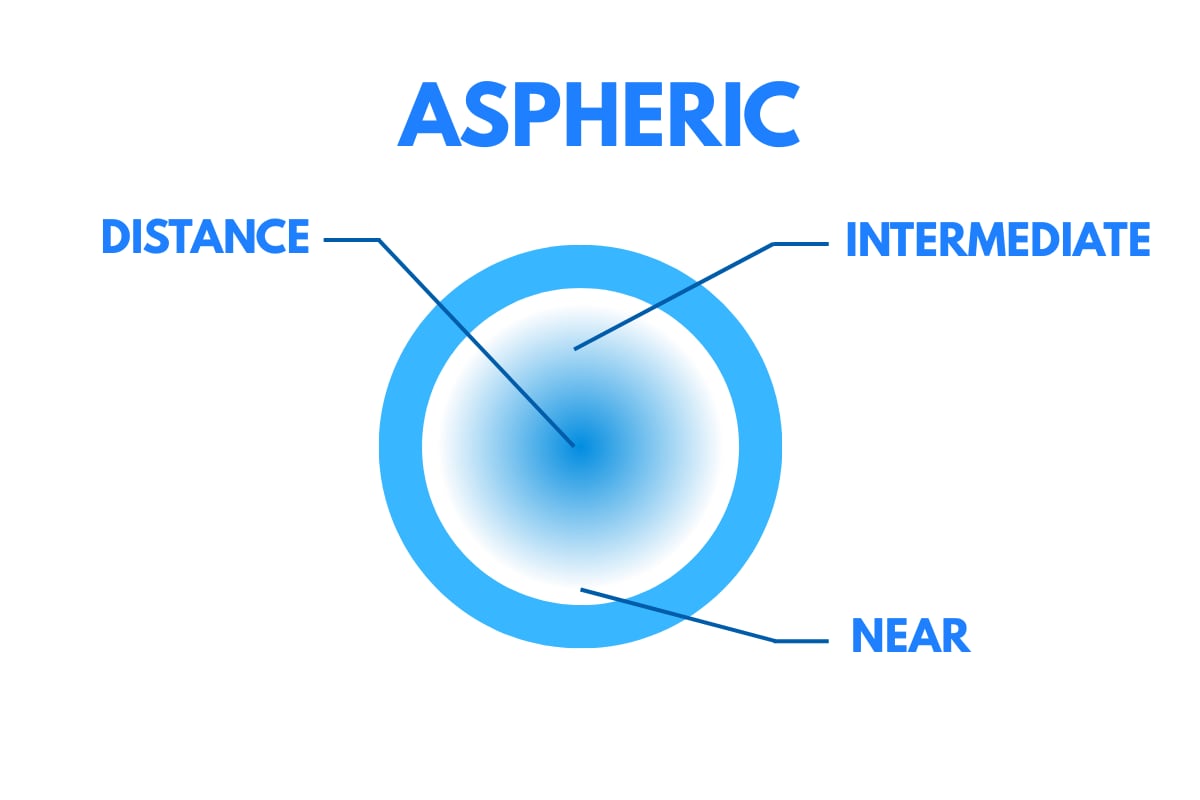
- Aspheric Designs: These lenses feature a gradual, seamless change in optical power from the center of the lens toward the outer boundary. The curvature changes incrementally, creating a smooth transition across distance, intermediate, and near powers. Aspheric lenses are typically customized into Center-Near (where the center of the lens holds the reading power and the periphery holds the distance power) or Center-Distance profiles.
- Concentric Ring Designs: These lenses utilize a series of alternating circular rings with distinct optical focal lengths. A central circle may hold the distance prescription, surrounded by a ring for near power, followed by another ring for distance or intermediate focus. The pupil encompasses several rings simultaneously, ensuring light from multiple distances enters the eye.
2. Translating (Alternating) Vision Optics
Translating optics function similarly to traditional bifocal spectacle lenses. Primarily manufactured in Rigid Gas Permeable (RGP) or hybrid materials, these lenses sit on the lower eyelid. The lens features a distinct upper section for distance vision and a lower section for reading vision.
When looking straight ahead, the pupil aligns with the upper distance zone. When the wearer casts their gaze downward to read, the lower eyelid holds the lens in place while the eye shifts downward, causing the pupil to "translate" through the lower reading zone. Translating lenses offer high optical clarity because only one focal power covers the pupil at any given moment, though they require a brief physical adaptation period due to lens movement on the eye.
Modalities and Fitting Strategies for Presbyopia
Achieving optimal vision with presbyopia contacts involves matching the lens optics with an individual's lifestyle and ocular dominance. Eye care professionals utilize three main fitting modalities:
True Multifocal Fitting
In a standard bilateral multifocal fitting, both eyes receive multifocal contact lenses calibrated to provide balanced distance, intermediate, and near vision. Eye care professionals frequently prescribe a Center-Distance design for the dominant eye (maximizing distance sharpness for driving and outdoor activities) and a Center-Near design for the non-dominant eye (prioritizing reading and smartphone use). This approach maintains binocular depth perception while expanding the overall functional range of vision.
Monovision Technique
Monovision does not require specialized multifocal optics; instead, it uses standard single-vision contact lenses. The practitioner fits the patient’s dominant eye with a single-vision lens fully corrected for distance vision, while the non-dominant eye receives a single-vision lens corrected for near vision.
While monovision is often lower in cost and straightforward to fit, it forces the brain to alternate between eyes rather than using them together. This can reduce stereopsis (depth perception) and cause eye strain during prolonged visual tasks.
Modified Monovision
Modified monovision blends true multifocal optics with monovision principles. The dominant eye receives a single-vision distance lens or a distance-biased multifocal lens, while the non-dominant eye wears a fully functional multifocal lens with a strong near addition. This modality provides crisp distance vision while offering superior intermediate and near clarity compared to standard monovision.
Comparing Presbyopia Correction Technologies
Choosing the appropriate presbyopia correction method requires evaluating optical performance, lifestyle compatibility, adaptation demands, and cost factors.
| Correction Design | Optical Mechanics | Key Advantages | Primary Limitations | Best Candidate Profile |
|---|---|---|---|---|
| Aspheric Multifocal | Progressive power transition from center to edge | Smooth visual transitions; preserves depth perception; excellent intermediate vision | Slight loss of contrast; mild halos in dim light | Office workers, computer users, active adults |
| Concentric Ring Multifocal | Alternating power rings across the pupil zone | Distinct focal zones; predictable near and distance performance | Potential ghosting around text; glare at night | Patients needing distinct near and far clarity |
| Translating Bifocal (RGP) | Physical lens translation upon downward gaze | Exceptional visual sharpness; clear separation of power | Greater initial lens awareness; complex fitting required | Patients dissatisfied with soft multifocal sharpness |
| Monovision (Single Vision) | One eye distance, one eye near | Lower cost; high contrast sharpness in individual eyes | Compromised depth perception; spatial disorientation | Budget-conscious wearers; low visual symmetry demands |
| Reading Glasses over Contacts | Single-vision distance contacts + OTC readers | Simple; maximum visual contrast at all distances | Requires carrying eyeglasses; inconvenient | Occasional wearers, long-distance drivers |
The Adaptation Period and What to Expect
Transitioning into presbyopia contact lenses requires physical adaptation of the eye surface and neurological adaptation of the brain. Patients evaluating multifocal lenses should consider several factors regarding visual performance:
- Neuroadaptation Timeframe: The brain typically requires anywhere from 1 to 4 weeks to fully adapt to simultaneous vision optics. Initially, objects may appear to have subtle shadow lines or light "ghosting." Patiently wearing the lenses daily speeds up the brain's ability to filter out secondary out-of-focus images.
- Light Dependence: Because simultaneous vision optics split incoming light across multiple focal points, less overall light reaches any single focal point on the retina. Consequently, wearers may notice reduced contrast sensitivity in dimly lit environments. Reading small print in low-light settings may require supplemental lighting.
- Night Driving Dynamics: Headlights and streetlights may produce minor halos or glare circles during night driving. Specialized anti-reflective glare strategies or center-distance dominant eye fits help minimize these visual artifacts.
- Discomfort vs. Visual Blur: Physical discomfort (dryness, grittiness) stems from the lens material or tear film deficiency, not the multifocal optics. Conversely, visual blur stems from power calibration or lens centration. Distinguishing between physical awareness and visual blur helps the eye care professional fine-tune the prescription.
Materials, Wear Schedules, and Maintenance
Modern presbyopia contact lenses are available in almost every lens material and replacement schedule, accommodating individual ocular health needs and daily schedules:
Silicone Hydrogel Soft Lenses
Silicone hydrogel is the standard material for soft multifocal contact lenses. It provides high oxygen transmissibility ($Dk/t$) to the cornea, supporting eye health during extended wear. Silicone hydrogel multifocals are available in:
- Daily Disposables: Single-use lenses that offer high hygiene standards, eliminate cleaning routines, and reduce lipid accumulation.
- Monthly / Monthly Replacement: Lenses worn daily, removed at night, and disinfected with appropriate contact lens solutions.
Rigid Gas Permeable (RGP) and Hybrid Lenses
For individuals with high astigmatism, irregular corneal shapes, or demanding visual acuity standards, RGP or hybrid presbyopia lenses (hard center, soft skirt) offer crisp optical clarity. RGP lenses maintain their shape on the eye, eliminating tear-film aberrations that can degrade soft lens performance.
The Professional Fitting and Prescription Process
Presbyopia contact lenses cannot be selected based on a standard eyeglasses prescription alone. Fitting multifocal contact lenses requires specialized clinical evaluation by an optometrist or ophthalmologist.
- Step 1: Baseline Refraction & Add Power Determination
- Evaluating distance power and necessary reading add (+1.00D to +2.50D)
- Step 2: Ocular Dominance Assessment
- Identifying dominant eye for distance power bias
- Step 3: Diagnostic Trial Fitting & Centration Check
- Confirming lens centers correctly over pupil
- Step 4: Real-World Visual Assessment (Binocular Testing)
- Testing distance/near under normal lighting (avoiding phoropter isolation)
- Step 5: Follow-Up & Prescription Fine-Tuning
- Adjusting powers after 1-2 week home/work trial
Critical Steps in the Fitting Process:
- Determining Ocular Dominance: The eye care provider uses sensory or sighting tests to identify which eye the brain prioritizes for distance vision.
- Corneal Topography and pupil size Measurement: Measuring the pupil under ambient and low light ensures the optic zones cover the pupil aperture appropriately.
- Binocular Over-Refraction: Unlike standard eye exams where one eye is covered, multifocal lenses are evaluated with both eyes open. This tests how well the brain combines images under real-world conditions.
- Trial Period Adjustments: Small prescription shifts (as minor as 0.25 Diopters) in near add power or distance power can dramatically alter clarity. Practitioners frequently adjust power allocations after a one-week trial.
Disclaimer: This article is intended for educational purposes and should not replace professional medical advice. Always consult a qualified eye care practitioner for diagnostic evaluation, fitting guidance, and personal eye care prescriptions.
Frequently Asked Questions
Can I wear presbyopia contacts if I also have astigmatism?
Yes. Eye care professionals routinely prescribe toric multifocal contact lenses, which correct corneal astigmatism alongside distance and near vision loss. Both custom soft silicone hydrogel and Rigid Gas Permeable (RGP) options are available for patients with astigmatism.
How long does it take for your brain to adjust to multifocal contact lenses?
Most wearers achieve comfortable visual function within 3 to 7 days, though full neuroadaptation can take up to 4 weeks. Consistently wearing the lenses every day during the adjustment period helps accelerate how quickly the brain adapts compared to alternating with glasses.
Why do lights look stretched or fuzzy at night with multifocal lenses?
Because simultaneous vision optics project distance and near focal points onto the retina at the same time, light sources in low-light environments—like headlights or streetlamps—can create secondary focal rings. This appears as faint halos or glare around bright points of light when your pupils dilate in the dark.
Are presbyopia contact lenses more expensive than standard contacts?
Yes. Multifocal contact lenses involve complex optical manufacturing, specialized ring geometries, and extra engineering. Additionally, fitting presbyopia contacts requires extra clinical trial lenses, ocular dominance testing, and follow-up visits, making initial fitting fees and annual lens costs higher than standard single-vision lenses.
Can I still drive at night while wearing presbyopia contact lenses?
Yes, most patients drive safely with presbyopia contacts. However, if you experience significant glare or reduced contrast sensitivity at night during your adaptation phase, consult your optometrist. They can modify the center-distance power in your dominant eye to improve nighttime visual sharpness.
Practical Recommendations for Patients
If you are experiencing age-related near-vision changes and want to transition away from reading glasses, consider these practical steps:
- Schedule a Dedicated Multifocal Evaluation: Inform your eye doctor before your visit that you are interested in a presbyopia contact lens fitting, as this requires specialized diagnostic testing beyond a standard exam.
- Define Your Primary Visual Needs: Keep a log of your typical daily viewing distances. Note whether your priorities are computer screens, driving, handheld devices, fine needlework, or nighttime visibility. Providing specific details helps your practitioner select between center-near, center-distance, or monovision options.
- Commit to the Adaptation Trial: Wear your trial lenses consistently as instructed, avoiding switching back to reading glasses during the trial period. Allow your brain time to adapt to simultaneous vision optics.
- Optimize Your Environment: Ensure adequate lighting for near reading tasks during the early adaptation phase, and use rewetting drops recommended by your optometrist if dry eye symptoms arise.
Image Gallery