What Is SAP HANA? Meaning, Architecture, and Enterprise Core Explained
SAP HANA stands for High-Performance Analytic Appliance. It is an in-memory, column-oriented relational database management system developed by SAP SE. Designed to process both transactional (OLTP) and analytical (OLAP) workloads simul...
SAP HANA stands for High-Performance Analytic Appliance. It is an in-memory, column-oriented relational database management system developed by SAP SE. Designed to process both transactional (OLTP) and analytical (OLAP) workloads simultaneously in real time, SAP HANA serves as the foundational database engine for modern enterprise software suites such as SAP S/4HANA.
Contents
What Does SAP HANA Stand For? Decoding the Acronym and Origin
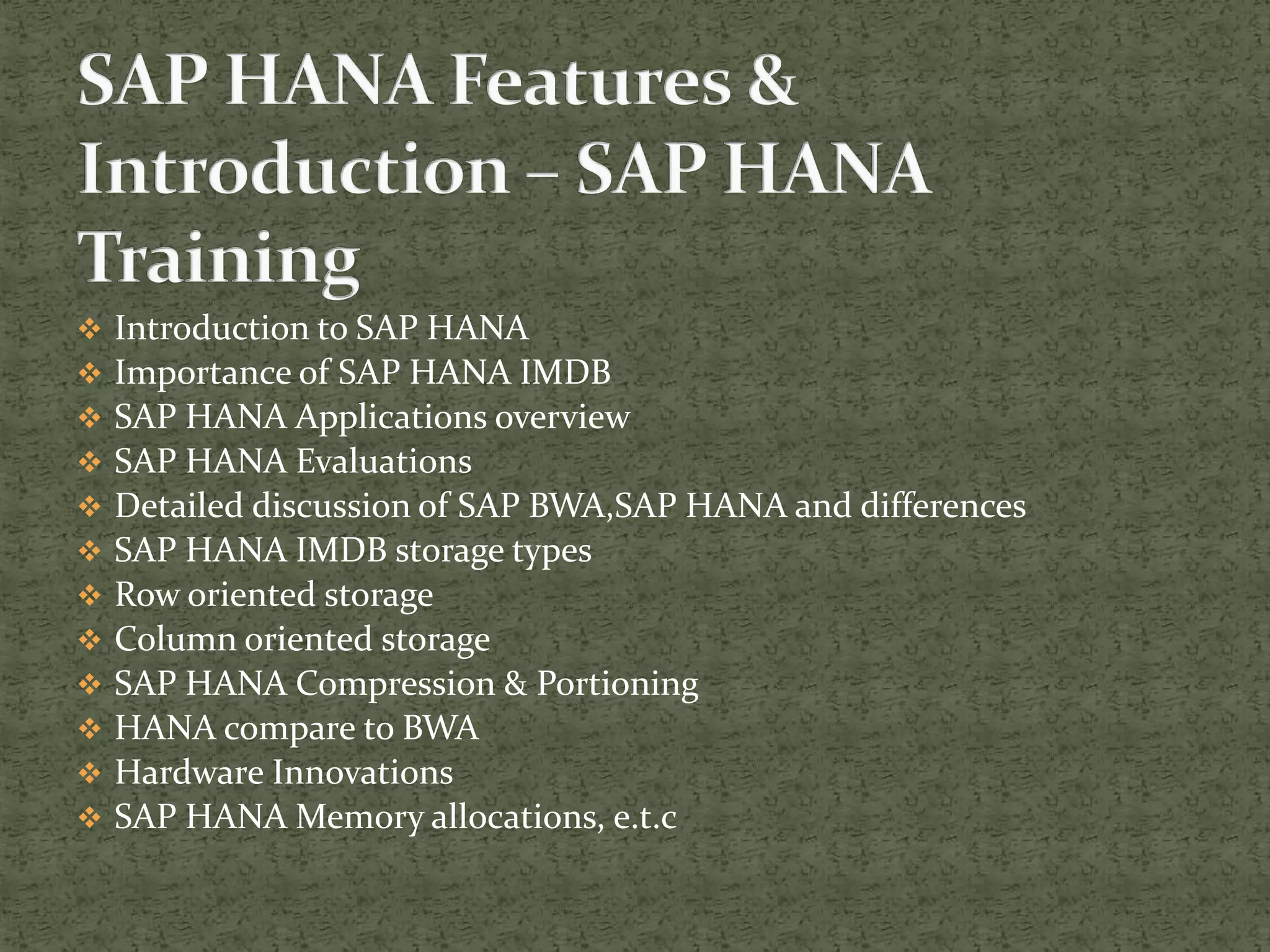
The acronym HANA officially stands for High-Performance Analytic Appliance. In its earliest development phases at SAP, the name was informally associated with "Hasso's New Architecture," referring to Hasso Plattner, the co-founder of SAP and a primary driving force behind the platform's creation in collaboration with the Hasso Plattner Institute.
SAP launched HANA to address a fundamental architectural bottleneck in enterprise computing: the physical separation between transactional processing databases and analytical processing systems. Historically, enterprise software wrote business transactions (like sales orders or invoice payments) to a relational database optimized for line-item updates. To run complex reporting or business intelligence queries, enterprises had to extract, transform, and load (ETL) that data into a separate data warehouse overnight.
SAP HANA replaced this dual-system paradigm by introducing an in-memory architecture capable of processing transactional writes and analytical queries on a single, unified database platform. By running entirely in main memory (RAM) rather than relying on traditional disk storage as the primary data retrieval engine, SAP HANA eliminated the time lag associated with legacy data processing.
Technical Foundation: How SAP HANA Architecture Works
To understand the practical meaning of SAP HANA, it is essential to examine the core technological innovations that distinguish it from legacy relational database systems.
- SAP HANA DB Engine
- Row-Based Storage (Optimized for Write/OLTP)
- Column-Based Storage (Optimized for Read/OLAP)
- In-Memory Processing Engine (RAM-Centric Execution)
- Multi-Model Engines: Spatial, Graph, Text, Machine Learning
- Persistence Layer (NVRAM / SSD / Disk)
- Log Volumes (Redo Logs)
- Data Volumes (Savepoints)
1. In-Memory Computing
Traditional database management systems keep primary data on spinning magnetic disks or solid-state drives (SSDs), fetching data blocks into memory buffers only when executing queries. Read and write latency is bounded by physical disk input/output operations (I/O).
In contrast, SAP HANA holds operational data in main memory (RAM). Because RAM access speeds are orders of magnitude faster than disk reads, database execution occurs in microseconds rather than milliseconds or seconds. Aggregations, calculations, and joins are calculated dynamically on the fly rather than relying on pre-calculated summary tables.
2. Columnar Data Storage vs. Row Storage
Standard enterprise databases store data in rows, which is efficient for writing complete records (e.g., adding a single customer record with twenty attributes). However, row-based storage is inefficient for analytical queries that analyze millions of records across only two attributes (e.g., calculating total revenue across all sales regions).
SAP HANA supports both row and column store structures, but its primary engine uses columnar storage. In a column-oriented store:
- Data for a single column is stored contiguously in memory.
- High compression ratios are achieved using dictionary encoding and run-length encoding because values within a single column often repeat.
- Analytical queries read only the specific columns requested by the SQL statement, avoiding unnecessary data scans across unneeded fields.
3. Hybrid Transactional/Analytical Processing (HTAP)
By combining columnar storage, high data compression, and massive parallel processing across multi-core CPU architectures, SAP HANA achieves HTAP (Hybrid Transactional/Analytical Processing) capabilities.
In an HTAP environment, a business user can execute real-time profitability analytics on live transactional tables while operations teams simultaneously insert thousands of new transactions into those exact same tables. This removes the operational delay, cost, and complexity of maintaining separate Enterprise Data Warehouse (EDW) staging layers for day-to-day business reporting.
4. Data Durability and the Persistence Layer
A common concern with in-memory computing is data volatility—specifically, what happens during a server power loss. SAP HANA guarantees full ACID (Atomicity, Consistency, Isolation, Durability) compliance through its built-in persistence layer.
While active processing takes place in RAM, SAP HANA continuously writes transactional changes to persistent storage (such as NVRAM, SSDs, or enterprise storage arrays):
- Redo Logs: Every completed database transaction is immediately written to non-volatile log volumes on disk before committing.
- Savepoints: At regular intervals (typically every five minutes), the memory state is flushed to data volumes on persistent disk storage.
If a server fails, SAP HANA restores its database state upon restart by loading the latest savepoint from disk and applying the committed redo logs written after that savepoint.
Disambiguation: SAP HANA vs. SAP S/4HANA vs. Legacy SAP ERP
A frequent point of confusion among business leaders and enterprise IT teams is the distinction between SAP HANA, SAP S/4HANA, and legacy systems like SAP ECC. These terms represent distinct layers of the software stack:
- SAP HANA: The underlying database management system and application platform software. It is not an enterprise software application itself; it is the database engine.
- SAP Business Suite / SAP ECC: Legacy enterprise resource planning (ERP) applications built by SAP. Historically, these applications were database-agnostic and could run on third-party databases such as Oracle, Microsoft SQL Server, or IBM DB2 (often referred to in the SAP ecosystem as "AnyDB").
- SAP S/4HANA: The modern generation of SAP's core ERP software suite (S/4 stands for SAP Business Suite 4 for SAP HANA). Unlike legacy ECC, SAP S/4HANA is written exclusively to leverage the parallel processing capabilities and simplified data structures of the SAP HANA database platform. It cannot run on third-party legacy databases.
| Technical Parameter | SAP HANA | SAP S/4HANA | Legacy SAP ECC (on AnyDB) |
|---|---|---|---|
| System Category | In-Memory Database Engine | Enterprise Resource Planning (ERP) Suite | Legacy Enterprise Resource Planning (ERP) Suite |
| Primary Function | Storing, querying, and processing data in RAM | Managing end-to-end business operations (Finance, Logistics, Sales) | Managing legacy business operations across modules |
| Supported Databases | N/A (It is the database) | Exclusively SAP HANA | Oracle, Microsoft SQL Server, IBM DB2, or SAP ASE |
| Data Architecture | Column-oriented and Row-oriented in-memory engine | Simplified tabular structure (no aggregate/index tables) | Complex table structures with heavy aggregate tables |
| Primary User Interface | SAP HANA Studio / Cockpit / SQL Interfaces | SAP Fiori web applications & GUI | SAP Graphical User Interface (SAP GUI) |
| Analytics Capability | Embedded HTAP, Predictive, Spatial, Graph | Real-time operational reporting embedded in ERP workflows | Batch reporting; reliance on separate SAP BW warehouse |
Core Capabilities and Built-in Processing Engines
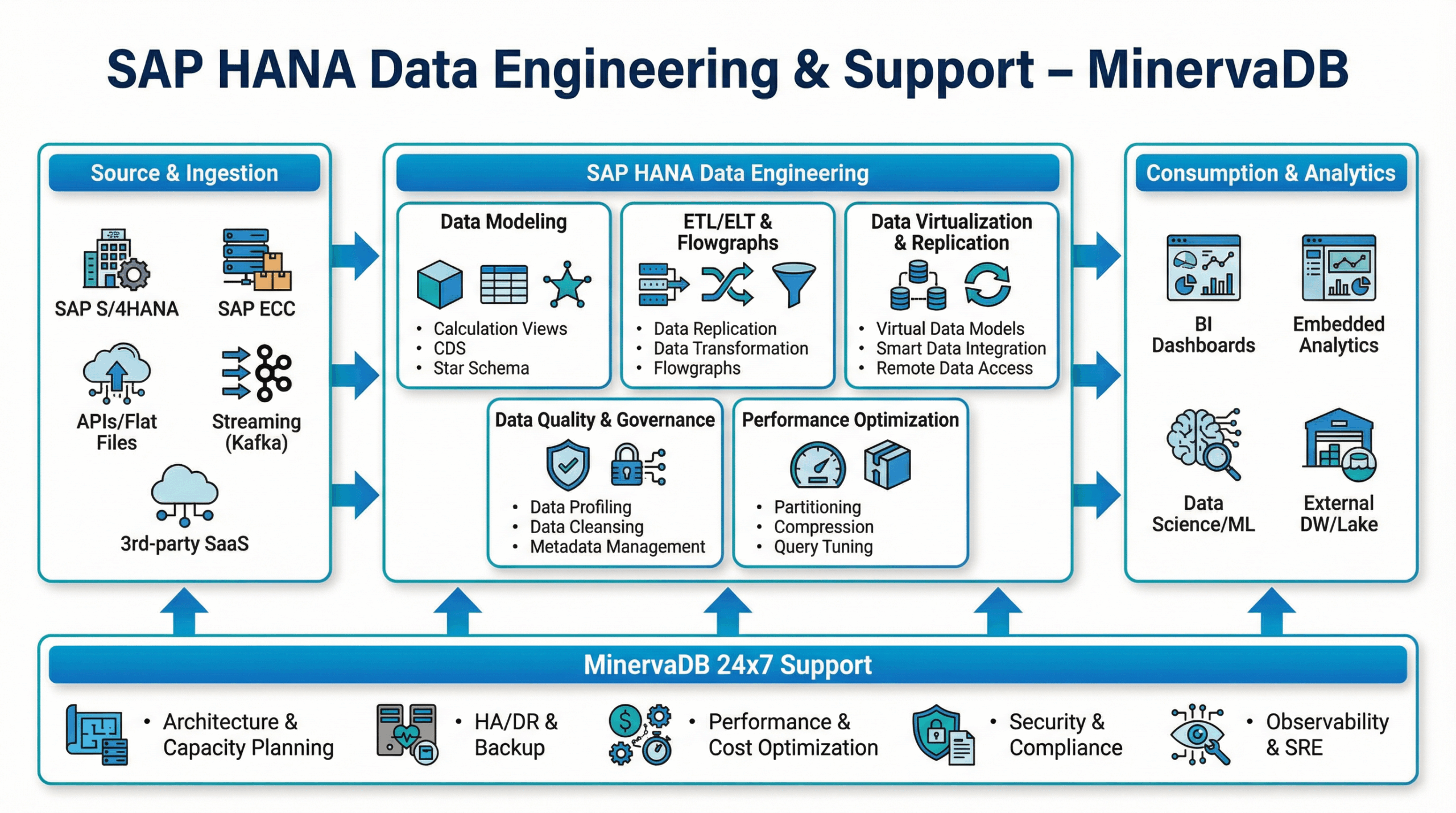
SAP HANA is more than a passive relational data store. It includes several native processing engines that execute advanced mathematical algorithms directly inside the database layer, eliminating the need to move large datasets out of the database to external application servers.
Multi-Model Processing Engines
- Spatial and Geographic Engine: Native processing of geospatial data standards (like OGC) allows organizations to perform location-aware queries directly within SQL operations (e.g., matching delivery fleet coordinates with warehouse proximity).
- Graph Data Engine: Evaluates complex relational networks, dependencies, and supply-chain structures through specialized graph modeling engines without complex relational join tables.
- Text Search and Natural Language Engine: Provides full-text indexing, fuzzy search parameters, and linguistic processing across unstructured documents and enterprise datasets.
Built-In Machine Learning Libraries
SAP HANA provides built-in machine learning libraries directly accessible via SQL interfaces:
- Predictive Analysis Library (PAL): Contains dozens of native algorithms for classification, regression, time-series forecasting, cluster analysis, and anomaly detection.
- Automated Predictive Library (APL): Automates the training and evaluation of predictive models for non-specialist business application developers.
By running machine learning computations within the database engine where the source data resides, enterprises avoid latency and network overhead when building predictive models. Official detailed specifications for these libraries are documented on the SAP Help Portal.
SAP HANA Deployment Models: On-Premises, TDI, and Cloud
Enterprises evaluating SAP HANA can choose from several deployment architectures based on their infrastructure requirements, compliance standards, and operating preferences:
- SAP HANA Deployment Models
- On-Premises: Pre-configured hardware appliances from partners
- Tailored (TDI): Custom certified enterprise servers & SAN storage systems
- Cloud Engine: Cloud-native, elastic multi-cloud DB platform
1. SAP HANA Appliance
An appliance model is an integrated, pre-configured hardware solution containing certified enterprise server hardware, storage arrays, and pre-installed SAP HANA software built by certified hardware partners (such as Dell Technologies, HPE, Lenovo, or Cisco). This deployment model offers predictable performance but limits customization.
2. Tailored Data Center Integration (TDI)
The TDI deployment strategy allows enterprises to utilize existing server hardware, storage area networks (SANs), and networking infrastructure within their enterprise data centers, provided the equipment meets SAP's performance certification guidelines. TDI reduces hardware spending and integrates with existing enterprise storage management tools.
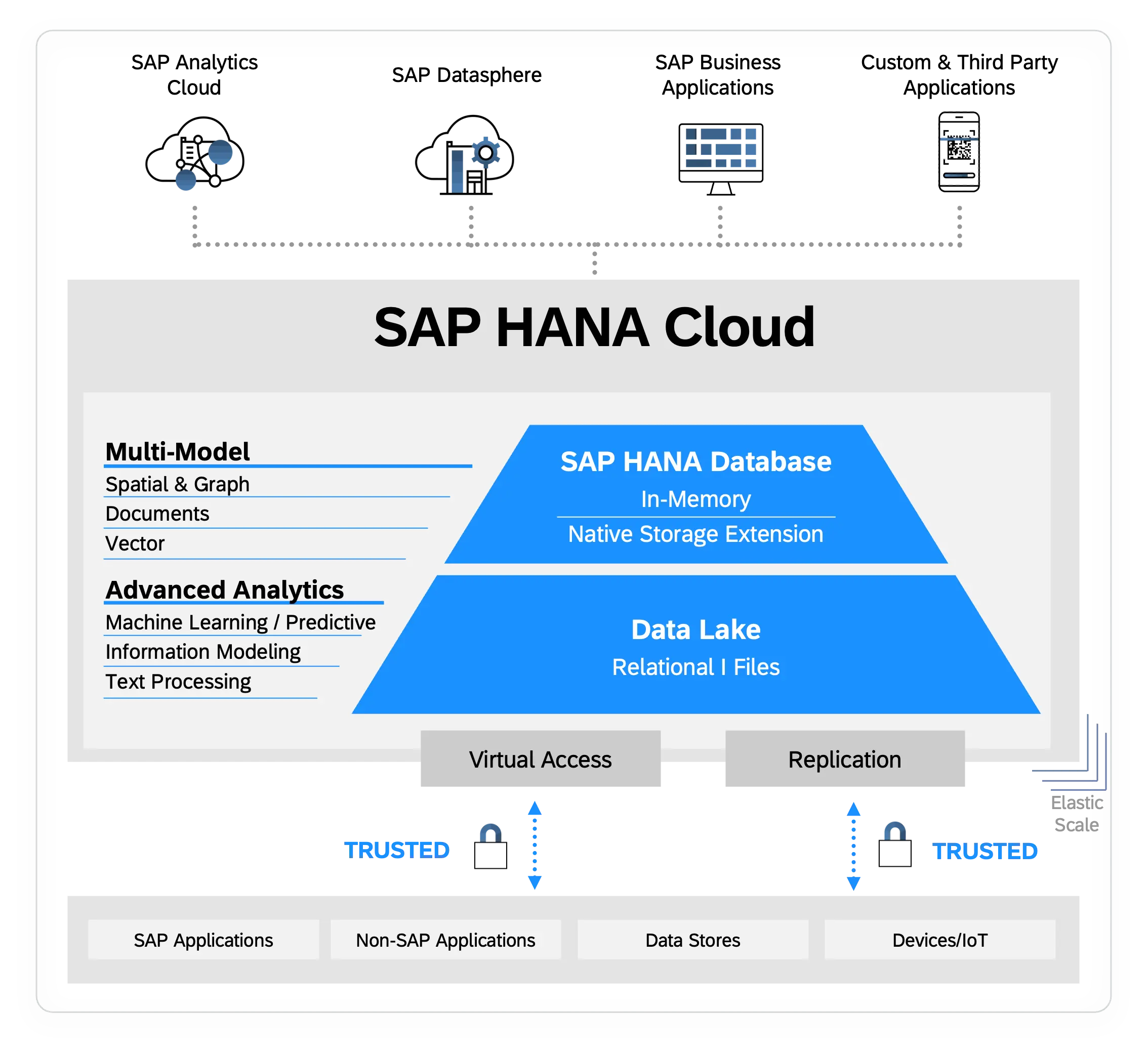
3. SAP HANA Cloud
SAP HANA Cloud is a cloud-native database platform delivered as a managed software-as-a-service (SaaS) or platform-as-a-service (PaaS) solution. Available across major hyper-scaler providers (such as Amazon Web Services, Microsoft Azure, and Google Cloud Platform), SAP HANA Cloud provides elastic scaling of compute and storage resources independently. For technical cloud management guidance, review cloud architecture standards through the Cloud Native Computing Foundation.
Key Enterprise Benefits of Implementing SAP HANA
Moving core workloads to SAP HANA provides measurable operational advantages across IT systems and core business functions:
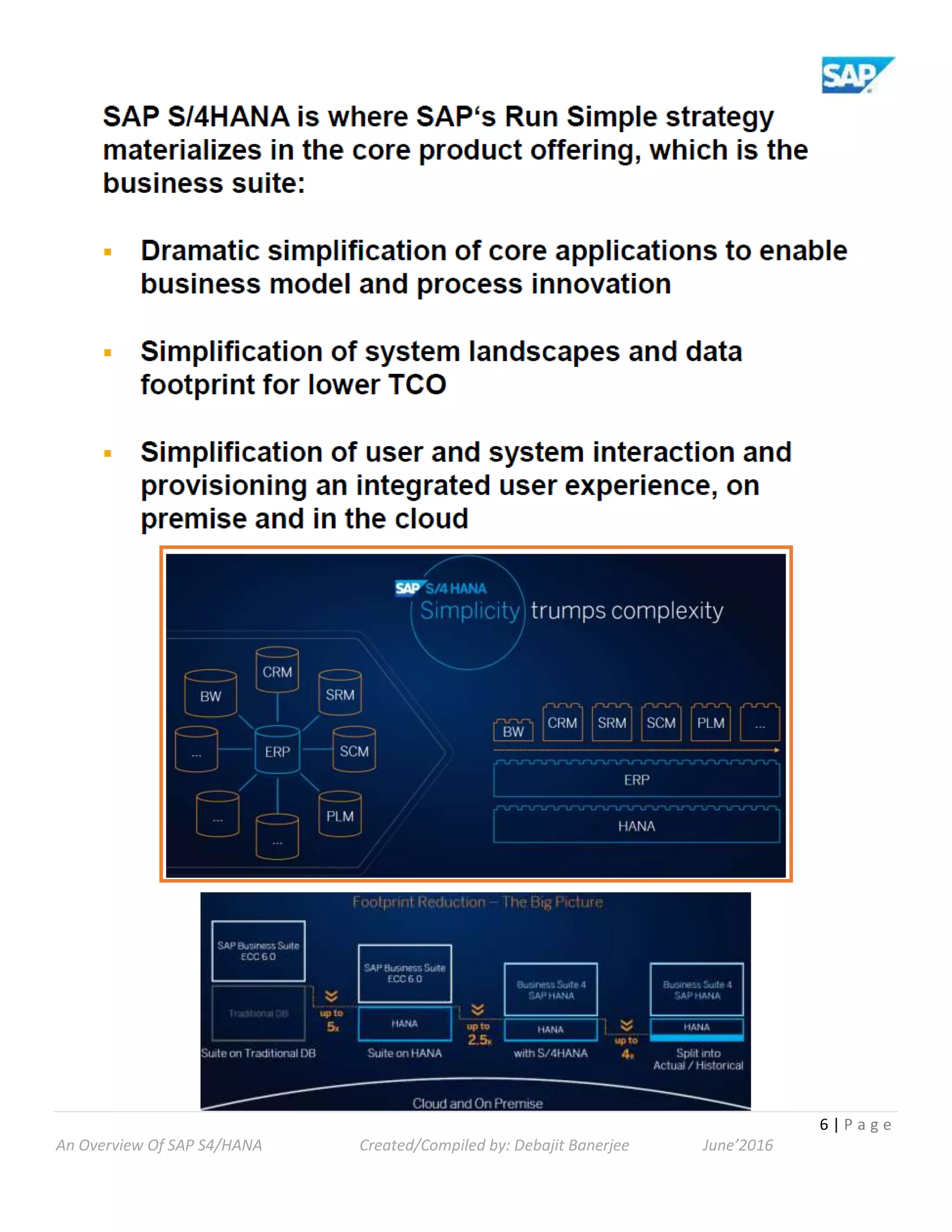
1. Significant Data Footprint Reduction
Legacy ERP database schemas relied heavily on secondary index tables, aggregate tables, and staging tables to speed up read performance for financial reports.
Because SAP HANA aggregates data dynamically in RAM at millisecond speeds, these redundant tables are deleted from the data schema. Combined with columnar data compression algorithms, organizations often experience a 3x to 5x reduction in overall database footprint when migrating from legacy databases to SAP HANA.
2. Accelerated Processing Speeds
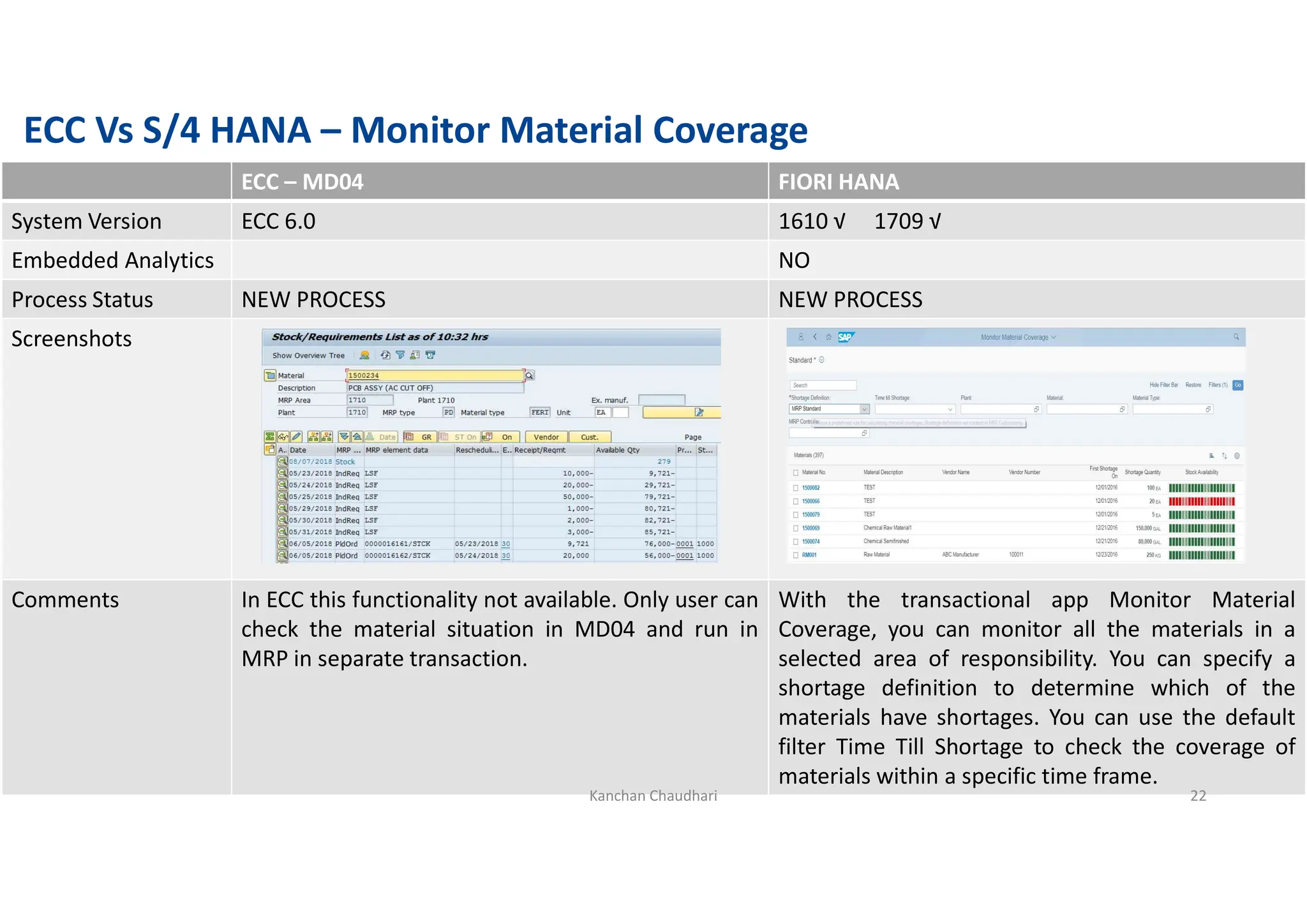
Complex batch routines that previously took hours—such as material requirements planning (MRP) runs, end-of-month financial closings, and real-time inventory valuations—often execute in minutes or seconds on SAP HANA. This performance increase enables real-time decision-making for logistics managers, plant directors, and financial controllers.
3. Simplified Application Architecture
By running OLTP and OLAP tasks in a single database kernel, IT organizations eliminate multi-hop data extraction scripts, external business intelligence staging layers, and complex synchronization logic. This simplification lowers maintenance costs and reduces points of operational failure within corporate networks.
Common Implementation Challenges and Technical Considerations
While the benefits of SAP HANA are significant, enterprise planning teams must evaluate specific technical requirements during implementation:
- Hardware Costs and Memory Footprint: Server RAM is more expensive per gigabyte than traditional magnetic or SSD storage. Sizing an SAP HANA hardware system requires careful data housekeeping, data archiving strategies, and memory allocation planning.
- Hot vs. Cold Data Tiering (Data Lifecycle Management): To manage RAM usage costs, organizations implement multi-temperature data storage tiering strategies:
- Hot Data: Frequently accessed operational data stored directly in SAP HANA RAM.
- Warm Data: Less frequently accessed data stored in dynamic tiering nodes or disk memory extension stores (such as SAP HANA Native Storage Extension - NSE).
- Cold Data: Historical or archived business records moved to low-cost cloud storage or historical data lakes.
- Code Optimization Requirements: Custom ABAP application code written for legacy row-based databases may contain inefficient database calls (e.g., nested loops issuing SELECT queries). To maximize performance on SAP HANA, IT teams must refactor legacy code to push processing logic down into the database layer (a pattern known as Code Pushdown).
Frequently Asked Questions
Is SAP HANA a database or an ERP system?
SAP HANA is an in-memory relational database management system and application platform. It is not an enterprise software application. However, SAP's modern ERP system (SAP S/4HANA) relies on SAP HANA as its mandatory database platform.
Can SAP S/4HANA run on databases like Oracle or Microsoft SQL Server?
No. Legacy SAP systems (like SAP ECC) could run on non-SAP databases, but SAP S/4HANA is engineered natively for the SAP HANA in-memory architecture and cannot run on third-party databases.
What happens to SAP HANA data if an unexpected power outage occurs?
Data is retained through the SAP HANA persistence layer. While active operations take place in RAM, all transactions are written to persistent log files on disk, and full database states are saved to persistent data volumes via regular savepoints (typically every 5 minutes). When power is restored, the database loads the latest savepoint and replays committed transaction logs.
What is the difference between row store and column store in SAP HANA?
Row store organizes data records horizontally, making it efficient for transactional operations that read or write an entire record at once. Column store organizes data vertically by attribute, making it efficient for analytical queries that process large numbers of rows across a small subset of columns. SAP HANA supports both, but relies primarily on column store for analytical efficiency and high data compression.
What is SAP HANA Cloud?
SAP HANA Cloud is a cloud-native database service provided by SAP. It offers the core in-memory performance and multi-model engines of SAP HANA as a managed cloud service, allowing enterprises to scale compute resources and storage independently across multi-cloud environments.
Practical Guidance for Enterprise IT Leaders
Organizations considering or planning a transition to SAP HANA should focus on these actionable steps:
- Perform Data Housekeeping Early: Conduct thorough data cleansing and archiving in existing databases prior to sizing SAP HANA hardware. Reducing historical data bloat directly decreases memory requirements and server costs.
- Evaluate Data Lifecycle Strategies: Implement dynamic tiering using native tools like SAP HANA Native Storage Extension (NSE) to keep cold, non-operational data off expensive in-memory RAM tiers.
- Audit Custom Code for Database Pushdown: Analyze custom application code to ensure queries take full advantage of parallel columnar processing, SQLScript, and embedded analytical views inside the database kernel.
- Determine the Optimal Deployment Model: Choose between on-premises TDI hardware configurations, cloud-hosted enterprise infrastructure (IaaS), or managed services like SAP HANA Cloud based on internal security policies, operational expertise, and budget structures.
Image Gallery