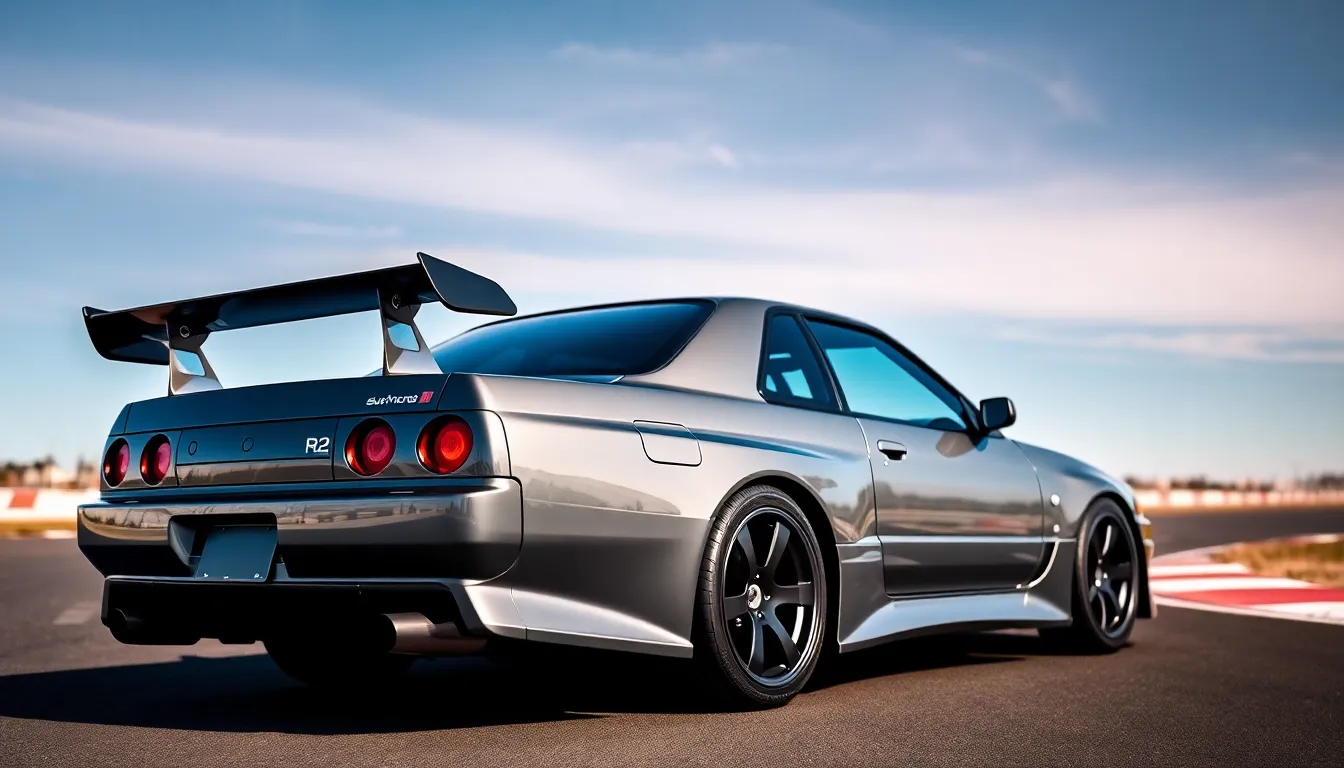
Nissan R32 Skyline Performance Specs Unpacked: Engine, Drivetrain, and Chassis Technical Breakdown
The Nissan R32 Skyline, produced from 1989 to 1994, redefined performance automotive engineering through its twin-turbocharged RB26DETT engine, ATTESA E-TS all-wheel-drive system, and Super HICAS four-wheel steering. This comprehensive...
The Nissan R32 Skyline, produced from 1989 to 1994, redefined performance automotive engineering through its twin-turbocharged RB26DETT engine, ATTESA E-TS all-wheel-drive system, and Super HICAS four-wheel steering. This comprehensive technical breakdown unpacks the factory specifications, trim variations, mechanical architecture, power delivery metrics, and chassis dynamics of Japan’s premier modern classic sports car.
Contents
The Engineering Legacy of the R32 Generation
Introduced in May 1989, the eighth-generation Nissan Skyline (R32 chassis) represented a complete mechanical overhaul intended to establish global motorsport dominance. Designed specifically under the leadership of chief engineer Naganori Ito, the flagship GT-R variant was built to satisfy Group A homologation requirements for the Japanese Touring Car Championship (JTCC). To achieve this, Nissan engineers developed an array of advanced propulsion, traction, and suspension technologies that pushed the boundaries of early 1990s automotive design.
While the GT-R serves as the performance pinnacle of the range, the R32 platform encompassed a diverse lineup of rear-wheel-drive and all-wheel-drive models, including the popular GTS-t Type M. Understanding the R32 generation requires evaluating how Nissan scaled engine performance, structural rigidity, and electronic driver aids across different trim levels.
Engine Architecture: The RB-Series Powertrains
The centerpiece of the R32 performance lineup is the RB engine family, an inline six-cylinder internal combustion design characterized by a cast-iron cylinder block and an aluminum alloy cylinder head.
RB26DETT (GT-R)
Found exclusively in the BNR32 GT-R, the RB26DETT is a 2.6-liter (2,568 cc) dual overhead camshaft (DOHC), 24-valve, twin-turbocharged engine.
- Bore & Stroke: 86.0 mm × 73.7 mm
- Compression Ratio: 8.5:1
- Induction System: Parallel twin Garrett T28 ceramic-wheel turbochargers feeding individual throttle bodies (ITBs)—a six-throttle setup that delivers instantaneous throttle response compared to single plenum designs.
- Factory Power Rating: 276 hp (280 PS / 206 kW) @ 6,800 RPM (officially governed by the Japanese Manufacturers' "Gentlemen’s Agreement").
- Actual Output: Independent dyno testing of unmodified units yields real-world flywheel figures closer to 296 hp to 300 hp.
- Factory Torque: 260 lb-ft (353 Nm) @ 4,400 RPM.
- Redline: 8,000 RPM.
The solid-lifter valvetrain design allows the RB26DETT to sustain high revs, while the oiling system utilizes a crank-driven oil pump. Early R32 models (1989–1992) featured a narrow oil pump drive collar on the crankshaft snout, which was upgraded in mid-1992 to a wider engagement surface to prevent oil pump drive failure during sustained high-RPM operation.
RB20DET (GTS-t and GTS-4)
The rear-wheel-drive GTS-t and all-wheel-drive GTS-4 utilize the 2.0-liter (1,998 cc) RB20DET engine.
- Bore & Stroke: 78.0 mm × 69.7 mm
- Compression Ratio: 8.5:1
- Induction System: Single Garrett T25 ceramic turbocharger operating through a single throttle body.
- Valvetrain: DOHC 24-valve hydraulic bucket design.
- Factory Power Rating: 212 hp (215 PS / 158 kW) @ 6,400 RPM.
- Factory Torque: 195 lb-ft (265 Nm) @ 3,200 RPM.
- Intake Air Flow
- Turbo 1 (Cyl 1-3)
- Turbo 2 (Cyl 4-6)
- Intercooler Core
- 6x Individual Throttle Bodies
- RB26DETT Combustion
Drivetrain Engineering: ATTESA E-TS and Super HICAS
The mechanical reputation of the R32 GT-R relies on two primary electronic control systems: its variable torque-split all-wheel-drive mechanism and its four-wheel steering setup.
ATTESA E-TS All-Wheel Drive
The ATTESA E-TS (Advanced Total Traction Engineering System for All-Terrain Electronic Twin Split) is an electro-hydraulic torque-split system. Unlike conventional permanent all-wheel-drive systems using a center differential, ATTESA E-TS operates predominantly as a rear-wheel-drive layout under normal traction conditions.
- Sensor Inputs: An 16-bit electronic control unit (ECU) monitors wheel speed sensors (ABS network), longitudinal and lateral G-force sensors, and throttle position at 100 Hz.
- Torque Transfer: When rear wheel slip is detected, an electric pump pressurizes a wet multi-plate clutch pack inside the transfer case.
- Torque Bias Range: Torque split modulates smoothly from 0:100 (Front:Rear) up to a maximum of 50:50 under heavy acceleration or wheelspin conditions.
- Handling Impact: By maintaining a 100% rear bias during corner entry, the car eliminates front-wheel binding and power-understeer, engaging front wheel drive only as acceleration torque exceeds rear traction limits on corner exit.
Super HICAS Four-Wheel Steering
The R32 features Super HICAS (High Capacity Actuated Steering), an evolution of Nissan's earlier HICAS technology. On early R32 models, the system operated hydraulically using power steering fluid pressure, while late-model revisions transitioned to electronic control.
- Operation: Super HICAS momentarily turns the rear wheels opposite to the front steering angle during initial turn-in to induce rotation, then swiftly turns the rear wheels in phase with the front steering angle (up to 1 degree) to stabilize the vehicle through high-speed directional transitions.
- Motorsport Trade-off: While beneficial for street high-speed stability, many track enthusiasts disable or lock out the system using aftermarket eliminate bars to maintain consistent, predictable rear suspension geometry under extreme lateral loads.
Technical Specifications Across the R32 Lineup
The table below contrasts the mechanical baseline, factory output, drivetrain configurations, and weights across the primary R32 trim variants:
| Trim Level | Engine Code | Displacement / Aspiration | Factory Horsepower | Factory Torque | Drivetrain Layout | Transmission | Kerb Weight |
|---|---|---|---|---|---|---|---|
| GT-R (BNR32) | RB26DETT | 2,568 cc Twin-Turbo I6 | 276 hp @ 6,800 RPM | 260 lb-ft @ 4,400 RPM | ATTESA E-TS AWD | 5-Speed Manual (FS5R30A) | 1,430 kg (3,152 lbs) |
| GT-R V-Spec II | RB26DETT | 2,568 cc Twin-Turbo I6 | 276 hp @ 6,800 RPM | 260 lb-ft @ 4,400 RPM | ATTESA E-TS AWD | 5-Speed Manual (FS5R30A) | 1,480 kg (3,263 lbs) |
| GTS-t Type M | RB20DET | 1,998 cc Single-Turbo I6 | 212 hp @ 6,400 RPM | 195 lb-ft @ 3,200 RPM | RWD | 5-Speed Manual / 4-Speed Auto | 1,260 kg (2,778 lbs) |
| GTS-4 (HNR32) | RB20DET | 1,998 cc Single-Turbo I6 | 212 hp @ 6,400 RPM | 195 lb-ft @ 3,200 RPM | ATTESA E-TS AWD | 5-Speed Manual / 4-Speed Auto | 1,360 kg (2,998 lbs) |
| GTS25 (ECR32) | RB25DE | 2,498 cc NA I6 | 178 hp @ 6,000 RPM | 170 lb-ft @ 4,400 RPM | RWD | 5-Speed Manual / 5-Speed Auto | 1,300 kg (2,866 lbs) |
| GTS (HR32) | RB20DE | 1,998 cc NA I6 | 153 hp @ 6,400 RPM | 134 lb-ft @ 5,200 RPM | RWD | 5-Speed Manual / 4-Speed Auto | 1,200 kg (2,646 lbs) |
Chassis Dynamics, Suspension, and Braking Systems
Nissan engineered the R32 body shell with localized structural reinforcements along the strut towers, floor pan, and rear bulkhead to withstand high cornering loads.
- Front Suspension Architecture:
- Upper Link
- Lower A-Arm
- Third Link / Upper Arm
- Steering Knuckle
- Third Link / Upper Arm
- Rear Suspension Architecture:
- Upper Control Arm
- Lower Control Arm
- Toe Link
- Hub Carrier assembly
Suspension Layout
- Front: Independent multi-link system incorporating a upper link, lower A-arm, and a third link (kingpin connection). This design isolates steering forces from suspension movement while maintaining optimal camber contact during body roll.
- Rear: Independent multi-link layout utilizing an upper control arm, lower control arm, and toe control arm, integrated directly with the Super HICAS rear steering subframe.
Braking Specifications
The standard R32 GT-R and GTS-t Type M utilize a four-wheel disc brake setup built around Sumitomo aluminum calipers:
- GT-R Standard: 296 mm vented front discs with 4-piston calipers; 297 mm vented rear discs with 2-piston calipers.
- GTS-t Type M: 280 mm vented front discs with 4-piston calipers; 297 mm rear discs with 2-piston calipers.
- GT-R V-Spec / V-Spec II: Upgraded factory braking system featuring Brembo 4-piston front calipers pinching 324 mm discs, paired with Brembo 2-piston rear calipers pinching 300 mm discs.
Performance Benchmark Metrics
Tested under factory conditions with stock boost pressure (approximately 0.7 bar / 10.1 psi), the factory R32 GT-R delivered competitive performance metrics for its era:
- 0–60 mph (0–97 km/h): 4.7 to 4.9 seconds
- 0–100 km/h (0–62 mph): 5.0 seconds
- Quarter Mile (1/4 mile): 13.5 to 13.7 seconds at 102 mph (164 km/h)
- Top Speed: Electronically limited to 112 mph (180 km/h) for the Japanese domestic market; unrestricted top speed exceeds 156 mph (251 km/h).
- Nürburgring Nordschleife Lap Time: 8 minutes 22.38 seconds (set by test driver Hiroyoshi Katoh in 1989), breaking the production car lap record at the time.
OEM Weak Points and Tuning Parameters
Understanding the R32 requires balancing factory specs with known mechanical limitations. Decades of platform testing have revealed specific operational boundaries:
1. Ceramic Turbo Wheels
The OEM Garrett turbochargers utilize ceramic turbine wheels designed to lower rotational inertia and reduce turbo lag. However, increasing boost pressure beyond 1.0 bar (14.5 psi) causes the ceramic wheel to shear off from its steel shaft due to thermal strain and centrifugal force. Upgrading to steel-wheel turbochargers or modern single-scroll/twin-scroll turbo systems is necessary for higher boost levels.
2. Oiling System Limitations
The RB26DETT engine holds approximately 4.6 liters of engine oil in factory trim. Under sustained track usage and high RPM acceleration, oil is pumped into the cylinder head faster than the small drain-back passages can return it to the sump. This causes oil starvation at the crankshaft bearings. Common reliability fixes include installing a high-capacity baffled oil pan, extended crank drive collars, head drain kits, and oil restrictors.
3. Factory ECU Limiting Factors
Stock R32 ECUs rely on dual Mass Air Flow (MAF) sensors and baked-in speed restrictors. Upgrading power outputs past ~350 hp typically necessitates switching to standalone engine management systems using Manifold Absolute Pressure (MAP) sensor conversion.
FAQ: Frequently Asked Questions
What is the main difference between an R32 GT-R and an R32 GTS-t?
The R32 GT-R features a 2.6L twin-turbo RB26DETT engine, ATTESA E-TS variable all-wheel drive, wider aluminum front and rear fenders, and heavy-duty 5-speed manual gearboxes. The GTS-t utilizes a 2.0L single-turbo RB20DET engine, a rear-wheel-drive layout, narrower bodywork, and lighter overall vehicle mass.
Did the R32 GT-R really only produce 276 horsepower from the factory?
No. The official 276 hp (280 PS) rating was an artificial figure established under Japan's voluntary self-regulation "Gentlemen's Agreement" among automobile manufacturers. Actual stock flywheel output of the RB26DETT was roughly 296 hp to 300 hp. Removing the factory brass boost restrictor pill safely yields an additional 20 to 30 hp.
Why do owners frequently remove or lock out the Super HICAS system?
As the Super HICAS hydraulic and electronic components age, solenoid failure, worn tie-rod ends, and sensor degradation can cause unpredictable rear-wheel steering inputs. Race drivers and drift enthusiasts typically install a HICAS delete bar to lock the rear toe setting permanently into a fixed geometry.
How does the ATTESA E-TS system compare to traditional mechanical AWD systems?
Traditional mechanical all-wheel-drive systems utilize center differentials that split torque continuously between front and rear axles. ATTESA E-TS uses an electro-hydraulic clutch pack controlled by a computer, keeping the front axle disconnected (0:100 rear bias) until slippage occurs. This provides natural rear-wheel-drive handling characteristics while applying front-wheel drive torque only when needed for traction.
What are the main points to inspect on an R32 before purchase or tuning?
Key areas requiring evaluation include strut tower rust, frame rail crushing from improper jacking, crank snout oil pump engagement (on pre-1992 RB26 engines), state of the twin ceramic turbochargers, and function of the hydraulic Super HICAS rack.
Practical Ownership and Maintenance Guidelines
For enthusiasts and collectors maintaining or purchasing an R32 Skyline, historical specs translates into specific maintenance practices:
- Engine Oil Selection: Run high-zinc synthetic oils (such as 10W-50 or 15W-50 grades) to protect the solid lifters and journal bearings under high operating temperatures.
- Fluid Maintenance: The ATTESA E-TS hydraulic system relies on Nissan MATIC D or equivalent ATF fluid in its boot-mounted reservoir; inspect hydraulic pump operation and lines regularly for pressure degradation.
- Cooling Upgrades: The factory two-row radiator is prone to cracking at the plastic end tanks over time. Upgrading to an all-aluminum radiator with an auxiliary oil cooler is essential for maintaining stable thermal conditions under load.
Image Gallery