What Is New Jersey Basic Auto Insurance and How Does It Work?
New Jersey Basic auto insurance is a low-cost, minimal-coverage motor vehicle policy established by state law to give drivers an affordable way to meet New Jersey’s mandatory insurance requirements. It provides basic Personal Injury Pr...
New Jersey Basic auto insurance is a low-cost, minimal-coverage motor vehicle policy established by state law to give drivers an affordable way to meet New Jersey’s mandatory insurance requirements. It provides basic Personal Injury Protection (PIP) and Property Damage Liability, but eliminates or severely limits Bodily Injury Liability and legal defense coverage.
Contents
Understanding the New Jersey Basic Auto Insurance Policy
Created under the New Jersey Automobile Insurance Cost Reduction Act (AICRA) in 1998, the Basic Policy was designed to curb the state's historically high uninsured motorist rate. It offers an alternative for individuals who have few financial assets to protect or who cannot afford the comprehensive protections of a traditional motor vehicle policy.
In New Jersey, driving without auto insurance is illegal and carries severe penalties, including mandatory community service, heavy fines, license suspension, and insurance surcharges. The Basic Policy serves as a legal safety net, allowing drivers to register a vehicle and legally operate it on public roads at a significantly reduced premium compared to a Standard Policy.
However, the Basic Policy leaves significant gaps in financial protection. Because auto insurance rules in New Jersey follow a modified choice no-fault system, understanding how the Basic Policy operates during an accident is critical before choosing this option over standard alternatives.
Core Coverages Included in the NJ Basic Auto Insurance Policy
The Basic Policy’s coverage structure is strictly regulated by the New Jersey Department of Banking and Insurance (DOBI). Unlike standard automobile policies that allow drivers to adjust coverage limits across high thresholds, the Basic Policy operates on static, bare-minimum legal defaults.
| Mandatory Minimums | Optional Add-Ons |
|---|---|
| • Personal Injury Protection: $15k• Property Damage Liability: $5k• Tort Option: Limited Right to Sue• Bodily Injury Liability: $0 | • Optional Bodily Injury: $10k (total per accident limit)• Collision / Comprehensive (offered by select insurers) |
Personal Injury Protection (PIP)
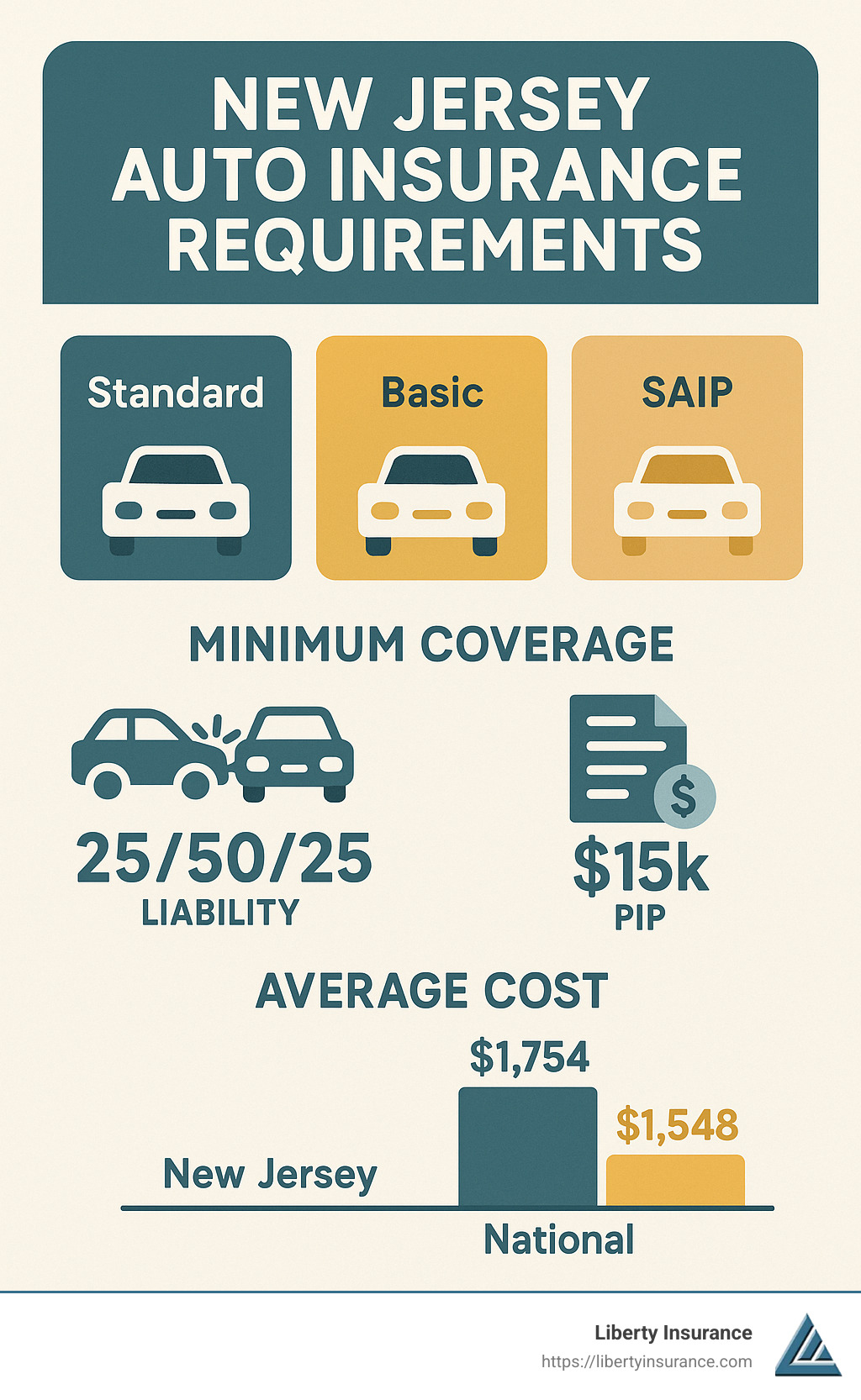
Under the default Basic Policy, Personal Injury Protection (PIP) is capped at $15,000 per person, per accident. PIP covers medical treatment expenses for you and any passengers listed on your policy, regardless of who caused the motor vehicle accident.
- Catastrophic Injury Provision: New Jersey statute provides an exception for severe, catastrophic injuries. Coverage expands up to $250,000 specifically for permanent brain damage, spinal cord injury, dismemberment, or medical conditions requiring immediate emergency care and acute care hospitalization.
- Exclusions: Unlike PIP under a Standard Policy, basic PIP does not include income continuation benefits, essential services reimbursement, death benefits, or funeral expense coverage.
Property Damage Liability (PD)
The Basic Policy includes a mandatory $5,000 per accident limit for Property Damage Liability. This pays for damage your vehicle causes to another person's car, property, or public infrastructure (such as guardrails or light poles). Given that the average cost of a modern passenger vehicle far exceeds $5,000, this limit leaves drivers vulnerable to personal liability for costs exceeding the policy cap.
Bodily Injury Liability (BI)
By default, the Basic Policy provides $0 in Bodily Injury Liability coverage.
- Optional Add-On: Drivers can elect to purchase a flat $10,000 coverage limit for bodily injury caused to all persons in a single accident.
- Defense Costs: Because baseline Bodily Injury coverage is $0, your insurance company is not obligated to provide legal representation or pay court costs if another party sues you for injuries caused in a crash, unless you purchase the optional $10,000 coverage.
Uninsured and Underinsured Motorist (UM/UIM) Protection
The Basic Policy does not include Uninsured Motorist (UM) or Underinsured Motorist (UIM) coverage, nor can it be added as an optional endorsement. If an uninsured driver hits your vehicle or flees the scene of an accident, your Basic Policy will not compensate you for physical injuries beyond your basic $15,000 PIP limit, nor will it cover physical damages to your vehicle.
Comprehensive and Collision Coverage
Physical damage protection for your own car (collision and comprehensive) is not automatically included. However, New Jersey law allows insurance companies to offer collision and comprehensive coverage as optional add-ons to a Basic Policy. Many insurance carriers choose not to offer these coverages on basic policies, or they set high deductibles that lower the value for policyholders.
Legal Provisions: The Limitation on Right to Sue
Every auto insurance policy issued in New Jersey includes a lawsuit option that defines your right to sue an at-fault driver for non-economic losses, such as pain and suffering.
When you select a Basic Policy, state law automatically assigns you the Limitation on Right to Sue (also referred to as the "verbal threshold"). You cannot opt for the "No Limitation on Right to Sue" option under a Basic Policy.
Under the Limitation on Right to Sue, you forfeit your right to bring a civil lawsuit against an at-fault driver for pain and suffering unless your injuries fall directly into one of six statutory categories:
- Death
- Dismemberment
- Significant disfigurement or significant scarring
- Displaced fractures
- Loss of a fetus
- Permanent injury within a reasonable degree of medical probability (meaning the body part or organ has not healed to function normally and will not heal even with further medical treatment)
This restriction applies to you and any family members residing in your household covered under the policy. While it reduces lawsuit litigation within the state court system, it limits your financial remedies if you suffer soft-tissue injuries, whiplash, or painful conditions that do not meet the strict statutory definitions of permanent injury.
Comparing New Jersey Auto Insurance Policies
New Jersey offers three main categories of auto coverage: the Standard Policy, the Basic Policy, and the Special Automobile Insurance Policy (SAIP).
| Coverage Feature | Basic Policy | Standard Policy | SAIP ("$1-a-Day" Insurance) |
|---|---|---|---|
| Target Audience | Low-asset drivers seeking legal minimums | General public needing complete protection | Individuals enrolled in Federal Medicaid |
| Personal Injury Protection (PIP) | $15,000 per person (Up to $250k for catastrophic injuries) | $15,000 up to $250,000 (choice of limit) | Emergency medical care only (Hospital/ER) |
| Property Damage Liability | $5,000 per accident | $5,000 up to $100,000+ | $0 |
| Bodily Injury Liability | $0 default ($10,000 optional total) | $15,000/$30,000 up to $250,000/$500,000+ | $0 |
| Uninsured Motorist (UM/UIM) | Not Available | Included (matches BI limits) | Not Available |
| Lawsuit Option | Mandatory Limitation on Right to Sue | Choice of Limited or No Limit on Right to Sue | Mandatory Limitation on Right to Sue |
| Collision & Comprehensive | Optional (if carrier permits) | Optional | Not Available |
| Average Annual Premium | Low ($400 – $800/yr typical) | Moderate to High ($1,500 – $3,000+/yr) | $365 per year ($1/day) |
How Claims Work Under an NJ Basic Auto Policy
Understanding how claims unfold under a Basic Policy highlights the operational differences between choice no-fault policies and full-coverage contracts.
Scenario A: Minor Single-Vehicle Accident
If you run off the road and hit a tree:
- Medical Expenses: Your PIP coverage pays your medical bills up to $15,000 (minus your elected PIP deductible, which ranges from $250 to $2,500).
- Vehicle Damage: Your policy pays $0 for repairs to your car unless you separately purchased optional collision coverage.
- Property Damage: If the tree was on private property or you damaged a township sign, your Property Damage Liability pays up to $5,000.
Scenario B: Two-Vehicle Collision (You Are At Fault)
If you run a red light and crash into another vehicle causing $12,000 in vehicle repairs and injuring the other driver:
Third-Party Medical Bills: The other driver's primary PIP policy covers their medical treatments initially under New Jersey's no-fault system.
Third-Party Property Damage: Your insurance policy pays out its maximum limit of $5,000 to repair the other driver's vehicle. You are personally liable for the remaining $7,000 out of pocket.
Third-Party Lawsuits for Injuries: If the injured party sues you for severe medical bills or pain and suffering:
- If you kept the default $0 Bodily Injury limit, your insurer provides no legal representation and pays $0 toward any settlement or court judgment.
- If you purchased the $10,000 optional BI limit, your insurer pays up to $10,000 total across all injured parties and provides defense attorneys. Any judgment amount exceeding $10,000 remains your personal legal liability.
Accident Caused by Basic Policyholder
- Property Damage
- Limit: $5,000
- Damages > $5,000
- Injuries Caused
- Limit: $0 (or $10k optional)
- Injuries > Limit
- Property Damage
Personal Financial Exposure
- Wage Garnishment Risk
- Personal Asset Seizure
Major Financial and Legal Risks of a Basic Policy
While a Basic Policy satisfies state vehicle registration requirements at an accessible price point, it places substantial financial exposure on the policyholder.
1. Personal Asset Exposure and Wage Garnishment
If you cause an accident resulting in substantial property damage or severe bodily injuries, third parties can sue you directly in civil court. If a judge issues a financial judgment against you, the claimant can enforce recovery through court-ordered wage garnishment, bank account levies, or judgment liens on real estate you own.
2. Lack of Uninsured Motorist Defense
If an uninsured or hit-and-run driver injures you or damages your car, your Basic Policy provides no compensation for loss of vehicle value or personal suffering. You must rely solely on your $15,000 PIP limit to address medical bills.
3. Absence of Administrative and Defense Protections
Traditional auto insurance policies obligate the insurer to provide legal representation if you are sued following an accident. With a default Basic Policy ($0 BI), the insurer has no duty to defend you in court, forcing you to hire a private defense attorney at your own expense.
Who Should Consider (and Avoid) NJ Basic Auto Insurance?
Suitable Candidates
- Judgmatically Unreachable/Low-Asset Drivers: Individuals who own no real estate, possess negligible bank savings, and have lower incomes that are generally exempt from aggressive debt recovery under federal and state garnishment caps.
- Drivers Without Dependents: Single individuals who do not need extended PIP benefits like wage replacement or survival benefits for family members.
- Vehicle Owners with Older Cars: Drivers operating older vehicles with low resale values who do not carry auto loans requiring physical damage insurance.
Who Should Avoid the Basic Policy
- Homeowners and Property Owners: Anyone with equity in home real estate, rental properties, or physical assets that could be targeted in a civil judgment.
- High-Earners and Salaried Professionals: Individuals whose wages exceed basic statutory execution thresholds, leaving them exposed to long-term wage garnishments.
- Vehicle Owners with Auto Loans or Leases: Lenders and leasing companies almost universally require full coverage insurance, including comprehensive, collision, and higher liability limits. A Basic Policy will violate standard financing agreements.
How to Apply for a Basic Policy in New Jersey
To purchase a Basic Policy, you must go through a licensed auto insurance company or agent operating in New Jersey.
- Request a Basic Policy Quote: Contact an insurance agent or broker licensed by the New Jersey Department of Banking and Insurance. State law mandates that all insurance carriers writing private passenger auto policies in New Jersey must offer the Basic Policy option.
- Sign the Coverage Selection Form: New Jersey requires policyholders to read and sign an official Coverage Selection Form. This document explicitly states that you understand you are purchasing minimal protection, opting into the limited lawsuit threshold, and waiving higher bodily injury limits.
- Verify Vehicle Title Details: Provide your vehicle registration, driver's license details, and proof of residence. Ensure there are no outstanding liens on the vehicle, as lienholders typically reject basic coverage.
- Select Optional Add-ons: Decide whether to add the optional $10,000 Bodily Injury coverage or collision/comprehensive protection (if offered by the insurer).
Frequently Asked Questions
Is New Jersey Basic auto insurance legal?
Yes. The Basic Policy fully satisfies New Jersey’s mandatory motor vehicle insurance requirements under N.J.S.A. 39:6A-3.1, allowing you to register and legally drive a vehicle in the state.
Can I add my family members to a Basic Policy?
Yes. Family members residing in your household can be listed as covered drivers on your Basic Policy. However, the $15,000 PIP limit applies per person per accident, and all household members will be bound by the mandatory Limitation on Right to Sue.
What is the difference between an NJ Basic Policy and SAIP?
The Basic Policy is available to any licensed New Jersey driver regardless of income level. The Special Automobile Insurance Policy (SAIP), often referred to as the "$1-a-Day policy," is restricted exclusively to individuals currently enrolled in Federal Medicaid with hospitalization coverage. SAIP only covers emergency medical treatment following an accident and provides zero property damage or bodily injury liability coverage.
Will a Basic Policy satisfy my car loan requirements?
No. Banks, credit unions, and auto leasing firms require borrowers to maintain comprehensive and collision insurance alongside higher liability limits to protect their financial stake in the vehicle. A Basic Policy fails to meet these lender mandates.
Can I upgrade from a Basic Policy to a Standard Policy later?
Yes. You can upgrade from a Basic Policy to a Standard Policy at any time during your policy term by contacting your insurance provider, signing a revised Coverage Selection Form, and paying the adjusted premium.
Summary and Next Steps
New Jersey Basic auto insurance provides a legal mechanism for drivers to meet state insurance mandates at a minimal cost. By capping Personal Injury Protection at $15,000, setting Property Damage Liability at $5,000, and removing baseline Bodily Injury Liability, it significantly lowers annual premiums while leaving substantial personal liability risks intact.
If you are evaluating auto insurance options in New Jersey:
- Audit your current personal financial assets, real estate equity, and income stability.
- Request side-by-side quotes for both a Basic Policy (with the optional $10k BI coverage) and a Standard Policy with baseline $15k/$30k liability limits.
- Consult a licensed New Jersey insurance professional or review consumer guides published by the New Jersey Department of Banking and Insurance before signing your Coverage Selection Form.
Image Gallery