Marilyn Ezzy v. Workers' Compensation Appeals Board: The Legal Standard for Recreational Off-Duty Injury Claims
In California workers' compensation law, Marilyn Ezzy v. Workers' Compensation Appeals Board (1983) 146 Cal.App.3d 252 is the seminal appellate decision governing injuries sustained during off-duty, employer-sponsored recreational or s...
In California workers' compensation law, Marilyn Ezzy v. Workers' Compensation Appeals Board (1983) 146 Cal.App.3d 252 is the seminal appellate decision governing injuries sustained during off-duty, employer-sponsored recreational or social activities. The court established that an injury is compensable if the employee subjectively believed participation was expected by the employer and that belief was objectively reasonable under the circumstances.
Contents
Factual Background of Ezzy v. Workers' Comp. Appeals Bd.
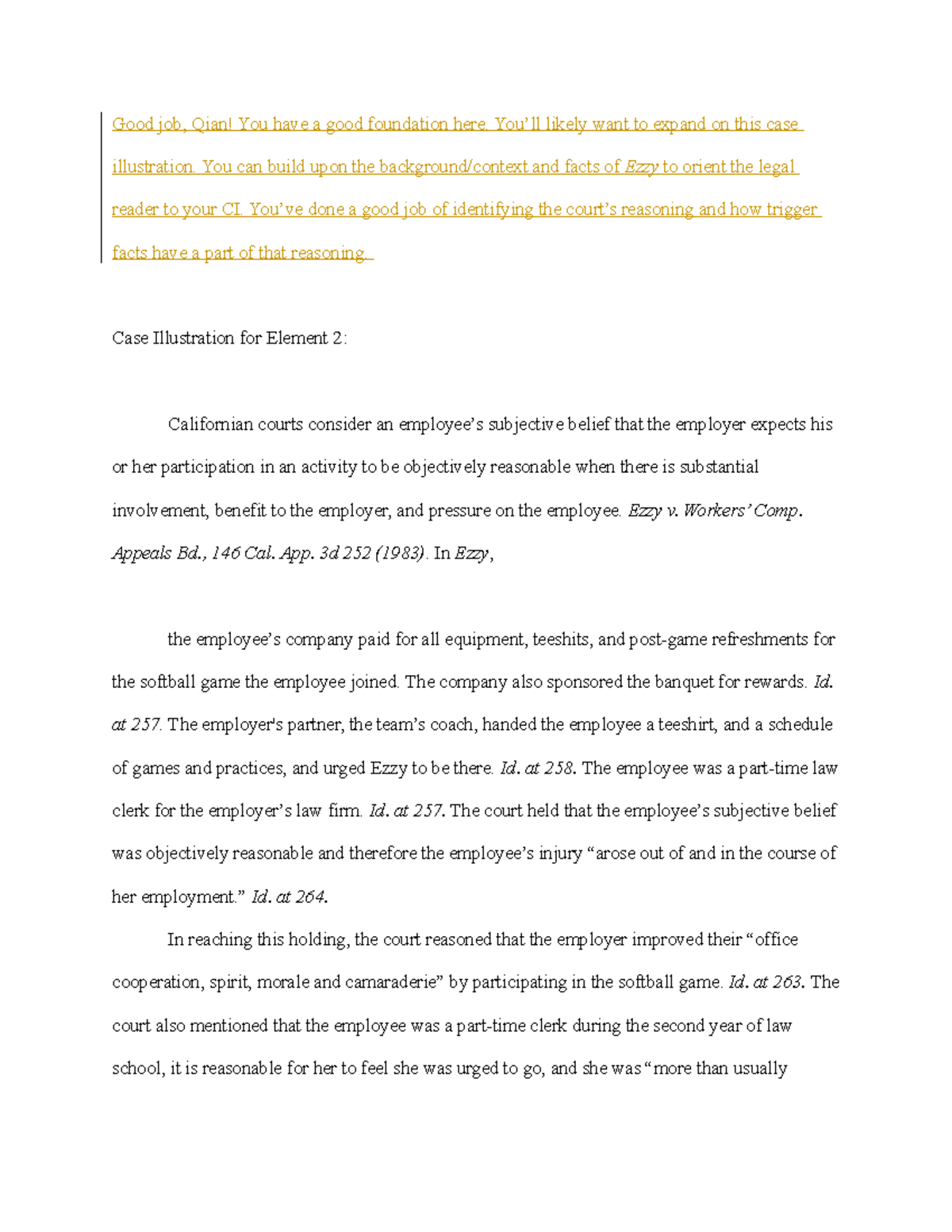
The dispute in Ezzy v. Workers' Comp. Appeals Bd. arose from an injury suffered by Marilyn Ezzy, a law clerk employed by a small law firm in San Francisco. The firm sponsored a team in a local co-ed recreational softball league. While playing in a scheduled softball game, Ezzy ran into another player while attempting to catch a fly ball, sustaining a serious finger injury that required surgical intervention.
Ezzy had no prior experience playing softball and had not initially sought to join the team. However, the law firm needed a minimum number of female players on the field to avoid forfeiting its games under the league rules. Prior to the game in question, a partner in the law firm handed Ezzy a softball glove and instructed her to play. Ezzy testified that she felt compelled to participate because a partner at her law firm requested her involvement to ensure the firm's team could field a compliant roster.
When Ezzy filed a claim for workers' compensation benefits, the employer's insurance carrier denied liability, contending that the softball game was a voluntary, off-duty athletic activity unrelated to her core job duties as a law clerk. The Workers' Compensation Appeals Board (WCAB) originally ruled in favor of the employer, concluding that participation was voluntary. Ezzy appealed the administrative ruling to the California Court of Appeal, First Appellate District.
Statutory Context: California Labor Code Section 3600(a)(9)
To understand the court's holding, it is necessary to examine the statutory framework governing off-duty recreational activities in California. In 1978, the California Legislature added language to California Labor Code Section 3600—currently codified under Labor Code Section 3600(a)(9)—to curb escalating workers' compensation costs associated with voluntary employee social and athletic events.
Labor Code Section 3600(a)(9) explicitly excludes workers' compensation liability for:
"Where the injury does not arise out of voluntary participation in any off-duty recreational, social, or athletic activity not constituting part of the employee's work-related duties, except where these activities are reasonably expected by, or expressly or impliedly required by, the employment."
The statute created a general rule of non-compensability for off-duty recreational activities, subject to a vital exception: coverage remains intact if the activity is reasonably expected by, or expressly or impliedly required by, the employment. Prior to Ezzy, California courts lacked a uniform judicial framework for interpreting what constituted a "reasonable expectation" under this statutory exception.
The Two-Prong Ezzy Test Explained
The Court of Appeal reversed the WCAB's decision, finding that Ezzy's injury was indeed compensable. In doing so, the court established a fundamental legal framework—commonly known as the Ezzy test—to evaluate whether an off-duty recreational injury meets the statutory exception in Labor Code Section 3600(a)(9).
Under the Ezzy standard, an off-duty recreational injury is compensable if the evidence satisfies a two-pronged test:
- Off-Duty Recreational Injury
- Prong 1: Subjective Test
- Did the employee subjectively believe participation was expected by the employer?
- YES
- Prong 2: Objective Test
- Was that subjective belief objectively reasonable under the totality of circumstances?
- YES
- Injury IS Compensable Under Labor Code Section 3600(a)(9)
Prong 1: The Employee's Subjective Belief
The first element focuses on the state of mind of the injured worker. The trier of fact must determine whether the employee genuinely believed that participation in the social, athletic, or recreational event was required or expected by the employer.
In Ezzy, the court found abundant evidence of the applicant's subjective state of mind. Ezzy testified that as a junior law clerk seeking permanent employment after law school, she felt significant subtle pressure to comply with the partner's direct request to play. She did not view the game as a casual, personal leisure activity, but rather as an obligation tied to her position within the firm.
Prong 2: Objective Reasonableness Under the Totality of Circumstances
The second element requires that the employee's subjective belief be objectively reasonable when evaluated against the totality of the circumstances. An employee’s mere internal perception of pressure is insufficient if a reasonable person in the same position would not have inferred such an expectation from the employer’s conduct.
In evaluating objective reasonableness, the Court of Appeal highlighted several critical facts in Ezzy's case:
- Employer Involvement and Sponsorship: The law firm paid for the team's league registration fees, purchased equipment, and provided t-shirts bearing the firm’s name.
- Direct Partner Solicitations: A firm partner personally handed Ezzy a glove and urged her to join the roster to prevent a game forfeit.
- Vulnerability of Employment Status: Ezzy was a non-tenured, temporary law clerk. The court recognized that lower-level employees are particularly susceptible to managerial suggestions, making it reasonable for her to perceive a senior partner's request as an employment expectation.
- Benefit to the Employer: The firm derived a direct benefit in team morale and firm cohesion by fielding a full team that met league gender requirements.
Because Ezzy satisfied both the subjective and objective criteria, her injury was ruled to have arisen out of and in the course of employment (AOE/COE).
Key Factors Courts and Judges Evaluate Under the Ezzy Standard
Since 1983, workers' compensation administrative law judges (WCALJs) and California appellate courts have applied the Ezzy framework across a wide array of workplace scenarios. Evaluating whether an off-duty event falls within the scope of employment requires a fact-intensive inquiry into several recurring factors.
1. Direct vs. Indirect Employer Pressure
Direct requests, invitations from supervisors, or supervisory attendance where participation is tracked heavily weigh in favor of compensability. Conversely, general company-wide announcements without individual solicitation suggest voluntary involvement.
2. Financial and Logistical Employer Involvement
Paying league entry fees, providing branded uniforms, allowing employees to practice during work hours, or hosting events on employer premises strengthen the inference of employment connection. However, financial support alone is not always dispositive if the employer merely acts as a passive donor.
3. Business Benefit to the Employer
Courts examine whether the event served a tangible business purpose beyond general worker relaxation. Examples include entertaining clients, conducting formal team-building exercises, promoting company brand visibility in the community, or fostering internal networking tied to performance evaluations.
4. Employment Status and Power Dynamics
The position of the worker within the organization plays a major role. Probationary staff, independent contractors seeking full-time roles, or lower-level personnel are held to have a lower threshold for establishing that a manager’s "request" was reasonably interpreted as a job expectation.
Comparative Matrix: Covered vs. Non-Covered Off-Duty Activities
The table below illustrates how California courts and the WCAB distinguish between compensable and non-compensable recreational injuries under Labor Code Section 3600(a)(9) and the Ezzy doctrine:
| Scenario / Activity Type | Fact Pattern | Subjective Belief Present? | Objectively Reasonable? | Legal Outcome (Compensability) |
|---|---|---|---|---|
| Law Firm Softball Game (Ezzy) | Partner directs law clerk to play to fill roster; firm pays fees and provides equipment. | Yes | Yes | Compensable: Direct supervisory directive to junior staff member. |
| Company Picnic (Mandatory Attendance) | Employer hosts annual picnic during normal paid business hours; attendance is recorded. | Yes | Yes | Compensable: Activity occurs during paid work time with mandated attendance. |
| After-Work Pickup Basketball | Co-workers organize independent games at a public park; employer has no financial involvement. | No / Unreasonable | No | Non-Compensable: Purely voluntary social activity without employer inducement. |
| Client Golf Outing | Sales executive plays golf with a major client; employer reimburses green fees and expense report. | Yes | Yes | Compensable: Directly advances employer business and commercial relationships. |
| Off-Site Fitness Gym Use | Employer offers optional subsidized gym memberships as a wellness perk; no tracking or job requirement. | No | No | Non-Compensable: Generalized fringe benefit without job expectation. |
| Unsolicited Manager Invitation | Supervisor asks an employee to join a weekend hiking trip; explicitly notes it is purely social and optional. | Potentially | No | Non-Compensable: Express employer disclaimers negate objective reasonableness. |
Subsequent Case Law and Evolution of the Doctrine
The Ezzy decision established a standard that has been refined by subsequent decisions from the California Court of Appeal:
Meyer v. Workers' Comp. Appeals Bd. (1984)
In Meyer v. Workers' Comp. Appeals Bd. (1984) 157 Cal.App.3d 533, an auto salesperson was injured in an automobile accident while driving to an off-duty weekend gathering organized by an upper-level manager. The Court of Appeal held the injury was non-compensable. The court clarified that an employer's mere encouragement or passive approval of a social gathering does not create an objective employment expectation, particularly where no business discussions were scheduled and attendance was not tied to job performance.
Hughes Aircraft Co. v. Workers' Comp. Appeals Bd. (1983)
In Hughes Aircraft Co. v. Workers' Comp. Appeals Bd. (1983) 149 Cal.App.3d 571, an employee was injured at an off-duty employee club social event. The court held that because the employer subsidised the club, derived a direct employee-relations benefit, and explicitly encouraged participation in executive communications, the injury met the Ezzy threshold for compensability.
Camps v. Workers' Comp. Appeals Bd. (1994)
In Camps v. Workers' Comp. Appeals Bd. (1994) 21 Cal.App.4th 1592, the court analyzed injuries occurring during employer-sponsored athletic events held on the employer's premises during non-work hours. The court reiterated that the primary focus must remain on the dual prongs of Ezzy, ensuring that off-duty injuries are not automatically excluded simply because they occur outside standard working shifts.
Employer and Employee Strategies: Preventing and Evaluating Claims
Understanding the Ezzy framework allows both employers and injured workers to navigate off-duty recreational injury claims effectively.
Best Practices for Employers
To minimize liability risks under Labor Code Section 3600(a)(9), risk managers and Human Resources departments should implement clear policies regarding social and athletic events:
- Issue Express Written Disclaimers: When organizing or funding optional recreational events (such as sports leagues, holiday parties, or charity runs), distribute written notices explicitly stating: "Participation in this event is entirely voluntary and is not a requirement of your employment. Participation or non-participation will have no impact on your employment status, performance evaluations, or compensation."
- Avoid Supervisory Coercion: Train managers and supervisors not to pressure subordinates to attend social events or join company teams.
- Separate Work from Play: Avoid holding mandatory business meetings during recreational events, and do not track attendance for off-duty social gatherings.
- Audit Funding Structures: Reconsider directly sponsoring high-risk physical contact sports teams under the corporate name unless clear voluntary waivers and disclaimers are in place.
Steps for Injured Workers
Employees who sustain injuries during off-duty employer-related events should preserve relevant evidence immediately:
- Document Communications: Save text messages, emails, or flyers where managers asked or encouraged attendance.
- Identify Witnesses: Record statements from co-workers who overheard management requests or who can testify to the employer's expectations.
- Report the Injury Promptly: Provide written notice of the injury to the employer, detailing the connection between the event and employment duties.
- Consult Legal Counsel: Because Ezzy inquiries depend heavily on factual nuances, consulting an experienced California workers' compensation applicant attorney is crucial for establishing objective reasonableness.
Disclaimer: This article provides general legal analysis and educational information regarding California workers' compensation case law. It does not constitute formal legal advice. Jurisdictional rules and statutory interpretations may vary; individuals seeking advice regarding specific claims should consult a qualified legal professional.
Frequently Asked Questions
What is the primary holding of Marilyn Ezzy v. Workers' Compensation Appeals Board?
The primary holding established that an off-duty recreational injury is compensable under California Labor Code Section 3600(a)(9) if the worker subjectively believed participation was expected by the employer, and that subjective belief was objectively reasonable under the totality of circumstances.
Does an employer paying for team uniforms automatically make an injury compensable?
No. Financial contributions, such as purchasing uniforms or paying entry fees, are considered part of the totality of circumstances, but funding alone does not automatically prove that participation was expected or required by the employment.
How does Labor Code Section 3600(a)(9) affect company holiday parties?
If attendance at a holiday party is mandatory, held during paid work hours, or strongly expected by management to build business relationships, injuries sustained at the event may be compensable. If the party is explicitly voluntary, held off-duty, and carries no employment consequences for non-attendance, claims are typically excluded under Section 3600(a)(9).
Can an employee waive their rights to workers' compensation benefits for recreational events?
Under California Labor Code Section 2804, employees cannot contractually waive their statutory rights to workers' compensation benefits. While signed acknowledgments of voluntary participation serve as strong evidence of objective voluntariness under the Ezzy test, they do not act as an absolute legal bar if actual employer coercion occurred.
Why is an employee's job status relevant under the Ezzy standard?
Job status is relevant because lower-level, non-tenured, or probationary workers are more susceptible to subtle workplace pressure. Courts recognize that a supervisor's "suggestion" to an entry-level worker carries significantly more weight than the same comment made to a senior executive.
Practical Next Actions for Legal Practitioners and Claims Administrators
When evaluating a workers' compensation claim involving an off-duty athletic, social, or recreational injury under the Ezzy framework, practitioners should execute the following steps:
- Obtain the Initial Communication Record: Collect all original written solicitations, emails, team sign-up sheets, and manager directives associated with the event.
- Conduct Targeted Witness Interviews: Question co-workers and direct supervisors regarding whether attendance was tracked, praised, or tied to workplace advancement.
- Analyze the Financial and Commercial Structure: Determine whether the employer claimed the event as a business tax deduction, advertised corporate branding, or utilized the event for client entertainment.
- Evaluate the Power Dynamic: Assess the applicant's exact employment status, tenure, and relationship to the individual who invited or requested their participation.
- Review Statutory Waivers and Disclaimers: Check if the employer distributed clear, explicit disclaimers confirming that participation was voluntary prior to the occurrence of the injury.
Image Gallery