What Lies Beneath the Magma Chamber: Exploring the Depths of Volcanic Plumbing Systems
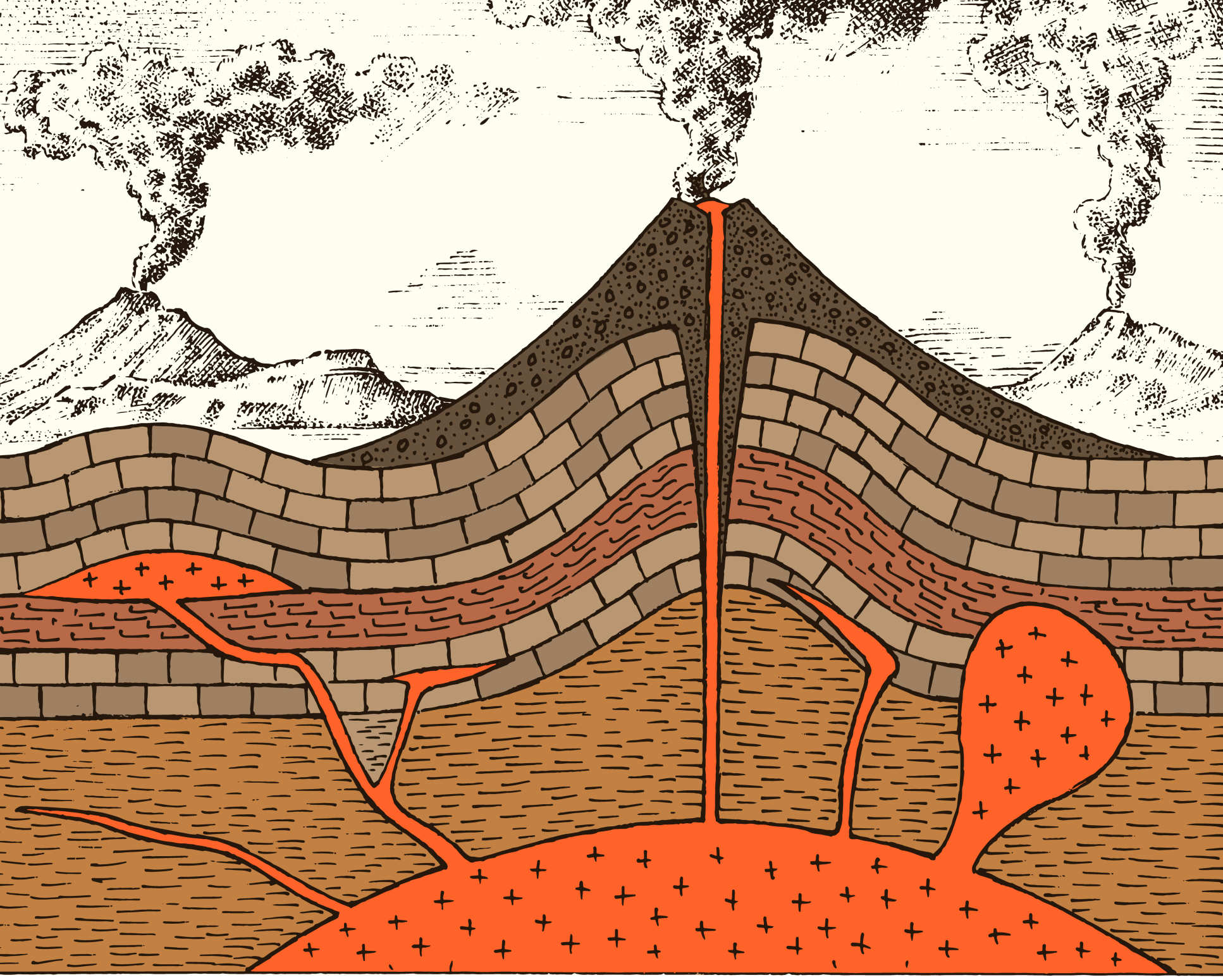
Beneath the primary magma chamber lies a complex trans-crustal magmatic system composed of vertically stacked "mush zones," sills, and dikes. These structures extend through the lower crust to the Mohorovičić discontinuity and into the...
Beneath the primary magma chamber lies a complex trans-crustal magmatic system composed of vertically stacked "mush zones," sills, and dikes. These structures extend through the lower crust to the Mohorovičić discontinuity and into the upper mantle, where primary melt generation occurs through decompression or flux melting of peridotite.
Contents
For decades, the popular conception of a volcano involved a singular, giant cavern of liquid rock sitting just below the surface. However, as of 2026, geophysical imaging and petrological modeling have refined this view significantly. We now understand that what we call a "magma chamber" is often just the uppermost part of a massive, multi-tiered plumbing system that reaches dozens of kilometers into the Earth’s interior. Understanding what lies beneath these chambers is critical for predicting eruption styles, durations, and the chemical composition of the lava that eventually reaches the surface.
Redefining the Magma Chamber: The Crystal Mush Model
To understand what lies beneath a magma chamber, one must first understand what a magma chamber actually is. Modern volcanology has largely moved away from the "big tank of liquid" model. Instead, most reservoirs are crystal mushes—regions where the rock is partially molten but contains a high percentage of solid crystals (often 50% to 90%).
Beneath the most active, eruptible part of a volcano is a long column of this mush. This "mush column" acts as a filter and a chemical laboratory. As magma rises from deeper levels, it gets trapped in these lower zones. Here, it cools slowly, allowing crystals to form and settle. This process, known as fractional crystallization, changes the chemistry of the remaining liquid. The "chamber" we see near the surface is often just a temporary gathering point for the most buoyant, gas-rich portions of this deeper system.
The Trans-Crustal Magmatic System (TCMS)
The architecture beneath a volcano is better described as a Trans-Crustal Magmatic System (TCMS). This system spans the entire thickness of the Earth’s crust, from the surface down to the mantle-crust boundary.
The Middle and Lower Crustal Reservoirs
Directly beneath the shallow magma chamber (typically located 2–6 km deep) are deeper reservoirs in the middle and lower crust (15–30 km deep). These zones are often wider and more diffuse than the shallow chambers. They serve as the primary storage sites for "primitive" magma arriving from the mantle.
In these lower depths, the high pressure keeps volatiles like water and carbon dioxide dissolved in the melt. These deep reservoirs are the "engine rooms" of the volcano. They regulate the supply of heat and mass to the shallower system. When a fresh injection of hot, basaltic magma enters the lower crustal reservoir from below, it can trigger a "mush rejuvenation" event, sending a pulse of heat and new melt upward to the shallow chamber, potentially leading to an eruption.
Dikes, Sills, and the Plumbing Network
The connections between these reservoirs are not simple pipes. Instead, they consist of:
- Dikes: Vertical or near-vertical sheets of magma that cut across rock layers.
- Sills: Horizontal sheets of magma that squeeze between existing rock layers.
- Plexus of Veins: A complex network of smaller pathways that allow melt to migrate through the solid or semi-solid rock matrix.
The Moho Discontinuity: The Ultimate Boundary
At the very base of the crustal plumbing system lies the Mohorovičić discontinuity, commonly called the Moho. This is the boundary between the Earth’s crust and the underlying mantle. In volcanic regions, the Moho is not a sharp line but a complex transition zone.
Beneath the Moho, the rock type changes from relatively silica-rich crustal rocks to peridotite, a dense, magnesium-rich rock that makes up the bulk of the mantle. The Moho acts as a density filter. Basaltic magma generated in the mantle is less dense than the mantle rocks, so it rises. However, once it hits the crust, the density contrast decreases. Some magma may "underplate" at the Moho, spreading out horizontally because it is too dense to rise further into the lighter crustal rocks until it has cooled and differentiated enough to become buoyant again.
The Mantle Source: Where Magma is Born
If you descend past the Moho and the base of the volcanic plumbing system, you reach the source of the magma itself: the Upper Mantle. Contrary to popular belief, the mantle is not liquid; it is a solid that flows plastically over geological timescales. Magma is only created in specific "melting zones" within the mantle.
Decompression Melting
In environments like mid-ocean ridges or rift zones (e.g., the East African Rift), the mantle rises toward the surface. As the pressure drops, the melting point of the rock also drops. This allows a small percentage of the peridotite to melt, creating basaltic melt. This melt then collects and begins its upward journey through the plumbing system.
Flux Melting
In subduction zones (like the "Ring of Fire"), an oceanic plate is pushed beneath another plate. As the subducting plate sinks, it releases water and other volatiles into the overlying mantle wedge. This water lowers the melting temperature of the mantle rock—a process called flux melting—producing the magma that eventually feeds arc volcanoes like Mount St. Helens or Mount Fuji.
Geophysical Detection: Imaging the Invisible
Since we cannot drill deep enough to see what lies beneath a magma chamber—the deepest human-made hole, the Kola Superdeep Borehole, only reached 12.2 km—scientists use indirect "remote sensing" methods.
- Seismic Tomography: Much like a medical CT scan, this method uses earthquake waves to map the interior. Seismic waves travel slower through hot or molten rock. By analyzing these delays, researchers can map the shape and size of mush zones.
- Magnetotellurics (MT): This technique measures the Earth's natural magnetic and electrical fields. Melted rock and saline fluids are much more conductive than solid rock. MT is particularly effective at identifying deep crustal reservoirs that seismic waves might miss.
- InSAR and GPS: By measuring how the ground surface deforms (bulging or sinking), scientists can use mathematical models to calculate the depth and pressure of the magma sources driving those movements.
Comparison of Magmatic System Components
The following table summarizes the different layers and structures located beneath a typical continental volcano's surface chamber.
| Layer | Approximate Depth | Physical State | Primary Function |
|---|---|---|---|
| Upper Magma Chamber | 2 – 8 km | High-melt mush | Final storage; gas buildup; eruption site. |
| Middle Crustal Mush | 10 – 20 km | Low-melt mush | Chemical differentiation; cooling. |
| Lower Crustal Hot Zone | 20 – 35 km | Sills and melt pockets | Magma "underplating"; density filtering. |
| The Moho | 30 – 40 km | Transition zone | Boundary between crust and mantle. |
| Lithospheric Mantle | 40 – 100 km | Solid (Rigid) | Pathway for mantle-derived melts. |
| Asthenosphere | > 100 km | Ductile/Partial melt | Original source of magma generation. |
The Role of Volatiles and Heat Flux
What lies beneath the chamber isn't just rock and melt; it is also a massive conveyor belt for heat and gases. Carbon dioxide (CO2) is less soluble than water and often starts bubbling out of the magma at great depths (20-30 km). These deep gases rise through the plumbing system long before the magma does.
By monitoring the ratio of CO2 to Sulfur Dioxide (SO2) at the surface, volcanologists can "see" what is happening in the reservoirs beneath the chamber. An increase in CO2 often indicates that a fresh batch of magma has entered the deep lower-crustal system, even if the shallow chamber remains quiet. This provides an early warning system that the entire trans-crustal network is being "recharged."
Case Studies: Yellowstone and Iceland
The depth and nature of what lies beneath varies significantly by tectonic setting.
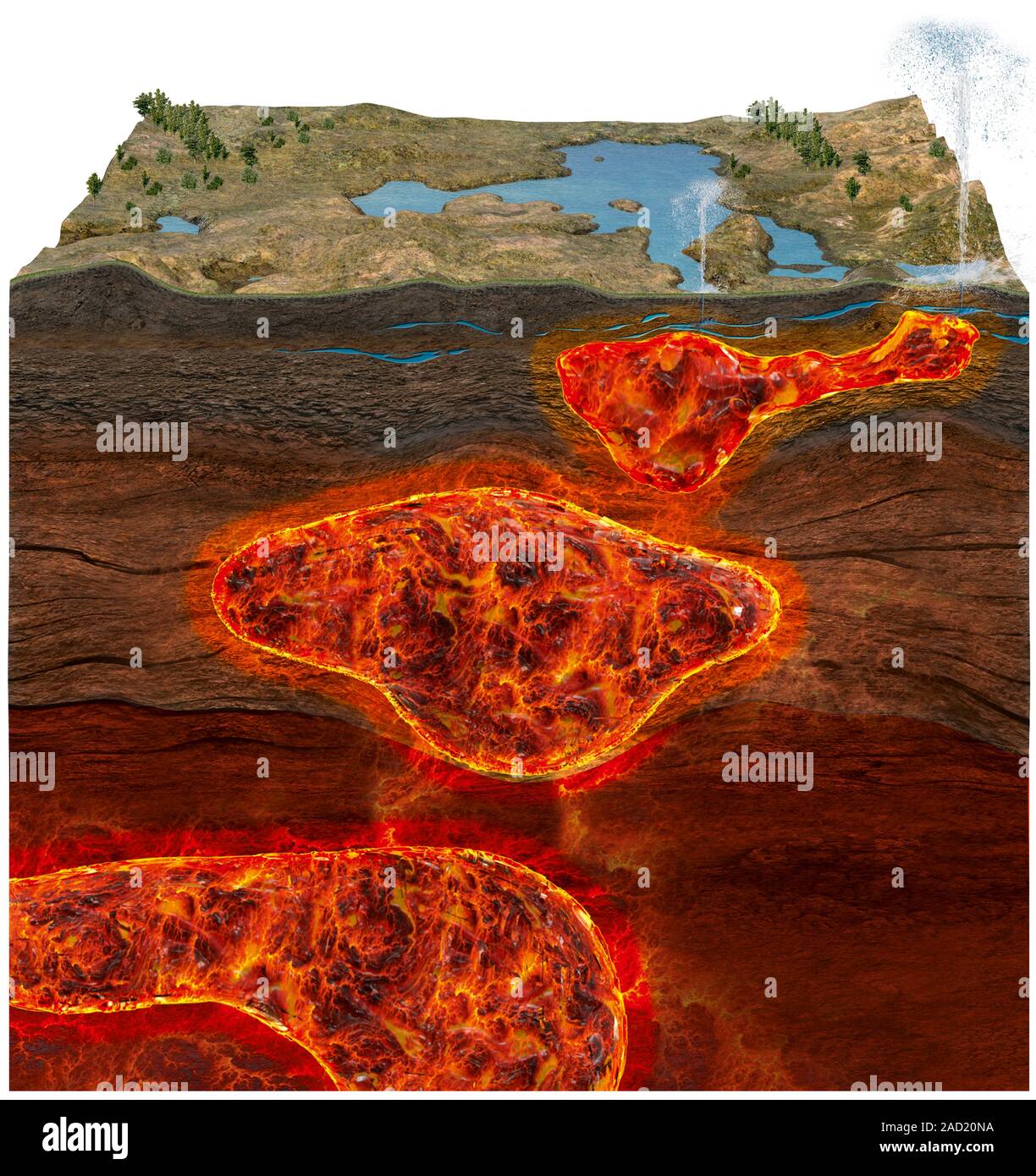
- Yellowstone (Hotspot/Continental): Beneath the famous shallow geysers and rhyolite chambers lies a second, much larger reservoir in the lower crust. As mapped by seismic studies in the mid-2010s and refined through the 2020s, this lower reservoir is roughly 4.5 times larger than the upper one, filled with hot, basaltic mush.
- Iceland (Hotspot/Mid-Ocean Ridge): In Iceland, the crust is thinner. Beneath the chambers of volcanoes like Fagradalsfjall, the plumbing system is almost direct. Observations during the 2021-2024 eruptions showed magma rising directly from the near-Moho boundary (approx. 15-20 km deep) to the surface with very little "rest time" in shallow chambers.
Frequently Asked Questions
Is there a giant void or empty cave beneath a volcano?
No. There are no empty "caverns." When magma moves out of an area, the immense pressure of the surrounding Earth causes the rock to collapse or deform to fill the space. If a shallow chamber empties quickly, the roof may collapse, forming a caldera, but the system remains filled with rock, rubble, or new magma.
How deep does the volcanic "plumbing" go?
The plumbing system typically extends to the base of the crust (30-40 km under continents, 5-10 km under oceans). However, the ultimate "roots" of the system—the zone where the rock begins to melt—can be 60 to 150 kilometers deep in the mantle.
Can we drill into the zones beneath a magma chamber?
Current technology limits us to the very top of these systems. Projects like the Krafla Magma Testbed in Iceland are working toward drilling into the edges of active magma chambers (approx. 2-3 km deep). Drilling into the deep crustal mush zones (15+ km) is currently impossible due to extreme heat and pressure which would melt or crush drilling equipment.
Does the magma always stay in these chambers?
No. Much of the magma that enters the crust from the mantle never erupts. It cools and solidifies underground to form plutons (large bodies of igneous rock like granite). This is actually how continental crust is built over millions of years.
What is the difference between a reservoir and a chamber?
In modern science, "reservoir" is often used to describe the entire region of mush and melt, whereas "chamber" often refers to a specific localized area where magma has accumulated in enough volume to be potentially eruptible.
Practical Recommendations for Researchers and Students
For those interested in the structures beneath volcanoes, it is recommended to follow the data provided by the Global Volcanism Program and the USGS Volcano Hazards Program. Understanding these systems requires a multi-disciplinary approach:
- Study Petrology: Learn how crystal chemistry reveals the pressure and temperature of the "deep" system.
- Monitor Geophysical Surveys: Look for new magnetotelluric and seismic tomographic maps of specific volcanic arcs.
- Focus on Volatiles: Pay attention to deep-gas monitoring (CO2/He isotopes) as these are the primary messengers from the depths beneath the chamber.
Image Gallery