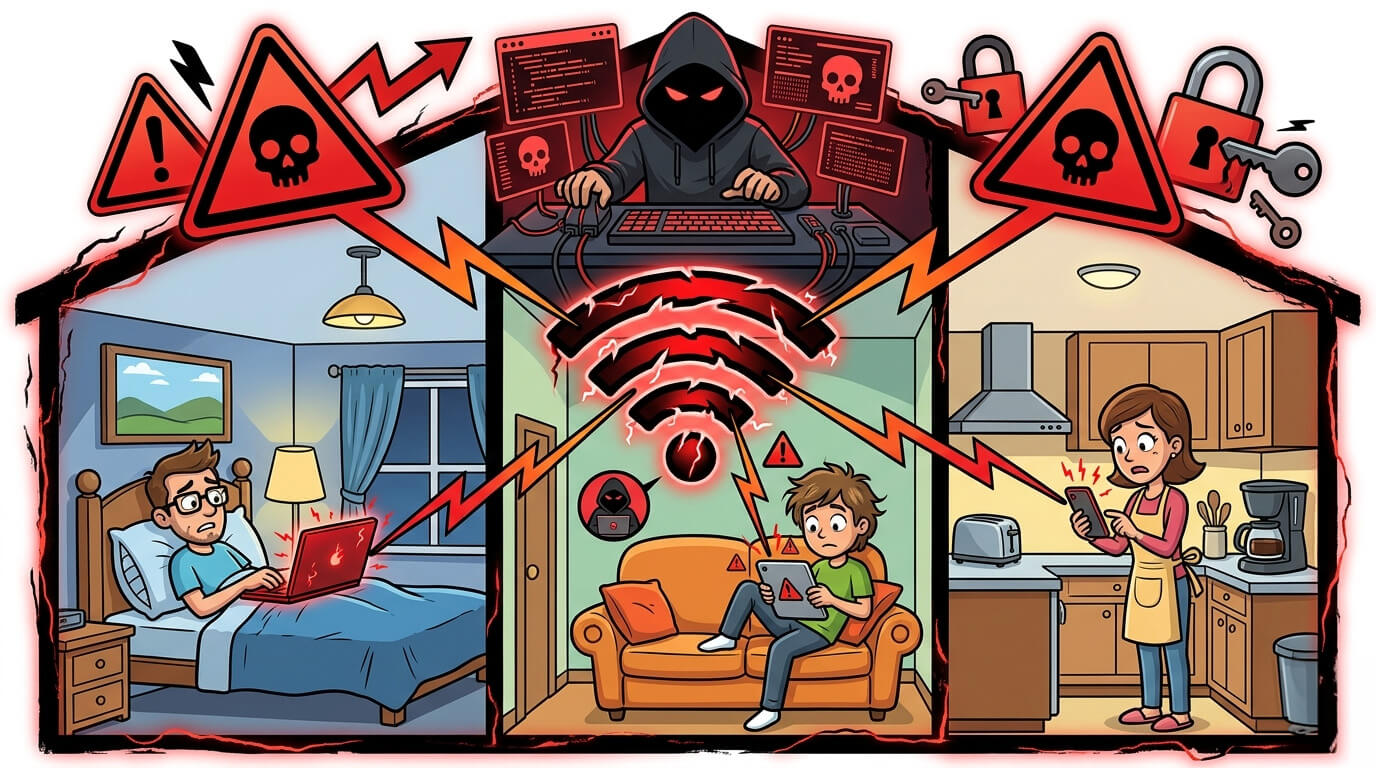
The Most Dangerous PC Viruses: A Deep Dive into Modern Threats
Modern PC threats have evolved far beyond legacy, self-replicating file viruses into sophisticated, multi-stage cyber weapons. Today’s most dangerous threats—including destructive wipers, double-extortion ransomware, modular info-steal...
Modern PC threats have evolved far beyond legacy, self-replicating file viruses into sophisticated, multi-stage cyber weapons. Today’s most dangerous threats—including destructive wipers, double-extortion ransomware, modular info-stealers, and kernel-level rootkits—bypass traditional signature-based antivirus by abusing legitimate system binaries, stealthy memory injection, and compromised administrative credentials to compromise systems and extract critical data.
Contents
The Evolution from Classic PC Viruses to Advanced Cyber Threats
In the early decades of personal computing, software threats were primarily classic file infectors and boot sector viruses. Early malware strains, such as CIH (Chernobyl) or ILOVEYOU, relied on self-replication by appending malicious code directly into executable binaries or propagating aggressively via email contact lists. Their primary goals were often direct system disruption, physical hardware corruption, or mere vandalism.
In the contemporary cyber threat landscape, the term "PC virus" serves as a broad colloquial label for an ecosystem dominated by complex, specialized malware categories. Malicious code is rarely designed simply to destroy a standalone machine for notoriety. Instead, modern threat actors operate profit-driven organizations or state-sponsored campaigns. Threat architecture has transitioned from monolithic, self-contained executables to modular, multi-stage attack chains designed to evade security controls, establish long-term persistence, and maximize financial gain or intelligence collection.
- Classic Viruses (1990s–2000s)
- Self-replicating infectors
- Direct binary modification
- Vandalism & system crash
- Defended by static AV signatures
- Modern Threat Ecosystem (2020s–2026)
- Multi-stage attack chains
- Memory-only / Fileless payloads
- Double-extortion ransomware & wipers
- Living-off-the-Land (LOLBins) tactics
Categorizing the Most Destructive PC Malware Strains
Understanding modern threats requires breaking down malware by operational behavior, payload objectives, and evasion mechanics. While many incidents involve a combination of these tactics, the core families responsible for catastrophic system compromises fall into four primary classifications.
1. Double-Extortion Ransomware and Destructive Wipers
Ransomware has shifted from basic local file encryption to complex corporate and endpoint extortion operations. Modern threat families do not simply encrypt local drives using symmetric-asymmetric hybrid cryptography (such as AES-256 combined with RSA-4096); they exfiltrate sensitive data prior to encryption. If a victim restores systems from offline backups, threat actors threaten to publish confidential files on public leak sites.
Wipers represent an even more destructive variant. disguised as ransomware, wipers contain no decryption mechanism. Their sole technical objective is the complete destruction of the Master Boot Record (MBR), GUID Partition Table (GPT), file allocation tables, or raw disk sectors, rendering recovery mathematically impossible.
2. Information Stealers and Banking Trojans
Info-stealers operate silently in user space, designed specifically to harvest valuable authentication artifacts. Rather than disrupting system stability, strains like RedLine, Lumma, and Raccoon target:
- Web browser credential stores and autofill databases.
- Stored session cookies and JSON Web Tokens (JWTs) to bypass Multi-Factor Authentication (MFA).
- Cryptocurrency wallet keys and browser extensions.
- System metadata, network configurations, and installed application lists.
This stolen information is bundled into structured logs and transmitted back to Command-and-Control (C2) infrastructure, where it is sold on initial access markets or used for enterprise network pivoting.
3. Fileless Malware and Living-off-the-Land (LotL) Tactics
Fileless malware avoids writing traditional .exe or .dll files to the hard drive, making traditional disk-scanning antivirus controls ineffective. These threats reside entirely within volatile system memory (RAM).
To execute commands and maintain persistence, attackers utilize Living-off-the-Land Binaries (LOLBins)—legitimate administrative utilities built directly into Microsoft Windows, such as PowerShell, Windows Management Instrumentation (WMI), certutil, and rundll32. By hijacking authorized processes, fileless attacks blend seamlessly into normal administrative activity.
4. Kernel-Level Rootkits and Bootkits
Rootkits operate at the deepest operational layers of the operating system. Kernel-mode rootkits insert malicious code directly into Ring 0—the execution level reserved for the operating system core and device drivers. From Ring 0, rootkits can modify kernel data structures, manipulate system calls, and hide their own processes, files, and network connections from user-space tools like Windows Task Manager and standard endpoint security agents.
Bootkits take this privilege escalation a step further by compromising the Unified Extensible Firmware Interface (UEFI) or the Master Boot Record before the operating system even loads. This ensures persistence that survives complete hard drive reformats and operating system reinstallations.
Case Studies: High-Impact Threats and Technical Mechanisms
Examining landmark malware campaigns reveals how technical features translate into widespread operational disruption.
- Initial Compromise Vector
- (Phishing, Vulnerable Driver, Exploited Edge Appliance)
- Privilege Escalation & Evasion
- (Kernel-level BYOVD, Process Injection, Token Stealing)
- Lateral Movement & Staging
- (Living-off-the-Land Binaries: WMI, PowerShell, PsExec)
- Payload Execution
- Exfiltrate & Encrypt Data (Double-Extortion Payload)
- Wipe Master Boot Record (Destructive State Payload)
WannaCry and NotPetya: The Abuse of Exploit Frameworks
In 2017, the security landscape was fundamentally changed by the release of WannaCry and NotPetya. Both campaigns weaponized EternalBlue, an exploit targeting a vulnerability in Microsoft’s Server Message Block version 1 (SMBv1) protocol documented under CVE-2017-0144.
- WannaCry functioned as a self-propagating worm that encrypted files across hundreds of thousands of systems worldwide, demanding Bitcoin ransoms.
- NotPetya appeared to be ransomware but was engineered as a wiper. It targeted the MBR and drive partition tables, deliberately overwriting encryption keys so that data recovery was impossible even if ransoms were paid.
Stuxnet: Nation-State Infrastructure Targeting
Stuxnet remains one of the most technologically complex malware frameworks ever discovered. Designed specifically to target industrial control systems (ICS) running Programmable Logic Controllers (PLCs), Stuxnet utilized four distinct zero-day vulnerabilities in Microsoft Windows alongside stolen legitimate digital certificates.
Its architecture included a user-mode rootkit, a kernel-mode driver, and specialized payload code designed to intercept control signals to industrial hardware while reporting normal operations back to monitoring consoles.
BYOVD and the Rise of Modern Driver-Based Rootkits
As Microsoft strengthened Windows kernel protections through features like Driver Signature Enforcement (DSE) and Hypervisor-Protected Code Integrity (HVCI), threat actors shifted to Bring Your Own Vulnerable Driver (BYOVD) attacks.
In a BYOVD campaign, malware drops a legitimately signed, legacy third-party driver containing known security flaws onto the target machine. The malware exploits that driver's valid signature to load into kernel space, then uses the driver's vulnerabilities to disable Endpoint Detection and Response (EDR) processes directly in Ring 0.
Comparative Analysis of Modern PC Malware Classes
The following table compares the structural characteristics, delivery methods, and damage metrics of major modern malware categories.
| Threat Category | Key Mechanisms & Tactics | Primary Damage Type | Detection Difficulty | Core Mitigation Focus |
|---|---|---|---|---|
| Double-Extortion Ransomware | AES/RSA encryption, volume shadow copy deletion, C2 exfiltrators | Financial extortion, permanent data loss, data leaks | Moderate to High | Immutable offline backups, network micro-segmentation |
| Destructive Wipers | Low-level disk writing, MBR/GPT corruption, master file table destruction | Permanent infrastructure destruction | Moderate | Strict access control, rapid incident isolation |
| Info-Stealers | Hooking web APIs, memory scraping, browser sqlite database parsing | Credential theft, identity takeover, initial access brokering | Low to Moderate | MFA with FIDO2 hardware keys, credential rotation |
| Fileless / LOLBin Malware | PowerShell execution, process injection (LSASS, svchost) |
Stealth persistence, lateral movement, internal reconnaissance | High | PowerShell logging, Behavioral EDR, Script Block Logging |
| Kernel & Bootkits | BYOVD exploits, UEFI firmware modification, Ring 0 interception | Complete system compromise, persistent surveillance | Extremely High | Secure Boot, HVCI, hardware-based TPM verification |
Technical Indicators of Compromise (IoCs) and Evasion Tactics
Modern threats use sophisticated techniques to avoid detection by security tools. Identifying these attacks requires looking beyond simple file hash matching to monitor behavioral patterns and system anomalies.
Evasion Tactics
- Process Injection: Malware injects shellcode into trusted processes (such as
explorer.exeorlsass.exe) using Windows APIs likeVirtualAllocEx,WriteProcessMemory, andCreateRemoteThread. This hides malicious code within legitimate process memory. - Obfuscation and Polymorphism: Payloads are dynamically packed, encrypted, or obfuscated using randomized variable names and string encryption (e.g., Base64 or XOR encoding) to frustrate static code analysis.
- Anti-Analysis and Sandbox Detection: Malicious scripts execute checks for virtual machine (VM) artifacts, specialized debugger registers, or low CPU core counts. If a sandbox environment is detected, the malware terminates execution or exhibits harmless behavior.
System Indicators of Compromise
- Shadow Copy Erasure: Automated execution of commands like
vssadmin.exe delete shadows /all /quietorwmic shadowcopy deleteto prevent easy local recovery. - Unusual Outbound C2 Traffic: Network connections originating from standard Windows binaries (
rundll32.exe,regsvr32.exe, orpowershell.exe) to unrecognized external IP addresses over non-standard ports or encrypted DNS over HTTPS (DoH) channels. - Abnormal Persistence Entries: Unexpected keys created in registry Run locations (
HKCU\Software\Microsoft\Windows\CurrentVersion\Run), scheduled tasks invoking encoded scripts, or newly registered system services. - LSASS Memory Dumping: Security logs recording unauthorized handle requests to the Local Security Authority Subsystem Service (
lsass.exe), often attempted via tools like Mimikatz or customized dumps viarundll32.exe comsvcs.dll.
Modern Defense Strategies and System Hardening
Relying solely on traditional standalone antivirus software is insufficient against modern fileless attacks, zero-day exploits, and kernel-level threats. Robust security requires a defense-in-depth framework combining system configuration, behavioral monitoring, and architecture-level controls.
- Zero Trust Access Policy (Least Privilege, FIDO2 MFA, Device Compliance)
- Endpoint Hardening Layer (Secure Boot, TPM 2.0, HVCI, Virtualization)
- Behavioral Detection & Containment (EDR Agent, Script Block Logging, ASR Rules)
- Resilience & Recovery Layer (3-2-1 Backups, Immutable Storage, Playbooks)
1. Implement Zero Trust Architecture and Principle of Least Privilege
Users should operate daily accounts under standard user privileges rather than localized administrative accounts. Enforcing administrative boundaries limits the scope of arbitrary code execution. Network segmentation ensures that if an endpoint is compromised, lateral movement across subnets via SMB or Remote Desktop Protocol (RDP) is restricted.
2. Enable Hardware-Enforced Security and Kernel Controls
Modern operating systems leverage CPU virtualization to isolate security-critical operations:
- Secure Boot: Verifies the cryptographic signatures of bootloaders, kernel components, and driver files prior to execution, preventing bootkits from loading.
- Memory Integrity (HVCI): Uses hypervisor-level security to prevent unsigned or untrusted code from executing within the Windows kernel, effectively mitigating standard driver injection techniques.
- Credential Guard: Isolates credential secrets within a virtualized container, blocking direct memory scraping of the
lsass.exeprocess.
Detailed guidelines on configuring platform security controls are maintained in the NIST Computer Security Resource Center frameworks.
3. Deploy Enterprise Endpoint Detection and Response (EDR)
Unlike legacy antivirus tools that rely on static database signatures, EDR solutions collect process execution, telemetry, registry modifications, and network connections in real time. EDR engines employ heuristic analysis and behavioral machine learning models to identify suspicious actions—such as a Word document spawning a PowerShell process that opens an outbound connection—and terminate execution automatically.
For threat hunting and telemetry classification, organizations align security operations with the MITRE ATT&CK Framework, mapping behavioral patterns to known adversary tactics.
4. Enforce Robust Backup Policies (The 3-2-1 Rule)
To counter double-extortion and wiper scenarios, data recovery strategies must rely on immutable infrastructure. Organizations should enforce the 3-2-1-1-0 backup rule:
- Maintain at least 3 copies of critical data.
- Store backups on 2 different media types.
- Keep 1 copy at an offsite location.
- Ensure 1 copy is completely offline (air-gapped) or stored in an immutable, write-once-read-many (WORM) cloud repository.
- Confirm 0 errors during automated recovery testing.
Frequently Asked Questions
What is the main difference between a legacy PC virus and modern malware?
A legacy PC virus is typically a standalone program that self-replicates by appending its code directly into local files or system sectors. Modern malware consists of complex, modular software systems—such as ransomware, info-stealers, and fileless scripts—that use advanced evasive maneuvers, command-and-control networks, and multi-stage infection techniques for financial gain or intelligence gathering.
Can traditional antivirus software prevent fileless malware attacks?
Traditional signature-based antivirus software often misses fileless malware because the attack runs entirely within volatile memory (RAM) and uses built-in operating system administrative utilities (LOLBins). Preventing fileless attacks requires Endpoint Detection and Response (EDR) agents capable of real-time process behavior monitoring, script block logging, and memory inspection.
How does modern ransomware differ from a destructive wiper?
While ransomware encrypts files and promises a decryption key in exchange for payment, a wiper is engineered solely to destroy data or disk structures permanently. Wipers often mimic ransomware interfaces, but they overwrite disk sectors, partition tables, or system metadata without retaining a decryption mechanism, making data restoration impossible.
How do modern threat actors bypass Multi-Factor Authentication (MFA)?
Threat actors bypass standard MFA primarily through session hijacking via info-stealer malware or Adversary-in-the-Middle (AiTM) phishing proxies. Info-stealers extract valid authentication session cookies directly from the victim's browser memory or local profile databases, allowing attackers to import those cookies into their own browsers and impersonate authenticated sessions without prompting for password or SMS OTP inputs.
Why are kernel-level rootkits exceptionally difficult to detect?
Kernel-level rootkits operate in Ring 0, the highest privilege level of the operating system. From Ring 0, malicious code can intercept system calls and modify operating system data structures. This allows the rootkit to hide its presence directly from user-level security applications, task managers, and system monitoring tools. Detection often requires hardware-enforced hypervisor security or offline forensic analysis.
Recommended Next Steps for Endpoint Hardening
To protect systems against modern, high-impact PC malware, system administrators and security managers should execute the following hardening baseline:
- Audit Account Privileges: Strip administrative rights from daily user accounts and enforce dedicated, isolated Administrative Workstations (PAWs) for privileged tasks.
- Enforce Baseline Hardening: Enable Hardware-Enforced Stack Protection, Secure Boot, and Memory Integrity (HVCI) within system security settings.
- Configure Attack Surface Reduction (ASR): Enable Microsoft Defender ASR rules to block executable content from email clients, prevent Office applications from creating child processes, and block credential stealing from the Windows Local Security Authority subsystem.
- Deploy System Auditing: Configure centralized logging for PowerShell (Module Logging, Script Block Logging), Process Creation (Event ID 4688 with Command Line auditing enabled), and WMI event consumers.
- Establish Out-of-Band Backups: Validate that all operational backups include at least one immutable or physically disconnected offline target, and run quarterly restoration exercises to verify data integrity.
For technical guidance on managing system vulnerabilities, refer to official alerts published by the Cybersecurity and Infrastructure Security Agency (CISA).
Image Gallery