What War Was WW2? Understanding World War II and Its Global Impact
World War II (WW2) was a global military conflict fought from 1939 to 1945 between two major international coalitions: the Allies and the Axis powers. Spanning multiple continents and oceans, it was the deadliest and largest war in hum...
World War II (WW2) was a global military conflict fought from 1939 to 1945 between two major international coalitions: the Allies and the Axis powers. Spanning multiple continents and oceans, it was the deadliest and largest war in human history, involving over 100 million military personnel from more than 30 countries and resulting in an estimated 70 to 85 million casualties.
Contents
Historical Context and Origins of World War II
To understand what war WW2 was, one must examine the geopolitical instability left unresolved by World War I (1914–1918). The peace settlement established under the 1919 Treaty of Versailles imposed severe financial reparations, territorial losses, and military restrictions on Germany. These punitive conditions severely damaged Germany's economy, contributing to hyperinflation during the 1920s and widespread socio-political turmoil during the Great Depression.
During the late 1920s and 1930s, totalitarian and fascist regimes seized power across several nations:
- Germany: Adolf Hitler and the National Socialist German Workers' Party (Nazi Party) took control in 1933, pursuing an aggressive expansionist policy centered on securing Lebensraum ("living space") for the German nation and overturning the Versailles Treaty.
- Italy: Benito Mussolini established a Fascist dictatorship in 1922, seeking to build a new Roman Empire through military conquests in East Africa and the Mediterranean.
- Japan: Military leaders gained dominant political control over Imperial Japan, invading Manchuria in 1931 and launching a full-scale invasion of China in 1937 to secure vital energy and industrial raw materials.
The international security framework created after World War I—primarily the League of Nations—proved incapable of preventing aggressive territorial annexations. Germany remilitarized the Rhineland in 1936, annexed Austria (Anschluss) in March 1938, and occupied the Sudetenland region of Czechoslovakia following the Munich Agreement later that year.
The immediate catalyst for World War II occurred on September 1, 1939, when Nazi Germany invaded Poland. In response to Germany's unprovoked aggression, Great Britain and France declared war on Germany on September 3, 1939, marking the formal beginning of the war in Europe.
The Opposing Alliances: Allies vs. Axis Powers
World War II was contested between two opposing military pacts: the Allies and the Axis powers. While the war began as a series of regional conflicts in Europe, Asia, and Africa, mutual defense treaties and global strategic alliances eventually consolidated the belligerents into these two primary blocs.
- WORLD WAR II (1939–1945)
- ALLIED POWERS
- Great Britain
- Soviet Union
- United States
- Republic of China
- AXIS POWERS
- Nazi Germany
- Imperial Japan
- Kingdom of Italy
- Co-belligerents
- ALLIED POWERS
The Axis Powers
The Tripartite Pact, signed in September 1940 by Germany, Italy, and Japan, formally established the Axis alliance. Other nations, including Hungary, Romania, Bulgaria, and Slovakia, subsequently joined the Axis coalition. The Axis strategic objectives were driven by aggressive territorial expansion, militaristic nationalism, and the dismantling of the existing international political order.
The Allied Powers
The primary Allied coalition—often referred to during the later stages of the war as the "Big Three" alongside China—comprised:
- Great Britain (and the Commonwealth): Led initially by Prime Minister Neville Chamberlain and later by Winston Churchill, Britain maintained continuous military resistance against Germany from the first day of the European conflict.
- The Soviet Union: Led by Joseph Stalin, the USSR initially signed a non-aggression pact with Germany (the Molotov-Ribbentrop Pact) in August 1939. However, after Germany launched a massive surprise invasion of Soviet territory in June 1941, the USSR became a central Allied power.
- The United States: Under President Franklin D. Roosevelt, the U.S. initially maintained official neutrality while supplying material aid to Britain and China via programs such as Lend-Lease. The U.S. formally entered the war following Imperial Japan's surprise attack on Pearl Harbor on December 7, 1941.
- The Republic of China: Led by Chiang Kai-shek, China fought Imperial Japan from 1937 through 1945 in the longest continuous conflict of the war, tying down huge numbers of Japanese troops on the Asian mainland.
Key Characteristics of the Belligerent Coalitions
| Coalition | Primary Members | Key Leaders | Strategic Objectives | Global Outcome |
|---|---|---|---|---|
| Allied Powers | United States, Soviet Union, Great Britain, China, Free France | Franklin D. Roosevelt, Joseph Stalin, Winston Churchill, Chiang Kai-shek | Defeat Axis expansion, restore sovereign independence, establish post-war collective security | Victory; established United Nations and post-war international framework |
| Axis Powers | Germany, Japan, Italy | Adolf Hitler, Hideki Tojo, Benito Mussolini | Establish regional hegemonies (Lebensraum, Greater East Asia Co-Prosperity Sphere) | Defeated; regime destructions, unconditional surrender, Allied military occupations |
Major Theaters of Operation
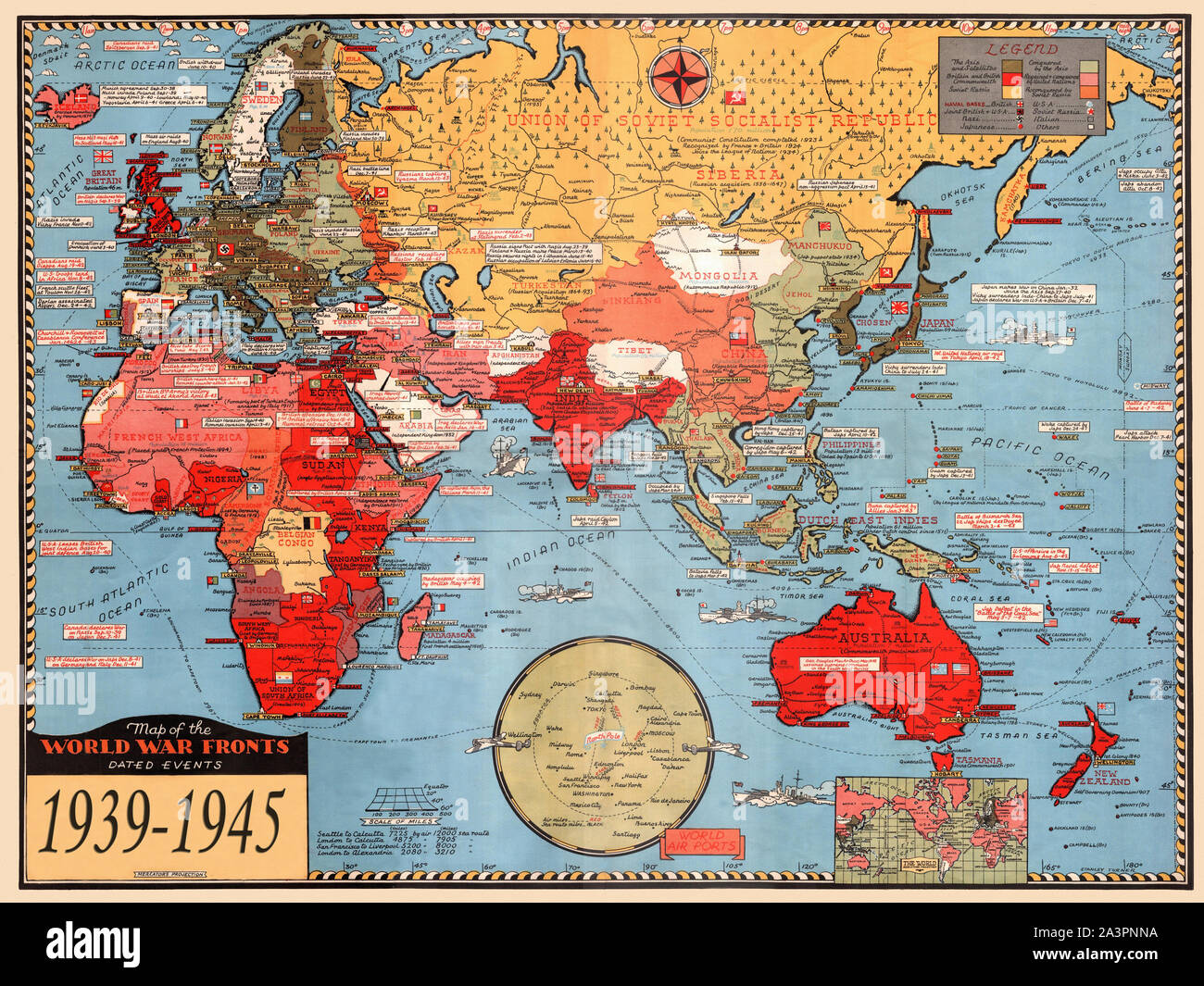
World War II was fought across vast geographical regions, broadly divided into two major operational arenas: the European Theater (which included North Africa and the Atlantic) and the Pacific Theater.
The European, North African, and Mediterranean Theaters
- Western Front: Began with the German Blitzkrieg ("lightning war") invasions of Poland, Denmark, Norway, the Low Countries, and France in 1940. Following the Fall of France, the Battle of Britain was fought entirely in the air as the Royal Air Force repelled the German Luftwaffe. The Western Front reopened on a massive scale on June 6, 1944 (D-Day), with the Allied amphibious landings at Normandy, France.
- Eastern Front: Launched on June 22, 1941, under the German code name Operation Barbarossa, the invasion of the Soviet Union created the largest and violent land theater in military history. The fighting along the Eastern Front was marked by unprecedented ferocity, immense military casualties, and systematic atrocities against civilian populations.
- North African and Mediterranean Campaigns: Allied forces fought Italian and German troops across the deserts of North Africa from 1940 to 1943 to control the Suez Canal and access to Middle Eastern oil fields. Allied victory in North Africa launched the invasions of Sicily and mainland Italy in 1943.
The Pacific and East Asian Theaters
- The Asian Mainland: The Second Sino-Japanese War (1937–1945) featured large-scale conventional military combat, guerrilla warfare, and severe attrition across eastern and central China.
- The Pacific Ocean Theater: Following the attack on Pearl Harbor, Japanese military forces rapidly expanded across Southeast Asia, capturing the Philippines, Malaya, Singapore, and the Dutch East Indies. Allied forces, dominated by the United States Navy, Marine Corps, and Army, executed a strategic campaign known as "island hopping" to capture key strategic positions while bypassing heavily fortified Japanese bases.
Pivotal Battles and Turning Points
Several decisive military engagements shifted the strategic initiative from the Axis powers to the Allies between 1942 and 1944.
Timeline of Key Turning Points:
- 1940: Battle of Britain (Air defense stops German invasion plan)
- 1942: Battle of Midway (U.S. Navy halts Japanese Pacific expansion)
- 1942-1943: Battle of Stalingrad (Soviet Army destroys German 6th Army)
- 1943: Battle of Kursk (Largest tank battle; Soviets gain permanent initiative)
- 1944: D-Day / Normandy (Allies establish Western European front)
- 1945: Atomic Bombings & Surrender (World War II officially ends)
1. The Battle of Midway (June 1942)
Fought in the Central Pacific, the Battle of Midway was a decisive naval battle in which the United States Navy intercepted and destroyed four Japanese aircraft carriers. This loss permanently crippled Imperial Japan's offensive naval capacity, placing the Axis on the defensive in the Pacific.
2. The Battle of Stalingrad (August 1942 – February 1943)
Widely considered one of the deadliest battles in human history, Stalingrad involved brutal urban fighting between German forces and the Soviet Red Army. The Soviet encirclement and destruction of the German Sixth Army marked the definitive turning point on the Eastern Front. Germany never recovered its strategic offensive capabilities in Eastern Europe after this defeat.
3. The Battle of El Alamein (October – November 1942)
British Commonwealth forces under General Bernard Montgomery defeated Field Marshal Erwin Rommel's German-Italian forces in Egypt. This victory secured the Suez Canal and marked the beginning of the complete expulsion of Axis forces from North Africa.
4. Normandy Landings / D-Day (June 6, 1944)
Code-named Operation Overlord, Allied forces under General Dwight D. Eisenhower launched the largest amphibious invasion in history along the coast of Normandy, France. The successful establishment of a beachhead allowed Allied armies to liberate Western Europe and launch a two-front land war against Nazi Germany.
Human Cost, Total War, and the Holocaust
World War II was the primary historical example of "total war," a condition in which belligerent nations mobilized their complete economic, industrial, scientific, and human resources for the war effort. Consequently, the distinction between combatants and non-combatants was erased to a degree never seen before.
Mobilization and Civilian Impact
Governments implemented widespread rationing, industrial conversions, and civil defense measures. Strategic bombing campaigns targeted industrial centers and major cities on both sides, including the Allied bombing of Dresden and Tokyo, and the German Blitz against London. Tens of millions of civilians were displaced, faced severe famine, or suffered under brutal military occupations.
Total Estimated World War II Deaths (~70–85 Million Total):
- Civilian Deaths (Disease, Famine, Atrocities): ~50–55 Million
- Military Deaths (Combat, POWs): ~20–25 Million
The Holocaust and Axis War Crimes
World War II was characterized by state-sponsored genocides and war crimes executed primarily by Nazi Germany and Imperial Japan.
- The Holocaust (Shoah): Under the cover of the war, Nazi Germany systematically murdered approximately six million Jewish people—representing two-thirds of Europe's Jewish population—alongside millions of others, including Romani people, Soviet prisoners of war, Poles, persons with disabilities, and political dissidents. This systematic extermination was carried out through mass shootings, forced labor, and industrial concentration and extermination camps such as Auschwitz-Birkenau and Treblinka.
- Japanese War Crimes: Imperial Japanese forces committed widespread war crimes across Asia, including the Nanjing Massacre (1937), forced human experimentation by Unit 731, mass executions of prisoners of war, and the forced sexual enslavement of women ("comfort women") across occupied territories.
The End of the War and Post-War Order (1945)
World War II ended in two distinct phases: first in Europe, and subsequently in Asia.
The Surrender of Germany (V-E Day)
By early 1945, Soviet forces advanced toward Berlin from the east, while Western Allied armies crossed the Rhine River from the west. Trapped in his bunker beneath Berlin, Adolf Hitler committed suicide on April 30, 1945. Germany signed an unconditional surrender on May 7–8, 1945, celebrated globally as Victory in Europe (V-E) Day.
The Surrender of Japan (V-J Day)
In the Pacific, Allied forces advanced toward the Japanese mainland through hard-fought battles at Iwo Jima and Okinawa. To force a rapid unconditional surrender and avoid a costly amphibious invasion of the Japanese mainland, United States President Harry S. Truman authorized the operational deployment of atomic weapons developed by the Manhattan Project.
- On August 6, 1945, the U.S. dropped an atomic bomb on the city of Hiroshima.
- On August 9, 1945, a second atomic bomb was dropped on Nagasaki.
- Concurrently, the Soviet Union declared war on Japan and invaded Japanese-occupied Manchuria.
Imperial Japan announced its unconditional surrender on August 15, 1945. The formal signing of the surrender documents occurred aboard the battleship USS Missouri in Tokyo Bay on September 2, 1945, bringing World War II to an official end.
Key Events Leading to the End of WW2:
- April 30, 1945: Hitler commits suicide in Berlin bunker
- May 8, 1945: Germany surrenders unconditionally (V-E Day)
- August 6, 1945: U.S. drops atomic bomb on Hiroshima
- August 9, 1945: U.S. drops atomic bomb on Nagasaki
- Sept 2, 1945: Japan formally signs surrender (V-J Day)
Geopolitical Legacy and Long-Term Consequences
The outcome of World War II completely reshaped the global political, economic, and institutional landscape:
- Establishment of the United Nations: To prevent future global conflicts, international leaders established the United Nations (UN) in October 1945, replacing the defunct League of Nations with a framework for diplomacy and collective security.
- Emergence of the Cold War: The war destroyed the traditional European balance of power, leaving two ideological superpowers—the capitalist United States and the communist Soviet Union—to dominate global geopolitics, initiating the Cold War (1947–1991).
- Decolonization: Financial exhaustion and political shifts weakened Western European colonial powers (such as Great Britain, France, and the Netherlands), accelerating decolonization movements across Asia, Africa, and the Middle East over the subsequent decades.
- Nuclear Age: The deployment of atomic weaponry introduced nuclear arms into global strategy, fundamentally altering defense policy and deterrence theory worldwide.
Frequently Asked Questions
What was the main cause of World War II?
World War II was caused by a combination of factors, including the harsh terms imposed on Germany by the 1919 Treaty of Versailles, severe global economic instability caused by the Great Depression, the failure of the League of Nations to stop aggression, and the rise of militaristic, expansionist dictatorships in Germany, Italy, and Japan.
How did World War II differ from World War I?
While World War I was primarily fought using defensive trench warfare concentrated in Western Europe, World War II was a highly mobile, industrialized conflict fought across global land, sea, and air fronts. World War II involved much higher civilian casualties, advanced radar and aviation technology, armored warfare, and the first deployment of nuclear weapons.
Which nations remained neutral during World War II?
Several countries maintained official neutrality throughout World War II, including Switzerland, Sweden, Spain, Ireland, Portugal, and Afghanistan. However, many neutral nations still provided economic trade, intelligence, or transit rights to one or both belligerent sides.
What was the deadliest battle of World War II?
The Battle of Stalingrad (1942–1943) is recognized as the deadliest battle of World War II, resulting in an estimated 1.8 to 2 million total casualties (killed, wounded, or captured) combined between the German Wehrmacht and the Soviet Red Army.
How many people died in total during WW2?
Historical estimates put total military and civilian fatalities between 70 million and 85 million people. More than half of these deaths were civilians who perished due to strategic bombings, massacres, state-sponsored genocide (including the Holocaust), forced labor, disease, and war-induced famines.
Recommended Resources for Further Historical Study
To gain a deeper understanding of World War II, its operational history, and its socio-political impact, consult these primary historical archives and research institutions:
- The National WWII Museum: Comprehensive educational resources, oral histories, and tactical campaign maps.
- Imperial War Museums (IWM): Deep collections of primary documents, photographs, and artifacts covering the global British and Commonwealth military commitments.
- United States Holocaust Memorial Museum: Essential historical documentation, evidence, and research regarding the Holocaust and Nazi war crimes.
Image Gallery