Why Cloud Storage Is Susceptible to Security Threats
Cloud storage is inherently susceptible to security threats due to its distributed architecture, shared responsibility models, multi-tenant environments, and constant exposure to the public internet, which multiplies the potential atta...
Cloud storage is inherently susceptible to security threats due to its distributed architecture, shared responsibility models, multi-tenant environments, and constant exposure to the public internet, which multiplies the potential attack surface for malicious actors.
Contents
The migration of enterprise data, personal archives, and critical application assets from local, air-gapped hard drives to remote cloud infrastructure has fundamentally transformed digital operations. While platforms managed by industry giants offer immense scalability, cost efficiency, and operational agility, they simultaneously introduce distinct security vulnerabilities. Understanding why cloud storage is susceptible to security threats requires an examination of the systemic design choices, human behavioral factors, and operational complexities that define modern cloud computing.
The Shift from Perimeter Defense to Distributed Infrastructure
Traditional enterprise security relied heavily on a physical perimeter model, often described as a "castle-and-moat" architecture. Data resided on servers inside a physical office building, protected by firewalls, locked server rooms, and physical security guards. Access was strictly regulated for individuals physically present on the local area network (LAN) or connecting via heavily monitored virtual private networks (VPNs).
Cloud storage completely dismantles this physical perimeter. Data stored in environments like Amazon S3, Microsoft Azure Blob Storage, or Google Cloud Storage exists on virtualized servers distributed across global data centers.
- Public Accessibility: Unlike a local hard drive, cloud storage buckets and repositories are accessible via uniform resource locators (URLs) over the public internet by default unless explicitly locked down.
- Decentralized Access: Users, administrators, and automated applications access these resources from varying geographic locations, disparate Wi-Fi networks, and diverse endpoint devices.
- Elimination of Physical Control: Organizations surrender physical custody of their hardware. They cannot physically inspect hard drives, pull network cables during a breach, or dictate the physical security protocols of the third-party data center floor.
This decentralization means that security is no longer a matter of protecting a physical box; it is an exercise in managing logical boundaries across an infinite, amorphous digital landscape.
The Shared Responsibility Model and Misconfigurations
One of the most profound structural vulnerabilities in cloud storage stems from the Shared Responsibility Model. Major cloud service providers (CSPs) like Amazon Web Services (AWS), Microsoft Azure, and Google Cloud Platform (GCP) operate under a strict division of security duties.
The CSP is responsible for the "security of the cloud"—securing the underlying physical infrastructure, hypervisors, cooling systems, hardware components, and foundational networking facilities. However, the customer or client organization remains entirely responsible for the "security in the cloud." This includes:
- Configuring access control lists (ACLs) and permissions.
- Managing user identities, credentials, and multi-factor authentication.
- Encrypting data at rest and in transit.
- Monitoring audit logs and setting up threat detection.
Human error routinely exploits this structural division. Misconfigured cloud storage buckets—where permissions are accidentally set to "public" or "read/write for all users"—are among the leading causes of data exposure. Administrators deploying rapid infrastructure templates often leave default credentials active, omit encryption keys, or fail to restrict API access keys. Because cloud storage systems are designed for seamless data sharing, a single misplaced checkbox can instantly broadcast terabytes of confidential corporate records, intellectual property, or personally identifiable information (PII) to the open web.
Multi-Tenancy and Isolation Complexities
Cloud storage architectures rely heavily on multi-tenancy, a design pattern where multiple distinct customers share the same physical hardware, storage arrays, and networking infrastructure. This virtualization maximizes resource efficiency and drives down costs, but it also creates shared risk pools.
In a multi-tenant cloud storage environment, logical separation replaces physical separation. Virtual machines, containers, and storage blocks are partitioned using software-defined networking and hypervisor isolation. While these software barriers are robust, they are not infallible:
- Hypervisor Vulnerabilities: Flaws in the virtualization layer can theoretically allow an attacker to escape a virtual container and access neighboring tenants' data streams.
- Resource Contention and Side-Channel Attacks: Advanced cyber threats involve monitoring hardware resource consumption (such as cache usage or memory access patterns) on shared physical servers to infer data belonging to other tenants.
- Cascading Failures: A catastrophic security event or misconfiguration affecting the core management plane of a multi-tenant cloud provider can ripple across thousands of seemingly unrelated client organizations simultaneously.
Identity and Access Management (IAM) Vulnerabilities
In cloud storage, identity is the new perimeter. Because data cannot be protected by a physical gate, access is governed entirely by digital credentials—usernames, passwords, API tokens, cryptographic keys, and OAuth grants. This reliance on Identity and Access Management (IAM) makes identity theft a primary vector for cloud breaches.
Adversaries routinely target IAM systems through several specialized techniques:
- Credential Stuffing and Brute Forcing: Automated bots test stolen username and password pairs across multiple cloud management portals.
- Stolen API Keys and Secrets: Developers frequently hardcode access tokens or AWS Secret Access Keys into public code repositories like GitHub, allowing automated scrapers to harvest them within minutes.
- Privilege Escalation: Once an attacker compromises a low-level user account, they exploit overly permissive IAM roles that grant administrative privileges, enabling them to alter security settings, disable logging, and exfiltrate entire storage volumes.
- Insider Threats: Malicious or disgruntled employees with legitimate access permissions can silently copy vast quantities of proprietary data to external personal storage accounts without triggering traditional perimeter alarms.
API Exposure and Automation Risks
Cloud storage is managed, monitored, and manipulated through extensive Application Programming Interfaces (APIs). Every time a file is uploaded, deleted, shared, or indexed, an API call is executed behind the scenes. While this automation is essential for modern software development and DevOps workflows, it significantly broadens the threat surface.
APIs represent direct programmatic gateways to data stores. If an API endpoint lacks rigorous authentication, input validation, or rate limiting, it becomes vulnerable to injection attacks, cross-site scripting (XSS), and unauthorized data extraction. Furthermore, automated scripts and microservices often require persistent access credentials to function without human intervention. If an automated service account is compromised, attackers can use its legitimate API permissions to siphon data undetected over extended periods.
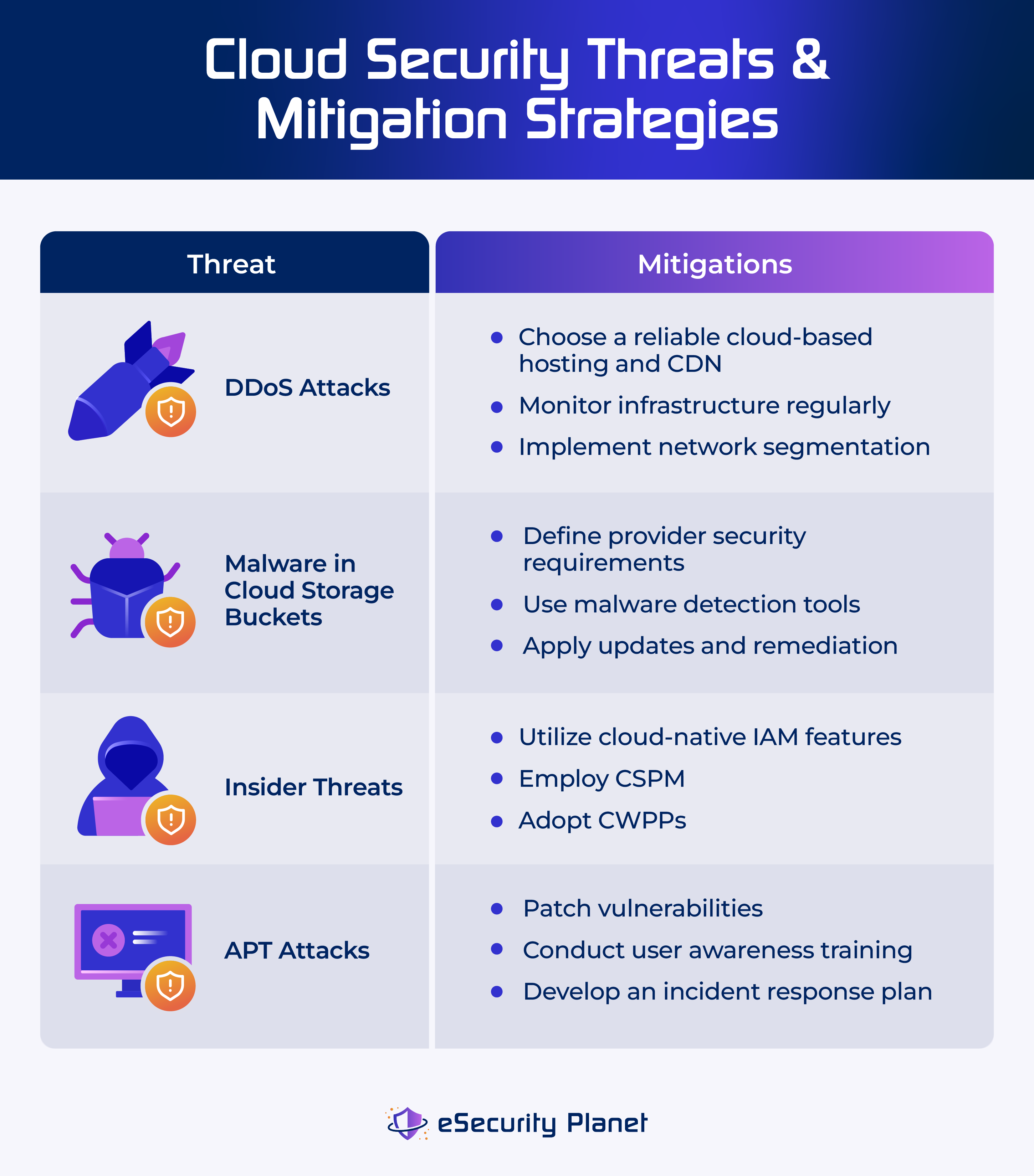
| Cloud Threat Vector | Primary Cause | Potential Impact | Mitigation Strategy |
|---|---|---|---|
| Misconfigured Buckets | Human error in IAM and ACL settings | Public exposure of sensitive files | Automated compliance scanning and policy-as-code |
| Compromised Credentials | Phishing, hardcoded API keys, password reuse | Unauthorized data access and exfiltration | Mandatory MFA, hardware tokens, and secret management tools |
| API Vulnerabilities | Insecure endpoints and lack of rate limiting | Data injection, system override, and silent extraction | API gateways, strict input validation, and token rotation |
| Multi-Tenant Flaws | Hypervisor bugs and logical separation failures | Cross-tenant data leakage | Hardware isolation options and continuous vulnerability patching |
Data Interception and Transit Vulnerabilities
Data in cloud storage is constantly in motion—traveling from local user devices across local internet service providers, through public peering exchanges, into cloud provider edge locations, and finally landing on physical storage disks. Each leg of this transit journey introduces exposure risks.
Without end-to-end encryption, data packets traversing public networks can be intercepted via man-in-the-middle (MitM) attacks, particularly when users access cloud storage via unsecured public Wi-Fi networks in airports, hotels, or cafes. While reputable cloud providers enforce HTTPS/TLS protocols for data in transit, legacy applications, misconfigured client software, or poorly implemented custom integrations may still transmit sensitive payloads in plain text. Similarly, data at rest must be encrypted using robust cryptographic standards (such as AES-256). If encryption keys are mismanaged, stored alongside the data, or controlled entirely by a compromised provider, the protection dissolves.
Supply Chain and Third-Party Integration Risks
Modern cloud storage ecosystems do not operate in a vacuum. Organizations routinely integrate third-party software-as-a-service (SaaS) applications, analytics plugins, backup tools, and customer relationship management (CRM) platforms directly into their cloud storage repositories.
This creates a complex software supply chain. An enterprise might maintain rigorous internal security controls, but if a third-party vendor possessing API access to their cloud storage bucket suffers a security breach, the enterprise's data is instantly compromised. Attackers frequently target vulnerable third-party plugins as an indirect entry point to bypass corporate firewalls and multi-factor authentication gates.
Regulatory, Compliance, and Visibility Gaps
Managing security in cloud storage is further complicated by a lack of operational visibility. Traditional IT teams could physically audit servers and review local logs with relative ease. In the cloud, tracking data lineage—knowing precisely who accessed a file, when they accessed it, where it was copied, and whether it was shared externally—requires sophisticated Cloud Access Security Brokers (CASBs) and continuous security posture management (CSPM) tools.
When organizations lack deep visibility, compliance failures follow. Regulations such as the General Data Protection Regulation (GDPR), the Health Insurance Portability and Accountability Act (HIPAA), and the California Consumer Privacy Act (CCPA) impose strict mandates on how personal and health data must be stored, encrypted, and monitored. Cloud storage susceptibility directly translates to severe regulatory fines, legal liabilities, and reputational damage when compliance frameworks fail.
Frequently Asked Questions
Why is cloud storage more vulnerable to human error than on-premises storage?
Cloud storage systems are designed for high accessibility, flexibility, and rapid deployment. This requires complex permission architectures managed via digital interfaces. Unlike physical server rooms where access is physically constrained, a single mistaken configuration toggle in a cloud console can instantly expose enterprise repositories to the public internet without triggering immediate hardware alerts.
Does encryption make cloud storage completely secure against threats?
Encryption significantly reduces the risk of data exposure by ensuring that even if unauthorized actors gain access to storage buckets, the files remain unreadable. However, encryption does not protect against data deletion, ransomware encryption loops, or unauthorized access if the threat actor successfully steals the cryptographic keys alongside the data.
What is the Shared Responsibility Model in cloud storage?
The Shared Responsibility Model divides security duties between the cloud service provider and the customer. The provider secures the underlying global infrastructure, physical data centers, and hardware. The customer remains entirely responsible for securing their data, configuring access permissions, managing user identities, and applying encryption.
How do cybercriminals typically access private cloud storage repositories?
Attackers most commonly access private cloud storage by harvesting compromised credentials through phishing, exploiting hardcoded API tokens left in public code repositories, or taking advantage of publicly misconfigured storage buckets that require no authentication whatsoever.
How can organizations reduce the security risks associated with multi-tenancy?
Organizations can minimize multi-tenancy risks by employing dedicated or single-tenant cloud architectures for highly sensitive workloads, enforcing strict end-to-end encryption with customer-managed keys (CMK), and continuously monitoring resource utilization patterns for anomalous behavior.
What role do APIs play in cloud storage security vulnerabilities?
APIs serve as the automated operational doorways to cloud storage. Insecure, unauthenticated, or poorly rate-limited API endpoints allow malicious actors to programmatically execute unauthorized data transfers, bypass security controls, and extract vast quantities of information at machine speed.
Practical Next Steps for Securing Cloud Storage
Mitigating the inherent vulnerabilities of cloud storage requires moving beyond default configurations and adopting a zero-trust posture. Organizations must immediately audit existing cloud storage permissions using automated Cloud Security Posture Management (CSPM) tools to identify and remediate publicly exposed buckets.
Next, enforce strict Identity and Access Management protocols: mandate multi-factor authentication (MFA) for all administrative accounts, implement the principle of least privilege so users only access files essential to their roles, and scan repositories regularly to ensure API keys are never hardcoded into software code. Finally, ensure robust data encryption both in transit and at rest, maintaining strict control over encryption keys independently from standard administrative accounts.
Image Gallery