How to Choose Accredited Pharmacy Technician Programs
To choose an accredited pharmacy technician program, verify that the curriculum holds programmatic accreditation from the American Society of Health-System Pharmacists (ASHP) and the Accreditation Council for Pharmacy Education (ACPE)....
To choose an accredited pharmacy technician program, verify that the curriculum holds programmatic accreditation from the American Society of Health-System Pharmacists (ASHP) and the Accreditation Council for Pharmacy Education (ACPE). Ensure the program meets your state board of pharmacy’s licensing requirements, includes hands-on clinical externships, offers affordable tuition, and prepares you directly for national certification exams.
Contents
Selecting the right pharmacy technician training program is a critical foundation for a career in healthcare. Pharmacy technicians work under the direct supervision of licensed pharmacists, preparing medications, managing inventory, maintaining patient records, and assisting with insurance claims in retail, hospital, long-term care, and mail-order settings.
Because healthcare regulations, drug safety standards, and employer expectations continue to advance, enrolling in an accredited program ensures you receive education aligned with modern clinical practices and national credentialing guidelines.
Disclaimer: Pharmacy technician registration, licensing, and education requirements vary by state. Consult your state’s Board of Pharmacy to verify specific legal prerequisites before enrolling in any training program.
1. Understand the Difference Between Institutional and Programmatic Accreditation
When researching pharmacy technician programs, candidates often encounter two distinct types of accreditation: institutional accreditation and programmatic accreditation. Understanding the distinction is vital, as institutional approval alone does not guarantee that a program satisfies national credentialing or state board criteria.
Institutional Accreditation
Institutional accreditation applies to an entire college, university, or vocational school. It evaluates overall operational stability, faculty qualifications, student support services, and financial integrity. Regional accrediting agencies (such as the Higher Learning Commission or the Southern Association of Colleges and Schools) and national programmatic bodies grant institutional accreditation. While institutional accreditation is necessary for a school to disburse federal financial aid, it does not evaluate the specific pharmacy technician curriculum or clinical laboratory standards.
Programmatic Accreditation (ASHP/ACPE)
Programmatic accreditation evaluates the specific pharmacy technician training curriculum, faculty expertise, laboratory facilities, and experiential clinical placements. The gold standard for pharmacy technician program accreditation is managed jointly by the American Society of Health-System Pharmacists (ASHP) and the Accreditation Council for Pharmacy Education (ACPE) through the Pharmacy Technician Accreditation Commission (PTAC).
ASHP/ACPE-accredited programs adhere to standardized educational frameworks, divided into entry-level and advanced-level competencies. Entry-level programs cover core dispensing, compounding, calculation, and pharmacy law concepts, while advanced-level programs incorporate complex sterile compounding, non-sterile compounding, and leadership tasks.
2. Align Program Selection with National Certification and State Licensing
Before committing to a tuition agreement, confirm that the program satisfies the credentialing pathways established by national certifying organizations and your state board of pharmacy.
National Certification Pathways
The primary credential for pharmacy technicians in the United States is the Certified Pharmacy Technician (CPhT) designation, offered by two primary bodies:
- Pharmacy Technician Certification Board (PTCB): To sit for the Pharmacy Technician Certification Exam (PTCE®), candidates must complete a PTCB-Recognized Education/Training Program or accumulate equivalent full-time pharmacy work experience (typically 500 hours). ASHP/ACPE-accredited programs automatically satisfy PTCB recognition requirements.
- National Healthcareer Association (NHA): The NHA offers the Exam for the Certification of Pharmacy Technicians (ExCPT®). Candidates must complete an NHA-approved training program or complete at least one year of supervised pharmacy work experience within the past several years.
State Board of Pharmacy Requirements
State pharmacy boards establish legal requirements for practicing within their jurisdiction. Some states require national certification (PTCB or NHA) for registration, while others mandate completion of a state-approved training program or a minimum number of clinical training hours. Choosing a program that holds ASHP/ACPE accreditation ensures compliance with the vast majority of state regulatory standards across the country.
3. Key Criteria for Evaluating Pharmacy Technician Programs
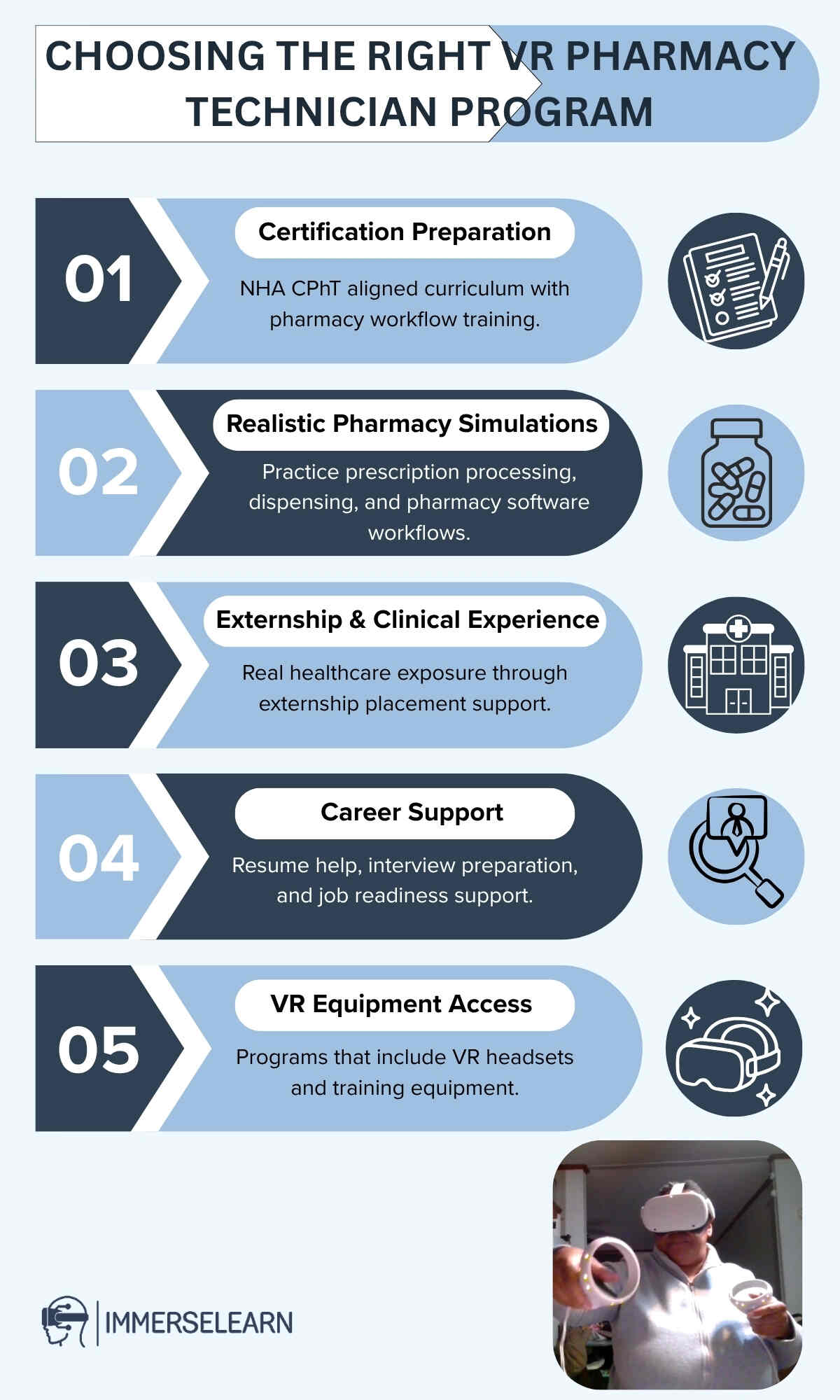
To narrow down your choices, evaluate each candidate program using the following core criteria:
Program Selection Criteria:
- ASHP/ACPE Accreditation
- Externship Placement
- PTCE/ExCPT Pass Rates
- Cost & Duration
- Lab & Tech Facilities
1. Verification of Accreditation Status
Never rely solely on marketing claims on a school's website. Verify active accreditation directly through official directories:
- Search the public database of ASHP Accredited Pharmacy Technician Programs.
- Check the school's standing with the U.S. Department of Education Database of Accredited Postsecondary Institutions and Programs (DAPIP).
2. Clinical Externship Placement
Theoretical knowledge must be matched with practical experience. High-quality programs include a guaranteed clinical externship (often 120 to 160 hours or more) in retail or hospital environments. Inquire whether the program places you directly with partner healthcare organizations or if you are expected to secure your own externship site. Programs with established clinical affiliate networks provide smoother transitions into hands-on training.
3. Certification Exam Pass Rates
Ask admissions advisors for the program's first-time pass rates on the PTCE or ExCPT over the past three years. Pass rates consistently above the national average indicate rigorous coursework, effective instructors, and targeted test preparation.
4. Curriculum Depth and Laboratory Facilities
Review the course syllabus to ensure it covers mandatory competencies:
- Pharmaceutical calculations and dosage conversions
- Topical, oral, and parenteral drug classifications and generic/brand naming
- Pharmacy law, ethics, and HIPAA compliance
- Aseptic technique and sterile compounding (USP <797> and USP <800> standards)
- Pharmacy inventory management and automation technology
For hybrid or on-campus programs, evaluate the physical simulation labs. Practicing hands-on skills—such as laminar flow hood operation, mock dispensing, and barcode scanning—prepares students for hospital and retail realities.
4. Comparing Program Formats: Online, Hybrid, and Community College
Pharmacy technician training is offered in multiple learning structures, ranging from short-term certificate programs to two-year associate degrees.
| Program Type | Typical Duration | Delivery Format | Pros | Cons | Ideal Candidate |
|---|---|---|---|---|---|
| Community College Certificate | 6 to 12 Months | Hybrid / On-Campus | Structured lab practice; local hospital connections; eligible for federal financial aid. | Fixed schedules; campus commute required. | Students seeking structured, hands-on guidance and strong local hiring networks. |
| Vocational / Technical Diploma | 4 to 9 Months | Hybrid / On-Campus | Accelerated timelines; focused technical training without general education electives. | Higher cost per credit hour; variable transferability of credits. | Career changers seeking fast entry into the workforce. |
| Online / Distance Learning | 3 to 12 Months | Self-Paced / Online | Flexible scheduling; lower tuition costs; study from home. | Requires high self-discipline; local externship arrangements can be complex. | Working adults needing scheduling flexibility. |
| Associate of Applied Science (A.A.S.) Degree | 18 to 24 Months | Hybrid / On-Campus | Comprehensive academic foundation; transferable credits for future healthcare degrees. | Longest duration; highest total tuition cost. | Individuals planning long-term advancement into pharmacy management or healthcare administration. |
5. Step-by-Step Framework to Select the Right Program
Follow this practical roadmap to select the program that best matches your career goals and budget:
Step 1: Verify State Requirements
Visit your state board of pharmacy website. Confirm whether your state requires PTCB/NHA certification, completion of an ASHP-accredited program, or specific registration credentials prior to starting externships.
Step 2: Compile a Shortlist of Accredited Programs
Gather a list of 3 to 5 programs that offer your preferred instructional format (online, hybrid, or on-campus). Cross-reference every school against the ASHP accredited program directory.
Step 3: Compare Total Financial Obligations
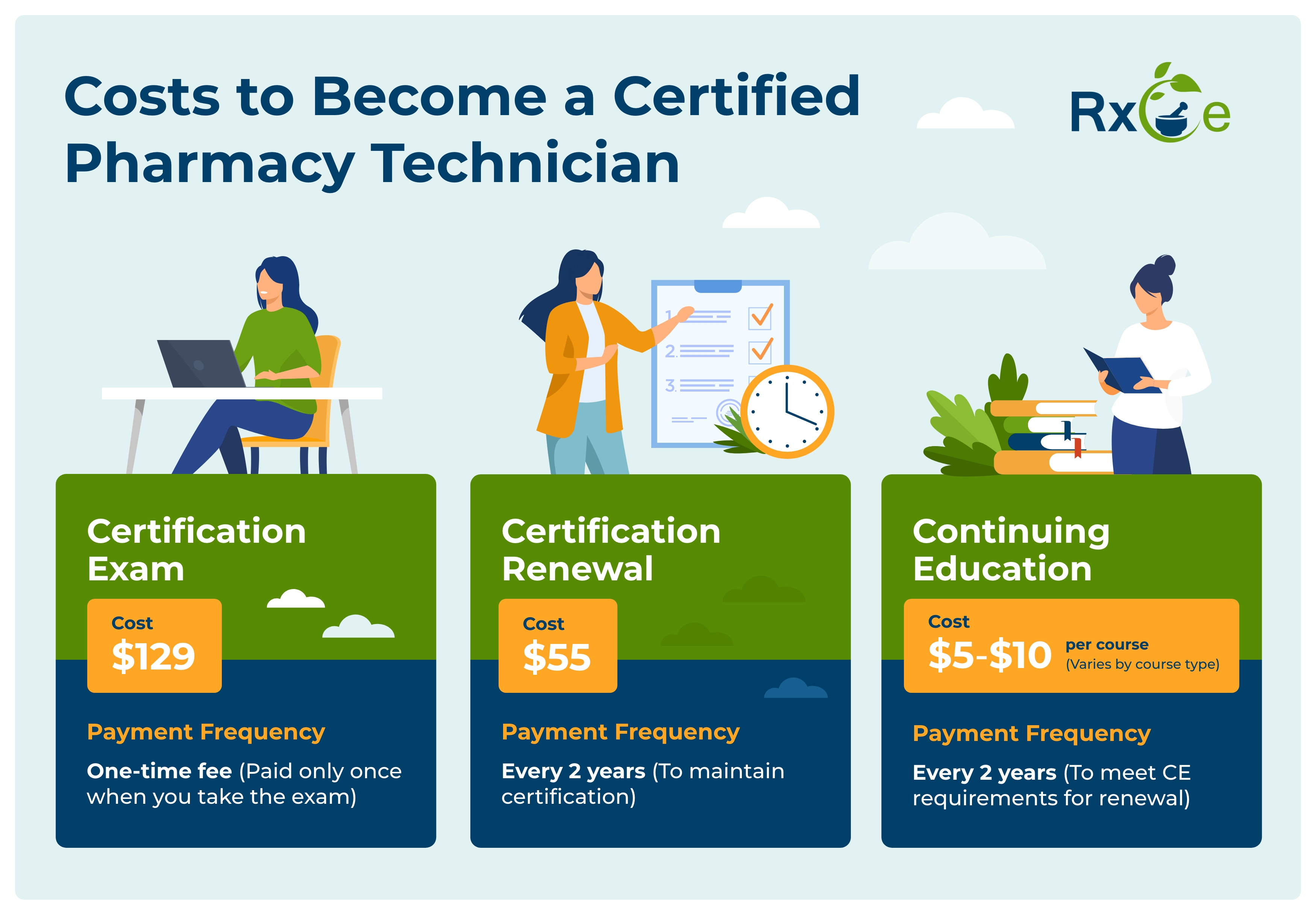
Calculate the total cost of attendance, including tuition, lab fees, course materials, textbooks, criminal background checks, drug screenings, and certification exam fees. Inquire whether certification exam costs are bundled into tuition.
Step 4: Evaluate Externship Support and Partner Networks
Ask program representatives key operational questions:
- Does the program assign clinical externship placements, or am I responsible for finding a site?
- Which retail chains, independent pharmacies, or hospital systems serve as active clinical affiliates?
- What safety protocols and background screening requirements apply to clinical placements?
Step 5: Assess Student Support Services
Check whether the program offers tutoring in pharmaceutical math, post-graduation job placement assistance, and structured PTCE/ExCPT test prep modules.
Common Pitfalls to Avoid
- Enrolling in Unaccredited "Diploma Mills": Avoid short online courses that promise rapid completion without ASHP/ACPE accreditation or PTCB recognition. Unaccredited programs may leave you ineligible for national certification or state registration.
- Ignoring Hands-on Lab and Externship Requirements: Pharmacy practice requires physical dexterity, sterile processing technique, and software familiarity. Programs lacking practical lab components or clinical externships leave graduates unprepared for real-world pharmacy environments.
- Overlooking Total Cost Discrepancies: Private vocational schools often charge significantly higher tuition than public community colleges for identical certificate curricula. Compare credit-hour rates across institutions before signing financial agreements.
Frequently Asked Questions
What is the difference between ASHP and ACPE accreditation for pharmacy technicians?
ASHP and ACPE collaborate through the Pharmacy Technician Accreditation Commission (PTAC) to govern a unified national accreditation process for pharmacy technician education. ASHP historically established health-system training standards, while ACPE is the recognized accrediting body for pharmacy degree programs. Together, they maintain single-standard programmatic quality.
Can I become a certified pharmacy technician completely online?
You can complete the didactic (classroom) portion of your education online through an accredited provider. However, comprehensive training requires a clinical externship component in a live retail or hospital pharmacy to develop essential hands-on skills before earning full credentialing.
Is an Associate Degree better than a Certificate in Pharmacy Technology?
For entry-level pharmacy technician positions, a certificate or diploma from an accredited program is fully sufficient to earn national certification and employment. An Associate of Applied Science (A.A.S.) degree is advantageous if you plan to transition into healthcare management, supervisory roles, or pursue further college degrees later in your career.
How much do accredited pharmacy technician programs cost?
Tuition varies widely based on program type and institution. Certificate programs at public community colleges generally range from $1,500 to $4,000. Private vocational schools and comprehensive online programs typically cost between $2,500 and $8,000, while two-year associate degree programs can range from $6,000 to $15,000 depending on residency status.
How do I check if my state requires PTCB or NHA certification?
Visit the official website of your state’s Board of Pharmacy (usually managed under your state government’s department of health or professional regulation). Review the statutes governing pharmacy technician registration, licensing, and practical practice scopes.
Next Actions and Conclusion
Choosing an accredited pharmacy technician program is an investment in your career security and professional growth. Prioritize programs with verified ASHP/ACPE accreditation, strong PTCE pass rates, and robust clinical externship networks to ensure you meet all legal and professional standards.
To get started today:
- Check your state's Board of Pharmacy regulations.
- Use the ASHP Accredited Program Directory to filter options in your location or preferred format.
- Contact admissions offices to compare tuition costs, externship placement details, and exam pass rates before submitting applications.
Image Gallery