How to Retire in Italy from the USA: A Comprehensive Guide for 2026
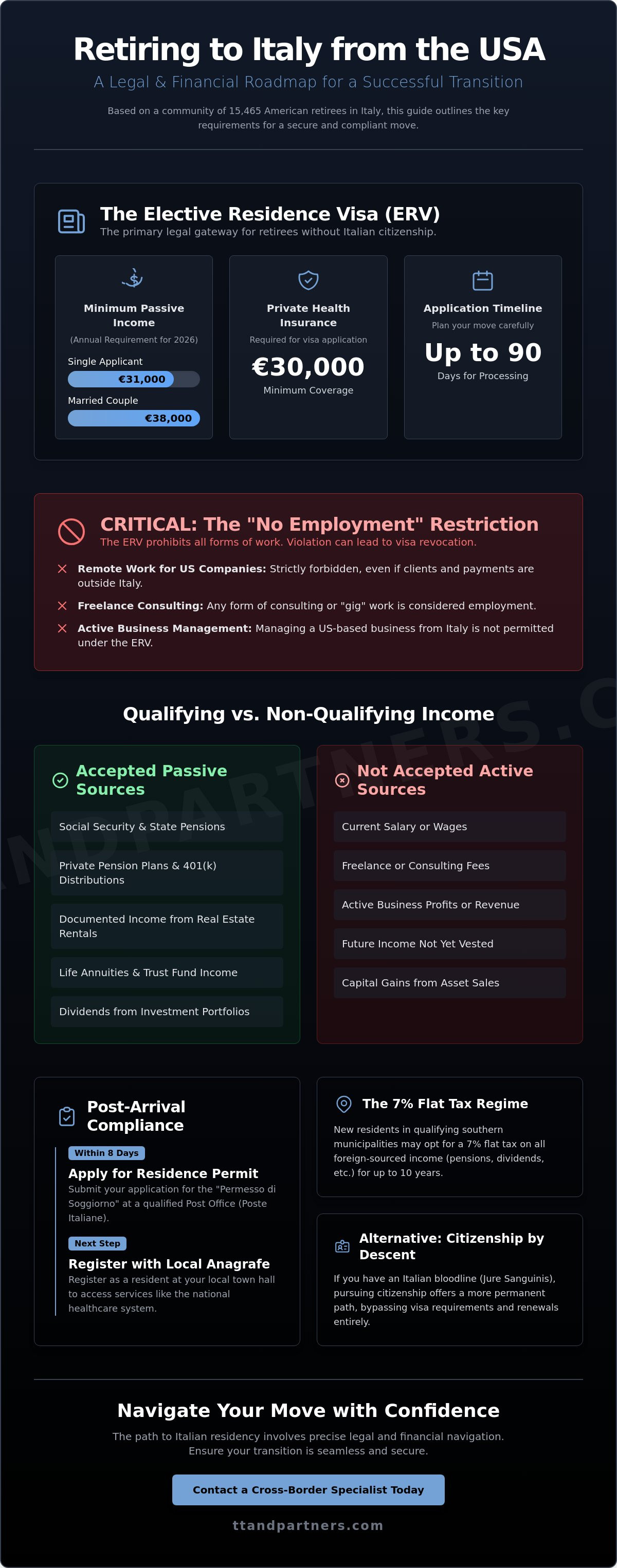
Retiring in Italy from the USA involves securing an Elective Residency Visa (ERV), demonstrating a consistent passive income of approximately €31,000 to €38,000 per year, and navigating a multi-step residency process. In 2026, retirees...
Retiring in Italy from the USA involves securing an Elective Residency Visa (ERV), demonstrating a consistent passive income of approximately €31,000 to €38,000 per year, and navigating a multi-step residency process. In 2026, retirees must balance Italian immigration requirements with U.S. tax obligations while choosing between various regional tax incentives, such as the 7% flat-tax regime in Southern Italy.
Contents
The allure of the Italian lifestyle—the "Dolce Vita"—remains as potent as ever in 2026. However, the transition from a U.S.-based life to a Mediterranean retirement requires meticulous planning. The process is not merely about moving house; it is a complex legal shift involving international taxation, healthcare transitions, and rigorous bureaucratic compliance. This guide provides the technical roadmap for Americans looking to make Italy their permanent home.
The Legal Foundation: The Elective Residency Visa (ERV)
The most common pathway for U.S. citizens to retire in Italy is the Elective Residency Visa (Visto per Residenza Elettiva). This visa is specifically designed for individuals who have the financial means to support themselves without seeking employment in Italy.
Financial Requirements and Passive Income
To qualify in 2026, the Italian Ministry of Foreign Affairs generally requires a minimum annual passive income. While official thresholds can vary by consulate (such as those in New York, Los Angeles, or Houston), a baseline of €31,160 for an individual and approximately €38,000 for a married couple is the standard benchmark.
Crucially, this income must be passive. This includes:
- Social Security benefits.
- Pensions (401k, IRA distributions).
- Rental income from properties.
- Interest and dividends from investment portfolios.
- Annuities.
Salaries, remote work income, or freelance consulting fees do not count toward this requirement, as the ERV strictly prohibits any form of work (including remote work for a U.S. company) while residing in Italy.
The Application Process in the USA
Applicants must apply at the Italian Consulate that has jurisdiction over their primary U.S. residence. The process involves submitting a comprehensive dossier that includes:
- A valid U.S. passport with at least 15 months of remaining validity.
- Proof of housing in Italy, which can be a registered lease agreement or a deed of ownership.
- Comprehensive health insurance with a minimum coverage of €30,000 per year, valid for the entire Schengen Area.
- A clean criminal record check (FBI background check and potentially state-level checks).
Once the visa is granted and you arrive in Italy, you have eight days to apply for the Permesso di Soggiorno (Residence Permit) at a local post office and later at the Questura (Police Headquarters).
Navigating Italian Healthcare for Retirees
One of the primary concerns for U.S. retirees is the loss of Medicare coverage, which generally does not provide benefits outside the United States. Italy offers one of the world's highest-ranked healthcare systems, the Servizio Sanitario Nazionale (SSN), but access for American retirees is not automatic or free.
Private vs. Public Coverage
During your first year, you will rely on the private international health insurance used for your visa application. Once you have obtained your Permesso di Soggiorno and registered with the local Anagrafe (Registry Office), you can apply for "voluntary enrollment" in the SSN.
Voluntary Enrollment (Iscrizione Volontaria)
For retirees, enrollment in the SSN is typically done through a voluntary contribution. The cost is calculated based on your total global income from the previous year. In 2026, the base rate is approximately 7.5% of income up to a certain threshold, though there are minimum and maximum caps. This "subscription" grants you a health card (Tessera Sanitaria) and allows you to choose a primary care physician (Medico di Base).
Many American retirees choose a hybrid approach: using the SSN for major procedures and chronic care, while maintaining a supplemental private policy to ensure faster access to specialists and private hospital rooms.
Taxation: The US-Italy Treaty and Regional Incentives
The United States is one of the few countries that taxes based on citizenship, not just residency. Consequently, American retirees in Italy remain subject to U.S. tax filings regardless of where they live.
Avoiding Double Taxation
The U.S.-Italy Tax Treaty is a critical document that prevents retirees from paying full taxes to both countries on the same income. Generally, Social Security benefits are taxed only in the country of residence (Italy), while government pensions may be taxed in the country of origin (USA). It is essential to consult with a cross-border tax specialist to manage Foreign Bank Account Reporting (FBAR) and FATCA requirements.
The 7% Flat Tax Incentive
To encourage residency in less populated areas, Italy continues to offer a generous tax regime in 2026 for retirees moving to specific regions. If you relocate to a municipality with fewer than 20,000 inhabitants in regions like Sicily, Calabria, Sardinia, Campania, Basilicata, Abruzzo, Molise, or Puglia, you may qualify for a 7% flat tax on all foreign-sourced income for up to 10 years.
| Feature | Standard Residency | 7% Flat Tax Regime |
|---|---|---|
| Eligibility | Anywhere in Italy | Southern regions; towns <20k pop. |
| Duration | Permanent (subject to brackets) | 10 years |
| Tax Rate | Progressive (23% to 43%) | Fixed 7% on foreign income |
| Wealth Tax (IVAFE/IVIE) | Applicable | Often exempt or simplified |
Cost of Living: Regional Comparisons
The cost of retiring in Italy varies significantly between the industrial North and the agrarian South. While the U.S. dollar's strength fluctuates, Italy generally offers a lower cost of living regarding fresh food, property taxes, and healthcare compared to major U.S. metropolitan areas.
Northern Italy (Lombardy, Piedmont, Veneto)
Cities like Milan or Turin offer world-class infrastructure and proximity to the Alps. However, real estate prices and heating costs in the winter are higher. A comfortable retirement for a couple here might require €3,500–€5,000 per month.
Central Italy (Tuscany, Umbria, Le Marche)
Tuscany remains the most popular destination for Americans. While the "Chiantishire" area is expensive, the neighboring region of Le Marche offers similar landscapes at roughly 30% lower costs for real estate.
Southern Italy (Sicily, Puglia, Calabria)
The South offers the lowest cost of living. In 2026, it is still possible to find renovated townhouses for under €150,000. Monthly expenses for a couple can often be covered by €2,000–€2,500, excluding the tax benefits mentioned previously.
Real Estate and Legal Safeguards
Buying property in Italy is a distinct process from the U.S. system. There is no centralized "Multiple Listing Service" (MLS), and the role of the Notaio (Notary) is central to the transaction.
The Role of the Notary
The Notary is a public official who represents the Italian State, not the buyer or the seller. They verify the title, ensure all taxes are paid, and witness the final deed (Rogito). It is highly recommended that U.S. buyers also hire an independent lawyer (Avvocato) to perform due diligence on building permits and "hidden" liens that the Notary might not investigate.
Renting Before Buying
Most relocation experts advise renting for at least 6 to 12 months before purchasing. Italy has diverse micro-climates; a village that is charming in July may be isolated and damp in November. Furthermore, the Elective Residency Visa requires a registered lease, and it is often easier to secure a visa with a rental agreement than a pending property purchase.
Common Pitfalls and Troubleshooting
- The "Working" Trap: Many retirees think they can continue a small consulting business or maintain an Etsy shop. The ERV is strict; if the Italian authorities discover active work income, your permit may not be renewed.
- Driving Licenses: U.S. citizens can drive on their home license (with an International Driving Permit) for one year. After 12 months of residency, you must obtain an Italian license (Patente), which requires passing a rigorous technical exam in Italian. There is currently no reciprocity agreement between the USA and Italy for license exchanges.
- The Codice Fiscale: This is the Italian equivalent of a Social Security number. You will need it for everything: opening a bank account, signing a lease, and buying a SIM card. You can and should obtain this from the Italian Consulate in the USA before you move.
FAQ
Can I use Medicare in Italy?
No, Medicare does not provide coverage for medical services received outside the United States. You must secure private health insurance or pay to enroll in the Italian National Health Service (SSN) once you have established residency.
Do I have to pay taxes in both countries?
While you must file tax returns in both the USA and Italy, the U.S.-Italy Tax Treaty generally prevents double taxation. You will typically receive a foreign tax credit in the U.S. for taxes paid to Italy.
Is it hard to open a bank account in Italy as an American?
Because of the U.S. Foreign Account Tax Compliance Act (FATCA), some Italian banks are hesitant to work with Americans due to the reporting requirements. However, major banks like Intesa Sanpaolo or UniCredit typically accommodate American residents, provided they have a Codice Fiscale and proof of residency.
How long does the visa process take?
In 2026, the timeline from initial application at the consulate to receiving the visa can take anywhere from 2 to 6 months. It is recommended to start the process at least 180 days before your intended move date.
Can I bring my pet to Italy?
Yes, Italy is quite pet-friendly. You will need an EU Pet Passport or a USDA-certified health certificate issued within 10 days of arrival, and your pet must be microchipped and vaccinated against rabies.
Final Recommendation
For a successful retirement in Italy, prioritize the financial paper trail above all else. Ensure your passive income sources are clearly documented and meet the current 2026 thresholds. Before committing to a specific location, spend an extended period in Italy during the "off-season" (November to February) to ensure the local climate and pace of life suit your long-term needs. Engaging a dual-qualified tax professional and an Italian immigration attorney early in the process is the most effective way to avoid costly bureaucratic delays.
Image Gallery