How to Sizing a Tennis Racket: The Complete 2026 Technical Guide
Sizing a tennis racket properly involves matching your age, height, and hand size to the correct frame length, grip size, and head size. The standard adult racket length is 27 inches, with grip sizes ranging from 0 (4 inches) to 5 (4 5...
Sizing a tennis racket properly involves matching your age, height, and hand size to the correct frame length, grip size, and head size. The standard adult racket length is 27 inches, with grip sizes ranging from 0 (4 inches) to 5 (4 5/8 inches), while junior rackets scale down from 26 inches to 19 inches based on player height.
Contents
Finding the correct tennis racket size is the single most critical step in preventing injuries like tennis elbow, maximizing swing mechanics, and accelerating skill development. Whether you are outfitting a junior player taking their first lessons or upgrading your own competitive tournament frame for the 2026 season, precision matters. A racket that is too heavy or has an incorrect grip size forces unnatural muscle compensation, leading to reduced shot control and chronic joint strain.
Understanding Tennis Racket Dimensions and Anatomical Specifications
Before measuring for a racket, you must understand how manufacturers measure frame parameters. A tennis racket is not a uniform tool; its dimensions directly dictate power, control, maneuverability, and shock absorption.
- Length: Standard adult frames measure 27 inches. Extended frames measure 27.5 to 29 inches, offering extra reach and leverage on serves at the expense of maneuverability. Junior frames range systematically from 19 to 26 inches.
- Grip Size (Circumference): Measured by the perimeter of the handle handle base, ranging from US Size 0 (4 inches) up to Size 5 (4 5/8 inches).
- Head Size: Measured in square inches. Midsize frames (85–95 sq in) prioritize control for advanced players. Midplus frames (98–105 sq in) offer a balanced blend of power and precision. Oversize frames (110–135 sq in) provide a massive sweet spot for beginners and doubles specialists.
- Unstrung Weight: Typically ranges from 250 grams (lightweight, highly maneuverable) to over 315 grams (heavy, stable, suited for advanced players with fast swing styles).
How to Determine Your Correct Adult Grip Size
The grip size is arguably the most critical dimension for injury prevention. An incorrect grip forces your hand to squeeze too tightly, transmitting excessive torsional shock to your forearm tendons.
The Index Finger Test
The most reliable method used by professional stringers and tennis coaches is the index finger test:
- Hold the racket in your dominant hand using a standard Eastern forehand grip (as if shaking hands with the racket handle).
- Take the index finger of your non-dominant hand and try to slide it into the gap between your palm and your ring finger.
- The Result: Your index finger should fit snugly into that gap. If there is too much space and your finger rattles around, the grip is too small. If your finger cannot fit or compresses your palm tightly, the grip is too large.
Alternative Method: The Ruler Measurement
If you do not have a racket on hand, you can measure your hand with a ruler:
- Open your dominant hand, keeping your fingers straight and close together.
- Locate the major crease in the center of your palm.
- Measure from the tip of your ring finger down to that horizontal palm crease in inches or millimeters.
- Compare your measurement to industry standard sizing charts.
| Grip Size (US) | Grip Size (Metric) | Palm-to-Finger Tip Measurement |
|---|---|---|
| Size 0 | 4 inches | 4 3/8 inches (approx. 11.1 cm) |
| Size 1 | 4 1/8 inches | 4 5/8 inches (approx. 11.7 cm) |
| Size 2 | 4 1/4 inches | 4 7/8 inches (approx. 12.4 cm) |
| Size 3 | 4 3/8 inches | 5 1/8 inches (approx. 13.0 cm) |
| Size 4 | 4 1/2 inches | 5 3/8 inches (approx. 13.7 cm) |
| Size 5 | 4 5/8 inches | 5 5/8 inches (approx. 14.3 cm) |
Pro Tip on Borderline Sizing: If you find yourself right between two grip sizes, always choose the smaller size. You can easily build up a small grip by adding an overgrip (which adds about 1/16 of an inch), but shrinking a grip that is too large requires a complete handle pallet replacement.
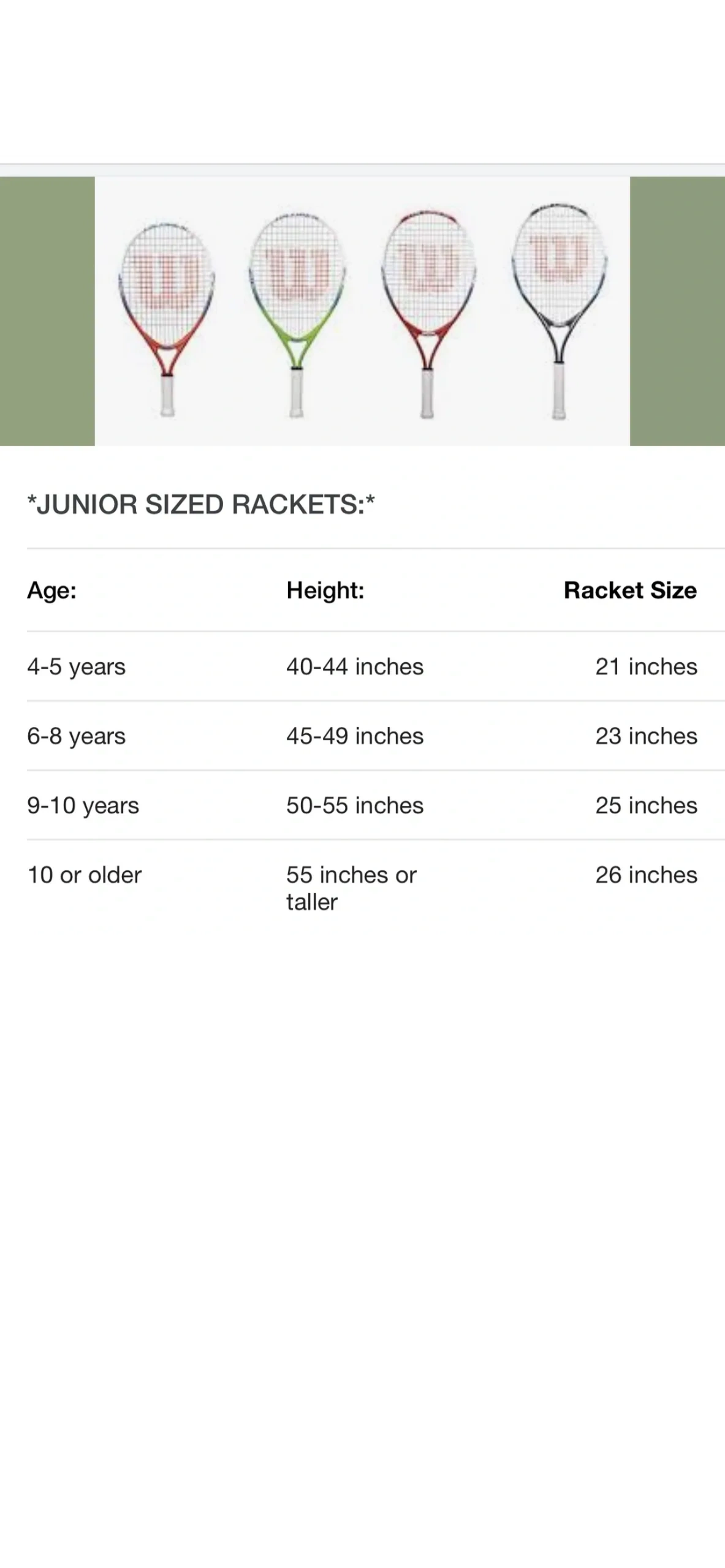
Junior Tennis Racket Sizing By Age and Height
Children cannot use adult rackets because the physical leverage ratios, weight distribution, and lever arms cause shoulder and elbow injuries. Junior racket sizing depends almost entirely on the child's height, with age serving as a secondary baseline reference.
| Player Height | Approximate Age | Racket Length | Recommended Ball Type |
|---|---|---|---|
| Under 3'6" (< 107 cm) | 4 and under | 19 inches | Red Foam / Red Felt (Stage 3) |
| 3'6" to 3'11" (107-119 cm) | 5 to 6 years | 21 inches | Red Felt (Stage 3) |
| 4'0" to 4'5" (122-135 cm) | 7 to 8 years | 23 inches | Orange Felt (Stage 2) |
| 4'6" to 4'11" (137-150 cm) | 9 to 10 years | 25 inches | Green Dot Felt (Stage 1) |
| 5'0" and taller (> 152 cm) | 11+ years | 26 to 27 inches | Standard Yellow Ball |
The Drop Test for Junior Players
To double-check if a junior racket is the correct length:
- Have the child stand straight and hold the racket handle downward by their side, with the racket head pointing toward the floor.
- The tip of the racket should hover just above the ankle bone or graze the top of the foot.
- If the racket head drags heavily on the ground, it is too long. If it floats well above the ankle, it is too short and will stunt the child's swing development.
Selecting Head Size and Weight Based on Playing Style
Once you have identified your length and grip size, you must optimize your racket's performance specifications. Your playing style, physical strength, and experience level dictate which technical tier you should select.
Beginner to Intermediate Recreational Players
- Head Size: 100 to 105 square inches. A larger hitting surface provides a wider margin for error on off-center hits.
- Weight: 260 to 280 grams (unstrung). Lightweight frames protect developing joints and allow for fast racket head speed without inducing arm fatigue.
- Balance: Even-balanced or slightly head-heavy to help drive power through the ball without relying purely on core strength.
Advanced and Tournament Players
- Head Size: 95 to 98 square inches. Smaller head sizes restrict the sweet spot but offer ultimate directional control and spin manipulation.
- Weight: 300 to 315+ grams (unstrung). Heavier frames absorb high-velocity incoming balls and provide exceptional stability against heavy hitters.
- Balance: Head-light. This shifts the mass toward the handle, making the heavy frame feel remarkably nimble during rapid net volleys.
Step-by-Step Guide to Customizing Your Tennis Racket Fit
If you purchase a racket and find the fit is slightly imperfect, you can fine-tune several elements manually rather than buying an entirely new frame.
- Assess the Grip Thickness: Wrap a standard replacement grip or overgrip over your existing grip. Note that a single overgrip increases the grip size by roughly one-half size index.
- Evaluate String Tension: If your racket feels too powerful and unmanageable, have it restrung at the higher end of the manufacturer's recommended tension range (e.g., 58 lbs). If you need more depth and power, string at the lower end (e.g., 50 lbs).
- Check Counterbalance Weight: If your racket feels too light and gets pushed around by heavy shots, add lead tape at the 3 o'clock and 9 o'clock positions on the hoop for torsional stability, or at the 12 o'clock position to add plow-through power.
Common Sizing Mistakes and How to Avoid Them
Even experienced players frequently make avoidable sizing errors that hinder performance and create injury risks.
- Buying an Adult Racket Too Early for Juniors: Parents often purchase a standard 27-inch racket for a 9-year-old so they "grow into it." This forces the child to choke up heavily on the handle, disrupting weight distribution and mechanics.
- Ignoring Grip Taper: Always test the grip while holding it in an active play position. Testing a loose, static grip in a retail store often leads to purchasing a size that is too large.
- Overlooking Frame Stiffness: Stiff frames (measured by RA ratings above 70) transfer intense shock to the arm. If you have history of arm trouble, pair a proper grip size with a flexible frame (RA rating under 65).
Frequently Asked Questions About Tennis Racket Sizing
What happens if my tennis racket grip is too small?
A grip that is too small forces your hand to squeeze tightly to prevent the racket from twisting in your hand during contact. This excessive muscle tension restricts wrist flexibility and is a primary catalyst for lateral epicondylitis, commonly known as tennis elbow.
Can I change the grip size of an adult tennis racket permanently?
Changing the size permanently requires removing the existing handle sleeve (pallet) and replacing it with a different size, which is a specialized modification best performed by a professional stringer. However, you can easily increase the size temporarily by adding one or two overgrips.
Is a larger head size always better for beginners?
Larger head sizes (105-110 sq in) are generally better for beginners because they offer a larger sweet spot and generate easy power. However, as players develop aggressive topspin strokes, smaller heads (98-100 sq in) provide better control over where the ball lands.
How often should I replace my tennis racket grip wrap?
You should replace your overgrip whenever it loses its tackiness, absorbs excessive sweat, or shows signs of tearing—typically every 10 to 15 hours of match play. Playing with a slick grip forces a tighter hand squeeze, which defeats the benefits of a correct sizing fit.
Does string pattern density affect racket sizing?
String pattern density does not change the physical dimensions of the racket, but it alters how the frame plays. An open pattern (16x19) offers more spin and launch angle flexibility, while a dense pattern (18x20) offers lower launch angles and tighter control for flat hitters.
Ready to find the ideal frame for your game? Visit your local certified tennis specialty pro shop to measure your hand dimensions accurately, test demo frames on the court, and ensure your equipment matches your biomechanical profile for peak performance.
Image Gallery