Understanding Auguste Comte’s Definition of Sociology: Positivism, Order, and Progress
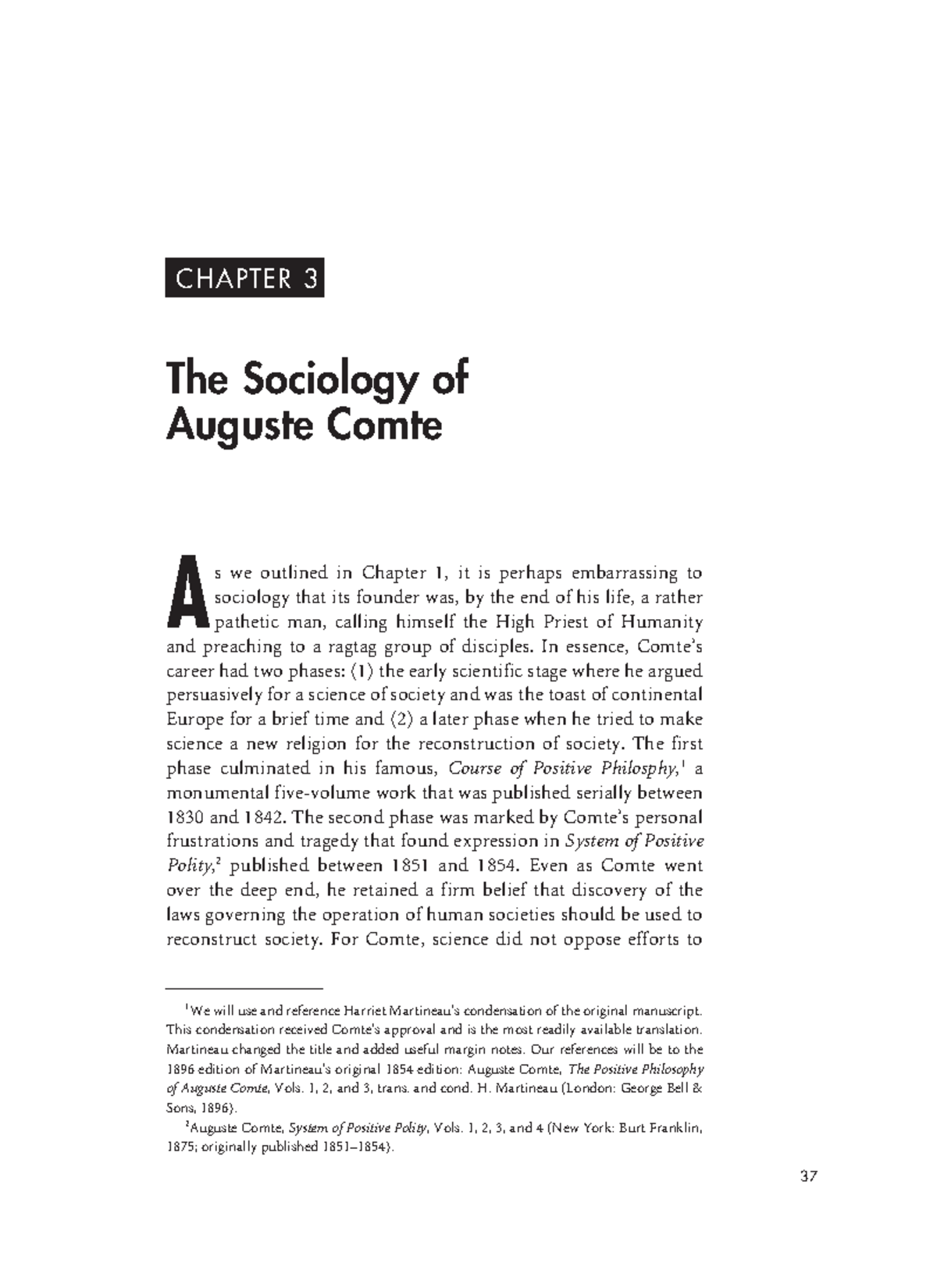
Auguste Comte defined sociology as the positive scientific study of social phenomena, governed by invariant natural laws. Coining the term in 1838 within his Course in Positive Philosophy, Comte envisioned sociology—initially called "s...
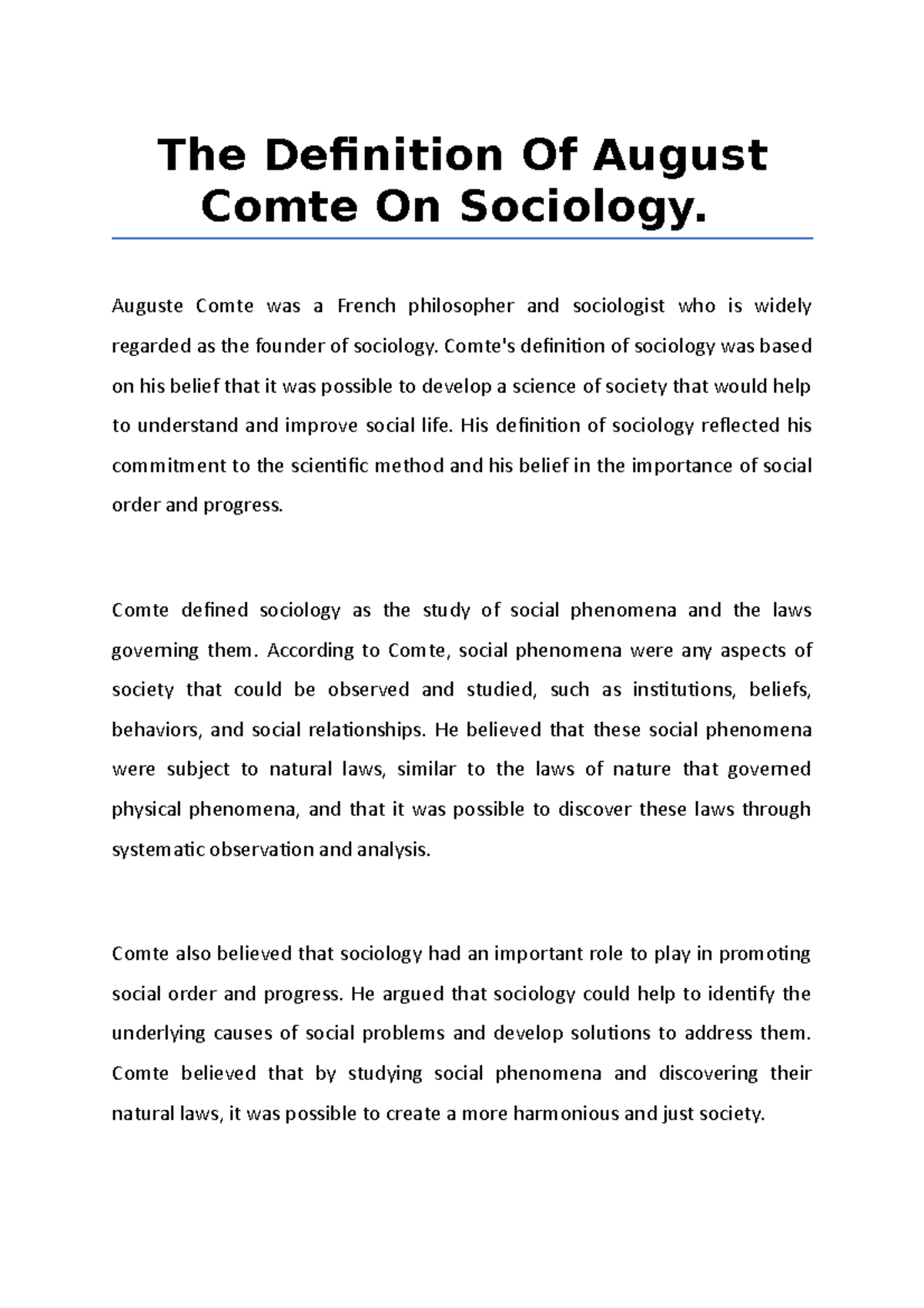
Auguste Comte defined sociology as the positive scientific study of social phenomena, governed by invariant natural laws. Coining the term in 1838 within his Course in Positive Philosophy, Comte envisioned sociology—initially called "social physics"—as the ultimate discipline designed to analyze, predict, and systematically improve human society through observation, experimentation, and historical comparison.
Contents
Historical Context: Why Auguste Comte Created Sociology
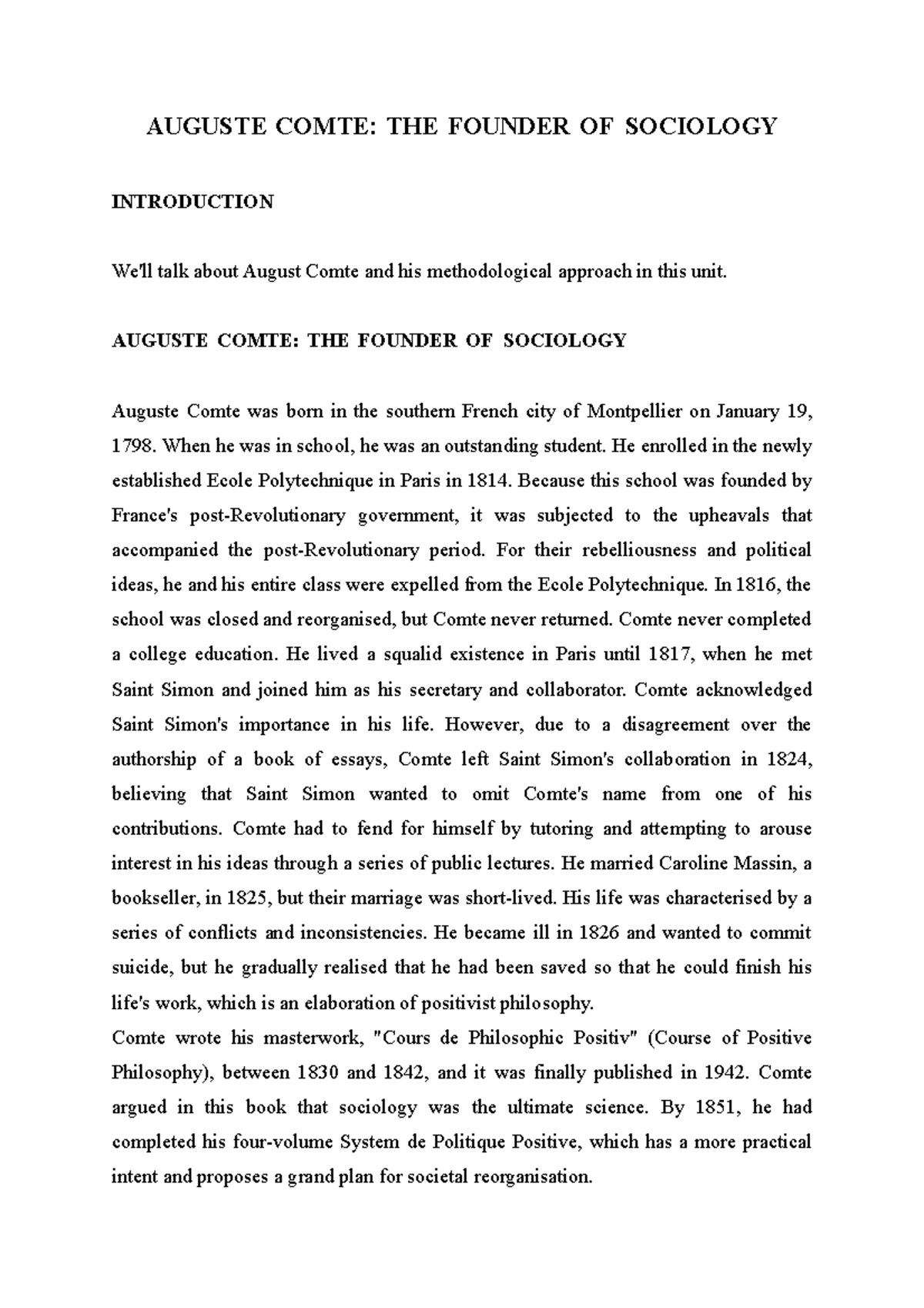
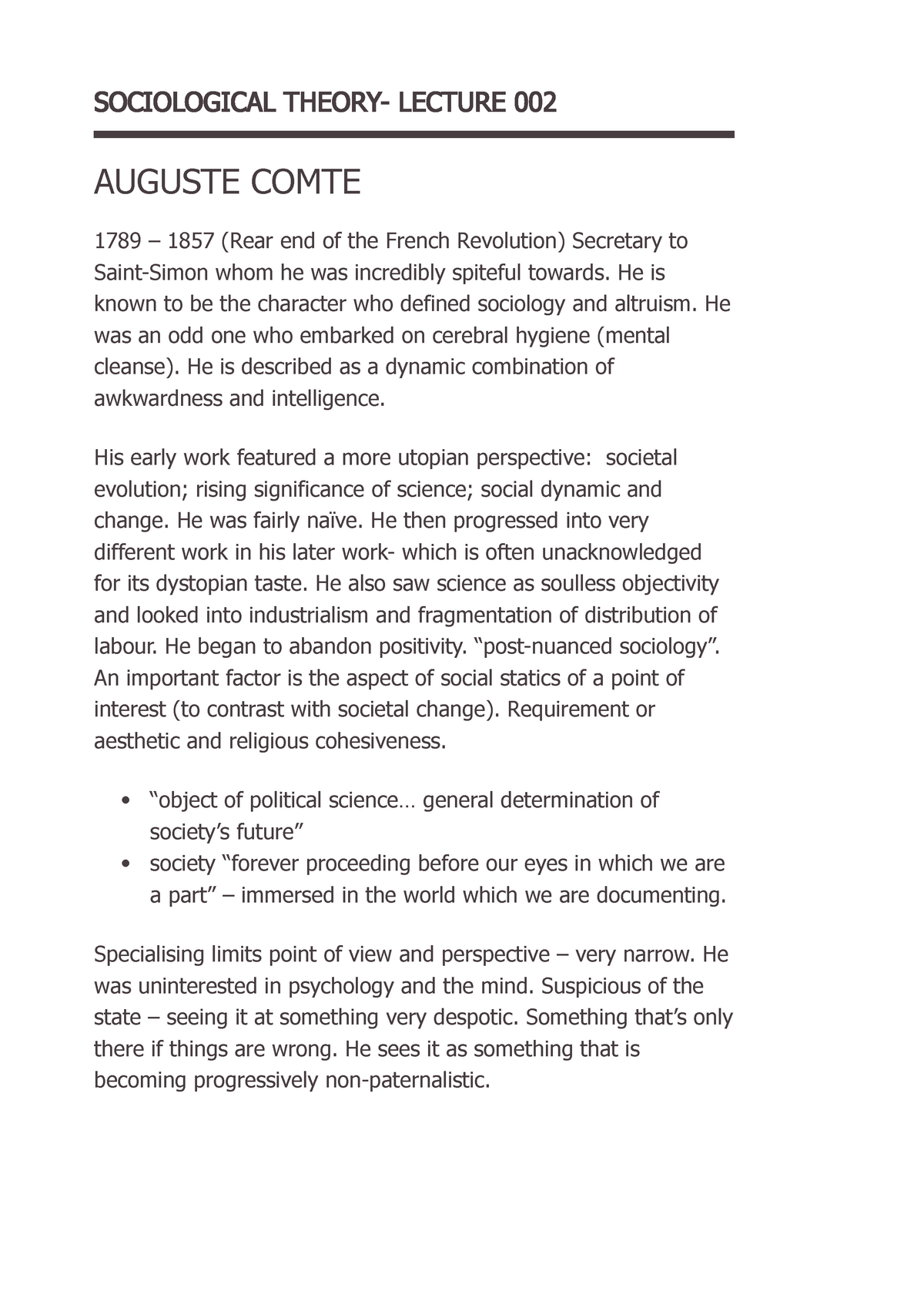
To understand Auguste Comte’s definition of sociology, one must first examine the intellectual and political turmoil of early nineteenth-century France. Writing in the wake of the French Revolution and the rapid rise of industrialization, Comte observed widespread social instability, moral confusion, and political breakdown. Traditional institutions such as the Catholic Church and monarchy were losing their authority, yet no stable scientific foundation had emerged to guide modern governance.
Comte concluded that societal reorganization required an intellectual revolution. He argued that political chaos stemmed from intellectual anarchy: people held contradictory belief systems rooted in medieval theology, abstract philosophy, or unverified speculation. To restore stability, humanity needed a unified framework capable of analyzing society with the same rigor and empirical precision used in the physical sciences.
Initially, Comte referred to this new discipline as physique sociale (social physics). However, after Belgian statistician Adolphe Quetelet began using the term to describe quantitative demographic studies, Comte coined the term sociologie—a hybrid derived from the Latin socius (companion or society) and the Greek logos (study or discourse). For Comte, sociology was not merely an academic exercise; it was an urgent necessity to diagnose social ailments and guide social reform based on scientific truth.
The Core Definition: Sociology as a Positive Science
At its core, Comte defined sociology as the science of social phenomena, subject to natural and invariant laws, the discovery of which is the object of investigation. This foundational concept relies on positivism—a philosophical system asserting that genuine knowledge is derived exclusively from sensory experience, empirical evidence, and logical interpretation.
Comte insisted that sociology must abandon speculative theology and metaphysical abstraction. Instead of asking why things exist in an ultimate or supernatural sense, sociological inquiry must focus on how social phenomena operate and interact.
The Scientific Methodology of Comtean Sociology
Comte outlined four primary methodological tools for sociological research:
- Observation: Scientific observation in sociology does not mean passive perception. Comte argued that observation must be guided by theoretical principles; isolated social facts are meaningless without a framework explaining their relationships.
- Experimentation: While direct laboratory experimentation on human society is rarely feasible, Comte highlighted indirect experimentation. Social disruptions—such as revolutions, political crises, or institutional failures—serve as natural experiments where normal social functioning is interrupted, revealing underlying structural laws.
- Comparison: Sociologists must compare human societies across different geographic regions and cultural contexts to identify common patterns of organization and development.
- Historical Method: Comte viewed the historical method as the most critical tool for sociology. By analyzing the sequential development of human societies over time, sociologists can uncover the evolutionary laws governing human progress.
Through these methods, Comte sought to establish sociology as an objective science capable of revealing patterns as deterministic as Newton’s laws of gravity.
The Two Pillars: Social Statics and Social Dynamics
Comte divided his definition of sociology into two interconnected branches: Social Statics and Social Dynamics. This division reflected his famous political and philosophical motto: "Order and Progress."
- Auguste Comte's Sociology
- Social Statics (Study of Order)
- Social Harmony
- Institutions (Family, State)
- Structural Cohesion
- Social Dynamics (Study of Progress)
- Law of Three Stages
- Historical Evolution
- Social Transformation
- Social Statics (Study of Order)
Social Statics: The Science of Social Order
Social Statics is the study of the conditions of existence, stability, and structural equilibrium in society. It investigates how different parts of a social system interact and maintain harmony at any given point in time.
Key elements of Social Statics include:
- The Principle of Consensus Universalis: Comte posited that a mutual harmony exists between all parts of a social system. An alteration in one institution—such as the economy or government—inevitably impacts all other institutions, including religion and the family.
- The Family as the Basic Unit: Unlike modern individualistic theories, Comte viewed the family, not the individual, as the fundamental building block of society. He argued that individuals are governed by egoism, whereas the family teaches altruism, cooperation, and social integration.
- Division of Labor: Comte recognized that specialized labor creates interdependence among social classes, bonding individuals to the broader collective whole, provided it is regulated by a centralized authority to prevent fragmentation.
Social Dynamics: The Science of Human Progress
While Social Statics analyzes societal structure in a state of rest, Social Dynamics examines societal development over time. It is the study of continuous structural change, historical evolution, and progressive advancement.
Comte believed that social dynamics reveals the laws of human progress. Progress, in the Comtean view, is not accidental or chaotic; it is an orderly, evolutionary progression driven by the development of the human mind. Social Dynamics demonstrates how social order naturally evolves into higher stages of intellectual, technical, and moral complexity.
The Law of Three Stages: The Drive Behind Social Dynamics
The cornerstone of Comte’s Social Dynamics is the Law of Three Stages. Comte argued that both individual human intelligence and entire human civilizations pass sequentially through three distinct intellectual phases. Because intellectual development drives societal structure, each stage corresponds to specific political and social arrangements.
1. The Theological (or Fictitious) Stage
In this initial stage, the human mind seeks the essential nature of beings, first and final causes, and absolute knowledge. Supernatural forces, deities, or spirits explain all natural and social phenomena. The theological stage evolves across three sub-phases:
- Fetishism: Inanimate objects (trees, stones, rivers) are believed to possess living spirits and divine power.
- Polytheism: Explanations shift to a pantheon of specialized gods governing distinct elements of nature and society (e.g., gods of war, agriculture, ocean).
- Monotheism: Divine authority consolidates into a single, supreme deity who governs the universe through divine will.
Social Correlation: The theological stage aligns with military dictatorship, feudalism, absolute monarchy, and strong clerical authority, where social order relies on unquestioned religious dogma.
2. The Metaphysical (or Abstract) Stage
The metaphysical stage serves as a temporary, transitional phase between theology and positive science. Rather than invoking supernatural deities, human thought relies on abstract entities, personified forces, and philosophical concepts (such as "nature," "natural rights," or "inherent essence") to explain the world.
During this era, thinkers critique divine authority and question established traditions. However, Comte viewed this stage as primarily destructive or critical rather than constructive, as it replaces religious dogmatism with speculative philosophy without providing empirical verification.
Social Correlation: The metaphysical stage corresponds to the Protestant Reformation, the Enlightenment, and the French Revolution—periods marked by constitutional crises, political turmoil, legalistic doctrines, and social instability.
3. The Positive (or Scientific) Stage
The positive stage represents the culmination of human intellectual maturity. The human mind abandons absolute inquiries into the origin or purpose of the universe. Instead, it focuses on empirical observation, logical reasoning, and mathematical formulation to discover the constant relationships and laws governing physical and social phenomena.
In this stage, scientific explanation replaces divine intervention and abstract speculation. Facts are verified through rigorous methodology, allowing humanity to predict outcomes and manage societal growth efficiently.
Social Correlation: The positive stage corresponds to modern industrial society, governed by scientific experts, industrial managers, and rational administration, resulting in social harmony and continuous progress.
The Hierarchy of the Sciences: Sociology as the "Queen Science"
Comte did not view sociology in isolation; he located it at the apex of a systematic classification of sciences. He arranged the basic sciences based on their historical emergence, degree of complexity, and dependence on preceding disciplines.
Sciences emerge in order from the most simple, general, and abstract to the most complex, specific, and concrete. Each discipline depends on the principles of the sciences below it, but develops its own distinct methods and empirical laws.
| Science | Level of Complexity | Dependency | Historical Emergence | Focus of Study |
|---|---|---|---|---|
| Mathematics | Lowest | Independent | First | Abstract quantity, spatial relationships, and basic logic. |
| Astronomy | Low | Depends on Mathematics | Second | Motion of celestial bodies and universal gravitation. |
| Physics | Moderate | Depends on Math & Astronomy | Third | General properties of matter, energy, mechanics, and light. |
| Chemistry | High | Depends on Physics | Fourth | Molecular composition, reactions, and transformations of matter. |
| Biology | Very High | Depends on Chemistry | Fifth | Organic life, anatomy, physiological functions, and organisms. |
| Sociology | Highest | Depends on all prior sciences | Final (Sixth) | Human society, collective behavior, and social institutions. |
Because human society is the most complex, interdependent, and variable subject in existence, sociology emerged last in human history. Comte declared sociology to be the "Queen of the Sciences" (la reine des sciences) because it synthesizes insights from all preceding disciplines to address the ultimate challenge: understanding and directing human civilization.
Evaluation: Strengths, Critiques, and Intellectual Legacy
Comte’s definition of sociology fundamentally shaped the development of modern social science, but his theory faced significant criticism as the discipline matured.
Major Contributions
- Institutionalization of Sociology: By naming the discipline and arguing for its scientific legitimacy, Comte created a distinct field separate from philosophy, history, and political economy.
- Foundations of Structural Functionalism: Comte's emphasis on social statics, consensus, and institutional interdependence directly influenced later functionalist theorists, including Émile Durkheim and Talcott Parsons.
- Empirical Focus: Comte shifted intellectual focus away from normative arm-chair philosophy toward empirical, observation-based social analysis.
Critical Limitations
- Over-reliance on Positivism (Scientism): Modern sociologists—most notably Max Weber—criticized Comte's assumption that human behavior can be measured using the exact same quantitative methods as physics or chemistry. Human action involves subjective meaning, consciousness, and intent, requiring interpretative (verstehen) methods rather than pure determinism.
- Unilinear Determinism: The Law of Three Stages assumes a universal, linear path of progress modeled on Western European history. Critics highlight that diverse cultures develop along non-linear, varied trajectories.
- The "Religion of Humanity": In his later years, Comte attempted to institutionalize positivism as a secular religion complete with positive sacraments, a positivist calendar, and himself as the high priest. This eccentric pivot alienated many of his contemporary supporters, including John Stuart Mill, and diminished his academic authority.
Practical Applications for Scholars and Students
For contemporary students, educators, and researchers analyzing sociological theory, Comte’s work provides essential foundational insights into how social science originated.
Key Steps for Analyzing Comtean Theory
- Differentiate Statics from Dynamics: When evaluating a social phenomenon (such as educational inequality), examine both its static elements (how laws and institutions maintain current conditions) and its dynamic trajectory (how public policy and technology drive change over time).
- Identify Positivist vs. Interpretive Methodologies: Recognize when research relies on Comtean positivism (quantitative metrics, statistical trends, structural modeling) versus qualitative, interpretive frameworks (ethnography, phenomenological interviews).
- Trace Modern Functional Connections: Apply Comte's concept of consensus universalis to modern social issues, analyzing how shifts in technological infrastructure impact family structures, labor markets, and legal frameworks simultaneously.
Frequently Asked Questions
Why did Auguste Comte change "social physics" to "sociology"?
Comte originally used the term "social physics" to emphasize that society could be studied like the natural sciences. He changed the name to "sociology" after Belgian statistician Adolphe Quetelet used "social physics" to describe statistical demographic research. Comte wanted a unique term to signify his broader qualitative and historical science of society.
What is the difference between Social Statics and Social Dynamics?
Social Statics examines social order, structural stability, and the harmony between social institutions at a given point in time. Social Dynamics studies social progress, continuous historical evolution, and structural change over time driven by human intellectual development.
How does Auguste Comte define positivism?
Comte defined positivism as an empirical philosophy asserting that valid knowledge comes exclusively from observable, verifiable facts and their logical relationships. Positivism rejects metaphysical speculation and divine explanations, focusing on scientific methods to uncover natural laws.
Why did Comte consider sociology the "Queen Science"?
Comte designated sociology as the supreme science because it sits at the top of his hierarchy of sciences. It deals with human society—the most complex, variable, and interdependent subject—and relies on the principles of mathematics, astronomy, physics, chemistry, and biology to operate.
What is the Law of Three Stages?
The Law of Three Stages is Comte’s theoretical framework stating that human thought and society pass through three sequential evolutionary phases: the Theological stage (guided by supernatural beliefs), the Metaphysical stage (guided by abstract concepts), and the Positive stage (guided by empirical science and natural laws).
Actionable Next Steps
To deepen your understanding of Auguste Comte's contributions to sociology:
- Primary Source Reading: Read selections from Comte’s Course in Positive Philosophy (specifically Volumes 1 and 4) to examine his original arguments on positivism and scientific methodology.
- Comparative Study: Compare Comte’s positivist definition of sociology with Karl Marx’s historical materialism and Émile Durkheim’s methodology in The Rules of Sociological Method.
- Academic Review: Analyze how Brazil incorporated Comte's positivist philosophy into its national motto (Ordem e Progresso), providing a real-world case study of Comtean political application.
Image Gallery