Master Strategy for Using Life Insurance Roleplay in Agent Training
Using life insurance roleplay for training equips financial advisors and insurance agents to master client communication, conduct thorough needs analyses, and navigate objections in a controlled environment. By simulating real-world sc...
Using life insurance roleplay for training equips financial advisors and insurance agents to master client communication, conduct thorough needs analyses, and navigate objections in a controlled environment. By simulating real-world scenarios—such as explaining complex policy structures or addressing budget concerns—agencies accelerate agent onboarding, improve compliance adherence, and boost policy conversion rates without risking actual client relationships.
Contents
Why Roleplay Training Is Essential in Life Insurance Sales
Selling life insurance differs significantly from selling traditional physical goods or standard consumer services. Agents must guide consumers through sensitive, emotionally charged conversations about mortality, terminal illness, income replacement, and long-term estate preservation. Without proper practice, new producers often struggle to find the right balance between empathetic listening and persuasive financial guidance.
Roleplay training bridges the gap between theoretical product knowledge—such as understanding the mechanics of term, whole, or universal life insurance—and practical execution in front of a prospective client. In a live sales meeting, hesitation or poor phrasing can instantly break client trust or lead to regulatory non-compliance.
From a regulatory standpoint, life insurance producers must strictly adhere to state insurance laws and national standards regarding suitability and disclosure. According to guidelines set by the National Association of Insurance Commissioners (NAIC), producers are obligated to act in the best interest of the consumer when recommending life insurance and annuity products. Practicing these disclosures and suitability questions during roleplay exercises ensures that agents internalize compliance protocols so they become second nature during actual consultations.
Disclaimer: Training programs should always align with current carrier guidelines, state department of insurance regulations, and corporate compliance standards. The following strategies provide educational frameworks for internal agency training.
Core Competencies Developed Through Insurance Roleplays
Structured roleplay exercises help producers master distinct technical, interpersonal, and procedural skills essential to a successful insurance career.
- Discovery & Fact-Finding: Gathering complete FNA data
- Technical Translation: Explaining riders & Cash Value
- Emotional Intelligence: Navigating grief, risk, & fear
- Objection Resolution: Overcoming budget & timing stalls
- Regulatory Compliance: Providing accurate disclosures
1. Conducting Comprehensive Financial Needs Analyses (FNA)
A common mistake among novice agents is jumping straight into product pitches before diagnosing the client’s actual situation. Roleplaying teaches agents how to ask open-ended questions to uncover mortgage balances, consumer debt, education funds, final expenses, and income replacement ratios.
2. Translating Technical Terminology into Layman's Terms
Clients rarely understand insurance jargon like "convertibility options," "guaranteed insurability riders," "paid-up additions," or "modified cash value." Roleplays force agents to practice explaining these terms using simple, relatable analogies. For instance, explaining a term policy as "renting coverage for a set period" versus whole life as "owning real estate that builds equity" helps clients make informed decisions.
3. Navigating Sensitive Emotional Conversations
Discussing untimely death or disability makes many clients uncomfortable. Through repeated practice, agents learn how to hold space for uncomfortable silences, show genuine empathy, and guide the prospect gently back to protecting their family's financial future.
4. Resolving Objections Fluidly
Whether a client claims "I'm already covered through work" or "I need to think it over," roleplays allow agents to practice validating the client's concern, isolating the root cause, and reframe the value proposition without becoming defensive or pushy.
The 3-Stage Framework for Structuring Roleplay Sessions
For roleplay training to yield measurable results, it must follow a consistent, structured format rather than an informal, unscripted conversation. Implementing a three-stage framework maximizes learning retention and skill transfer.
- Stage 1: Preparation & Setup
- Stage 2: Live Execution
- Stage 3: Structured Debrief & Action
Stage 1: Pre-Session Preparation & Scenario Definition
Before starting the exercise, define the specific scenario, client profile, and learning goal. Avoid generic prompts like "sell me a policy." Instead, provide detailed client persona cards detailing age, income, dependents, existing coverage, health concerns, and emotional disposition.
- Agent Role: Conducts the meeting using standard sales aids and financial needs analysis software.
- Client Role: Portrays the persona faithfully based on assigned constraints without making the sale impossibly hard or unrealistically easy.
- Observer/Evaluator Role: Tracks specific metrics using a standardized scorecard (e.g., active listening, compliance disclosures, objection responses).
Stage 2: Controlled Live Execution
Set a strict timer (typically 10 to 15 minutes) for the interaction to mimic real-world appointment pacing. To keep the simulation realistic, instruct the participant playing the client to test the agent with one or two realistic objections during the interaction.
Stage 3: Structured Debrief and Feedback Cycle
Feedback must follow a specific sequence to protect agent confidence while driving continuous improvement:
- Self-Evaluation: The agent identifies what went well and where they felt stuck.
- Client Perspective: The actor shares how the agent’s words made them feel as a prospect.
- Evaluator Analysis: The coach or manager provides objective, actionable feedback tied directly to the training rubric.
Four High-Impact Life Insurance Roleplay Scenarios
To prepare agents for diverse market segments, agencies should integrate these four core scenarios into their recurring training curriculum.
Scenario 1: The Young Family with a Restricted Budget
- Client Persona: A 32-year-old parent of two children with a mortgage, high monthly expenses, and limited cash flow.
- Primary Objective: Uncover income replacement needs and present an affordable term life insurance solution while educating them on future conversion options.
- Key Objection: "We can't afford another monthly expense right now; every dollar is accounted for."
- Core Technique Taught: Re-prioritizing budget items against catastrophic risk and demonstrating how pennies-a-day term insurance fits within tight family finances.
Scenario 2: The Corporate Employee Relying Solely on Group Life Insurance
- Client Persona: A mid-level executive who receives 1x or 2x salary in group term coverage through their employer.
- Primary Objective: Explain the limitations of employer-provided life insurance, focusing on portability issues, cap limits, and job mobility risks.
- Key Objection: "I already have free insurance through my job, so I don't need my own policy."
- Core Technique Taught: Conducting a gap analysis to show how group coverage leaves long-term financial plans exposed if the employee changes jobs, faces layoffs, or develops medical conditions later in life.
Scenario 3: The High-Net-Worth Business Owner (Key Person & Buy-Sell)
- Client Persona: A 50-year-old co-owner of a growing manufacturing firm with 25 employees.
- Primary Objective: Address business continuation planning, key employee protection, and cross-purchase agreement funding using permanent insurance.
- Key Objection: "All my capital is tied up in expanding the business; I don't want money sitting in an insurance policy."
- Core Technique Taught: Framing life insurance as a strategic corporate balance sheet asset that preserves business valuation and provides tax-advantaged liquidity during ownership transitions.
Scenario 4: Delivering a Substandard Rating or Medical Declinature
- Client Persona: A 45-year-old applicant who received a table-rated policy approval due to elevated blood pressure and diabetes, leading to higher premiums than initially quoted.
- Primary Objective: Maintain client trust, explain the underwriting decision transparently, and secure policy delivery without losing the sale.
- Key Objection: "This rate is higher than your original estimate. I feel like this was a bait-and-switch."
- Core Technique Taught: Managing expectations early, explaining field underwriting principles, and focusing on the underlying need for protection over minor price adjustments.
Master Roleplay Matrix: Scenario Design & Evaluation Rubric
The following matrix organizes training scenarios by skill level, focus area, and evaluation targets:
| Scenario Title | Target Skill Level | Primary Focus Area | Key Objection / Challenge | Key Evaluation Criteria |
|---|---|---|---|---|
| 1. The Young Family | Beginner | Income Replacement & Term Basics | "We don't have extra room in our budget." | Clear calculation of FNA; use of simple analogies; empathetic tone. |
| 2. Group Policy Reliance | Intermediate | Gap Analysis & Coverage Portability | "My company already covers me for free." | Explanation of job change risks; tax treatment clarity; non-pushy pivot to supplemental policies. |
| 3. Business Owner Continuation | Advanced | Buy-Sell Funding & Key Person | "I prefer reinvesting profits into business operations." | Presentation of business balance sheet benefits; coordination with estate planners. |
| 4. Substandard Delivery | Intermediate / Advanced | Underwriting Communication | "You quoted me a lower price during our initial call." | Transparency; reference to medical underwriting guidelines; maintaining value focus. |
| 5. Wealth Transfer & Final Expense | Intermediate | Senior Market & Estate Liquidity | "My kids can sell my house to cover final costs." | Sensitivity regarding end-of-life expenses; liquidity vs. illiquid asset explanation; legacy framing. |
Integrating Modern Technology and AI Roleplay Tools
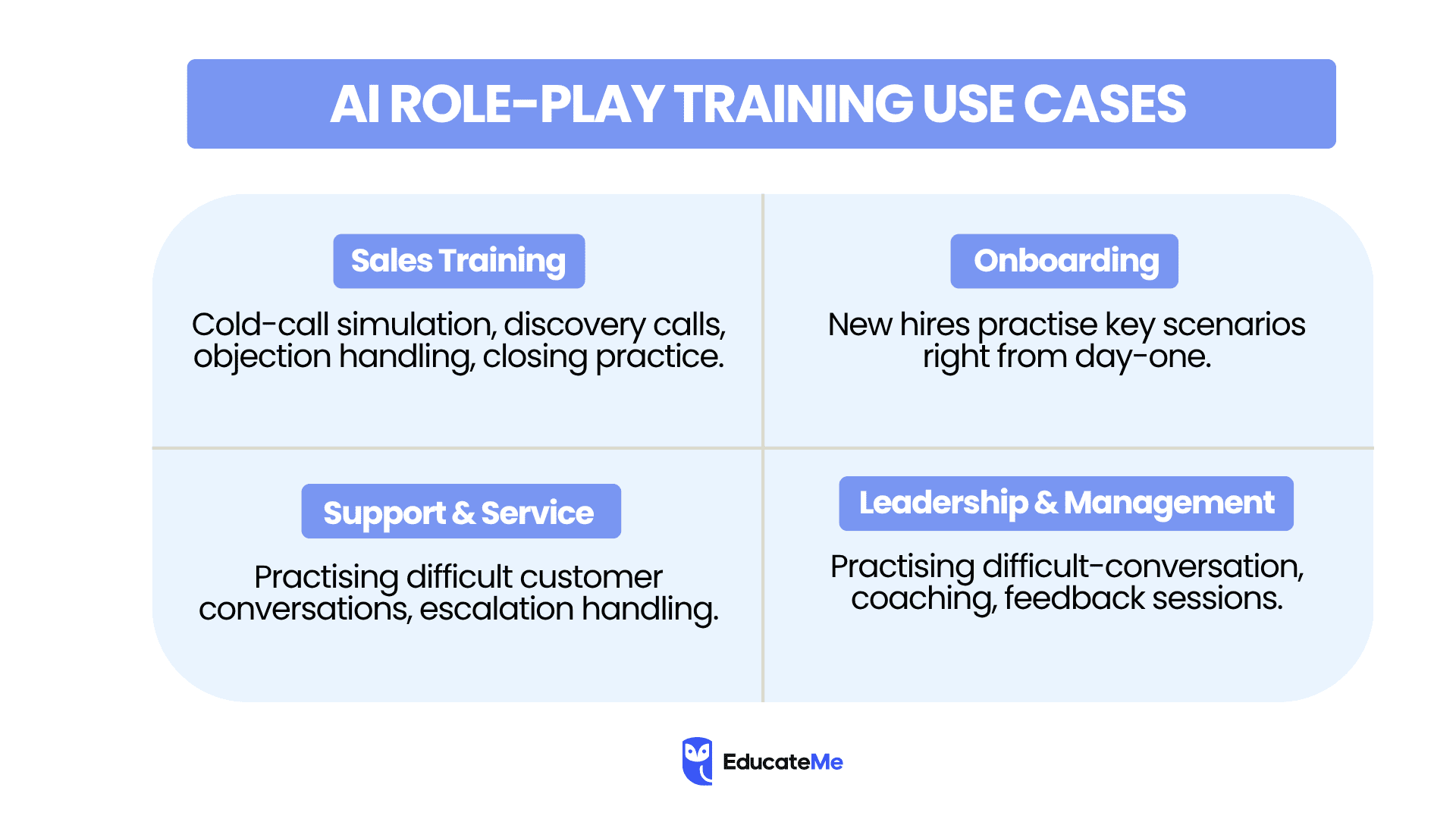
Roleplay training has evolved beyond simple peer-to-peer exercises in a conference room. Modern agencies leverage technological tools to scale training efficiency and maintain consistent standards across remote or hybrid teams.
- AI Conversational Bots: Practice async objection handling 24/7
- Call Recording Software: Evaluate real-world phone calls
- Video Scorecard Apps: Streamline manager feedback & metrics
Generative AI and Conversational Simulation Platforms
Interactive AI roleplay applications allow agents to practice scenarios independently. These platforms use voice recognition and large language models to act as prospect personas, offering immediate, objective scoring on parameters such as:
- Pace of speech and filler word frequency.
- Adherence to compliance disclaimers.
- Resolution of specific objection triggers.
AI roleplay platforms offer a safe space for new agents to build foundational confidence before stepping into live peer-to-peer or manager-led exercises.
Conversation Intelligence and Real-Call Audits
Integrating call analysis platforms (such as Gong or Chorus) allows sales managers to compare simulated roleplay performance against actual client interactions. By recording and analyzing real client meetings, leaders can identify common points where agents hesitate or struggle, creating customized roleplay scenarios tailored to real-world operational challenges.
Measuring Training ROI and Key Performance Metrics
To confirm that roleplay training yields a tangible return on investment, sales leaders must track concrete performance indicators before and after implementing a structured program.
- Baseline Metrics
- Conversion %
- Policy Retention
- Compliance Scores
- Roleplay Training
- Weekly Scenarios
- Scorecard Rubrics
- Peer Feedback
- Output Tracking
- Faster Time-to-First-Sale
- Higher Average Premium
- Improved Persistency Rates
Key Metrics to Monitor
- Time-to-First-Policy Written: Track how quickly newly licensed agents write their first active policy after joining the agency. Structured roleplay programs significantly shorten this onboarding ramp-up period.
- First-Appointment Conversion Rate: Measure the percentage of initial discovery meetings that successfully transition to a completed life insurance application.
- 13-Month Policy Persistency Rate: Agents who accurately identify client needs and handle financial objections through roleplays write higher-quality business. This direct alignment reduces early policy lapses and cancellations.
- Compliance Audit Scores: Track internal compliance audit scores to ensure agents deliver mandatory disclosures correctly and maintain accurate client suitability files.
Frequently Asked Questions (FAQ)
How often should an insurance agency conduct roleplay sessions?
Agencies should conduct roleplay training at least once a week for experienced agents and three to four times a week for newly licensed producers. Short, focused 20-minute daily sessions yield better retention than sporadic, multi-hour workshops.
How do you give constructive feedback without discouraging new agents?
Follow the "Sandwich Method" or the 2-for-1 feedback rule: highlight two specific techniques the agent executed well for every construct area targeted for improvement. Ensure feedback focuses strictly on observable actions, phrasing, and technique rather than personal traits.
Can AI completely replace peer-to-peer roleplay in life insurance training?
No. While AI tools provide excellent solo practice for basic pitch mechanics and technical objection handling, they cannot fully replicate human non-verbal cues, micro-expressions, and genuine emotional dynamics. A hybrid model combining AI practice with human peer evaluation produces the best results.
How do you keep roleplay sessions from feeling awkward or artificial?
Establish clear context before starting. Provide fully fleshed-out client background sheets, set strict timer limits, and mandate that all participants stay in character throughout the simulation. Normalizing mistake-making as a vital part of professional development helps reduce performance anxiety.
How should regulatory compliance be incorporated into roleplays?
Integrate mandatory disclosure steps directly into the evaluation rubric. Require agents to present appropriate informational brochures, verify buyer suitability details, and explain replacement regulations naturally within the flow of the simulated conversation.
Implementation Plan: Launching Your Agency Roleplay Program
To build a high-performing training environment, execute these immediate next steps:
- Build a Scenario Library: Create 5 to 10 detailed client buyer personas based on your agency's target markets (e.g., young families, pre-retirees, business owners).
- Develop a Standardized Scorecard: Define clear evaluation criteria covering rapport building, financial discovery, technical presentation, objection handling, and compliance adherence.
- Schedule Dedicated Practice Block: Block off recurring 30-minute training sessions on the agency calendar to establish roleplaying as a core operational priority.
- Train Your Evaluators: Ensure agency managers and senior producers understand how to give actionable, objective feedback that encourages continuous agent growth.
Image Gallery