Understanding the True Cost of Car Insurance Auto Rates
The true cost of car insurance encompasses far more than the monthly or annual premium cited in a quote. It represents the total financial obligation of vehicle ownership, including out-of-pocket deductibles, coverage gaps, potential p...
The true cost of car insurance encompasses far more than the monthly or annual premium cited in a quote. It represents the total financial obligation of vehicle ownership, including out-of-pocket deductibles, coverage gaps, potential premium surcharges following a claim, and the "opportunity cost" of choosing one coverage level over another. In 2026, understanding this cost requires a detailed analysis of how real-time data, repair inflation, and regional risk factors converge to dictate your final expenditure.
Contents
The Three Pillars of Total Insurance Expenditure
To accurately calculate what you are paying for protection, you must look beyond the "sticker price" of the policy. The true cost of auto insurance is generally divided into three distinct categories: fixed costs, variable costs, and hidden financial impacts.
Fixed Costs: The Policy Premium
The premium is the most visible element of insurance. It is the amount you pay to the insurer to keep the policy in force. In 2026, premiums are increasingly influenced by sophisticated AI-driven underwriting models that analyze thousands of data points, from your driving history to the local frequency of vehicle thefts. While this is a fixed monthly or semi-annual expense, it is often adjusted at every renewal period based on macro-economic trends and individual risk profiles.
Variable Costs: Deductibles and Risk Retention
A deductible is the amount you agree to pay out-of-pocket before your insurance coverage applies. Choosing a higher deductible, such as $1,000 or $1,500, lowers your fixed premium but increases your variable risk. The "true cost" here is a calculation of probability. If you have a high-deductible plan but live in an area with high accident rates, your expected annual expenditure may actually be higher than if you had paid for a more expensive, low-deductible policy.
Hidden Costs: Surcharges and Depreciation
Hidden costs are those that materialize only after an event occurs. The most significant of these is the "claim surcharge." When a driver is found at fault in an accident, insurers often increase premiums by 20% to 50% for a period of three to five years. Additionally, there is the factor of "diminished value"—the reality that a car involved in an accident is worth less upon resale, even if perfectly repaired. These long-term financial hits are rarely accounted for when looking at an initial auto rate quote.
Actuarial Evolution in 2026: Why Rates Are Changing
The landscape of auto insurance in 2026 is markedly different from previous decades due to the integration of advanced vehicle technology and shifts in climate-related risks. Understanding these factors explains why your "true cost" might be rising despite a clean driving record.
Advanced Driver Assistance Systems (ADAS) and Repair Inflation
Modern vehicles are equipped with complex sensors, cameras, and lidar systems. While these features reduce the frequency of accidents, they exponentially increase the severity of repair costs. A minor fender-bender that cost $500 to fix ten years ago can now exceed $4,000 because of the need to replace and calibrate sensitive electronic components. Insurers pass these high repair costs onto the consumer through adjusted comprehensive and collision rates.
Telematics and Usage-Based Insurance (UBI)
By 2026, telematics—technology that monitors driving behavior in real-time—has become a standard offering. While these programs promise discounts for "safe drivers," they also reveal the true cost of specific behaviors. Hard braking, late-night driving, and rapid acceleration are now quantified. For some, the true cost of insurance includes a "data tax," where the lack of privacy or the inability to meet strict driving metrics results in higher rates than traditional actuarial models would have dictated.
The Impact of Social Inflation and Litigation
"Social inflation" refers to the rising costs of insurance claims resulting from increased litigation, higher jury awards, and broader definitions of liability. In many jurisdictions, the legal environment has forced insurers to increase their reserve funds, leading to a baseline rate hike for all policyholders within that state, regardless of individual performance.
Comparing Policy Structures and Financial Outcomes
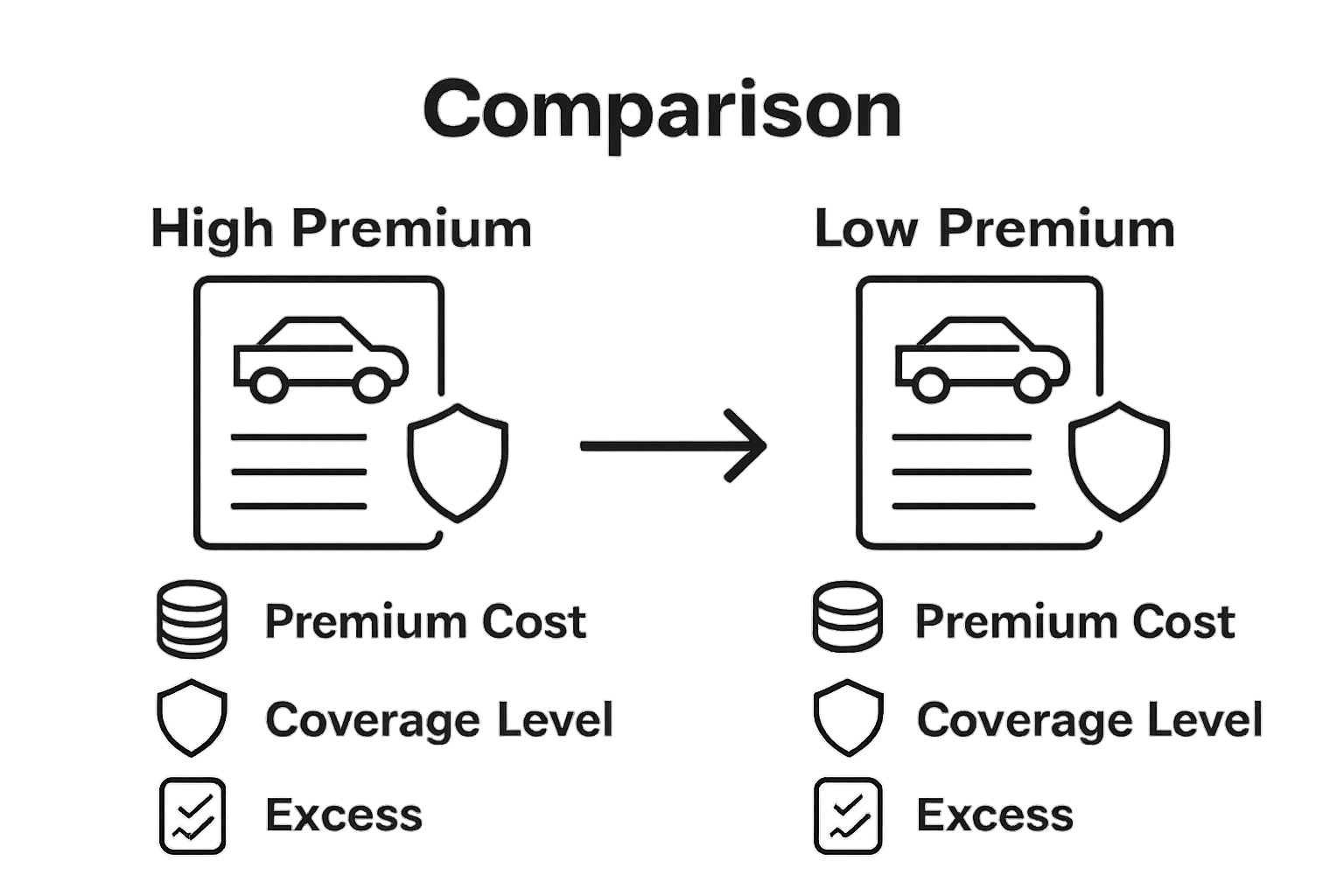
Choosing the right policy requires a comparison of how different structures affect your total financial outlook. The table below illustrates three common strategies and their projected financial impact over a three-year period, assuming one minor at-fault incident.
| Feature | Low-Premium / High-Risk | Balanced Coverage | Premium / Low-Risk |
|---|---|---|---|
| Annual Premium | $1,200 | $1,800 | $2,600 |
| Deductible (Collision) | $2,000 | $500 | $250 |
| Coverage Limits | State Minimum | 100/300/100 | 250/500/250 |
| 3-Year Fixed Cost | $3,600 | $5,400 | $7,800 |
| Out-of-Pocket (1 Claim) | $2,000 | $500 | $250 |
| Estimated Surcharge | 40% ($1,440) | 25% ($1,350) | 10% ($780) |
| Total 3-Year True Cost | $7,040 | $7,250 | $8,830 |
Note: Figures are estimates based on 2026 market averages and are intended for comparative analysis.
Vehicle Selection and its Direct Impact on Auto Rates
The type of vehicle you drive is perhaps the single most controllable factor in the true cost of your insurance. Insurers look at the "Loss Cost" of a vehicle—essentially, how much they expect to pay out for that specific model based on historical data.
Electric Vehicles (EVs) vs. Internal Combustion Engines (ICE)
In 2026, EVs often carry higher insurance premiums despite having fewer moving parts. This is due to the specialized labor required for repairs and the high cost of battery replacement. If a battery pack is damaged in a collision, the vehicle is often declared a total loss by the insurer, even if the rest of the car is intact. This "total loss threshold" significantly increases the collision portion of your auto rate.
Theft Rates and Security Features
Certain vehicle models are disproportionately targeted by thieves. The National Insurance Crime Bureau provides annual data on the most stolen vehicles. If your car lacks modern anti-theft encryption or is a high-target model, your comprehensive coverage costs will reflect that risk. Conversely, vehicles equipped with proactive theft-recovery systems (like GPS tracking) may qualify for significant discounts that lower the true cost of ownership.
Strategies to Manage and Lower Your True Insurance Costs
Reducing the true cost of car insurance requires a proactive approach that goes beyond simply "shopping around" every six months.
- Improve Your Credit-Based Insurance Score: In most states, your credit history is a major factor in determining your risk level. Improving your score can sometimes lead to greater premium reductions than even a perfect driving record.
- Audit Your Coverage Annually: As vehicles age, the necessity of collision and comprehensive coverage diminishes. If the annual cost of these coverages exceeds 10% of the vehicle’s book value, it may be more cost-effective to "self-insure" for physical damage.
- Bundle and Consolidate: Carrying multiple policies (home, life, auto) with a single provider remains one of the most effective ways to trigger significant percentage-based discounts.
- Inquire About Group Affiliations: Professional organizations, alumni associations, and even certain employers often have negotiated "group rates" that are not available to the general public.
Frequently Asked Questions
Why did my car insurance rate increase even though I haven't had an accident?
Rates often increase due to external factors known as "rate revisions." These are filed by insurance companies with state regulators and are based on the overall loss experience of the company. If there has been an increase in regional accidents, natural disasters, or the cost of medical care and auto parts, the insurer must raise rates for everyone in that risk pool to maintain solvency.
Does the "true cost" change if I use my car for a side gig?
Yes, significantly. Most personal auto policies explicitly exclude "commercial use," which includes ridesharing or delivery services. If you have an accident while working without a specific commercial endorsement or "rideshare add-on," your insurer may deny the claim entirely. The true cost then becomes the total value of the damages you must pay out-of-pocket, plus the potential for policy cancellation.
Is it always cheaper to choose the highest possible deductible?
Not necessarily. While a higher deductible lowers your premium, you must have that cash readily available in an emergency. If a $2,000 deductible prevents you from getting your car repaired and back to work after an accident, the "true cost" includes lost wages and transportation alternatives, which can quickly exceed the premium savings.
How do 2026 safety ratings affect my auto insurance rate?
Insurers rely on data from organizations like the Insurance Institute for Highway Safety (IIHS) to determine how well a vehicle protects its occupants. Vehicles with top safety ratings generally have lower injury-related premiums. However, if those safety features (like automatic braking) are expensive to repair, your collision premium may remain high even if your medical payment premium drops.
What is "Gap Insurance" and is it part of the true cost?
Gap insurance covers the difference between what you owe on a car loan and the actual cash value (ACV) of the vehicle if it is totaled. If you are financing a new car with a small down payment, the true cost of an accident without gap insurance could be thousands of dollars of "underwater" debt. Including gap coverage in your policy is often a necessary cost for those with high-interest or long-term loans.
Recommendation for Moving Forward
To effectively manage the true cost of your car insurance in 2026, you should perform a "Total Cost Audit" rather than a simple price comparison. Begin by requesting a full breakdown of your current policy, identifying the specific cost of each coverage type. Compare this against your vehicle's current market value and your personal emergency savings. If your savings can comfortably cover a higher deductible, increasing it can provide immediate premium relief. However, always ensure your liability limits are sufficient to protect your total assets; saving a few hundred dollars on a premium is never worth the risk of a multi-million dollar legal judgment. For those looking for the most competitive rates, visit the National Association of Insurance Commissioners (NAIC) to find state-specific consumer reports and complaint ratios for companies you are considering.
Image Gallery