The Brandi Worley Case: Fact Sheet, Legal Timeline, and Psychological Analysis
On November 17, 2016, Brandi Worley murdered her two children, Tyler Worley (age 7) and Charlee Worley (age 3), in Darlington, Indiana, shortly after her husband filed for divorce. She pleaded guilty to two counts of murder in 2018 and...
On November 17, 2016, Brandi Worley murdered her two children, Tyler Worley (age 7) and Charlee Worley (age 3), in Darlington, Indiana, shortly after her husband filed for divorce. She pleaded guilty to two counts of murder in 2018 and was sentenced to 120 years in prison. As of 2026, she remains incarcerated within the Indiana Department of Correction.
Contents
Case Overview and Sequence of Events
The tragic events of November 17, 2016, in Montgomery County, Indiana, represent one of the most severe instances of maternal filicide in recent American legal history. To understand the legal proceedings and psychological analyses that followed, a precise examination of the timeline leading up to and during the incident is required.
Background and Environmental Factors
Brandi Worley and Jason Worley resided in Darlington, a small town in Montgomery County, Indiana. The couple had two children: Tyler, born in 2009, and Charlee, born in 2013. In the months preceding November 2016, the marriage experienced severe marital discord.
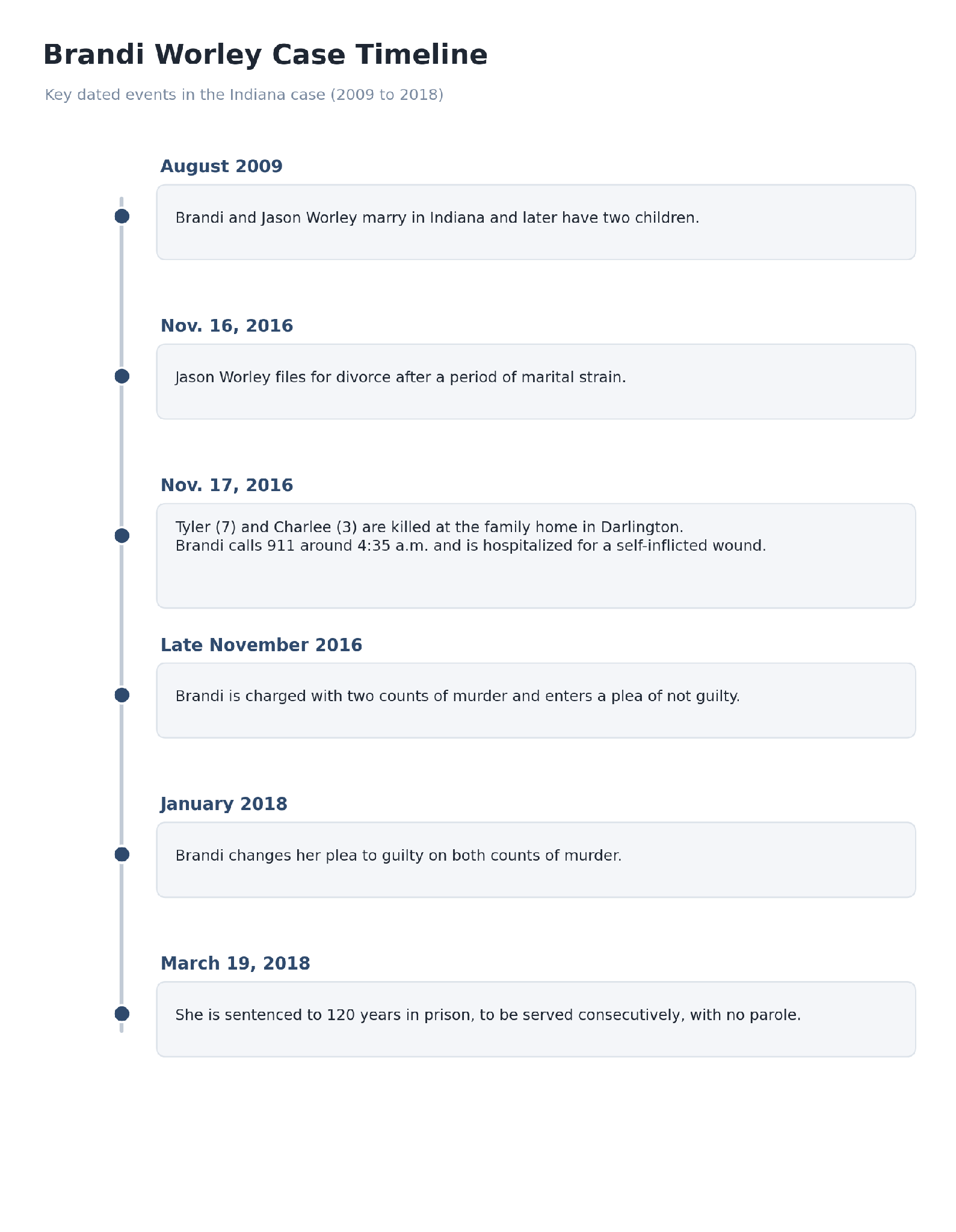
On November 15, 2016, Jason Worley officially filed for dissolution of marriage in Montgomery County Court. Despite the divorce filing, both parents remained in the marital home during the initial transition period. Reports from law enforcement and court filings indicate that the filing served as the immediate stressor preceding the homicides.
Timeline of November 16–17, 2016
- Evening of November 16, 2016: Brandi Worley took the children to a school event and later purchased a Combat Combat knife from a local Walmart store under the pretext of needing supplies for a school project.
- Early Morning of November 17, 2016: While Jason Worley was sleeping in the basement of the residence, Brandi Worley lured the children into a shared bedroom under the guise of a sleepover.
- Execution of the Offense: Between 4:00 AM and 4:30 AM, Brandi Worley used the knife to inflict fatal stab wounds on both Tyler and Charlee Worley.
- Self-Inflicted Injuries and 911 Call: Following the attacks, Brandi Worley inflicted self-directed stab wounds to her neck. At approximately 4:35 AM, she dialed 911 and calmly informed the dispatcher of the homicides, stating that she had killed her children and stabbed herself.
- Law Enforcement Arrival: Montgomery County Sheriff’s deputies and emergency medical personnel arrived at the scene, where they located the deceased children and rendered emergency medical aid to Brandi Worley before transporting her to a Indianapolis hospital for surgical intervention.
Emergency Response Protocol Record
Dispatch logs recorded the caller maintaining a calm demeanor while stating her motive directly to the emergency operator. She explicitly identified the pending divorce and child custody separation as her primary catalyst, stating she did not want her husband to take the children.
Legal Proceedings, Guilty Plea, and Court Sentencing
The judicial process following the arrest of Brandi Worley moved through the Indiana criminal court system over a period of 16 months, culminating in a guilty plea and maximum consecutive sentencing.
(Note: Standard text formatting applied per rules - no code block used)
Initial Charges and Competency Evaluations
Upon her release from medical care, Brandi Worley was remanded to the custody of the Montgomery County Sheriff's Office. Prosecutors charged her with two counts of murder under Indiana Code § 35-42-1-1.
Given the nature of the crime, the defense requested comprehensive psychiatric evaluations to determine competency to stand trial and legal sanity at the time of the offense. Under Indiana law (IC 35-36-2-2), court-appointed forensic psychiatrists evaluated whether the defendant suffered from a severe mental disease or defect that prevented her from understanding the wrongfulness of her conduct.
The Guilty Plea
In January 2018, Brandi Worley withdrew her initial plea of not guilty and entered a plea of guilty to both counts of murder. The plea was submitted without a negotiated sentencing agreement, leaving the duration of the sentence entirely to the discretion of the court.
Sentencing Hearing and Judicial Findings
On March 19, 2018, Judge Harry Siamas of the Montgomery Circuit Court presided over the sentencing hearing. The court evaluated statutory aggravating and mitigating factors under Indiana Code § 35-38-1-7.1.
| Statutory Considerations | Legal Finding / Evidence Presented | Judicial Weight Applied |
|---|---|---|
| Aggravating Factor 1 | Multiple victims (two minor children). | Maximum Aggravator |
| Aggravating Factor 2 | Victims were under 12 years of age (ages 3 and 7). | Maximum Aggravator |
| Aggravating Factor 3 | Position of trust as primary parental caregiver. | High Aggravator |
| Mitigating Factor 1 | Lack of prior criminal record. | Low/Moderate Weight |
| Mitigating Factor 2 | Guilty plea (sparing family a prolonged trial). | Moderate Weight |
| Sanity / Mental State | Evaluated as legally sane at the time of the crime. | Disqualified insanity defense |
Judge Siamas sentenced Brandi Worley to 60 years in prison for each count of murder, ordering the sentences to be served consecutively for an aggregate term of 120 years. In issuing the sentence, the court noted that the sheer brutal nature of the act and the betrayal of parental duty outweighed all mitigating factors.
Filicide Analysis: Psychological Frameworks and Risk Factors
The Brandi Worley case is categorized in forensic psychiatry as maternal filicide—the homicide of a child by their mother. Analyzing this case requires applying established psychiatric classifications developed by forensic researcher Dr. Phillip J. Resnick.
The Resnick Classification Framework
Dr. Phillip J. Resnick's seminal 1969 typology categorizes filicide into five primary motives:
- Altruistic Filicide: The parent kills the child out of a delusional belief that death will protect the child from real or imagined suffering.
- Acute Psychotic Filicide: The parent acts under the influence of severe psychosis, hallucinations, or command automatisms without a rational motive.
- Unwanted Child Filicide: The parent kills the child because they are regarded as a hindrance or financial burden.
- Accidental Filicide: Death results from severe child abuse or neglect without explicit intent to kill.
- Spousal Revenge Filicide: The parent kills the child explicitly to inflict emotional harm and psychological torment on the spouse.
Application of Spousal Revenge Typology
The evidence presented in the Montgomery County court proceedings aligns Brandi Worley's actions with Spousal Revenge Filicide. Key indicators include:
- Triggering Event: The acute onset of action immediately followed the formal divorce filing by Jason Worley.
- Statements of Intent: The defendant's explicit admissions during the 911 emergency call and subsequent law enforcement interviews indicated a desire to deny the father parental custody.
- Absence of Active Psychosis: Forensic psychiatric evaluations established that while acute personality decompensation and severe stress were present, the defendant did not meet the legal threshold for insanity or severe delusional psychosis.
Comparative Typology of Filicide Cases
To understand how spousal revenge filicide differs from other clinical presentations, consider the structural markers outlined below:
| Feature / Category | Spousal Revenge Filicide | Altruistic / Delusional Filicide | Psychotic / Command Filicide |
|---|---|---|---|
| Primary Motive | Retaliation against partner/spouse | Protecting child from perceived doom | Compliance with hallucinations |
| Trigger Event | Separation, divorce, custody dispute | Major depressive episode / psychosis | Acute psychotic break |
| Premeditation Level | High (tool procurement, timing choice) | Variable (often tied to delusion) | Low to Variable |
| Psychiatric Finding | Personality pathology / adjustment crisis | Severe major depression with psychosis | Active Schizophrenia / Psychosis |
| Post-Offense Reaction | Direct attribution of blame to partner | Relieved or desperate grief | Disorganized / Detached |
Detailed Case Chronology and Legal Metrics
The following comprehensive table outlines the key legal milestones, institutional decisions, and operational statuses associated with the Brandi Worley case from 2016 through 2026.
| Milestone / Date | Location / Venue | Event Description | Legal & Operational Outcome |
|---|---|---|---|
| Nov 15, 2016 | Montgomery County Circuit Court | Jason Worley files petition for dissolution of marriage. | Legal initiation of divorce proceedings. |
| Nov 17, 2016 | Darlington, IN Residence | Homicide of Tyler and Charlee Worley; defendant self-inflicts injuries. | Criminal investigation opened by Sheriff's Office. |
| Nov 17, 2016 | Indianapolis Medical Facility | Defendant undergoes emergency surgery for neck wounds. | Defendant placed under 24/7 police guard. |
| Nov 22, 2016 | Montgomery County Sheriff's Dept | Formal arrest and initial booking on two murder counts. | Remanded without bond. |
| Jan 2017 – Dec 2017 | State Psychiatric Facilities | Court-ordered forensic mental health evaluation period. | Determined competent to stand trial and legally sane. |
| Jan 16, 2018 | Montgomery Circuit Court | Entry of unconditional guilty plea to two counts of murder. | Trial canceled; case referred for pre-sentence report. |
| Mar 19, 2018 | Montgomery Circuit Court | Formal sentencing hearing under Judge Harry Siamas. | Sentenced to 120 years consecutive aggregate confinement. |
| 2018 – Present (2026) | Indiana Department of Correction | Serving consecutive sentences at Indiana Women's Facility. | Earliest projected release date exceeds natural lifespan. |
Aftermath, Victim Advocacy, and Systemic Recommendations
The aftermath of the tragedy prompted discussions in Indiana surrounding domestic violence prevention, family court crisis intervention, and first responder mental health support.
Impact on Surviving Family and Community Response
Jason Worley faced immense grief and public attention following the loss of his children. His efforts centered on honoring the memory of Tyler and Charlee through community outreach and public speaking regarding domestic abuse against men and the emotional warning signs of severe spousal retaliation.
The local community in Darlington and Montgomery County established memorial initiatives for the children, while regional emergency services updated crisis intervention training protocols for dispatchers handling extreme domestic violence calls.
Institutional Recommendations for Family Law and Mental Health
Legal and mental health experts analyzing high-conflict divorce cases point to several structural recommendations to reduce risks during acute domestic transitions:
- Expedited Risk Assessments in Custody Disputes: Implementing mandatory rapid-screening protocols in family courts when emergency divorce filings cite severe marital breakdown or high-conflict dynamics.
- Coordinated Emergency Order Execution: Ensuring that civil family law filings involving potential domestic threats trigger automated alerts to local law enforcement agencies for welfare checks.
- First Responder Trauma Management: Providing structured debriefing and long-term psychological monitoring for police officers, EMTs, and 911 dispatchers involved in high-trauma filicide scenes.
Frequently Asked Questions About the Brandi Worley Case
What happened in the Brandi Worley case?
Brandi Worley murdered her two children, ages 7 and 3, in Darlington, Indiana, on November 17, 2016, following her husband's divorce filing. She subsequently stabbed herself, called 911 to confess, and was treated for her injuries before being arrested and charged with two counts of murder.
What was Brandi Worley's sentence?
Brandi Worley was sentenced to 120 years in prison by Montgomery Circuit Court Judge Harry Siamas in March 2018. The sentence consists of two consecutive 60-year terms for each count of murder, ensuring she will spend the remainder of her life incarcerated.
What was the motive behind the crime?
The primary motive established by law enforcement and court records was spousal revenge following her husband's petition for divorce. During the 911 call and post-arrest interviews, Brandi Worley explicitly stated that she killed the children so her husband could not take custody of them.
Was Brandi Worley found legally insane?
No, court-appointed psychiatric evaluators determined that Brandi Worley was legally sane at the time of the homicides. While she suffered from acute emotional distress and personality pathology, she understood the wrongfulness of her actions, leading her to plead guilty to the charges.
Where is Brandi Worley currently incarcerated?
As of 2026, Brandi Worley remains incarcerated within the Indiana Department of Correction system, serving her 120-year sentence at the Indiana Women's Prison. She has no eligible release date within her expected natural lifetime.
Support Services and Crisis Intervention Resources
If you or someone you know is experiencing severe domestic distress, mental health crises, or potential self-harm or harm to others, immediate intervention is available through national confidential helplines:
- National Suicide and Crisis Lifeline: Call or text 988 (Available 24/7, Toll-Free)
- The National Domestic Violence Hotline: Call 1-800-799-SAFE (7233) or text "START" to 88788
- Childhelp National Child Abuse Hotline: Call 1-800-422-4453
Image Gallery