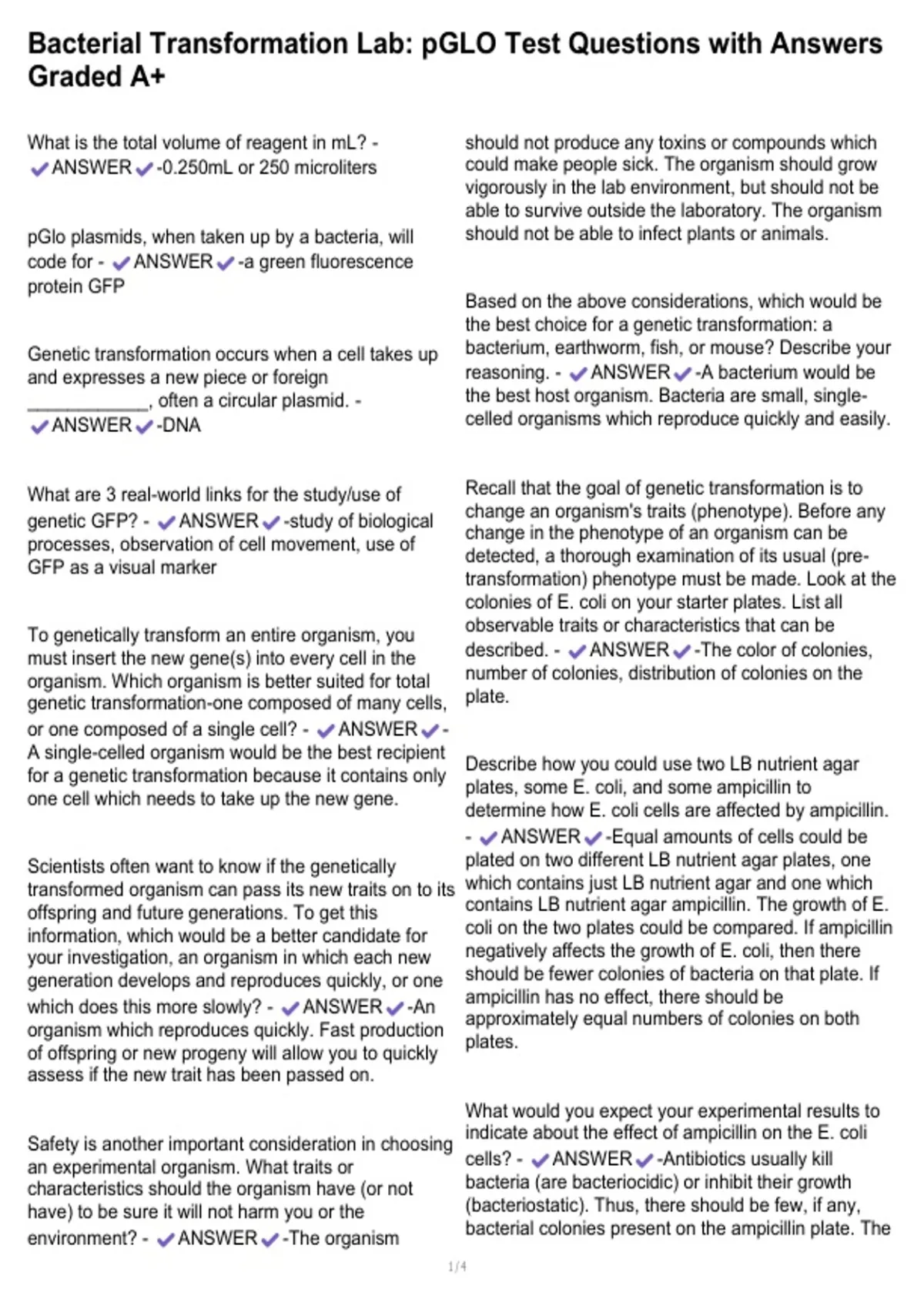
How to Get the pGLO Transformation Lab Answers PDF: A 2026 Study Guide
To obtain the pGLO Transformation Lab answers PDF, the most reliable method is through the official Bio-Rad Laboratories website, where the "Teacher’s Guide" is provided to verified educators. Alternatively, students can find comprehen...
To obtain the pGLO Transformation Lab answers PDF, the most reliable method is through the official Bio-Rad Laboratories website, where the "Teacher’s Guide" is provided to verified educators. Alternatively, students can find comprehensive theoretical explanations and expected results in AP Biology lab manuals or university-hosted biotechnology repositories that detail the plasmid's genetic mechanism.
Contents
The pGLO bacterial transformation lab remains the gold standard in biotechnology education as of 2026. This experiment allows students to witness genetic engineering firsthand by inserting a jellyfish gene into bacteria. However, finding the specific "answers" or the instructor’s key often requires navigating academic portals or understanding the underlying biological principles to derive the results independently.
Understanding the pGLO Bacterial Transformation Lab
The pGLO lab is designed to teach the fundamentals of genetic transformation, which is the process by which a cell takes up foreign DNA from its environment and expresses it. In this specific lab, the organism used is typically Escherichia coli (E. coli), and the vector is the pGLO plasmid.
A plasmid is a small, circular piece of DNA that exists independently of the chromosomal DNA. The pGLO plasmid is unique because it contains several key genetic components:
- GFP (Green Fluorescent Protein): The gene from the bioluminescent jellyfish Aequorea victoria that provides the "glow."
- bla (beta-lactamase): A gene that provides resistance to the antibiotic ampicillin.
- araC: A regulator gene that acts as a switch. In the presence of the sugar arabinose, the switch turns "on," allowing the GFP gene to be expressed.
Searching for a PDF of the answers usually implies a search for the Bio-Rad Teacher’s Guide. Bio-Rad is the primary manufacturer of these kits. Their manual includes not only the step-by-step protocol but also the "Quick Guide" and the expected data for each of the four experimental plates.
Official Sources for the pGLO Lab Manual and Answer Key
In 2026, educational resources have become more centralized, yet access to "Teacher's Keys" remains restricted to prevent academic dishonesty. If you are an educator or a student looking for legitimate study materials, here is how to find the PDF:
1. The Bio-Rad Life Science Education Portal
Bio-Rad provides the most comprehensive documentation. To get the full answer key, you generally need an educator account.
- Process: Visit the Bio-Rad Biotechnology Education page. Search for "pGLO Bacterial Transformation Kit."
- Verification: You may be asked to provide school affiliation. Once verified, you can download the full "Teacher's Guide PDF" which contains all the pre-lab and post-lab question answers.
2. AP Central and College Board
Since the pGLO lab is a core component of the AP Biology curriculum, the College Board provides extensive "Lab 8" (or its 2026 equivalent) resources. These PDFs often include "Sample Data" which serves as the "answers" for what a successful transformation looks like.
3. University Open Courseware (OCW)
Many universities, such as MIT and various state colleges, post their microbiology lab manuals online. These documents frequently include the pGLO protocol and a "Results and Discussion" section that explains the expected growth patterns and fluorescence.
Theoretical Results: The "Answers" to the Four Plates
Most students searching for "answers" are actually looking for what is supposed to happen on the four agar plates. Understanding these results is essential for writing a lab report. Below is a breakdown of the expected outcomes for a standard pGLO experiment.
The Four-Plate Comparison Table
| Plate Label | DNA Added (Plasmid) | Media (Agar Content) | Expected Growth | Fluorescence (UV Light) |
|---|---|---|---|---|
| +pGLO LB/amp | Yes | LB Agar + Ampicillin | Bacterial Colonies | No |
| +pGLO LB/amp/ara | Yes | LB + Amp + Arabinose | Bacterial Colonies | Yes (Green Glow) |
| -pGLO LB/amp | No | LB Agar + Ampicillin | No Growth | No |
| -pGLO LB | No | LB Agar Only | Bacterial Lawn | No |
Analyzing the Results
- -pGLO LB (The Control): This plate contains the "wild-type" bacteria with no plasmid and no antibiotic. You should see a "lawn" of growth, meaning the bacteria cover the entire surface. This proves that the bacteria were viable (alive) to begin with.
- -pGLO LB/amp (The Negative Control): Since these bacteria do not have the pGLO plasmid, they do not have the bla gene. Therefore, the ampicillin kills them. There should be zero growth. This proves that the antibiotic is working.
- +pGLO LB/amp (Selection Plate): Only the bacteria that successfully took up the pGLO plasmid can grow here because they now possess the bla gene. You will see individual white/off-white colonies. However, they will not glow because there is no arabinose to flip the GFP switch.
- +pGLO LB/amp/ara (Expression Plate): Like the previous plate, only transformed bacteria grow. However, the presence of arabinose triggers the araC regulator, which then promotes the transcription of the GFP gene. Under UV light, these colonies will glow bright green.
Genetic Mechanism: The "Why" Behind the Answers
To truly answer the post-lab questions in the PDF, you must understand the operon system. The pGLO plasmid utilizes a modified version of the ara operon.
In nature, bacteria use the ara operon to break down the sugar arabinose for food. Scientists replaced the genes for breaking down arabinose (araB, araA, and araD) with the jellyfish GFP gene. The araC protein remains as the gatekeeper.
- Without Arabinose: The araC protein binds to the DNA and prevents RNA polymerase from binding to the promoter. The "switch" is off.
- With Arabinose: Arabinose binds to the araC protein, changing its shape. This new shape allows RNA polymerase to bind and transcribe the GFP gene. The "switch" is on.
This is a classic example of gene regulation—the idea that even if a gene is present (like in the +pGLO LB/amp plate), it isn't always active.
Troubleshooting Common Lab Failures
If your results don't match the "answers" in the PDF, it is usually due to one of several technical errors.
- No Growth on +pGLO Plates: This is often caused by a failure in the heat shock step. If the temperature wasn't exactly 42°C for 50 seconds, the bacterial pores may not have opened, preventing the plasmid from entering. Another cause is "killing" the bacteria by leaving them at 42°C for too long.
- Growth on the -pGLO LB/amp Plate: This indicates contamination. Either the ampicillin was expired/denatured, or the bacteria were accidentally exposed to the plasmid.
- No Glow on +pGLO LB/amp/ara: Check your UV light source first. If the light works, the arabinose might have been missing from the agar or degraded.
Ethical Considerations and Academic Integrity
While it is tempting to download a "pGLO transformation lab answers PDF" to finish an assignment quickly, doing so without understanding the material can be detrimental, especially for students aiming for careers in medicine or research.
In 2026, many educational institutions use AI-detection and plagiarism software to cross-reference lab report submissions against known online answer keys. A better approach is to use the theoretical results (like those provided in the table above) to explain your actual experimental data, even if your experiment "failed." In science, an explained failure is often worth more marks than a perfect result that the student cannot explain.
Frequently Asked Questions
Why do we use E. coli for this transformation?
E. coli is the preferred organism because it is well-understood, grows rapidly (doubling every 20 minutes), and is generally safe (the HB101 or K-12 strains used in labs are non-pathogenic). Its simple genome makes it easy to observe the effects of adding a single plasmid.
What is the purpose of the 10-minute incubation on ice?
The incubation on ice, following the heat shock, helps to "close" the bacterial cell membrane and stabilize the newly entered plasmid. This increases the transformation efficiency, ensuring that the bacteria survive the transition.
Can I see the glow without a UV light?
No. The Green Fluorescent Protein (GFP) requires an external energy source (ultraviolet light) to excite the electrons in the protein's chromophore. Once excited, they release energy in the form of visible green light.
What is "transformation efficiency"?
This is a calculation often required in the lab answers. it is the number of colonies on the +pGLO LB/amp/ara plate divided by the amount of DNA (in micrograms) spread on the plate. It tells you how successful the transformation process was at a cellular level.
Final Recommendation
To get the most accurate pGLO transformation lab answers, refer to the Bio-Rad pGLO Bacterial Transformation Kit Instruction Manual (Catalog #1660003EDU). If you are a student, focus on explaining the relationship between the bla gene (survival) and the araC/GFP system (fluorescence) to satisfy your lab requirements. Use the expected data table as a benchmark for your own observations.
Image Gallery