How Compression Set Testing Works: A Comprehensive Technical Guide
Compression set testing measures a material's ability to return to its original thickness after being subjected to prolonged compressive stresses at specific temperatures and durations. It is primarily used to evaluate elastomers and c...
Compression set testing measures a material's ability to return to its original thickness after being subjected to prolonged compressive stresses at specific temperatures and durations. It is primarily used to evaluate elastomers and cellular materials, determining the permanent deformation—expressed as a percentage—that remains after the compressive force is removed.
Contents
In the engineering of seals, gaskets, and dampers, "memory" is a critical performance metric. When a rubber O-ring is squeezed between two metal surfaces, it creates a seal by exerting force back against those surfaces. Over time, due to heat, chemical exposure, or mechanical fatigue, the polymer chains reorganize, causing the material to lose its "push-back" capability. Compression set testing quantifies this loss, providing engineers with the data necessary to predict service life and prevent leakage in critical systems.
The Fundamentals of Viscoelasticity and Permanent Set
To understand how a compression set test works, one must first understand the viscoelastic nature of polymers. Unlike purely elastic materials (like a steel spring) that return immediately to their original shape, or purely plastic materials (like clay) that retain a new shape entirely, elastomers sit in between.
When an elastomer is compressed, the polymer chains are forced into new configurations. If the material is held in this state—especially under high temperatures—chemical changes occur. These include the breaking and reforming of cross-links (the "bridges" between polymer chains) and chain scission. When the load is finally released, the material attempts to recover, but the newly formed chemical structures "lock" it into a partially deformed state. This permanent loss of height is what we define as the compression set.
Standard Methodologies: ASTM D395 and ISO 815
While there are various niche standards, the global industry in 2026 continues to rely predominantly on two frameworks: ASTM D395 (Standard Test Methods for Rubber Property—Compression Set) and ISO 815 (Rubber, vulcanized or thermoplastic — Determination of compression set).
ASTM D395 defines two primary methods:
- Method A (Constant Force): A known mass or force is applied to the specimen. This is less common in modern sealing applications but remains relevant for materials designed to support specific static loads.
- Method B (Constant Deflection): This is the industry standard for gaskets and seals. The specimen is compressed to a fixed percentage of its original height (typically 25%) using steel spacers. This method replicates the real-world conditions of a bolted flange or a seated O-ring.
Essential Equipment for the Test
The accuracy of a compression set test depends on the precision of the apparatus. High-quality laboratories utilize the following components:
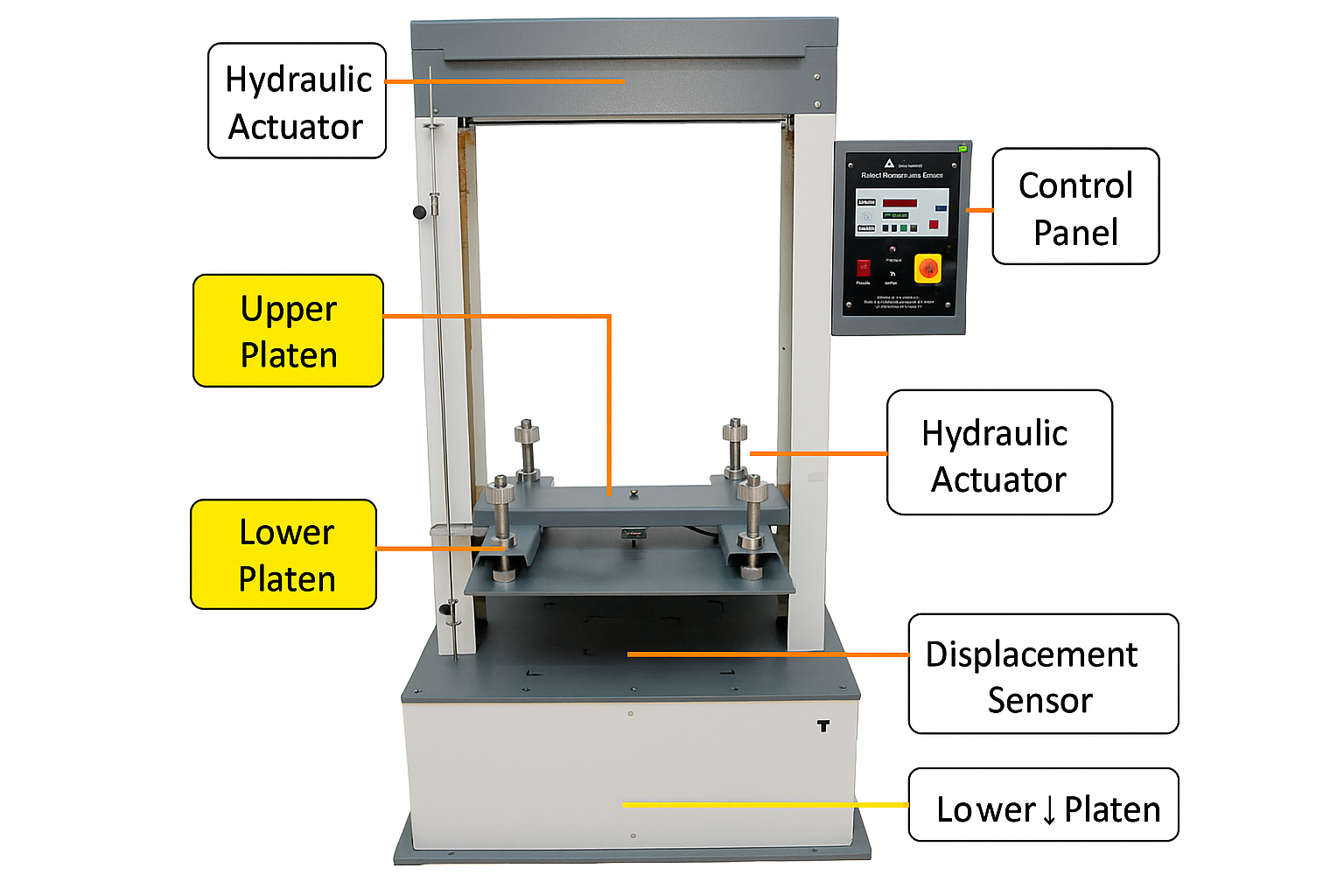
- Compression Plates: Two highly polished, chrome-plated, or stainless steel plates. The surface finish is vital; if the plates are too rough, friction will inhibit the material's lateral expansion (barreling), skewing the results.
- Steel Spacers: These are precision-ground metal shims placed between the plates to ensure the sample is compressed to the exact required deflection (e.g., if a 12.5mm sample needs 25% deflection, 9.375mm spacers are used).
- Environmental Chamber (Oven): A circulating air oven capable of maintaining temperatures within ±1°C. Heat accelerates the chemical changes in the polymer, allowing a test of 22 to 70 hours to simulate months or years of service.
- Digital Micrometer: In 2026, high-resolution digital micrometers with calibrated contact pressure are used to measure the specimen thickness to the nearest 0.01mm.
The Step-by-Step Testing Process
Executing a valid compression set test requires strict adherence to timing and environmental controls.
1. Specimen Preparation
Standard specimens are usually cylindrical "buttons." According to ASTM D395, a standard Type 1 specimen is 29mm in diameter and 12.5mm thick. If the material is too thin, multiple disks can be "plied" together, though this is generally less preferred than a single molded piece because the interfaces between plies can introduce air and friction variables.
2. Initial Measurement ($t_0$)
The original thickness of the specimen is measured at room temperature. It is essential to measure the center of the button, as edges may have slight molding irregularities.
3. Compression
The specimen is placed between the compression plates with the appropriate spacers. The bolts on the compression jig are tightened until the plates make firm contact with the spacers. At this stage, a lubricant (such as silicone oil or molybdenum disulfide) is often applied to the plates to ensure the rubber can expand freely without sticking.
4. Thermal Conditioning
The loaded jig is placed into the oven. Common test parameters include 70°C, 100°C, or 125°C for durations of 22, 70, or 166 hours. The combination of heat and time forces the polymer to undergo accelerated aging.
5. Release and Recovery
This is the most critical phase for consistency. Once the time is up, the jig is removed from the oven. The specimens must be released from the plates immediately (usually within 30 to 60 seconds).
6. Final Measurement ($t_i$)
The specimen is allowed to "rest" on a low-thermal-conductivity surface (like wood or plastic) at standard room temperature. For ASTM D395 Method B, the final thickness measurement is taken after exactly 30 minutes of recovery. Measuring too early will result in an artificially high set, while waiting too long might allow for additional "cold" recovery that doesn't reflect the material's immediate sealing capability.
Calculating the Compression Set Percentage
The result is expressed as a percentage of the original deflection. It is not a percentage of the total original thickness, but rather a percentage of the squeeze that was lost.
The formula for Method B is: $$C_B = \frac{t_0 - t_i}{t_0 - t_n} \times 100$$
Where:
- $C_B$ = Compression Set (%)
- $t_0$ = Original thickness
- $t_i$ = Final thickness after recovery
- $t_n$ = Thickness of the spacer (the height the material was compressed to)
Example Interpretation: If a 10mm sample was compressed to 7.5mm (25% deflection) and, after recovery, it only returned to 9mm, it has "lost" 1mm of its potential 2.5mm recovery. The compression set would be $(10 - 9) / (10 - 7.5) = 1/2.5 = 40%$.
Comparison of Testing Standards
| Feature | ASTM D395 (Method B) | ISO 815-1 |
|---|---|---|
| Primary Focus | Constant Deflection | Constant Deflection |
| Standard Deflection | 25% (usually) | 25% (standard), 15%, 10% |
| Recovery Time | 30 minutes | 30 minutes (Standard) |
| Specimen Shape | Cylindrical Button | Cylindrical Button |
| Lubrication | Recommended | Required (unless specified) |
| Application | North American Industrial | International/European |
Critical Factors Influencing Results
Several variables can lead to inconsistent data or test failure. Understanding these helps in troubleshooting unexpected results.
Temperature Sensitivity
Elastomers are highly sensitive to thermal fluctuations. A 5°C variance in oven temperature can lead to a 10-15% difference in compression set values for certain nitrile (NBR) or Viton (FKM) compounds. Ensuring the oven has adequate airflow and calibrated sensors is mandatory.
Lubrication and Friction
If the specimen sticks to the plates during compression, it cannot expand radially. This creates internal stresses that may cause the material to "pop" or tear. Conversely, a lack of lubrication can result in "barreling," where the center of the specimen expands but the surfaces do not, leading to uneven set.
Cooling Rates
The speed at which the material cools after being removed from the oven can impact the molecular "locking" process. ASTM standards emphasize removing the samples from the jig quickly so they cool in an uncompressed state.
Material Hardness (Durometer)
Softer materials (30-50 Shore A) generally show different recovery profiles than harder materials (80-90 Shore A). Harder materials may appear to have a better compression set but might actually be more prone to "stress relaxation," a related but different phenomenon where the material stays the same shape but the force it exerts drops over time.
Frequently Asked Questions
What is considered a "good" compression set?
A "good" value depends entirely on the application. For high-performance O-rings in aerospace or automotive engines, a compression set of less than 20% at high temperatures is often required. For general-purpose spacers or weather-stripping, a set of 30-50% may be perfectly acceptable. Values above 60% usually indicate a high risk of seal failure.
How does compression set differ from stress relaxation?
Compression set measures the physical deformation (change in height) after a load is removed. Stress relaxation measures the reduction in force the material exerts while it is still being compressed. While they are related, a material can have a decent compression set but poor stress relaxation, making it fail as a seal even though it looks "okay" upon inspection.
Why does heat make the compression set worse?
Heat provides the activation energy for chemical reactions. In elastomers, this leads to "oxidative cross-linking" (becoming brittle) or "chain scission" (becoming soft). Both processes prevent the polymer network from returning to its original matrix.
Can I compare results from different test times?
No. A 22-hour test and a 70-hour test are not linearly comparable. The rate of set is usually logarithmic; the most significant deformation occurs in the first few hours, followed by a slower, steady increase. Engineers must ensure they are comparing "apples to apples" when reviewing material datasheets.
Practical Recommendations for Engineers
When selecting a material based on compression set data, always verify the test temperature and duration. A material that boasts a 10% compression set at room temperature may skyrocket to 80% at 125°C.
For 2026 industrial applications, it is recommended to:
- Request Long-Term Data: If a seal must last five years, ask for 166-hour or 500-hour test data rather than the standard 22-hour "quick look."
- Test in Media: If the seal will be submerged in oil or coolant, perform the compression set test while the sample is immersed in that fluid (following ASTM D471 protocols). Chemicals often plasticize the rubber, significantly altering its recovery properties.
- Verify Recovery Timing: Ensure your lab or supplier is strictly following the 30-minute recovery window, as this is the most common source of inter-laboratory variance.
Image Gallery