Pool Robotic Cleaner Reviews Guide: How to Select the Best Automatic Vacuum
Selecting the right robotic pool cleaner requires matching your pool's physical dimensions, surface material, and debris types with specific machine capabilities. Unlike suction or pressure-side cleaners, robotic units operate on indep...
Selecting the right robotic pool cleaner requires matching your pool's physical dimensions, surface material, and debris types with specific machine capabilities. Unlike suction or pressure-side cleaners, robotic units operate on independent low-voltage power, using internal motors and filter canisters to clean floors, walls, and waterlines without adding strain to your main pool pump.
Contents
How Robotic Pool Cleaners Function and Key Components
Robotic pool cleaners are self-contained electro-mechanical systems engineered to operate submerged in pool water. While suction-side cleaners rely on the suction from your pool's skimmer and pressure-side cleaners require dedicated booster pumps, a robotic cleaner functions entirely independently. It plugs into a standard outdoor electrical outlet via a low-voltage transformer step-down power supply, converting high-voltage household alternating current (120V AC) into safe direct current (typically 24V DC).
- Robotic Cleaner Architecture:
- Power Supply / Transformer (120V AC to 24V DC)
- Floating Swivel Cable
- Drive Motor(s): Drives Tracks / Wheels
- Pump / Impeller Motor: Pulls Water Through Filter Canister
- Active Brushes: Scrubs Algae & Biofilm
- Microprocessor / Gyro: Controls Navigation & Wall Climbing
- Floating Swivel Cable
- Power Supply / Transformer (120V AC to 24V DC)
Inside the robot, electric motors drive two main operational systems:
- The Water Displacement System: An internal pump motor spins an impeller, drawing raw pool water through bottom intake valves at high flow rates—often between 3,000 and 5,000 gallons per hour (GPH). The water passes through internal filter baskets or micro-filter cartridges, which trap organic debris, leaves, sand, and fine silt before discharging clean water back into the pool through a top exhaust port. This downward water propulsion also generates downforce, pressing the robot against pool floors and walls for enhanced traction.
- The Traction and Propulsion System: Separate drive motors power rubber tracks or synthetic wheels to move the unit across pool surfaces. Advanced models use dual-drive motors, allowing the left and right tracks to rotate independently in opposite directions. This dual-motor drive setup enables 360-degree zero-radius turns on both horizontal floors and vertical walls.
The internal navigation logic relies on onboard microprocessors paired with solid-state gyroscopic sensors. These sensors detect orientation, tilt angle, and surface resistance, helping the machine map out systematic cleaning patterns, overcome obstacles like main drain covers, and maintain vertical balance when scrubbing high along the waterline.
Corded vs. Cordless Robotic Pool Cleaners: Technical Comparison
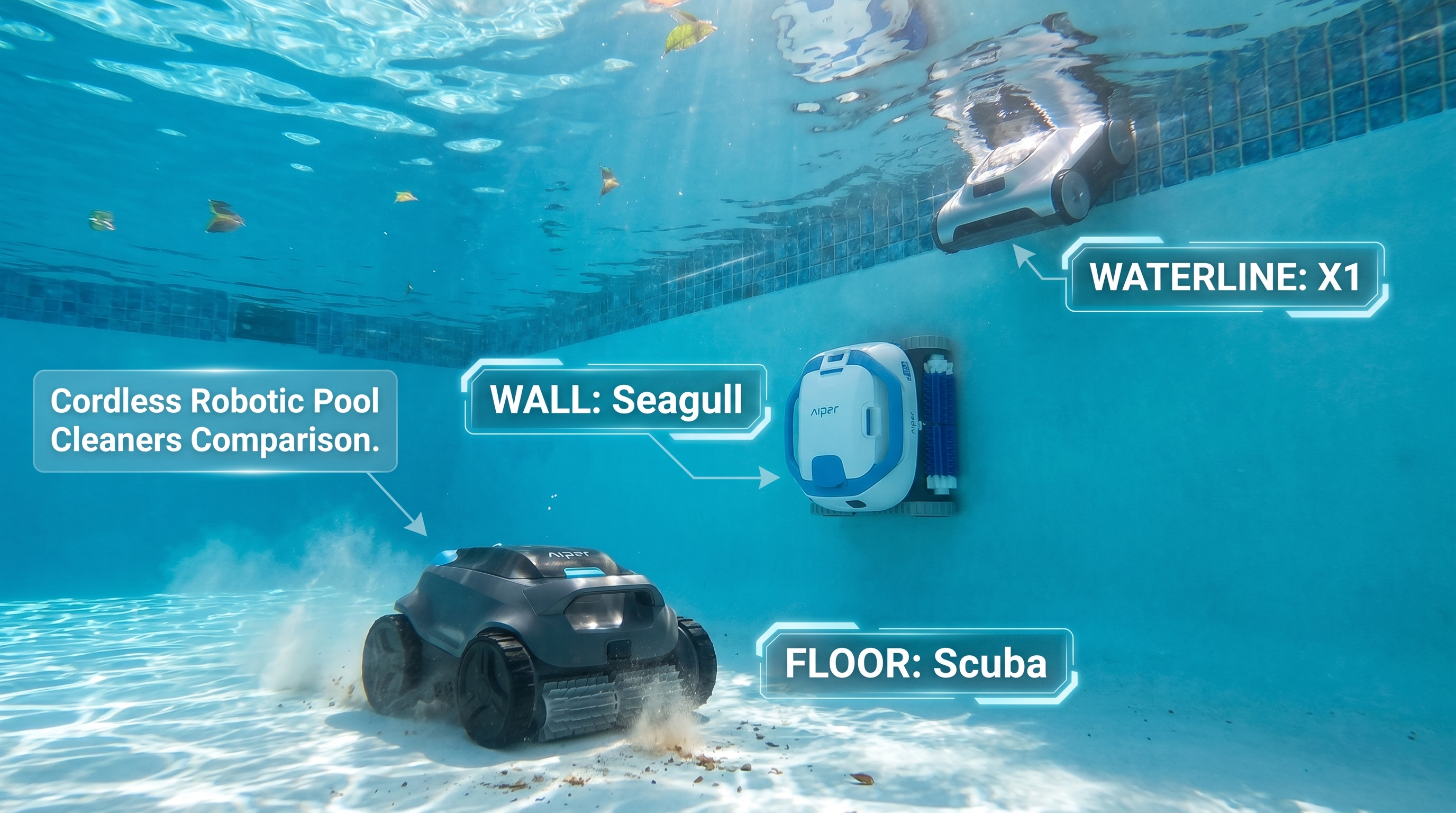
The robotic pool cleaner market features two primary product architectures: traditional corded models powered by continuous shore power via a floating cable, and modern battery-powered cordless units equipped with integrated rechargeable lithium-ion battery packs.
| Corded Cleaners | Cordless Cleaners |
|---|---|
| Unlimited Run Time | Zero Cable Tangling |
| Continuous Suction Power | Quick Drop-In Setup |
| Higher GPH Flow Rates | Restricted Run Time |
| Heavier Cable Management | Battery Degradation over 3-5 Year Lifecycle |
Corded Robotic Cleaners
Corded models remain the benchmark for deep-cleaning large residential and commercial pools. They connect to an external power supply unit positioned at least 10 to 12 feet away from the pool edge.
- Advantages:
- Continuous Power: Unrestricted run times allow corded units to complete multiple or extended cleaning cycles (typically 2 to 3.5 hours) without stopping to recharge.
- Consistent Suction: High-output pump motors maintain uniform suction power throughout the cycle, maintaining peak performance even as the filter basket fills with debris.
- Higher Flow Rates: Corded architectures can support larger motors capable of processing over 4,500 GPH, making them ideal for heavy debris loads and large surface areas.
- Disadvantages:
- Cable Management: Floating cables can twist or tangle if the unit lacks an anti-tangle swivel mechanism, limiting coverage range.
- Setup and Storage Requirements: Requires storing and unwinding a heavy electrical cord alongside the unit, often necessitating a specialized storage caddy.
Cordless Battery-Powered Cleaners
Cordless robotic vacuums rely on sealed, internal lithium-ion battery packs, eliminating the need for a floating power cord.
- Advantages:
- Unrestricted Mobility: Absence of a cord prevents tangling around narrow steps, water features, drop-offs, or complex geometric pool edges.
- Simplified Operation: Lightweight design with one-touch button operation allows users to drop the unit straight into the pool without untangling cables.
- Disadvantages:
- Restricted Run Time: Operating times typically range from 90 to 180 minutes per charge, requiring a 2- to 5-hour recharging period between cycles.
- Battery Lifespan: Sealed lithium-ion batteries degrade over time, usually offering a functional lifespan of 3 to 5 years before battery capacity drops significantly, often requiring full unit replacement or factory battery service.
- Reduced Suction Late in Cycle: As battery voltage declines near the end of a cycle, pump power and drive speed can drop on budget cordless models.
Core Evaluation Criteria for Buying a Robotic Pool Cleaner
When evaluating robotic pool cleaner specifications, focus on these critical performance factors to match your pool's operational needs.
- Coverage: Floor Only | Floor & Wall | Floor, Wall & Waterline
- Filtration: Coarse (100 µm) | Fine (50 µm) | Ultra-Fine (2-5 µm)
- Suction: Standard (3,000 GPH) vs High-Flow (4,500+ GPH)
- Brushing: PVC Serrated vs WonderBrush (PVA Foam)
1. Cleaning Coverage (Floor, Wall, and Waterline)
Not all robotic cleaners clean the entire pool surface:
- Floor-Only Units: Entry-level units navigate strictly along the flat pool bottom and mild slopes up to 15 degrees. They cannot scale vertical walls or clean the waterline.
- Floor and Wall Cleaners: Mid-tier units scale 90-degree transitions, climbing walls to clean algae and sediment off vertical surfaces before descending.
- Floor, Wall, and Waterline Cleaners: Premium cleaners use specialized side-draft thrusters or high-torque drive motors to pause at the top of the wall. They travel horizontally along the tile line, scrubbing oil, grease, and bio-film off the waterline where dirt builds up most.
2. Micron Rating and Filtration Capacity
Filter performance determines the size of particles a cleaner can trap, measured in micrometers (microns):
- Coarse Mesh Filters (100+ microns): Ideal for spring opening or yards with heavy foliage. They capture large leaves, twigs, acorns, and pebbles without clogging quickly, but let fine dust pass through.
- Fine Filters (50 to 70 microns): Standard for everyday maintenance. Traps general dirt, insect parts, small plant matter, and coarse sand.
- Ultra-Fine Micro Filters (2 to 5 microns): Essential for capturing fine silt, red clay, dead algae, pollen, and microscopic debris. Ultra-fine pleated cartridges clarify water but require more frequent rinsing because their dense surface area fills up faster.
3. Drive System, Traction, and Brushing Mechanics
A cleaner's ability to navigate slippery surfaces depends on its drive tracks and brush design:
- Single vs. Dual Drive: Dual-drive motors provide precise control, letting the unit spin on a dime to escape tight corners or stair footings. Single-drive models rely on mechanical deflection, which can cause them to get stuck on obstacles like main drain covers.
- Active Scrubbing Brushes: Look for models with brushes that spin at double the speed of the robot's tracks. This fast spinning creates friction that scrubs attached algae and scum off pool surfaces rather than just rolling over it.
- Brush Material: Standard PVC serrated rubber brushes work well on textured surfaces like concrete or plaster. Smooth surfaces like polished tile, vinyl liners, and slippery fiberglass need specialized PVA (polyvinyl alcohol) foam brushes—often called WonderBrushes—to maintain traction on vertical walls.
Technical Comparison of Robotic Pool Cleaner Categories
The table below breaks down the primary categories of robotic pool cleaners available for residential and commercial pools, comparing their technical specifications, optimal applications, and operational capabilities.
| Cleaner Category | Power Source | Primary Coverage | Micron Rating | Flow Rate (GPH) | Best Suited Applications |
|---|---|---|---|---|---|
| Above-Ground / Compact | Corded or Cordless Battery | Floor Only (Optional mild incline) | 100 to 250 Microns (Mesh Bag/Basket) | 2,200 – 3,000 GPH | Small flat-bottom above-ground pools, vinyl plunge pools, and small pop-up pools under 24 feet. |
| Mid-Range Residential | Corded (Swivel Cable) | Floor & Vertical Walls | 50 to 70 Microns (Fine Cartridge) | 3,500 – 4,200 GPH | Standard in-ground vinyl, concrete, or fiberglass pools up to 40 feet requiring floor-to-wall cleaning. |
| Premium Smart In-Ground | Corded (Wi-Fi / App Control) | Floor, Wall, & Horizontal Waterline | Multi-layer (2 to 50 Microns dual-stage) | 4,500 – 5,000+ GPH | Large complex in-ground pools with sun shelves, deep ends, tile waterlines, and heavy silt/fine leaf debris. |
| Cordless Freedom Class | Lithium-ion Battery Pack | Floor, Wall, & Waterline (Model dependent) | 30 to 100 Microns (Basket Filter) | 3,000 – 4,000 GPH | Mid-sized pools without nearby power outlets, or yards where floating cables cause tangling risks. |
| Commercial Heavy-Duty | Corded (Heavy Duty Transformer) | Floor, Wall, & Waterline (Large format) | Dual Fine/Coarse (Down to 5 Microns) | 6,000 – 10,000+ GPH | Public municipal pools, hotel facilities, athletic clubs, and resort pools up to 80+ feet in length. |
Selecting the Right Cleaner by Pool Surface and Design
Matching a robotic cleaner's mechanical specifications to your pool's construction material and layout prevents premature wear and ensures full cleaning coverage.
| Surface / Layout | Requirement |
|---|---|
| Concrete / Plaster | High-abrasion PVC serrated brushes + Heavy-duty treads |
| Vinyl Liner | Smooth rubber tracks + Non-abrasive soft bristles |
| Fiberglass / Tile | High-grip PVA Foam Brushes (WonderBrushes) |
| Complex Shapes | Gyro-guided dual-drive motors with wall detection |
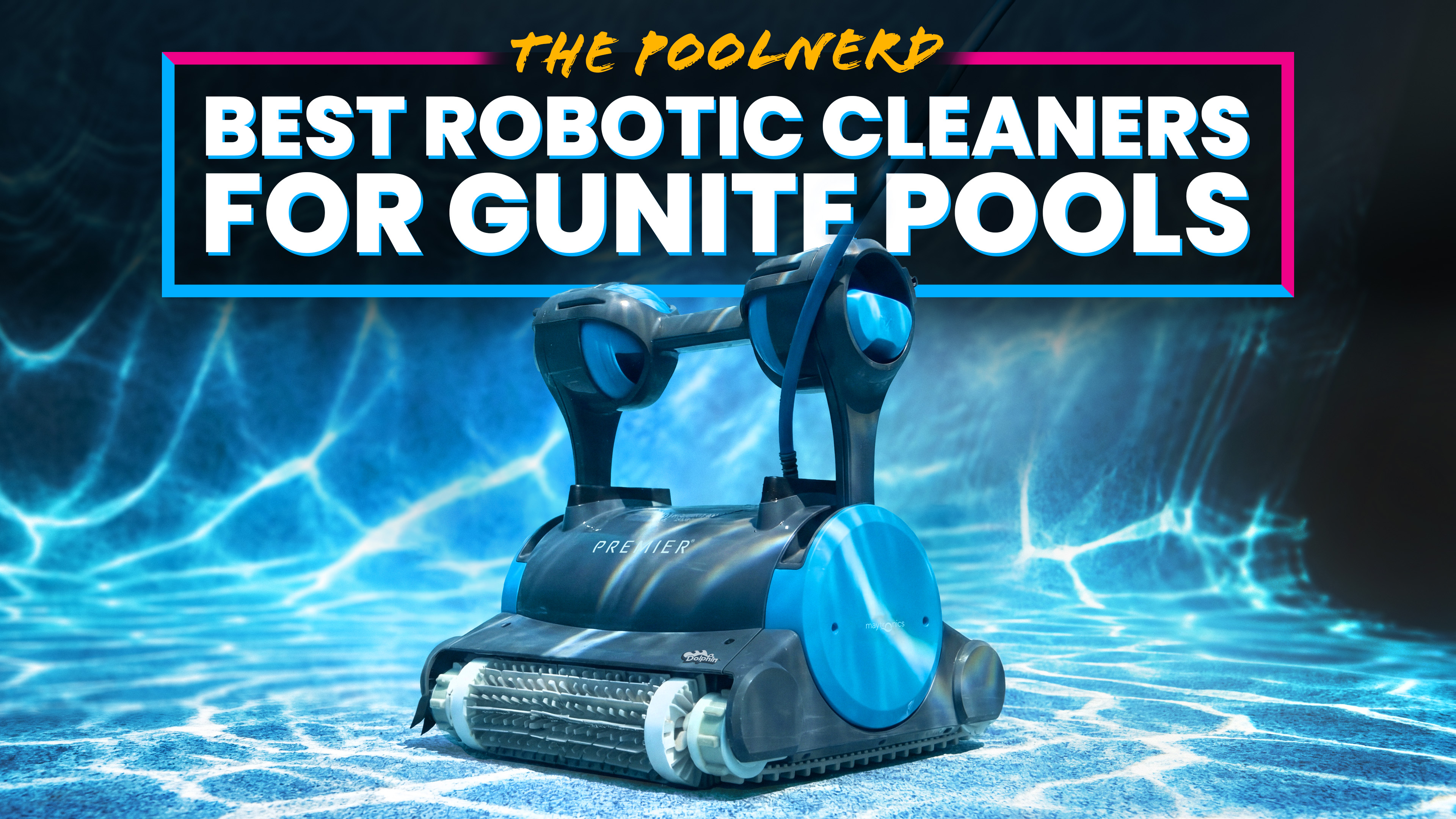
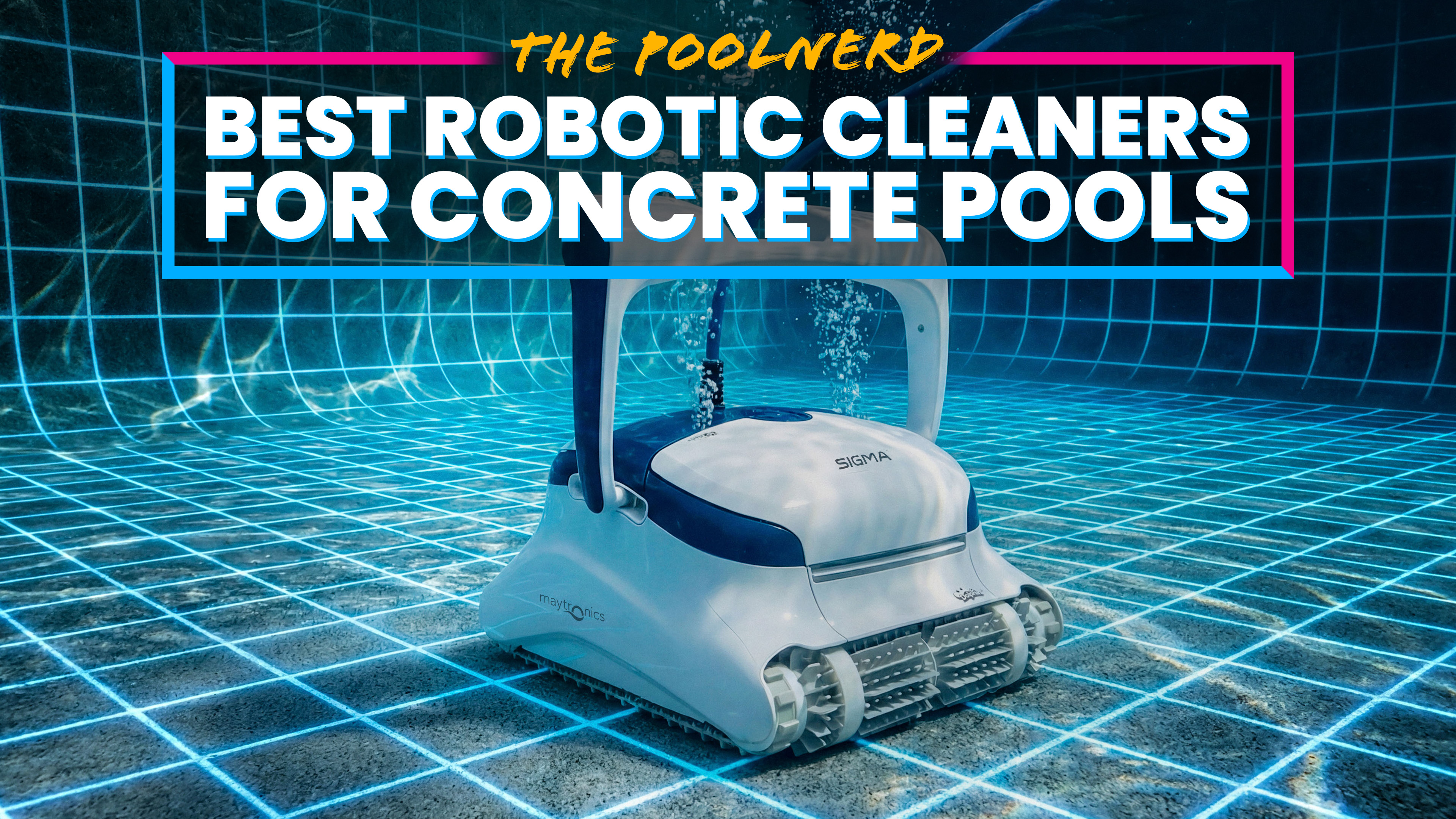
Concrete and Gunite Plaster Pools
Plaster, exposed aggregate (such as PebbleTec), and painted gunite pools offer high mechanical traction but are abrasive to equipment.
- Brush Requirements: Standard rubber or serrated PVC brushes work exceptionally well on concrete. The texture provides high traction for heavy-duty drive tracks.
- Wear Considerations: Abrasive plaster surfaces wear down rubber tracks, drive belts, and bottom brushes over time. Select units with thick, reinforced rubber treads and user-replaceable wear pads on the underside chassis to prevent structural scraping.
Vinyl Liner Pools
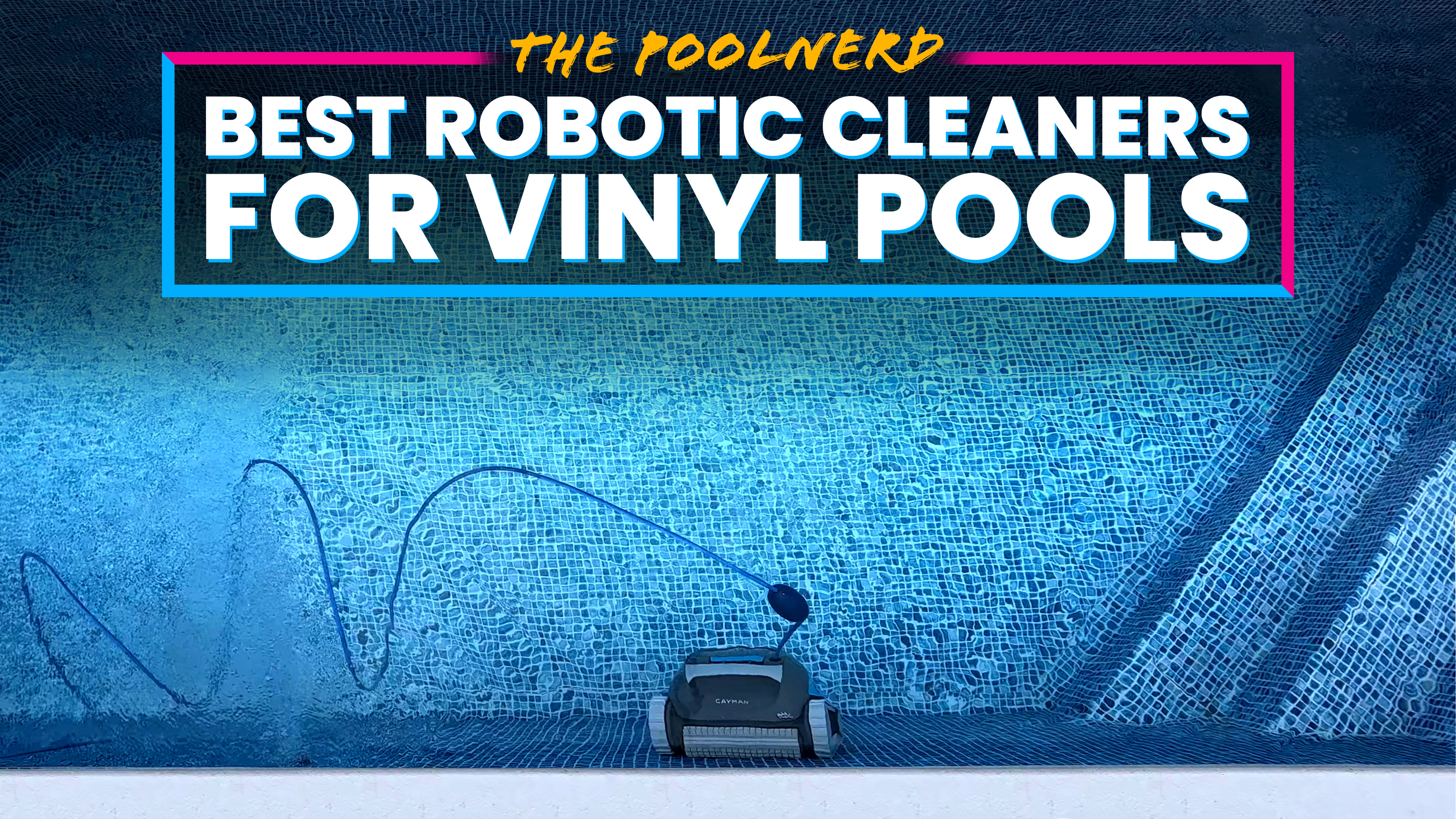
Vinyl liners are smooth and delicate. Cleaners must provide firm traction without using sharp tread patterns that could snag, stretch, or puncture the liner.
- Traction Needs: Look for continuous rubber tracks that spread the cleaner's weight evenly across the vinyl surface. Avoid rigid plastic wheels that can slip on steep transitions or scrub patterns off printed vinyl.
- Scrubbing Mechanics: Use soft PVC brushes with rounded bristles. Ensure the unit's bumper guards are smooth to prevent tearing or stretching vinyl in tight radius corners.
Fiberglass and Smooth Ceramic Tile
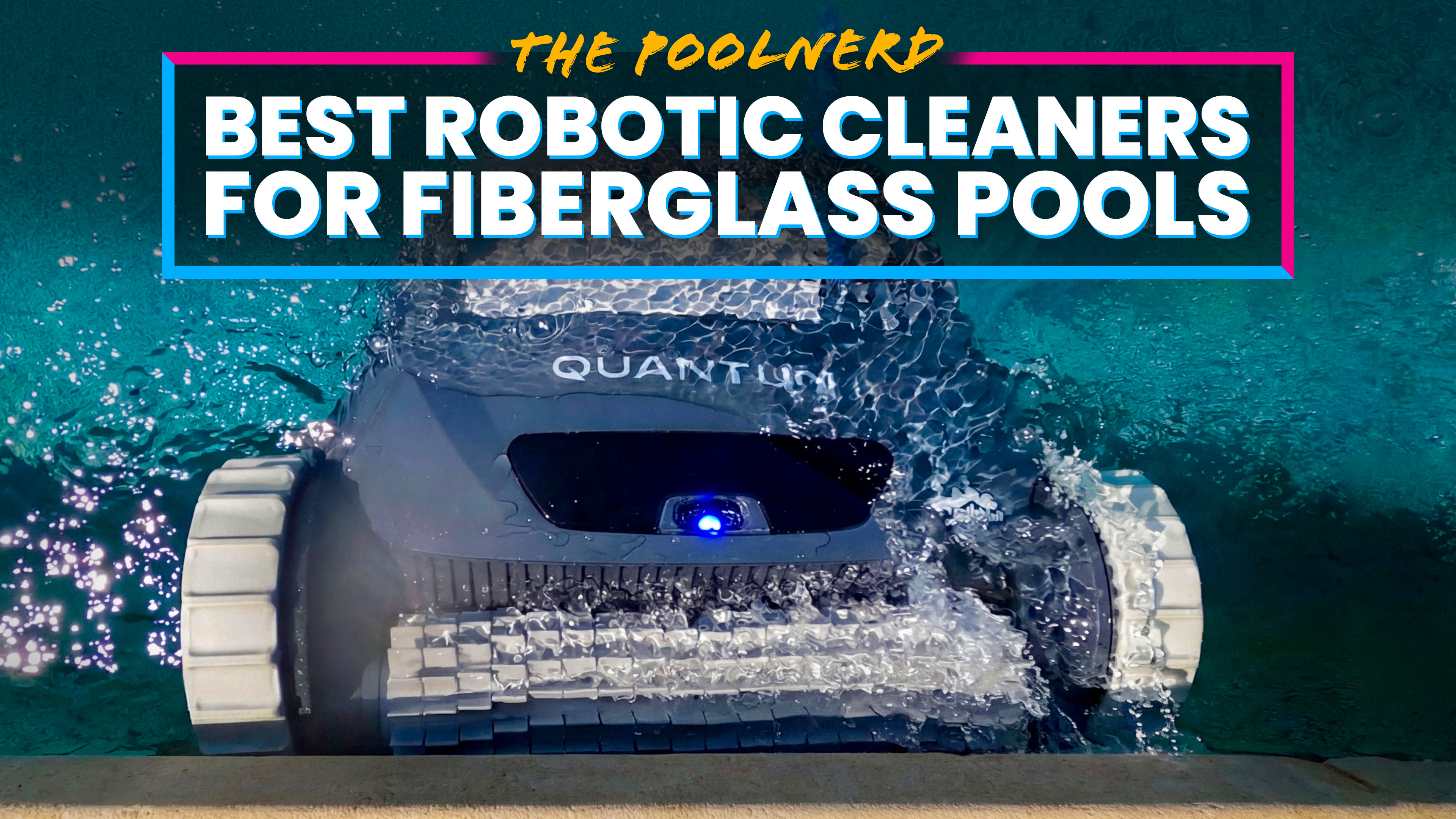
Fiberglass shells and fully tiled pools are slippery. Standard hard PVC brushes often spin without gripping on smooth vertical surfaces, causing the robot to slip backward off the wall.
- Component Requirements: Equipping the robot with PVA expansion foam brushes (WonderBrushes) is critical. When wet, PVA foam expands into a soft, sponge-like material that grips smooth gel-coat fiberglass and vitrified ceramic tile.
- Weight Balance: Choose lightweight or neutrally buoyant units. Heavy cleaners often struggle to scale smooth vertical fiberglass walls, even when using foam brushes.
Complex Shapes, Steps, and Sun Shelves
Pools with freeform curves, deep-end drop-offs, swim-out benches, and shallow tanning ledges present navigation challenges.
- Navigation Hardware: Look for robots featuring 3D gyroscopic sensors and smart mapping logic. These sensors detect when the robot tilts beyond safe limits, backing it away from ledges before it traps air inside its drive housing.
- Water Depth Minimums: Standard robotic cleaners need a minimum water depth of 18 to 24 inches to remain fully submerged. If dropped on shallow sun shelves (depths under 1.5 feet), the pump impeller can draw in air, lose prime, and trigger an automatic safety shutoff.
Maintenance, Troubleshooting, and Lifespan Maximization
Proper operational care extends the working lifespan of a robotic pool cleaner from an average of 3 years to 7 years or more.
- After Every Cycle: Empty debris canister & thoroughly rinse filters
- Weekly: Inspect impeller for hair/threads; untwist cable
- Storage: Store on caddy off the ground out of direct sun
- Water Chemistry: Maintain pH 7.2-7.6 & Free Chlorine < 4.0 ppm
Essential Preventive Maintenance Steps
- Rinse Filter Elements Immediately: Never allow wet organic debris, silt, or algae to dry inside fine filter cartridges. Dried debris clogs the microscopic pores of fine filter media, reducing suction power by up to 50% on subsequent runs. Hose out canisters from the outside in using high-pressure garden hose nozzles after every cycle.
- Proper Cable Storage and Swivel Care: For corded units, lay the cable flat in the sun periodically to release memory coils. Store the cable loosely in large loops—never wrap it tightly around the robot's body. If your cable includes a mechanical swivel, inspect it monthly to clear away caught hair, fine thread, or sand grains.
- Protecting Internal Electronics: Never leave the power supply transformer out in standing water or exposed to direct sunlight during summer heat. Mount the transformer at least 11 inches off the ground on a dedicated caddy or shade post to prevent thermal overload and water intrusion.
- Water Chemistry Balance: High levels of free chlorine (above 5.0 ppm), low pH (below 7.0), or high salt concentration can corrode internal rubber seals, drive belts, and motor shaft O-rings. Always balance pool chemistry before deploying the robot, and pull the unit out of the pool during hyper-chlorination or shock treatments.
Troubleshooting Common Operational Issues
- Robot Will Not Scale Walls:
- Check the filter canister first. A dirty, clogged filter basket limits water throughput, reducing the downward thrust required to hold the robot against vertical walls.
- Check the brushes. If using PVC brushes on smooth fiberglass or tile, upgrade to PVA foam brushes.
- Inspect the drive tracks for loose tension or worn drive belts.
- Cleaner Floats or Cannot Submerge:
- Trapped air inside the motor housing or filter media causes unwanted buoyancy. Submerge the unit and tilt it sideways and upside down under water to vent trapped air bubbles before releasing it to the bottom.
- Foam brushes must be completely saturated with water to achieve neutral buoyancy. Squeeze PVA foam brushes under water before starting a cycle.
- Cable Twists into Knots:
- Verify that the swivel mechanism spins freely.
- Check for uneven motor drive output. If one drive track is restricted by hair or debris, the cleaner will turn continuously in one direction, twisting the power cable over time. Clean out the track wheels and drive gear assemblies.
Frequently Asked Questions
How long do robotic pool cleaners typically last?
With proper care, high-quality residential robotic pool cleaners have an average lifespan of 5 to 8 years. Key components like drive tracks, brushes, and filter baskets may need replacement every 2 to 3 years, while internal sealed drive motor assemblies typically last the lifetime of the unit. Cordless models generally require battery service or replacement after 3 to 5 years (300 to 500 charge cycles).
Can a robotic pool cleaner replace my pool's main filtration pump?
No. While a robotic pool cleaner filters pool water internally while running, it cannot replace your main pool filtration system. Your pool's circulation pump runs for extended daily periods to move water through primary sand, cartridge, or DE filters, balance chemical distribution, and run surface skimmers. Robotic cleaners serve as auxiliary tools designed to remove settled floor debris and scrub bio-films off surfaces.
What is the practical difference between fine mesh and ultra-fine filters?
Fine mesh filter baskets (around 100 microns) trap large debris like leaves, seeds, and pine needles while allowing water to pass through easily without clogging. Ultra-fine pleated filter cartridges (2 to 5 microns) trap invisible silt, fine sand, pollen, dust, and dead algae spores. Ultra-fine filters clarify cloudy pool water, but they require frequent rinsing because their dense mesh fills up quickly.
How do I stop my corded robotic pool cleaner's cord from tangling?
To keep power cords from tangling, choose models equipped with a mechanical anti-tangle swivel joint along the floating cable line. Additionally, avoid dropping excessive lengths of cord into the pool; only feed enough cable length for the robot to reach the farthest corner of the pool. Store corded units on specialized transport caddies that support large, sweeping cable loops.
Are cordless robotic pool cleaners powerful enough to scrub vinyl and tile walls?
Yes, high-end cordless robotic cleaners feature advanced dual-motor drive architectures paired with high-capacity lithium-ion batteries that supply sufficient power for wall climbing and waterline scrubbing. However, cordless units generally offer shorter cleaning cycles (typically 90 to 120 minutes) compared to corded models, which can scrub heavy wall deposits continuously for over 3 hours.
Practical Final Recommendation
When choosing a robotic pool cleaner, focus on your pool's physical characteristics rather than buying based on extra features:
- Measure Your Reach and Surface Type: Select a model rated for your pool length plus at least 5 feet of extra cable margin. If your pool features smooth ceramic tile or slick fiberglass, select a unit equipped with PVA foam brushes (WonderBrushes) to ensure wall traction.
- Prioritize Dual-Drive and Ultra-Fine Filtration: For in-ground pools with complex angles, steps, or heavy silt accumulation, choose dual-drive motors with ultra-fine cartridge filtration (under 5 microns). Dual-drive systems prevent the robot from getting stuck on obstacles, while ultra-fine filters capture small dust particles that standard filter baskets miss.
- Establish a Post-Cycle Maintenance Routine: Protect your investment by removing the cleaner from the pool after every cycle, rinsing the filter canister thoroughly, and storing the unit out of direct sunlight on a specialized caddy. Never leave the cleaner submerged during chemical shock treatments.
Image Gallery