Is Martin Cooper Still Alive? Current Status and Legacy of the Mobile Phone Pioneer
Yes, Martin Cooper is still alive. As of 2026, the American engineer and inventor—widely recognized as the "Father of the Handheld Cell Phone"—is 97 years old. Born on December 26, 1928, Cooper remains active in public discourse, offer...
Yes, Martin Cooper is still alive. As of 2026, the American engineer and inventor—widely recognized as the "Father of the Handheld Cell Phone"—is 97 years old. Born on December 26, 1928, Cooper remains active in public discourse, offering insightful commentary on the evolution of personal communications, wireless technology, and the social impact of modern smartphones.
Contents
Current Status of Martin Cooper in 2026
Martin Cooper continues to be a prominent figure in the technology and engineering communities. Residing in California alongside his wife and fellow tech entrepreneur Arlene Harris, Cooper remains intellectually vibrant, regularly participating in industry conferences, technology podcasts, and media interviews.
Despite reaching his late nineties, Cooper frequently shares his perspective on how modern society interacts with mobile devices. Far from being a nostalgic observer, he actively critiques the current state of smartphone software, advocating for intuitive user interfaces, improved battery efficiency, and digital wellness. His longevity and ongoing intellectual contributions make him one of the few living technology pioneers whose original invention directly transformed global infrastructure and human daily life.
Early Life and Educational Background
Martin Cooper was born in Chicago, Illinois, to Jewish immigrants from Ukraine. Raised during the Great Depression, he developed an early fascination with how mechanical and electrical systems operated, often disassembling household items to understand their internal mechanisms.
Cooper pursued his higher education at the Illinois Institute of Technology (IIT) in Chicago, earning a Bachelor of Science degree in Electrical Engineering in 1950. His academic trajectory was briefly interrupted by military service during the Korean War, where he served as a submarine officer in the United States Navy.
Following his naval service, Cooper returned to academia while beginning his corporate engineering career. He earned his Master of Science degree in Electrical Engineering from IIT in 1957. His education at IIT provided the rigorous theoretical foundation in radio frequency (RF) engineering and electromagnetic theory that later fueled his breakthroughs at Motorola.
The Breakthrough: Inventing the Handheld Cellular Phone
In 1954, Martin Cooper joined Motorola as a senior development engineer in its communications division. Over the next two decades, he led teams developing portable products, including the first portable police radio system designed for the Chicago Police Department in 1967. However, his defining achievement emerged from an intense corporate rivalry in the early 1970s.
The Competition with AT&T Bell Labs
During the late 1960s and early 1970s, AT&T's Bell Laboratories was the dominant entity in telecommunications research. AT&T focused its efforts on car-based cellular phones, envisioning a network where individuals could make calls while inside their automobiles.
Cooper strongly disagreed with this philosophy. He believed that telephone numbers should be assigned to individual people rather than physical places, buildings, or vehicles. He envisioned a truly personal communication device that a user could carry anywhere in their pocket or bag.
To prevent AT&T from obtaining a monopoly on cellular radio spectrum, Motorola management gave Cooper three months to build a working prototype of a handheld portable phone to prove the feasibility of personal cellular communication to the Federal Communications Commission (FCC).
The First Mobile Phone Call: April 3, 1973
Leading a team of engineers and industrial designers—including chief designer Rudy Krolopp—Cooper designed and assembled the Motorola DynaTAC (Dynamic Adaptive Total Area Coverage) prototype in just 90 days.
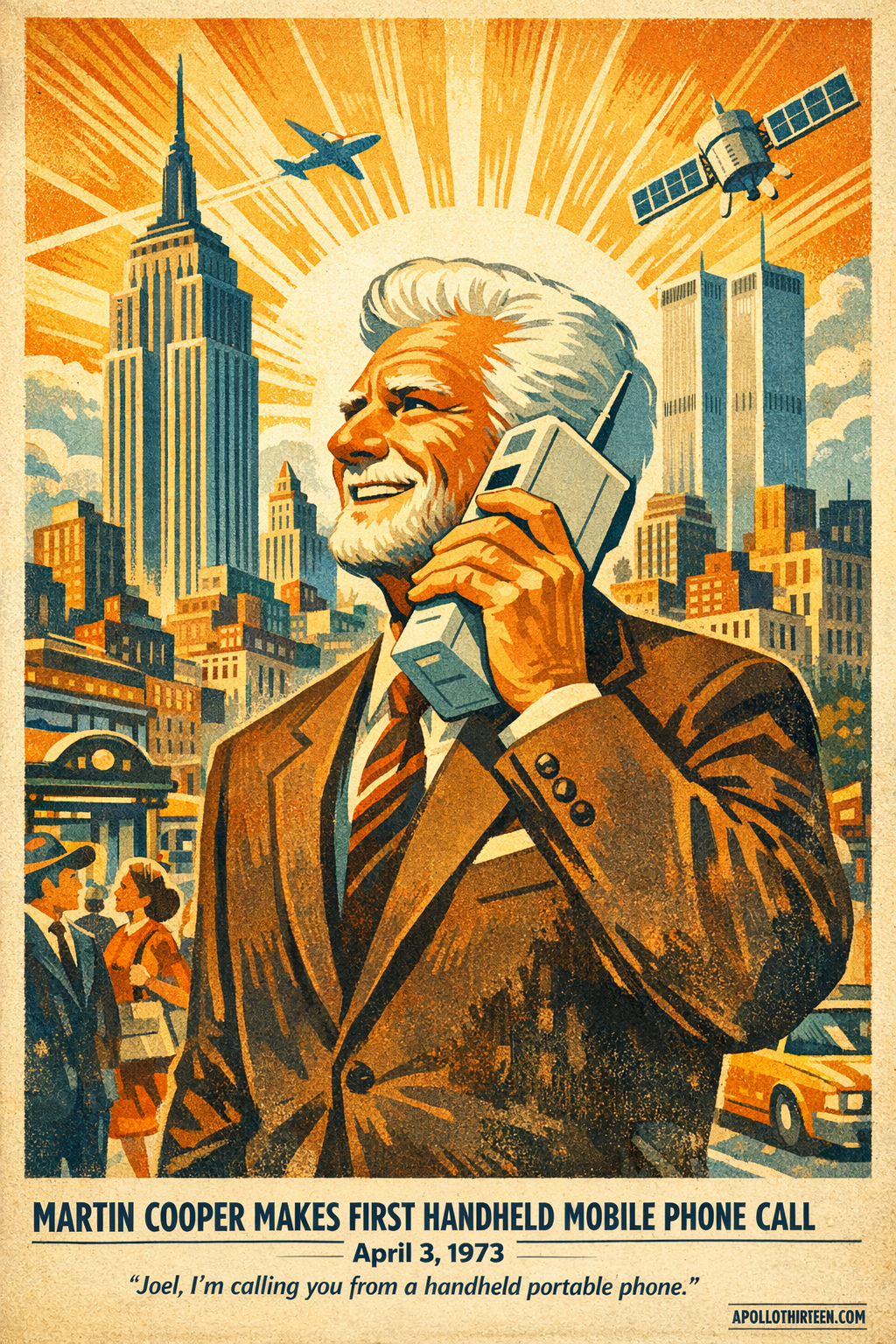
On April 3, 1973, Cooper held a press conference in Midtown Manhattan outside the Manhattan Midtown Marriott hotel on Sixth Avenue. Before walking into the hotel for the formal demonstration, Cooper stepped onto the sidewalk with the 2.5-pound brick-shaped prototype and dialed a number.
The call was connected through a temporary base station installed on the roof of 909 Third Avenue to the fixed landline network. Cooper called his chief competitor, Dr. Joel S. Engel, head of AT&T's cellular program.
"Joel, this is Marty Cooper. I'm calling you from a cell phone, a real handheld portable cell phone."
This historic conversation marked the world's first public call made from a handheld mobile device, fundamentally altering the trajectory of telecommunications history.
- Motorola DynaTAC Prototype (1973)
- Radio Frequency Transmission
- Local Base Station (3rd Ave, NYC)
- Standard Landline Network
- Joel Engel's Desk at AT&T Bell Labs
Technical Overview of the Original DynaTAC Prototype
The original 1973 DynaTAC prototype was a remarkable achievement in engineering given the microchip technology available at the time. Commercial cellular networks did not exist yet, meaning the device relied on specialized base stations and custom radio circuitry.
| Feature / Metric | Motorola DynaTAC Prototype (1973) | Motorola DynaTAC 8000X (Commercial 1983) |
|---|---|---|
| Weight | 2.5 lbs (1.1 kg) | 1.75 lbs (790 g) |
| Dimensions | 9 x 5 x 1.75 inches | 10 x 1.75 x 3 inches |
| Battery Talk Time | Approx. 20–30 minutes | Approx. 30–60 minutes |
| Recharge Time | 10 hours | 10 hours |
| Retail Price | Prototype (N/A) | $3,995 USD |
| Primary Frequency | 800 MHz band | 800 MHz band (AMPS network) |
| Key Engineers | Martin Cooper, Rudy Krolopp | Martin Cooper, John F. Mitchell |
It took another decade of regulatory approvals, network infrastructure construction, and hardware miniaturization before Motorola introduced the first commercial handheld cell phone—the DynaTAC 8000X—in 1983.
Cooper’s Law and Technical Contributions
Beyond the invention of the physical cell phone, Martin Cooper made lasting contributions to wireless communication theory. One of his most influential conceptual frameworks is Cooper’s Law of Spectral Efficiency.
Understanding Cooper's Law
Formulated in the late 20th century, Cooper’s Law states that the maximum number of voice calls or data transmissions that can pass through a given location’s radio spectrum doubles every 30 months. This law has held true since Guglielmo Marconi’s first transatlantic radio transmissions in 1901.
- Cooper's Law Spectrum Efficiency Curve: Capacity Doubles Every 30 Months (1901 to 2026)
- Analog Telegraph
- AM/FM Radio
- Cellular (1G-5G)
- Advanced Spatial Multiplexing
Cooper pointed out that this exponential increase in spectrum capacity was not primarily achieved by acquiring more radio frequencies, but through technological innovations such as:
- Cell Division: Breaking geographical areas into smaller hexagonal cells to reuse frequencies.
- Advanced Modulation: Shifting from basic AM/FM analog signals to complex digital encoding.
- Smart Antenna Systems: Directing radio signals toward specific users rather than broadcasting in all directions indiscriminately.
Post-Motorola Career and Entrepreneurship
After leaving Motorola in 1983, Cooper co-founded several successful telecommunications companies focused on solving spectral efficiency challenges and enhancing accessible technology.
- Cellular Business Systems, Inc. (CBSI): Founded in 1983, CBSI became a leader in cellular billing software before being acquired by Cincinnati Bell Information Systems.
- ArrayComm: Established in 1992, ArrayComm developed smart antenna technology (adaptive antenna arrays) designed to dramatically increase the coverage and capacity of wireless networks. Under Cooper's guidance, the company became a pioneer in multi-antenna signal processing (MIMO concepts used in 4G and 5G today).
- GreatCall, Inc.: Co-founded alongside his wife Arlene Harris, GreatCall developed the Jitterbug smartphone—a simplified mobile device tailored specifically for senior citizens and individuals with vision or hearing impairments.
Martin Cooper’s Views on Modern Smartphones
In recent years, Martin Cooper has shared candid, highly publicized thoughts regarding modern smartphones and digital culture. While he admires the immense processing power and connectivity of contemporary devices, he frequently highlights two major areas of concern:
1. Ergonomics and Software Complexity
Cooper argues that modern smartphones try to perform too many functions at once. He believes that flat glass rectangles lack ergonomic efficiency for voice calls and that complex menu structures introduce unnecessary friction for everyday users.
2. Digital Addiction and Mental Health
In interviews with international news outlets, Cooper has voiced concern over screen addiction, encouraging younger generations to spend less time staring at devices and more time engaging with the real world. He maintains that technology should serve human safety and efficiency without overwhelming daily existence.
"I am amazed that everyone has a phone now, but we are still in the primitive stage of mobile communications. The future mobile device will be custom-fitted to your body, perhaps integrated under your skin, serving as the ultimate health monitor."
Awards and Public Recognition
Martin Cooper's contributions to engineering and human communication have earned him numerous international honors and awards throughout his career:
- Charles Stark Draper Prize (2013): Awarded by the National Academy of Engineering, often regarded as the engineering equivalent of the Nobel Prize, shared with Joel S. Engel.
- Marconi Prize (2013): Conferred by the Marconi Society for outstanding achievements in communications science and technology.
- Prince of Asturias Award for Technical and Scientific Research (2009): One of Spain's highest honors, recognizing pioneering work in mobile telecommunications.
- IEEE Centennial Medal (1984): Presented by the Institute of Electrical and Electronics Engineers for exemplary contributions to electrical engineering.
- Induction into the Wireless Hall of Fame (2002): Recognizing his foundational role in establishing the global wireless industry.
Frequently Asked Questions
Is Martin Cooper still alive today?
Yes. Martin Cooper is alive and well at age 97 in 2026. He remains active, giving occasional lectures, writing, and commenting on technological trends.
How old was Martin Cooper when he made the first cell phone call?
Martin Cooper was 44 years old when he made the first public handheld cellular phone call on April 3, 1973.
Who did Martin Cooper call on the first mobile phone?
Cooper called Dr. Joel S. Engel, the head of Bell Labs’ cellular development project at AT&T. The call was intended to inform AT&T that Motorola had successfully built a working handheld portable cell phone first.
Did Martin Cooper invent the smartphone?
No. Martin Cooper invented the first handheld mobile cellular telephone (the DynaTAC prototype). Smartphones—which integrate computing operating systems, touchscreens, and internet connectivity—evolved decades later through contributions from companies like IBM (Simon Personal Communicator), Palm, BlackBerry, and Apple.
What is Martin Cooper's estimated net worth?
While exact figures remain private, estimates place Martin Cooper’s net worth between $5 million and $10 million. Unlike some tech founders who retained massive equity in global monopolies, Cooper earned his income primarily as a corporate executive, inventor, and founder of tech ventures like CBSI and ArrayComm.
The Lasting Legacy of Martin Cooper
Martin Cooper’s invention fundamentally re-architected global communication networks. When he made that historic call in 1973, mobile communications were confined to heavy, expensive car phones accessible only to government agencies or wealthy executives.
By demonstrating that wireless communications should follow the individual rather than the vehicle or desk, Cooper established the foundation for modern global connectivity. Today, over seven billion people worldwide carry mobile phones—a testament to a vision conceived half a century ago by a dedicated team of Motorola engineers under Cooper's leadership.
Image Gallery