Network Security Assessments: An Overview of Types, Methodologies, and Implementation
A network security assessment is a systematic evaluation of an organization's network infrastructure, policies, and controls to identify technical vulnerabilities, misconfigurations, and operational gaps. It combines automated scanning...
A network security assessment is a systematic evaluation of an organization's network infrastructure, policies, and controls to identify technical vulnerabilities, misconfigurations, and operational gaps. It combines automated scanning, manual testing, architecture reviews, and configuration analysis to measure how effectively network defenses protect sensitive data against unauthorized access and cyber threats.
Contents
What Is a Network Security Assessment?
A network security assessment provides a comprehensive evaluation of an organization's internal and external network environments. Rather than relying on a single security tool or point-in-time check, a network assessment systematically examines physical devices, logical configurations, routing protocols, wireless access points, access control mechanisms, and perimeter defenses.
The primary objective is to discover exploitable weaknesses before malicious actors can leverage them to gain access, escalate privileges, disrupt services, or exfiltrate sensitive data. Assessments measure technical security controls against established industry frameworks—such as the National Institute of Standards and Technology (NIST) Special Publications, ISO/IEC 27001 standards, and Center for Internet Security (CIS) Controls—providing security leaders with documented evidence of their overall security posture.
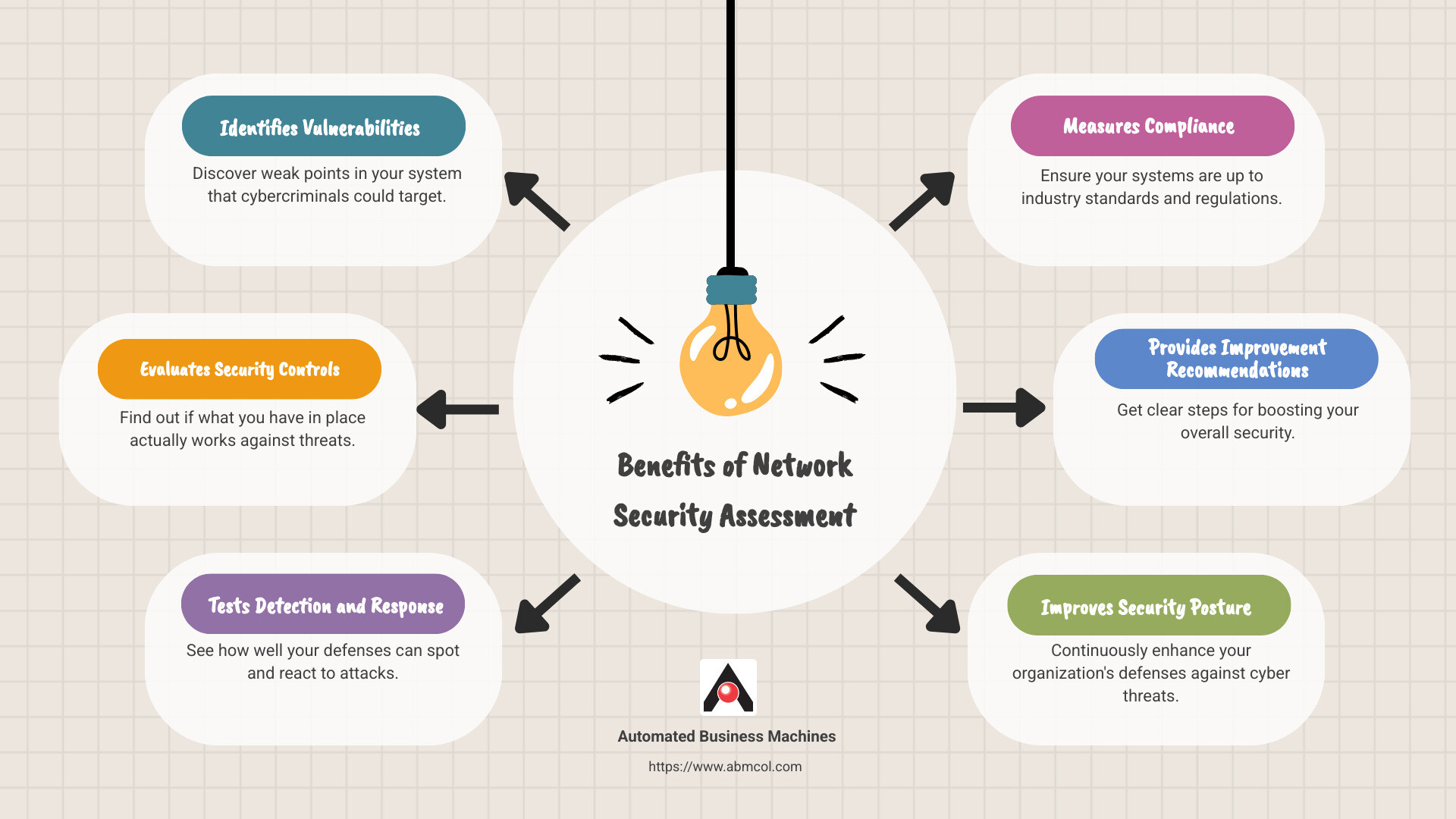
Network security assessments are vital components of modern governance, risk management, and compliance (GRC) programs. They allow enterprise IT teams, Chief Information Security Officers (CISOs), and compliance officers to prioritize remediation efforts based on risk severity, justify security budgets, and satisfy statutory or contractual compliance mandates.
Core Components of a Network Security Assessment
Modern network environments consist of interconnected cloud services, remote endpoints, legacy hardware, and hybrid architectures. Consequently, a thorough network assessment relies on distinct methodologies targeting different layers of the infrastructure.
Network Security Assessment:
- Vulnerability Scanning
- Penetration Testing
- Architecture Reviews
- Configuration Audits
1. Vulnerability Scanning vs. Penetration Testing
While often used interchangeably, vulnerability scanning and penetration testing serve distinct functions:
- Vulnerability Scanning: Employs automated software tools to inventory network assets, identify open ports, detect running services, and match systems against databases of Known Vulnerabilities and Exposures (CVEs). Scans can be unauthenticated (testing defenses from an external attacker’s perspective) or authenticated (using system credentials to inspect internal patch levels, missing updates, and registry settings).
- Penetration Testing: Involves authorized, ethical security professionals actively attempting to exploit detected vulnerabilities. Penetration testers use manual tools, custom scripts, and chaining techniques to simulate real-world cyberattacks, validate whether vulnerabilities can lead to system compromise, and demonstrate the potential business impact.
2. Network Architecture and Topology Reviews
Architecture reviews evaluate the conceptual and physical design of the network. Evaluators inspect topology diagrams, traffic flow patterns, and network boundary definitions to verify appropriate isolation between critical assets and less secure zones. Key evaluation criteria include:
- Network Segmentation: Verifying that subnets, Virtual Local Area Networks (VLANs), and micro-segmentation controls isolate sensitive environments (such as Payment Card Industry data zones or production databases) from general employee workstations.
- Redundancy and Resilience: Inspecting dual-homed connections, load balancers, and failover pathways to ensure high availability during hardware failures or Denial-of-Service (DoS) events.
- Ingress/Egress Filtering: Analyzing boundary devices to confirm that unauthorized inbound traffic is dropped and that outbound egress rules prevent rogue processes from communicating with external command-and-control (C2) servers.
3. Security Configuration and Policy Audits
Hardware devices and software systems often ship with default settings optimized for ease of deployment rather than security. Configuration audits inspect key network components—including firewalls, core routers, managed switches, VPN gateways, and intrusion prevention systems (IPS)—against hardened baseline configurations (such as CIS Benchmarks). Evaluators verify:
- Removal or changing of default vendor administrative credentials.
- Disabling of insecure or deprecated protocols (e.g., Telnet, SNMP v1/v2, SSL v3, TLS 1.0/1.1).
- Correct implementation of rule bases in firewalls, including the elimination of overly permissive ("ANY/ANY") rules.
- Enforcement of access control lists (ACLs) and administrative management access over secure protocols (e.g., SSH v2, HTTPS, SNMP v3).
Key Frameworks and Industry Standards
To provide consistent, repeatable results, network security assessments align with recognized industry standards and regulatory frameworks.
Security Assessment Frameworks:
NIST SP 800-115 Technical Testing Guide
ISO/IEC 27001:2022 Annex A 8.8 Management Vulnerabilities
CIS Controls Control 7 & 12 Vulnerability & Network
PCI DSS 4.0 Requirement 11 Penetration Testing
NIST SP 800-115 (Technical Guide to Information Security Testing and Assessment): Published by the National Institute of Standards and Technology, this publication serves as the foundational benchmark for planning, executing, and reporting technical security assessments.
ISO/IEC 27001:2022: Under Annex A control 8.8 (Management of technical vulnerabilities), organizations must regularly evaluate exposed networks and systems to prevent exploitation of technical gaps.
CIS Critical Security Controls (v8): Controls 7 (Continuous Vulnerability Management) and 12 (Network Infrastructure Management) provide concrete operational steps for auditing network assets, service configurations, and perimeter security.
PCI DSS 4.0: Payment Card Industry Data Security Standard Requirement 11 mandates quarterly internal and external vulnerability scans, annual penetration testing, and continuous monitoring of network security controls for systems processing cardholder data.
Comparison of Network Assessment Methodologies
Choosing the appropriate evaluation approach depends on an organization's risk profile, regulatory obligations, and technical maturity.
| Assessment Type | Primary Objective | Scope & Target | Execution Frequency | Depth of Analysis | Typical Output |
|---|---|---|---|---|---|
| Vulnerability Assessment | Identify missing patches, misconfigurations, and known CVEs across assets. | Entire network IP range, internal and external hosts. | Continuous or Monthly | Automated / Surface-level broad coverage | Prioritized lists of software vulnerabilities with CVSS scores |
| Penetration Test | Validate exploitability of security weaknesses and test defense response. | Target IP blocks, specific applications, or network segments. | Annual or after major changes | Deep manual exploitation and privilege escalation | Proof-of-concept exploits, attack path analysis, remediation steps |
| Architecture Review | Evaluate structural design, zoning, segmentation, and failover capabilities. | Topologies, firewall rule bases, cloud interconnects. | Bi-annually or post-merger | Conceptual and administrative policy review | Architectural gap report, network redesign recommendations |
| Red Team Exercise | Test operational detection, response, and incident handling capabilities. | Entire organization (technology, physical, human). | Periodic (e.g., every 18-24 months) | Multi-vector adversarial simulation | SOC detection timeline, response efficacy report, resilience metrics |
| Compliance Audit | Verify adherence to mandatory regulatory and technical security standards. | In-scope environments (PCI, HIPAA, CMMC, FISMA). | Scheduled annually or per policy | Formal compliance verification against control frameworks | Attestation of Compliance (AoC) or formal audit gap report |
Step-by-Step Methodology for Conducting an Assessment
A structured methodology ensures that assessments remain safe, legal, comprehensive, and non-disruptive to production operations.
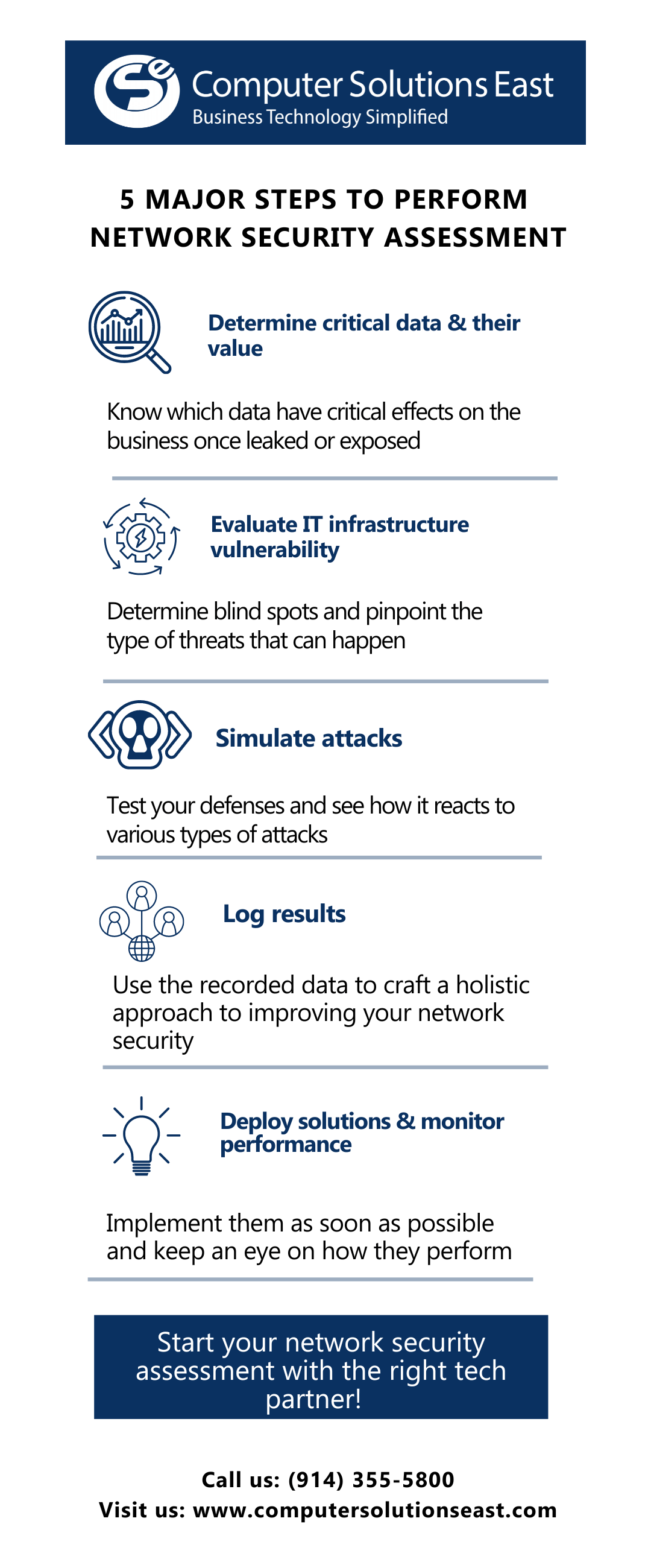
Assessment Execution Lifecycle:
- Scoping & Planning
- Define boundaries, ROE, schedules, and legal authorizations.
- Reconnaissance & Discovery
- Map IP ranges, active hosts, open ports, and operating systems.
- Threat & Vulnerability Analysis
- Identify patch gaps, misconfigurations, and weak protocols.
- Exploitation & Risk Validation
- Safely test vulnerabilities to confirm real-world exploitability.
- Reporting & Remediation Planning
- Document findings, rank risks, and deliver action items.
1. Scoping and Planning
Before initiating technical scans, assessors and stakeholders establish clear boundaries:
- Define target IP ranges, domain names, and exclusions (e.g., critical production databases sensitive to automated scanning).
- Establish Rules of Engagement (ROE), including allowed testing windows, emergency contacts, and stop-test parameters.
- Obtain formal written authorization ("permission to test") from asset owners to avoid legal issues under computer misuse statutes.
2. Reconnaissance and Discovery
Assessors map the exposed network landscape using active and passive techniques:
- Passive Reconnaissance: Gathering public domain registry records, DNS records, and exposed asset information without directly querying target interfaces.
- Active Discovery: Executing host discovery scans (using ICMP, TCP/UDP port sweeps) to identify live interfaces, active services, protocol versions, and host operating systems.
3. Threat and Vulnerability Analysis
Discovered services are evaluated against threat databases and baseline policies:
- Automated engines correlate service banners and open ports against vulnerability databases using the Common Vulnerability Scoring System (CVSS v3.1/v4.0).
- Assessors conduct manual checks to verify legacy services, missing authentication requirements on internal management interfaces, and improper SSL/TLS certificate implementations.
4. Exploitation and Risk Validation
During penetration testing or targeted validation, assessors safely attempt to exploit confirmed weaknesses:
- Demonstrate whether a vulnerability permits unauthorized Remote Code Execution (RCE), arbitrary file access, or lateral movement across subnets.
- Carefully execute exploits to avoid causing operational downtime or corrupting production data.
5. Reporting and Remediation Planning
The final phase translates technical output into actionable business intelligence:
- Executive Summary: Translates findings into business risk metrics for C-level leadership and board oversight.
- Technical Findings: Detailed lists of discovered vulnerabilities, evidence (proof-of-concept screenshots or logs), root causes, and explicit remediation steps (e.g., registry keys, software updates, or rule updates).
Common Challenges and Implementation Best Practices
Executing network assessments within complex enterprise environments introduces operational risks that require strategic management.
Operational Challenges
- Production Disruption: Aggressive vulnerability scanning or exploit attempts can trigger buffer overflows, crash legacy industrial control systems (ICS/SCADA), or exhaust network bandwidth.
- False Positives and Negatives: Automated scanners frequently misinterpret service banners or miss custom vulnerabilities hidden behind web application firewalls (WAFs).
- Scope Creep and Asset Blind Spots: Unmanaged cloud instances, shadow IT systems, and remote worker devices can easily escape inventory checks, leaving unmonitored attack paths.
Best Practices for Success
- Maintain an Updated Asset Inventory: Accurate assessments depend on complete visibility. Implement automated asset discovery tools to track subnets, cloud environments, and connected hardware prior to testing.
- Combine Automated Tools with Manual Expertise: Relying exclusively on automated scan reports leaves logic flaws, broken access controls, and complex attack paths undiscovered. Pair automated scans with manual architecture reviews and penetration testing.
- Perform Authenticated Scans: Unauthenticated scans only observe exposed perimeter surfaces. Authenticated scans provide full internal visibility into local software inventories, missing system patches, and internal configuration drift.
- Establish Clear Remediation SLA Metrics: Prioritize patch management based on environmental risk rather than raw CVSS scores alone. Establish Service Level Agreements (SLAs)—such as remediating critical vulnerabilities within 7 to 14 days—to ensure findings result in actual risk reduction.
Frequently Asked Questions
What is the primary difference between a network security assessment and a vulnerability scan?
A vulnerability scan is an automated, high-level software check that flags potential known security holes and missing patches across IP addresses. A network security assessment is a broader evaluation that encompasses vulnerability scanning alongside architecture reviews, firewall rule analysis, configuration audits, and manual penetration testing to provide a complete view of risk.
How often should an organization perform a network security assessment?
Organizations should conduct comprehensive network security assessments at least annually. Additionally, targeted vulnerability scans should occur monthly or continuously, while supplementary assessments must be triggered whenever significant network changes occur—such as major infrastructure updates, cloud migrations, or corporate acquisitions.
Can automated vulnerability scanning replace manual penetration testing?
No. Automated scanning excels at identifying known software bugs and missing patches rapidly across thousands of hosts, but it cannot evaluate business logic flaws, chain minor vulnerabilities together, or assess an organization's operational incident response capabilities. Manual penetration testing is required to validate whether identified vulnerabilities pose a real-world threat.
Are network security assessments safe for production environments?
When conducted by qualified professionals adhering to agreed-upon Rules of Engagement (ROE), assessments are designed to minimize operational risk. Evaluators use throttled scan speeds, schedule intensive tests during off-peak hours, and avoid destructive exploit payloads on critical production systems.
What deliverables should an organization expect after an assessment?
A formal assessment yields a comprehensive report containing an Executive Summary for leadership, a technical risk analysis prioritized by severity, confirmed proof-of-concept evidence, root-cause analyses, and concrete step-by-step remediation guidance for network engineering teams.
Next Steps for Organizations
To establish or refine a network security assessment program:
- Scope the Target Environment: Define clear boundaries across cloud networks, local infrastructure, and external perimeters.
- Select Qualified Partners or Internal Teams: Engage certified professionals holding credentials such as Offensive Security Certified Professional (OSCP), Certified Information Systems Auditor (CISA), or GIAC Penetration Tester (GPEN).
- Integrate Findings into Vulnerability Management: Align assessment output directly with operational patch management workflows and enterprise risk registers to measure security improvements continuously over time.
Image Gallery