How to Choose a Real Estate Business Structure in 2026
Choosing a real estate business structure involves weighing personal liability protection against tax efficiency and administrative complexity. Most investors opt for a Limited Liability Company (LLC) due to its flexibility and asset p...
Choosing a real estate business structure involves weighing personal liability protection against tax efficiency and administrative complexity. Most investors opt for a Limited Liability Company (LLC) due to its flexibility and asset protection, while high-growth firms might consider S-Corps or C-Corps for specific tax advantages or capital requirements.
Contents
Selecting the right legal entity is one of the most consequential decisions a real estate professional or investor can make. In 2026, the landscape of real estate investment remains highly competitive, and the legal framework surrounding asset protection and tax obligations has become increasingly nuanced. Whether you are a solo house flipper, a long-term rental owner, or a real estate agent earning commissions, your business structure dictates how you pay taxes, how you are treated in a lawsuit, and your ability to raise capital.
Failure to choose the correct structure can lead to "piercing the corporate veil," where a court ignores your business entity and holds you personally liable for debts or legal judgments. Furthermore, the wrong choice can lead to significant tax overpayments or the inability to take advantage of depreciation and expense deductions. This guide provides an exhaustive analysis of available structures and the criteria for making an informed choice.
Why Your Choice of Structure Matters
The primary purpose of a business structure in real estate is to create a legal "firewall" between your personal assets—such as your home, savings, and personal vehicles—and your business activities. Real estate is inherently risky; a tenant could be injured on a property, a contractor could sue over a payment dispute, or a lender could seek a deficiency judgment after a foreclosure.
Beyond liability, the structure determines your relationship with the Internal Revenue Service (IRS). In 2026, tax laws continue to evolve, particularly concerning pass-through entities and the self-employment tax. Real estate income is generally classified as either "active" (like flipping houses or earning commissions) or "passive" (like rental income). Each business structure treats these income types differently, affecting your bottom line.
Finally, the structure impacts your operational scalability. If you plan to bring on equity partners or eventually go public, a simple sole proprietorship will not suffice. You need a framework that allows for the issuance of shares, clear management hierarchies, and standardized accounting practices.
Core Factors to Evaluate
Before selecting an entity, evaluate your business against four primary pillars: liability, taxation, management, and exit strategy.
Personal Liability Protection
In a sole proprietorship or a general partnership, there is no legal distinction between the owner and the business. If the business is sued, your personal bank accounts are at risk. In contrast, entities like LLCs and Corporations provide "limited liability," meaning your risk is generally limited to the amount you have invested in the business.
Tax Treatment
Real estate offers unique tax benefits, including depreciation, interest deductions, and 1031 exchanges. Pass-through entities (LLCs, S-Corps, Partnerships) allow income to "pass through" to the owners' personal tax returns, avoiding the "double taxation" associated with C-Corporations. However, active real estate professionals must also consider the 15.3% self-employment tax, which can be mitigated through certain structures like S-Corps.
Administrative Costs and Complexity
Some structures require significant upkeep. Corporations, for example, must hold annual meetings, keep formal minutes, and maintain a board of directors. LLCs are far less formal but still require state filings and annual fees. You must weigh these administrative burdens against the benefits the structure provides.
Comparative Overview of Real Estate Structures
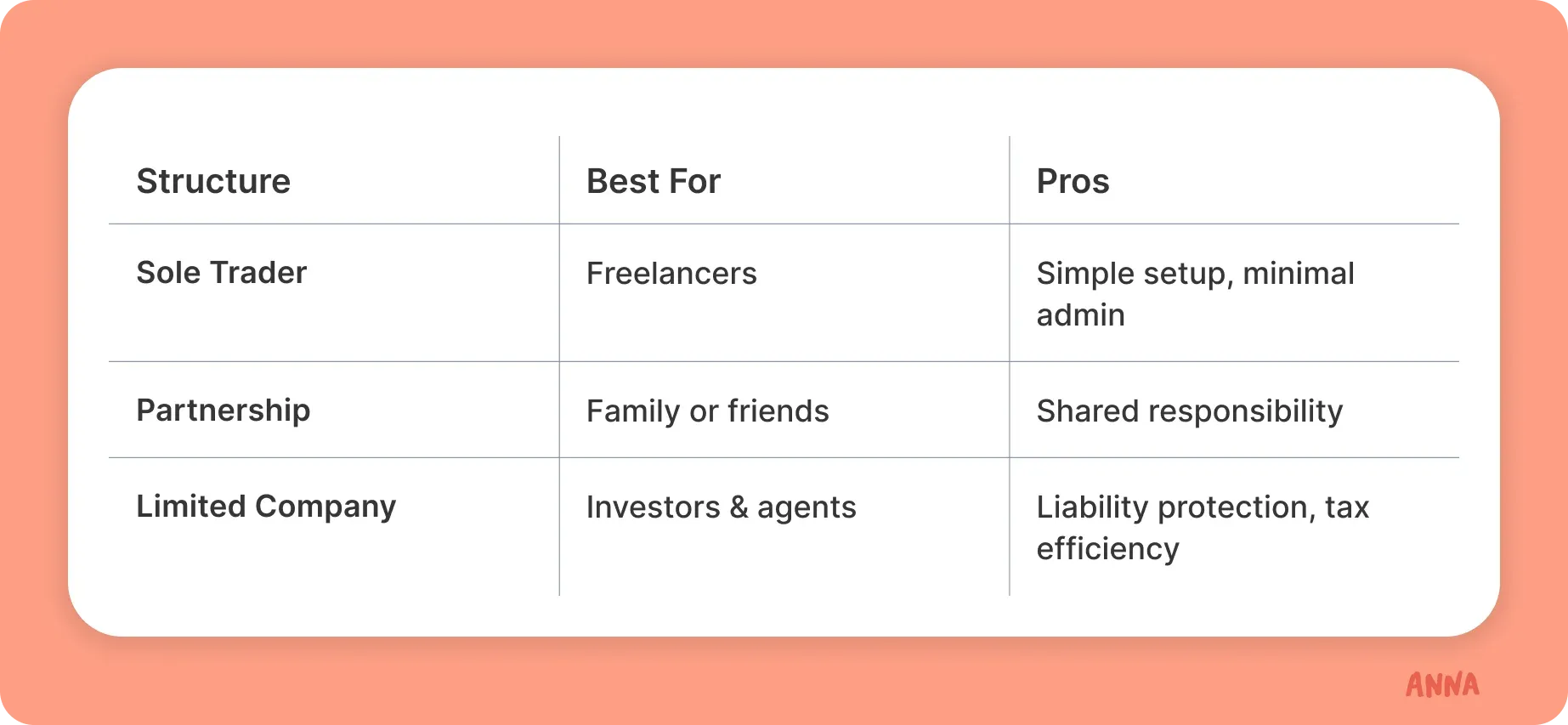
The following table summarizes the key characteristics of the most common business structures used in real estate as of 2026.
| Structure | Liability Protection | Tax Treatment | Administrative Complexity | Best For |
|---|---|---|---|---|
| Sole Proprietorship | None | Pass-through (Personal) | Very Low | New solo agents or very small-scale side hustles. |
| General Partnership | None (Joint/Several) | Pass-through | Low | Rare; usually replaced by LLCs for better protection. |
| Limited Liability Company (LLC) | High | Pass-through (Flexible) | Moderate | Rental property owners and small-to-midsize firms. |
| S-Corporation | High | Pass-through (Tax savings) | High | Active flippers and agents with high commission income. |
| C-Corporation | High | Double Taxation | Very High | Large developers or firms seeking institutional capital. |
| Series LLC | High (Per Cell) | Pass-through | High (Initial setup) | Investors with multiple properties seeking "siloed" risk. |
Deep Dive: The Limited Liability Company (LLC)
The LLC remains the gold standard for real estate investors in 2026. Its primary advantage is the "Check-the-Box" regulation, which allows the owners (members) to choose how they want to be taxed: as a sole proprietorship (if single-member), a partnership (if multi-member), or even a corporation.
Asset Protection and the Operating Agreement
The strength of an LLC lies in its Operating Agreement. This internal document outlines how the company is managed, how profits are distributed, and how disputes are resolved. In the event of a lawsuit, a robust Operating Agreement serves as evidence that the LLC is a legitimate, separate entity.
The Rise of the Series LLC
In states that recognize it, the Series LLC allows an investor to hold multiple properties under one "master" LLC, with each property assigned to a separate "cell" or "series." If a lawsuit occurs regarding Property A, the assets in Property B and Property C are legally protected from the judgment. This is more cost-effective than forming ten separate LLCs for ten different properties, though it requires meticulous accounting to ensure assets are not commingled between series.
When to Consider an S-Corporation
An S-Corp is not a separate legal entity like an LLC; rather, it is a tax designation made with the IRS (Form 2553). Real estate professionals who engage in "active" business—such as house flipping or brokerage services—often choose this to save on self-employment taxes.
In an S-Corp, you can pay yourself a "reasonable salary" and take the remaining profit as a distribution. Only the salary portion is subject to Social Security and Medicare taxes, whereas the distribution is only subject to income tax. However, S-Corps are generally discouraged for long-term rental properties. Transferring real estate out of an S-Corp can trigger significant capital gains taxes, and the rules regarding "basis" make it harder to pass through losses from depreciation to the owners.
The Role of C-Corporations in Real Estate
C-Corporations are rarely used by individual rental owners because they face double taxation: the corporation pays tax on its profits, and then shareholders pay tax on dividends. However, C-Corps are the preferred vehicle for large-scale development companies or Real Estate Investment Trusts (REITs).
If you plan to raise capital from hundreds of investors or eventually take your company public, the C-Corp structure offers the most standardized and legally recognized framework for issuing different classes of stock and managing complex governance. In 2026, C-Corps also benefit from specific corporate tax rates that may be lower than individual top-tier tax brackets, though the double taxation usually offsets this benefit for passive investors.
Choosing Based on Your Real Estate Role
Your specific niche in the real estate market should dictate your choice.
- The Buy-and-Hold Investor: An LLC is almost always the best choice. It allows you to pass through the "paper losses" from depreciation to offset other income while providing essential liability protection.
- The High-Volume Flipper: An LLC taxed as an S-Corp may be ideal. Since flipping is an active business, the S-Corp election can save thousands in self-employment taxes annually.
- The Real Estate Agent: A solo agent might start as a sole proprietorship but should transition to a "Professional LLC" (PLLC) or S-Corp as their commissions grow, both for liability protection and tax efficiency.
- The Syndicator: Syndicators typically use a complex structure involving a Limited Partnership (LP) or a multi-member LLC where the syndicator is the "Manager" or "General Partner" and the investors are "Limited Partners."
Step-by-Step Implementation Guide
Once you have identified the appropriate structure, follow these steps to formalize your business in 2026:
- Conduct a Name Search: Ensure your desired business name is available in your state and does not infringe on existing trademarks.
- File Articles of Organization/Incorporation: Submit the required forms to your Secretary of State and pay the filing fees.
- Obtain an EIN: Apply for an Employer Identification Number from the IRS website. This is essentially a Social Security number for your business.
- Draft an Operating Agreement: Even if you are a single-member LLC, a written agreement is crucial for proving the entity's legitimacy.
- Comply with the Corporate Transparency Act (CTA): By 2026, most small entities must report "Beneficial Ownership Information" (BOI) to the Financial Crimes Enforcement Network (FinCEN). Ensure you file this promptly to avoid steep daily fines.
- Open a Dedicated Business Bank Account: Never mix personal and business funds. Commingling is the fastest way to lose your liability protection.
Frequently Asked Questions
Can I change my business structure later?
Yes, you can often convert one entity type to another (e.g., from an LLC to a C-Corp) through a process called "statutory conversion." However, changing from a Corporation back to an LLC can be tax-expensive, as the IRS may view it as a liquidation of assets. It is better to start with a flexible LLC structure.
Do I need a separate LLC for every property I own?
While not strictly required, it is a common practice to "silo" assets. If you own ten properties in one LLC, a single lawsuit at one property puts all ten at risk. Using separate LLCs or a Series LLC limits the risk to the specific asset involved in the dispute.
How does the 2026 tax environment affect my choice?
In 2026, investors must be mindful of the sunsetting of certain provisions from the Tax Cuts and Jobs Act (TCJA). For instance, the 20% Qualified Business Income (QBI) deduction for pass-through entities was a major factor in previous years. Always consult a tax professional to see which deductions remain active in the current 2026 tax year.
Is a land trust a business structure?
No. A land trust is a privacy tool, not a liability protection tool. It hides your name from public records, but it does not provide the legal "shield" that an LLC or Corporation offers. Many investors use a land trust in combination with an LLC for both privacy and protection.
Final Recommendation
For the vast majority of real estate professionals in 2026, the Limited Liability Company (LLC) provides the best balance of protection, tax flexibility, and ease of use. If you are an active flipper or high-earning agent, consider the S-Corp election for your LLC to optimize your tax burden. Before finalizing any filing, consult with a qualified real estate attorney and a CPA to ensure your structure aligns with your specific portfolio size and long-term financial goals.
Disclaimer: This article is provided for informational purposes only and does not constitute legal, financial, or tax advice. Laws vary by jurisdiction and are subject to change. Always consult with a licensed professional before making business structure decisions.
Image Gallery