Indiana Time Change Map: A Guide to the State’s Dual Time Zones
Indiana follows two distinct time zones: Eastern Time (ET) and Central Time (CT). While the vast majority of the state—80 of its 92 counties—observes Eastern Time, 12 counties situated in the northwest and southwest corners operate on...
Indiana follows two distinct time zones: Eastern Time (ET) and Central Time (CT). While the vast majority of the state—80 of its 92 counties—observes Eastern Time, 12 counties situated in the northwest and southwest corners operate on Central Time. All 92 counties currently observe Daylight Saving Time (DST), a practice that was standardized statewide in 2006.
Contents
Understanding the Indiana time change map requires a look at both geography and history. For residents, business owners, and travelers, the "time frontier" within the Hoosier State can create logistical hurdles, particularly when commuting across county lines. As of 2026, the division remains a defining characteristic of Indiana’s infrastructure, reflecting the state’s diverse economic ties to neighboring metropolitan hubs like Chicago, Louisville, and Cincinnati.
The Geographic Breakdown of Indiana’s Time Zones
The Indiana time map is not a straight vertical line. Instead, it features two distinct "pockets" of Central Time that accommodate the economic and social rhythms of specific regions. The rest of the state aligns with the Eastern Time Zone, which includes major cities such as Indianapolis, Fort Wayne, and South Bend.
The Northwest Corner (Near Chicago)
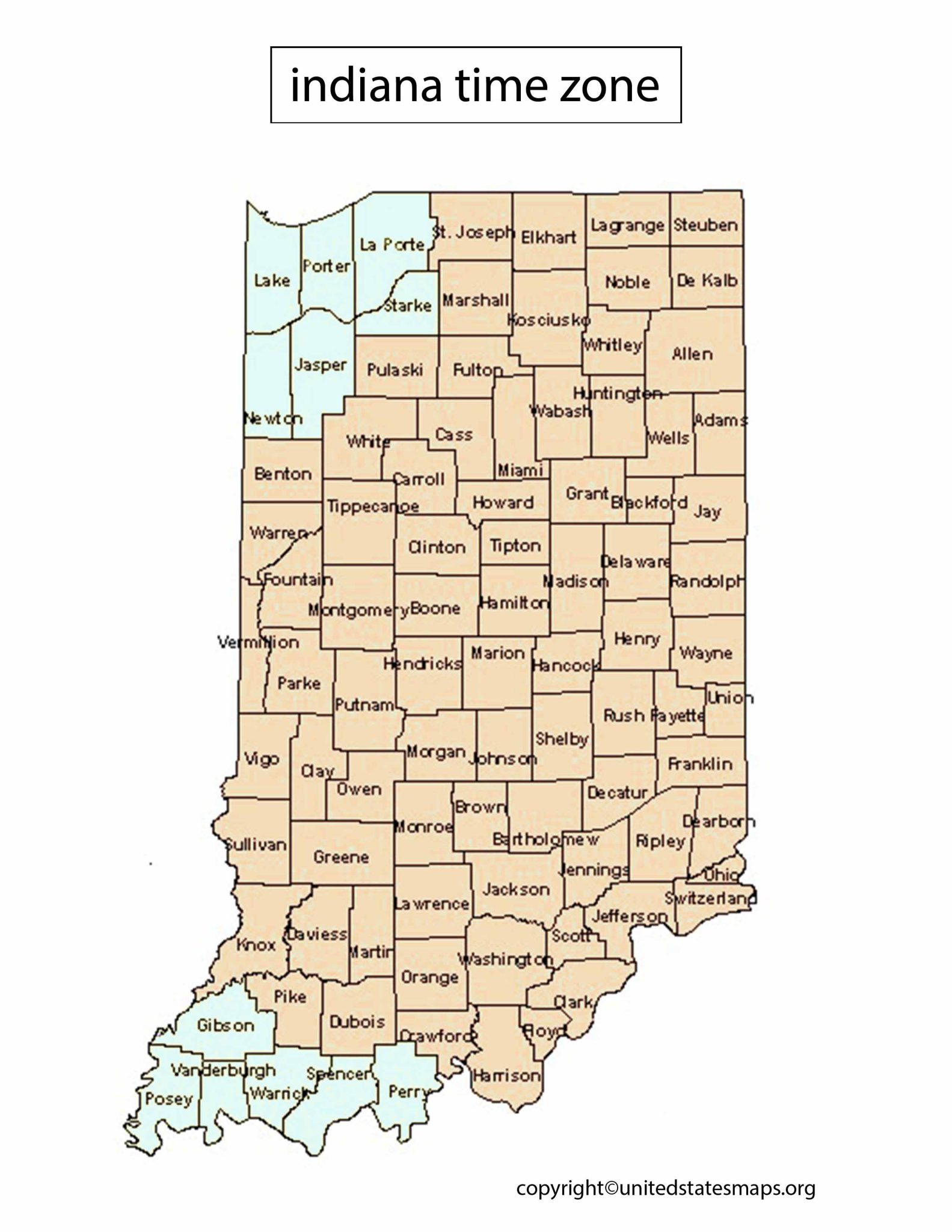
The northwest portion of Indiana is heavily influenced by the Chicago metropolitan area. Because many residents in these counties commute to Illinois for work or rely on Chicago-based media and commerce, maintaining alignment with Chicago’s Central Time is a matter of practical necessity. The counties in this cluster include Lake, Porter, LaPorte, Newton, Jasper, and Starke.
The Southwest Corner (Near Evansville)
The southwest corner of the state also operates on Central Time. This region, anchored by the city of Evansville, has historically maintained strong ties to the tri-state area of Illinois and Kentucky. The counties in this group include Gibson, Posey, Vanderburgh, Warrick, Perry, and Spencer. While some neighboring counties have petitioned to switch zones over the last two decades, this core group has remained consistently on Central Time to support local industry and transit.
Historical Context: Why Indiana Has Two Time Zones
The complexity of Indiana’s time map is the result of decades of federal intervention, local petitioning, and legislative debate. The United States Department of Transportation (DOT) holds the legal authority to determine time zone boundaries under the Uniform Time Act of 1966. However, Indiana’s unique position at the crossroads of the Midwest has made it a focal point for time-related controversy.
For much of the late 20th century, Indiana was a patchwork of time observation. Some counties observed Daylight Saving Time, while others stayed on standard time year-round. This led to a famous joke that if you traveled across Indiana, you would have to change your watch five times. The confusion ended—or at least lessened—in 2006 when the Indiana General Assembly passed legislation to implement Daylight Saving Time statewide.
The 2006 Standardization
Under the leadership of then-Governor Mitch Daniels, Indiana sought to modernize its economy by ensuring the entire state followed the same seasonal clock changes. Before 2006, most of the state stayed on Eastern Standard Time year-round, meaning they were effectively on Central Time during the summer months and Eastern Time during the winter. Since the 2006 shift, every Indiana county now "springs forward" in March and "falls back" in November, regardless of which of the two primary time zones they reside in.
County-by-County Time Zone Classification
The following table outlines the 12 counties that operate on Central Time. All other 80 Indiana counties not listed here observe Eastern Time.
| Region | County | Primary City/Seat | Time Zone |
|---|---|---|---|
| Northwest | Lake | Gary / Crown Point | Central (CT) |
| Northwest | Porter | Valparaiso | Central (CT) |
| Northwest | LaPorte | La Porte / Michigan City | Central (CT) |
| Northwest | Newton | Kentland | Central (CT) |
| Northwest | Jasper | Rensselaer | Central (CT) |
| Northwest | Starke | Knox | Central (CT) |
| Southwest | Gibson | Princeton | Central (CT) |
| Southwest | Posey | Mt. Vernon | Central (CT) |
| Southwest | Vanderburgh | Evansville | Central (CT) |
| Southwest | Warrick | Boonville | Central (CT) |
| Southwest | Perry | Tell City | Central (CT) |
| Southwest | Spencer | Rockport | Central (CT) |
Practical Implications for Residents and Travelers
Navigating the Indiana time change map involves more than just adjusting a clock; it requires awareness of how these zones affect daily life. In 2026, technology such as smartphones and GPS units typically handle the transition automatically, but manual awareness remains vital for several reasons.
Commuting and Commerce
Thousands of Hoosiers cross the time zone boundary daily for work. A resident of Pulaski County (Eastern Time) commuting to a job in Jasper County (Central Time) effectively "gains" an hour on their way to work but "loses" an hour on the way home. This can complicate daycare drop-offs, medical appointments, and business meetings. Companies operating in both zones must be explicit about "Eastern Time" or "Central Time" when scheduling regional calls or deliveries to prevent missed deadlines.
Logistics and Transportation
Indiana is a major hub for freight and logistics. Trucking companies moving goods through the I-65 or I-64 corridors must account for the time shift to remain compliant with federal Electronic Logging Device (ELD) requirements and delivery windows. For travelers driving from Indianapolis to Chicago, the time change occurs roughly near the Jasper/White county line on I-65. Conversely, traveling from Evansville to Louisville on I-64 involves a shift from Central to Eastern Time near the Perry/Crawford county line.
Sunset and Daylight Variance
One of the most noticeable effects of the time zone split is the difference in sunset times. In the summer months, counties on the western edge of the Eastern Time Zone (such as Tippecanoe or Marion) experience very late sunsets, sometimes as late as 9:15 PM. Meanwhile, counties just a few miles west in the Central Time Zone see the sun set an hour earlier by the clock, though the physical amount of daylight remains the same. This has long-standing implications for high school sports, outdoor festivals, and agricultural operations.
The Role of the U.S. Department of Transportation
It is a common misconception that the Indiana Governor or the State Legislature can unilaterally change a county's time zone. While the state can pass laws regarding the observation of Daylight Saving Time, the actual boundary between Eastern and Central Time is governed by the U.S. Department of Transportation.
Counties that wish to switch zones must petition the DOT. The federal government evaluates these requests based on the "convenience of commerce." This includes looking at where people shop, where they work, the reach of television and radio signals, and the flow of regional traffic. Since the 2006-2007 period, during which several counties (like Pulaski, Martin, Pike, and Dubois) moved back and forth between zones, the map has remained stable. As of 2026, there are no active federal petitions to alter the current Indiana time zone boundaries.
Frequently Asked Questions
Which Indiana counties are on Central Time?
There are 12 counties on Central Time. In the Northwest, they are Lake, Porter, LaPorte, Newton, Jasper, and Starke. In the Southwest, they are Gibson, Posey, Vanderburgh, Warrick, Perry, and Spencer. All other 80 Indiana counties observe Eastern Time.
Does Indiana still change clocks in 2026?
Yes, all of Indiana observes Daylight Saving Time in 2026. This means that regardless of whether a county is in the Eastern or Central zone, residents must move their clocks forward one hour on the second Sunday in March and back one hour on the first Sunday in November.
Why is Gary, Indiana on a different time than Indianapolis?
Gary is part of the Chicago metropolitan area. To ensure that businesses, commuters, and public transit in Gary are synchronized with Chicago—one of the world's largest economic hubs—the region stays on Central Time. Indianapolis, being further east and having strong ties to the East Coast and Ohio, remains on Eastern Time.
When did Indiana start observing Daylight Saving Time statewide?
Indiana began statewide observation of Daylight Saving Time in April 2006. Prior to this, the state was a mix of counties that observed the change and those that remained on "slow time" (Standard Time) year-round, leading to significant confusion for interstate commerce.
What happens if I cross the time zone line while driving?
Your mobile devices will typically update automatically based on the nearest cell tower. However, if you have a dashboard clock or a traditional watch, you will need to manually adjust it. When traveling west from Eastern to Central, you subtract one hour. When traveling east from Central to Eastern, you add one hour.
Recommendation for Travelers and Businesses
If you are planning a trip through Indiana or managing a business with locations in both zones, it is highly recommended to use a digital calendar that supports time zone detection. Always specify "EST/EDT" or "CST/CDT" in communications. For those living near the boundary, keep your phone's "Set Time Automatically" feature enabled to ensure you are always synchronized with the local tower, but be wary of "signal bleed" where a phone might pick up a tower from a neighboring county in a different zone.
Image Gallery