The Guitar Popular Songs That Shaped Modern Music
The guitar popular songs that shaped modern music did so by introducing groundbreaking playing techniques, pioneering tonal distortion, and altering song structure forever. From Chuck Berry's opening double-stops in the 1950s to Nirvan...
The guitar popular songs that shaped modern music did so by introducing groundbreaking playing techniques, pioneering tonal distortion, and altering song structure forever. From Chuck Berry's opening double-stops in the 1950s to Nirvana's quiet-loud dynamic contrast in the 1990s, these pivotal tracks transformed the electric and acoustic guitar from rhythm accompaniment into the primary driving engine of modern popular culture.
Contents
The Evolution of the Guitar in Popular Songwriting
Before the mid-20th century, the acoustic guitar functioned primarily as a subtle rhythm instrument in big bands, country string ensembles, and delta blues recordings. The invention and commercial distribution of solid-body electric guitars by manufacturers like Fender and Gibson altered this balance. Amplification allowed guitarists to play single-note lead passages that could compete in volume with brass sections and drums.
As recording technology advanced throughout the 1950s, 1960s, and 1970s, guitarists began deliberately pushing equipment past its designed limits. Amplifiers driven into harmonic distortion created sustained notes and aggressive textures. Signal processors—such as fuzz boxes, envelope filters, and tape delays—further expanded the instrument's sonic palette.
The songs that defined this evolution were not merely commercially successful; they established architectural templates for rock, pop, punk, metal, and alternative music. Understanding these key tracks requires examining the technical innovations, gear setups, and performance techniques that made them transformative.
Epochal Guitar Tracks That Redefined Modern Music
Chuck Berry – "Johnny B. Goode" (1958)
Chuck Berry's opening sequence on "Johnny B. Goode" serves as the foundational blueprint for rock and roll lead guitar. Adapted partly from Louis Jordan’s 1946 jump-blues track "Ain't That Just Like a Woman" (played by guitarist Carl Hogan), Berry transposed the horn-style riff into a driving, two-note double-stop pattern on the electric guitar.
- Key Technical Innovation: The usage of rhythmic double-stops, rapid hammer-ons, and sliding pentatonic shapes in standard tuning.
- Gear Profile: Gibson ES-350T hollow-body electric guitar running into a cranked Gibson amplifier.
- Structural Impact: Berry established the guitar intro as a song's central hook, creating a formula that dominated popular radio for decades.
The Kinks – "You Really Got Me" (1964)
Prior to 1964, guitar tones in popular music were kept mostly clean, with natural tube saturation reserved for blues circuits. For "You Really Got Me," guitarist Dave Davies intentionally damaged his amplifier speaker cone with a razor blade to achieve a raw, buzzing overdrive.
- Key Technical Innovation: Reliance on simple, two-note power chords (root and fifth) played with aggressive downward pick strokes.
- Gear Profile: A small Elpico amplifier (modded/damaged) plugged into a larger Vox AC30.
- Structural Impact: The track stripped away complex jazz-influenced chord progressions, laying the mechanical foundation for hard rock, heavy metal, and punk rock.
Jimi Hendrix – "Purple Haze" (1967)
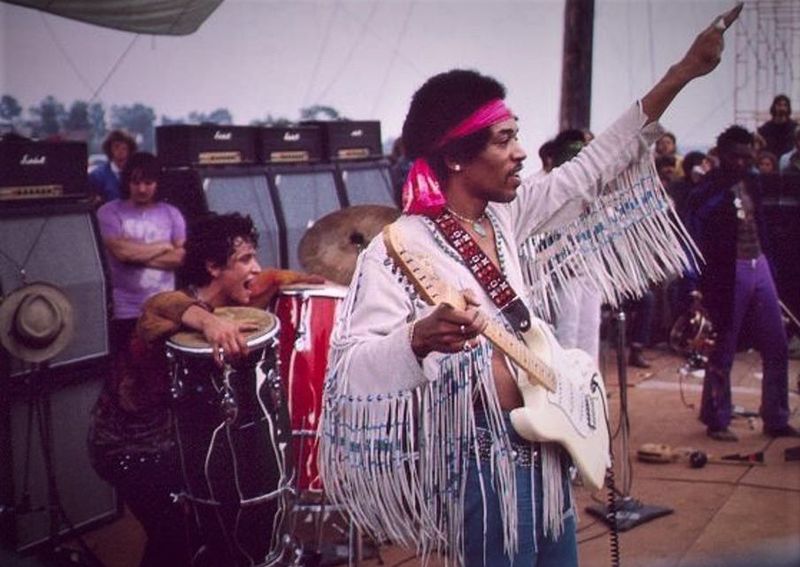
Jimi Hendrix radically altered the expressive limits of the electric guitar by integrating outboard signal processing directly into his performance style. "Purple Haze" introduced mainstream audiences to aggressive fuzz, custom pitch-shifting effects, and complex extended chords.
- Key Technical Innovation: Popularization of the dominant 7th sharp 9th chord (commonly called the "Hendrix chord") combined with controlled amplifier feedback and octave-fuzz modulation.
- Gear Profile: Fender Stratocaster played left-handed (strung upside down), Dallas Arbiter Fuzz Face, Roger Mayer Octavia pedal, and Marshall Super Lead amplifiers.
- Structural Impact: Hendrix proved that the guitar could produce avant-garde, atmospheric textures while remaining firmly anchored in commercial pop songwriting.
Led Zeppelin – "Stairway to Heaven" (1971)
Written by Jimmy Page and Robert Plant, "Stairway to Heaven" demonstrated how acoustic fingerstyle arrangement and multi-tracked electric guitars could be combined into a multi-part epic.
- Key Technical Innovation: Seamless dynamic progression from a minor-key fingerpicked acoustic arpeggio to a multi-layered, hard-rock electric solo.
- Gear Profile: Harmony Sovereign H1260 acoustic guitar, Fender Telecaster (used for the famous studio solo), and a Gibson Les Paul / Gibson EDS-1275 double-neck for live performance.
- Structural Impact: Page introduced a cinematic approach to guitar tracking, employing ambient mic placement and stacked guitar harmonies that influenced progressive rock and heavy metal production.
Van Halen – "Eruption" (1978)
Although "Eruption" began as an off-tempo warm-up exercise by Eddie Van Halen, its inclusion on Van Halen's debut album completely reset the technical standards for guitar virtuosity.
- Key Technical Innovation: Two-handed tapping, where the right index or middle finger taps notes directly on the fretboard while the left hand performs legato pull-offs and hammer-ons.
- Gear Profile: The "Frankenstrat" (a custom-built guitar featuring a humbucking pickup mounted in a Stratocaster-style body), an MXR Phase 90 pedal, an Echoplex unit, and a heavily modded Marshall Plexi amplifier.
- Structural Impact: The solo transformed guitar soloing from blues-based pentatonic runs into rapid-fire, classical-influenced arpeggiated movement.
Nirvana – "Smells Like Teen Spirit" (1991)
In the early 1990s, popular guitar music shifted away from the technical shredding of the 1980s. Kurt Cobain's work on "Smells Like Teen Spirit" re-emphasized emotional urgency, spatial dynamics, and rhythmic simplicity.
- Key Technical Innovation: Extreme implementation of the "quiet-loud-quiet" verse-chorus dynamic contrast using foot-switched modulation pedals.
- Gear Profile: Fender Mustang or Jaguar electric guitar, Electro-Harmonix Small Clone chorus pedal, Boss DS-1 Distortion, and high-wattage Mesa/Boogie amplification.
- Structural Impact: The track dismantled hair-metal production standards and proved that four basic power chords combined with tonal contrast could redefine global pop and rock culture.
Technical and Gear Comparison of Iconic Guitar Songs
The table below outlines how specific equipment choices, playing techniques, and tonal profiles directly shaped the recording character of these historic tracks:
| Song Title & Release Year | Lead Guitarist | Primary Technique Introduced / Featured | Signature Gear Used | Lasting Impact on Modern Music |
|---|---|---|---|---|
| "Johnny B. Goode" (1958) | Chuck Berry | Pentatonic double-stops & rhythmic slides | Gibson ES-350T, Gibson Tube Amp | Established the standard rock and roll intro riff formula. |
| "You Really Got Me" (1964) | Dave Davies | Driving root-fifth power-chord riffing | Slit-speaker Elpico Amp, Vox AC30 | Created the distorted guitar tone that birthed punk and hard rock. |
| "Purple Haze" (1967) | Jimi Hendrix | Octave fuzz modulation & 7#9 extended chords | Fender Stratocaster, Fuzz Face, Octavia | Transformed the electric guitar into a multi-dimensional sound generator. |
| "Stairway to Heaven" (1971) | Jimmy Page | Dynamic fingerstyle-to-electric composition | Harmony Acoustic, 1959 Telecaster, Marshall | Standardized multi-tracked acoustic/electric studio arrangements. |
| "Eruption" (1978) | Eddie Van Halen | Two-handed fretboard tapping & whammy dives | Custom Frankenstrat, MXR Phase 90, Marshall Plexi | Launched the virtuoso shred guitar era and influenced instrument modification. |
| "Smells Like Teen Spirit" (1991) | Kurt Cobain | Dynamic quiet-clean to loud-distorted shifts | Fender Mustang, EHX Small Clone, Boss DS-1 | Shifted 1990s production toward minimalist power chords and alternative dynamics. |
Core Techniques Born from Influential Guitar Songs
The songs listed above did more than hit the top of music charts; they established core playing techniques that remain essential to guitar education and music composition.
1. The Power Chord (Root-Fifth Economy)
Before Dave Davies and Pete Townshend popularized the power chord, guitarists largely used full triad or extended chord voicings. The power chord omits the major or minor third interval, using only the root, fifth, and octave notes.
$$\text{Power Chord} = \text{Root} + \text{Perfect Fifth}$$
Because it lacks a defining third, a power chord produces minimal harmonic clutter when heavily distorted. This allows amplifiers to produce maximum saturation without sounding muddy or dissonant.
2. Signal-Chain Manipulation and Feedback Control
Jimi Hendrix treated the amplifier and pedalboard as an extension of the instrument itself. Instead of suppressing acoustic feedback caused by high volume levels, Hendrix positioned his guitar relative to his Marshall cabinets to sustain notes indefinitely. Modern pedalboard layouts—featuring controlled stages of gain, modulation, and pitch shifting—trace their routing logic back to these 1960s experimental sessions.
3. Extended Fingerboard Mechanics (Two-Handed Tapping)
Eddie Van Halen brought fretboard tapping into mainstream pop guitar playing. By tapping the fretboard with the picking hand, guitarists expanded their available interval jumps beyond the physical reach of a single hand.
Standard Playing: (Left Hand Fret) -----------------------------> Range: ~4-5 Frets Tapping Technique: (Left Hand Fret) <---- Pitch Jump ----> (Right Hand Tap) -> Range: 10+ Frets
This mechanical innovation allowed players to execute wide arpeggiated figures rapidly, influencing instrumental rock, progressive metal, and neoclassical composition.
4. Dynamic Contrast Through Pedal Switching
Kurt Cobain’s arrangement strategy on "Smells Like Teen Spirit" relied heavily on foot-switchable tone changes. By executing verses with an clean tone treated with a shimmering chorus effect, then switching instantly to high-gain distortion for the chorus, Cobain established a structural formula that dominated modern alternative rock, pop-punk, and indie production throughout the 1990s and 2000s.
Practical Application for Guitarists and Music Producers
Studying the guitar popular songs that shaped modern music provides actionable value for contemporary song arrangers, sound engineers, and performing musicians.
Tone Sculpting and Gain Staging
- Avoid Over-Saturation: When attempting to recreate classic rock tones, use less preamp distortion than you think you need. Track recordings like "You Really Got Me" and "Johnny B. Goode" rely on power-section tube headroom and aggressive right-hand attack rather than modern high-gain fuzz.
- Modulation Placement: To achieve dynamic vintage textures, place modulation effects (like chorus or phaser) before overdriven amplifiers for a darker, chewed-up sound (as heard on early Van Halen records), or after drive pedals for a cleaner, wider modern tone (typical of 1990s grunge).
Song Arrangement and Frequency Management
- Carving Space for Bass and Vocals: Power chords played in higher registers leave mid-frequency space for the bass guitar to define the harmonic root. When arranging heavy rock or pop sections, ensure the guitar rhythm track doesn't crowd the sub-bass frequencies reserved for kick drums and synth bass lines.
- Dynamic Transitions: Use pedal switches or pickup changes to mark transitions between song sections. Changing from a neck-pickup single-coil sound in a verse to a bridge-pickup humbucker in a chorus creates perceived width and energy without requiring volume increases.
Frequently Asked Questions
Which song is widely considered the first to feature intentional guitar distortion?
While minor overdrive occurred earlier in blues recordings, Dave Davies' sliced speaker cone on The Kinks' 1964 hit "You Really Got Me" is generally recognized as the track that brought intentional, aggressive fuzz/distortion into mainstream pop and rock songwriting.
How did Jimi Hendrix change the way the electric guitar was recorded in the studio?
Jimi Hendrix, working alongside engineer Eddie Kramer, pioneered the use of stereo panning, backwards guitar tracking, controlled feedback, and radical outboard effects like the Octavia. Rather than capturing a live natural performance, Hendrix used the recording studio as an active musical instrument.
Why is Eddie Van Halen's "Eruption" considered a turning point for solo guitar technique?
"Eruption" popularized two-handed tapping, whammy bar dive-bombs, and fluid legato passages within a single solo track. It introduced a new technical vocabulary that shifted late-1970s and 1980s guitar performance toward high-speed virtuosity.
How do minimalist guitar riffs shape modern pop and rock production today?
Minimalist guitar riffs—such as Kurt Cobain's four-chord sequence in "Smells Like Teen Spirit"—demonstrate that simple, rhythmically tight hooks leave room for prominent vocal melodies and dynamic drum mixes. This approach remains a standard template for modern pop, indie, and alternative music production.
What role did instrument selection play in defining these historic guitar sounds?
The choice between single-coil pickups (found in Fender Stratocasters and Telecasters) and humbucking pickups (found in Gibson Les Pauls) dramatically impacted sound clarity and gain response. Single-coils delivered bright, cutting tones with articulate high frequencies, whereas humbuckers provided thicker, mid-heavy tones that drove tube amplifiers into smoother sustain.
Next Steps for Musicians and Songwriters
To incorporate the lessons of these historic guitar tracks into your own writing and performing workflow, follow these practical steps:
- Analyze Riff Architecture: Select three songs from different eras listed in this guide. Transcribe their main guitar hooks to observe how simple intervals (such as root-fifth power chords or minor pentatonic double-stops) interact with the drum groove.
- Audit Your Gain Staging: Experiment with lowering pedal gain and increasing amplifier volume. Practice controlling distortion levels using only your guitar's volume knob and picking dynamics, as demonstrated by players like Jimi Hendrix and Jimmy Page.
- Implement Structural Contrast: When arranging your next song, apply the quiet-loud dynamic template. Keep verse guitar arrangements clean and modulated, reserving high-gain stereo tracks for the chorus sections to maximize emotional impact.
Image Gallery