Why the Knowledge Base Matters for Teams: Boosting Productivity and Preserving Institutional Memory
A centralized knowledge base provides teams with a single source of truth, converting isolated individual expertise into accessible, actionable organizational data. By streamlining information retrieval, reducing repetitive internal in...
A centralized knowledge base provides teams with a single source of truth, converting isolated individual expertise into accessible, actionable organizational data. By streamlining information retrieval, reducing repetitive internal inquiries, and cutting employee onboarding times, a structured knowledge base stabilizes daily operations, mitigates turnover risk, and drives consistent execution across cross-functional workflows.
Contents
Understanding the Hidden Cost of Fragmented Information
In organizations lacking a dedicated knowledge management strategy, information naturally scatters across personal laptops, unindexed chat threads, local text documents, and individual memories. This dispersion creates severe operational friction. When team members cannot find the technical specifications, standard operating procedures (SOPs), or historical context required to execute their work, projects stall and productivity drops.
Workplace studies continuously show that knowledge workers spend a significant portion of their workweek simply searching for information or tracking down colleagues who hold key context. According to research from the McKinsey Global Institute, employees spend roughly 20 percent of their workweek looking for internal information or seeking help from colleagues for tasks they could resolve themselves if documented properly.
This fragmentation manifests in two primary ways:
- Tacit Knowledge Dependency: Critical information remains locked inside the heads of senior employees. When these individuals are out of the office or leave the company, operational capabilities degrade immediately.
- Context Switching and Interruption Loops: Without a centralized reference point, junior staff must repeatedly interrupt senior specialists for basic guidance. This constant context switching disrupts focus and reduces high-value output.
Building a formal team knowledge base transforms this implicit expertise into explicit knowledge—searchable, verifiable documentation accessible to every authorized team member at any time.
The Operational Imperative: Why Every Team Needs a Centralized Knowledge Base
Developing and maintaining a team knowledge base requires dedicated operational effort and clear governance. However, the operational return on investment (ROI) far outweighs the upkeep cost.
1. Accelerating Employee Onboarding and Time-to-Productivity
Onboarding new personnel is historically resource-intensive. Without a centralized hub, onboarding relies heavily on shadowing and informal mentoring, which pulls experienced staff away from strategic deliverables.
A well-structured knowledge base provides new hires with self-directed learning paths. Instead of guessing how to set up local environments, process client requests, or deploy code, new team members can access verified, step-by-step guides. This structured access cuts time-to-productivity significantly, allowing new hires to contribute independently much earlier in their tenure.
2. Eliminating Knowledge Loss from Staff Turnover
Every time an employee resigns, transfers, or retires, the company risks losing institutional memory—a phenomenon often evaluated through the "bus factor" metric. When critical deployment scripts, client preferences, or operational workarounds exist solely in an individual’s memory, their departure causes immediate vulnerability.
- Individual Tacit Knowledge
- Formal Documentation
- Centralized Knowledge Base
- Resilient Operations
Documenting processes in a shared repository ensures that organizational capability belongs to the team, not just to individual workers. When staff departures occur, business operations continue without costly downtime or knowledge recovery efforts.
3. Mitigating Context Switching and Interruption Fatigue
Deep work requires sustained focus. When software engineers, financial analysts, or content creators are constantly pinged on chat applications like Slack or Microsoft Teams for basic instructions, their primary output suffers.
A knowledge base functions as an asynchronous operational layer. Team members learn to check the internal knowledge center before escalating inquiries to colleagues. This cultural shift protects focus time, lowers occupational burnout, and fosters a more deliberate, asynchronous working culture.
4. Standardizing Operational Quality and Compliance
As organizations grow, maintaining consistency across distributed teams becomes increasingly difficult. Variations in task execution can lead to quality drops, customer dissatisfaction, or regulatory non-compliance.
Centralized knowledge bases house authoritative standard operating procedures (SOPs), templates, and guidelines. Adhering to standards such as the ISO 30401 Knowledge Management Systems Standard allows enterprise organizations to audit, track, and standardize operational workflows across global locations, ensuring consistent outputs regardless of who performs the work.
5. Scaling Support and Cross-Department Collaboration
Engineering teams, product managers, marketing groups, and customer support staff often operate in silos using different tools. A unified internal knowledge base bridges these operational gaps.
For instance, when product teams document upcoming features, system changes, and known bugs in a shared repository, support teams can instantly handle customer tickets without submitting internal escalation requests. Cross-functional clarity eliminates misalignment and accelerates problem resolution across departments.
Comparative Matrix: Unstructured Communication vs. Centralized Knowledge Base
The operational differences between unstructured communication channels and a dedicated, managed knowledge base demonstrate how systemization improves performance across metrics:
| Operational Parameter | Unstructured (Chat, Email, Local Docs) | Centralized Team Knowledge Base |
|---|---|---|
| Search & Retrieval Time | High (15–45 minutes per query across channels) | Low (< 2 minutes via indexed global search) |
| Onboarding Velocity | Slow (Heavy reliance on peer shadowing) | Fast (Self-serve documentation and onboarding paths) |
| Risk of Knowledge Loss | Severe (Critical context lost upon employee turnover) | Minimal (Institutional memory remains preserved) |
| Process Standardization | Low (Execution varies by individual preference) | High (Single source of truth for all SOPs) |
| Context Switching Frequency | Constant (Frequent interruption of senior staff) | Low (Self-service access encourages asynchronous work) |
| Version Control & Accuracy | Poor (Multiple conflicting document versions exist) | High (Centralized edit histories and explicit ownership) |
Core Architecture of an Effective Team Knowledge Base
Deploying a knowledge base tool is only the first step. To deliver long-term value, the system must be built around four core structural pillars:
- Centralized Knowledge Base
- Intuitive Taxonomy
- Explicit Governance
- Continuous Lifecycle
Intuitive Information Architecture and Search Engine Optimization
A knowledge base is only as useful as its search engine. Content must be organized logically with intuitive navigation taxonomies, metadata tagging, and clear categories. Modern platforms utilize natural language processing (NLP) to parse queries, allowing users to locate accurate solutions even if they do not know the exact internal terminology.
Explicit Ownership and Governance
Outdated documentation is often worse than no documentation, as it leads to incorrect execution and wasted effort. Every article, guide, or runbook must have an assigned owner—typically a Subject Matter Expert (SME)—who is directly responsible for its accuracy.
Organizations should implement verification workflows where content owners automatically receive prompts every 90 to 180 days to review, update, or archive existing documentation.
Continuous Lifecycle Management
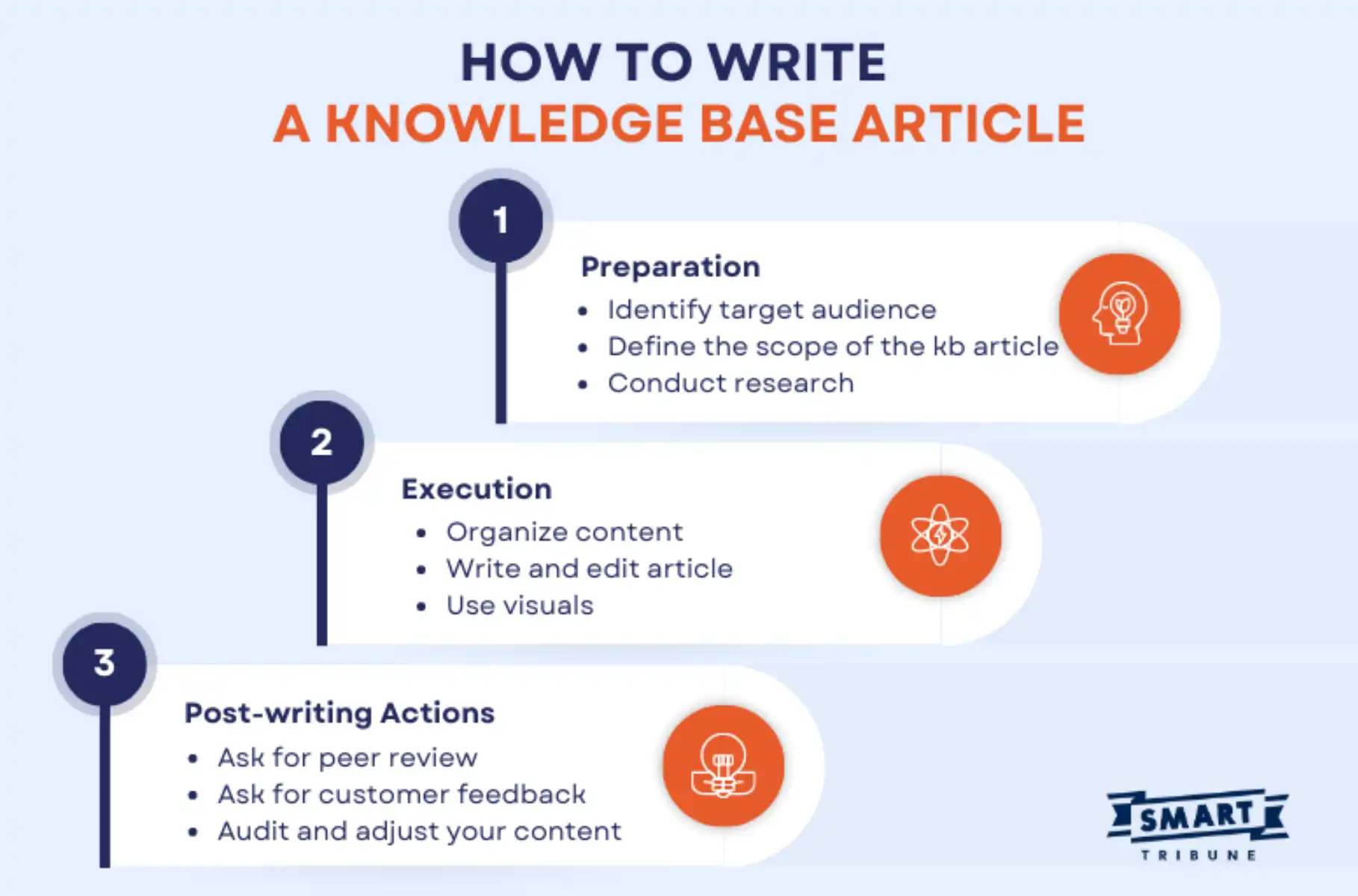
Knowledge management is a continuous operational cycle rather than a static project. Content must pass through a structured lifecycle:
- Drafting: SMEs or technical writers document new features, policies, or troubleshooting procedures.
- Peer Review: A secondary expert verifies technical accuracy and formatting.
- Publication: The content is tagged, indexed, and made available with proper security permissions.
- Auditing & Archiving: Stale or obsolete content is flagged, updated, or retired to prevent search clutter.
Measuring the Business Impact and ROI of Knowledge Management
To justify ongoing investment in knowledge systems, leadership must track both quantitative and qualitative performance indicators.
Key Quantitative Metrics
- Mean Time to Resolution (MTTR): For technical support and customer success teams, a robust knowledge base directly reduces the time required to resolve tickets.
- First-Contact Resolution (FCR): Enables support agents to accurately answer complex technical queries during initial interactions by consulting internal guides.
- Search Failure Rate: Tracks the percentage of user searches that return zero results or do not lead to an article view, highlighting missing documentation gaps.
- Onboarding Ramp-Up Time: Measures the days or weeks required for a new hire to reach full independent productivity compared to historical baselines.
Key Qualitative Indicators
- Employee NPS (eNPS): Reduced frustration around information access correlates directly with higher staff satisfaction and lower turnover intent.
- Audit Readiness: Regulated industries can quickly demonstrate compliance during internal or external audits by producing fully version-controlled SOPs.
Common Implementation Pitfalls and How to Avoid Them
Even well-funded knowledge base projects can fail if organizations fall into predictable traps. Avoid these common mistakes:
The "Set It and Forget It" Trap
Teams often launch a knowledge base with enthusiasm, populate it with initial articles, and then abandon maintenance. Without automated review reminders and clear content ownership, the system quickly becomes unreliable.
Over-Architecting Hierarchy and Permissions
Creating deep subfolder structures or overly restrictive permission rules makes information difficult to find. Keep folder hierarchies shallow (3 levels deep maximum) and use robust tag-based systems. Restrict view access only when necessary for security or regulatory compliance.
Tolerating Duplicate and Conflicting Sources
If employees can choose between an outdated local document, an unverified chat message, or the official knowledge base, information drift is inevitable. Leadership must establish the knowledge base as the sole authoritative reference point for business operations.
Frequently Asked Questions (FAQs)
How do you encourage team members to document their work regularly?
Integrating documentation directly into daily operational workflows is the most effective approach. For example, make updating a runbook a mandatory requirement for completing a software release ticket or closing a project milestone. Recognizing and rewarding team members who contribute high-quality documentation also builds a strong culture of shared knowledge.
What is the difference between a team wiki and a structured knowledge base?
A team wiki is typically open-ended, allowing any user to add or edit content with minimal formal governance. A structured knowledge base incorporates formal taxonomy, assigned content ownership, role-based access controls, and explicit review lifecycles to ensure high accuracy and security.
How often should a team knowledge base be audited for accuracy?
Key operational procedures, security policies, and technical setup guides should be reviewed every 90 to 180 days. High-turnover processes or rapidly changing product features may require continuous or monthly updates. Automating review notifications ensures these audits occur systematically.
What are the main differences between internal and external knowledge bases?
An internal knowledge base is designed exclusively for employees, housing confidential operational procedures, infrastructure credentials, and internal escalation pathways. An external knowledge base is client-facing, providing self-service product documentation, user guides, and billing FAQs to help customers resolve issues independently.
How do modern AI capabilities impact team knowledge bases?
Modern knowledge platforms leverage artificial intelligence to power conversational search, automatically draft documentation summaries, detect duplicate articles, and flag outdated content based on system usage patterns. This speeds up retrieval and reduces manual administrative overhead.
Actionable Next Steps for Team Leaders
Building a functional, resilient knowledge base requires a phased approach:
- Conduct an Information Audit: Map out where critical team knowledge currently resides—chat history, local drives, or individual memories—and identify the high-risk knowledge gaps.
- Define Governance Roles: Assign dedicated Subject Matter Experts (SMEs) to oversee specific technical or operational categories.
- Establish a Core Template: Create standardized templates for troubleshooting guides, standard operating procedures (SOPs), and project post-mortems to maintain consistent document formatting.
- Integrate into Operational Workflows: Connect your knowledge base directly with your team's everyday communication tools (e.g., Slack, Microsoft Teams, or Jira) so team members can search and reference documentation directly within their work environment.
By committing to a centralized knowledge base, organizations protect institutional memory, minimize costly operational delays, and empower team members to work with clarity and speed.
EDITORIAL CATEGORY METADATA:
Image Gallery