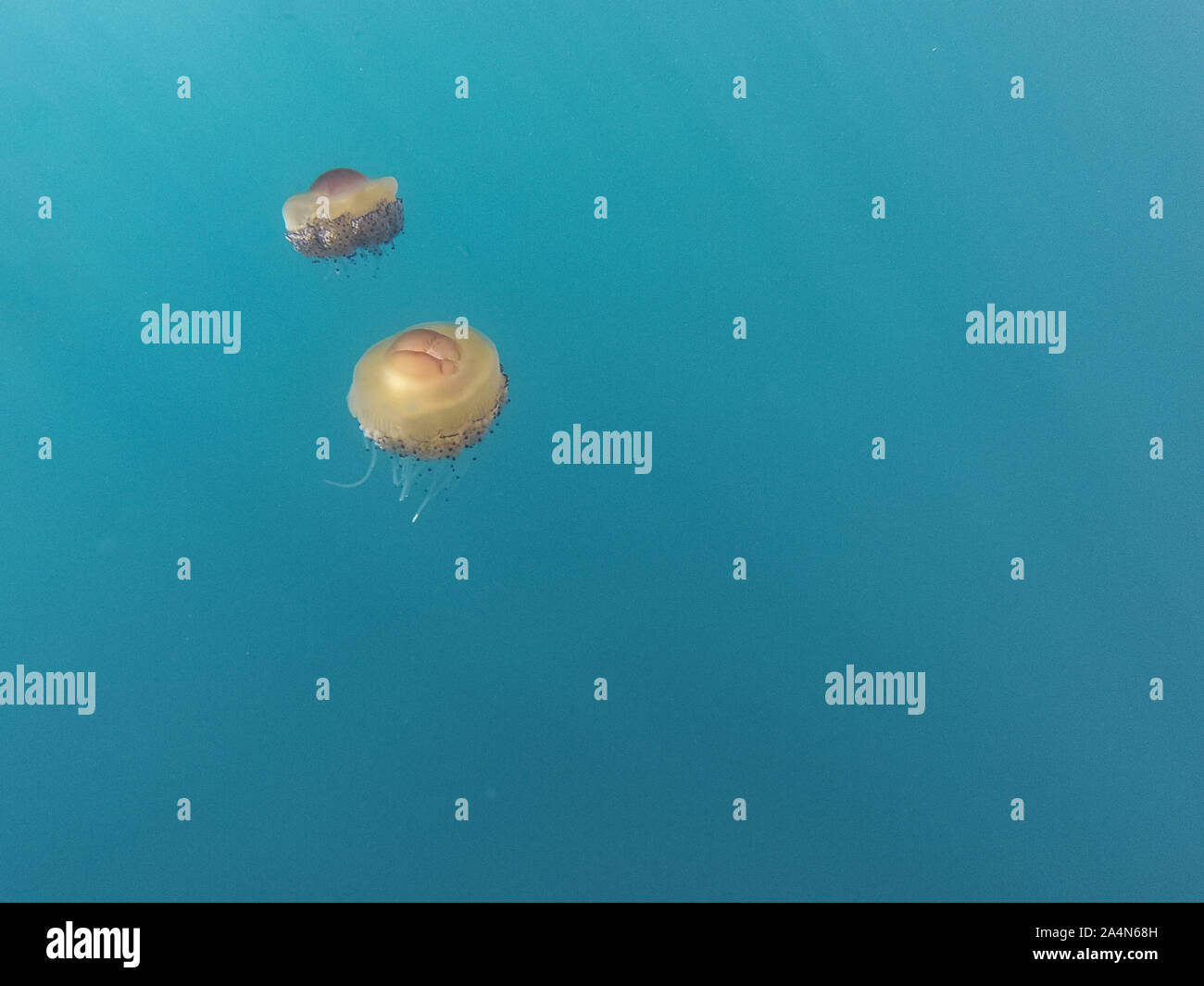
What Phylum Are Jellyfish In? Understanding Cnidarian Classification
Jellyfish belong to the phylum Cnidaria. This taxonomic group includes over 11,000 species of aquatic animals found in both freshwater and marine environments. Cnidarians are characterized by their specialized stinging cells called cni...
Jellyfish belong to the phylum Cnidaria. This taxonomic group includes over 11,000 species of aquatic animals found in both freshwater and marine environments. Cnidarians are characterized by their specialized stinging cells called cnidocytes, radial symmetry, and a relatively simple body plan consisting of a jelly-like substance known as mesoglea.
Contents
To understand why jellyfish are classified within this specific phylum, one must look beyond their translucent appearance and explore their biological makeup, evolutionary history, and the distinct classes that separate "true" jellyfish from their close relatives, such as corals and sea anemones. As of 2026, marine biology continues to refine our understanding of these ancient organisms, emphasizing their role as both resilient survivors and indicators of changing ocean health.
The Defining Characteristics of Phylum Cnidaria
The phylum Cnidaria (pronounced ny-DARE-ee-ah) derives its name from the Greek word "knide," which translates to "nettle." This is a reference to the stinging capabilities shared by almost all members of the group. For an organism to be classified within this phylum, it typically exhibits several key biological traits.
Cnidocytes and Nematocysts
The most defining feature of a cnidarian is the presence of cnidocytes. These are specialized cells used primarily for prey capture and defense. Inside each cnidocyte sits a "harpoon-like" organelle called a nematocyst. When triggered by chemical or mechanical stimuli, the nematocyst fires at incredible speed, injecting toxins into the target. While some jellyfish stings are mild to humans, others, such as those from certain box jellyfish, can be fatal.
Radial Symmetry
Unlike humans and most other animals that exhibit bilateral symmetry (having a distinct left and right side), jellyfish exhibit radial symmetry. This means their body parts are arranged around a central axis, similar to the spokes of a wheel. This orientation is highly advantageous for a drifting creature, as it allows the jellyfish to detect food or threats from any direction in the water column.
Tissue Layers and Body Plan
Jellyfish are diploblastic, meaning their bodies develop from two primary germ layers: the ectoderm (outer layer) and the endoderm (inner layer). Between these layers lies the mesoglea, a non-living, jelly-like substance that provides buoyancy and structural support. They lack complex organ systems; for instance, they do not have a centralized brain, a heart, or a respiratory system. Instead, they rely on a decentralized nerve net to process sensory information and facilitate movement.
The Four Major Classes of Jellyfish and Their Relatives
Within the phylum Cnidaria, jellyfish are distributed across several distinct classes. While we often use the term "jellyfish" as a catch-all, taxonomists distinguish between "true jellyfish" and other gelatinous zooplankton based on their life cycles and anatomical nuances.
1. Class Scyphozoa (True Jellyfish)
The Scyphozoans are what most people refer to when they say "jellyfish." This class includes well-known species like the Moon Jelly (Aurelia aurita) and the Lion’s Mane Jellyfish. In this class, the medusa stage (the bell-shaped, swimming form) is the dominant part of the life cycle. While they do have a polyp stage (a stationary, stalk-like form), it is usually small and short-lived.
2. Class Cubozoa (Box Jellyfish)
Box jellyfish are distinguished by their cube-shaped bells and remarkably complex sensory systems. Unlike Scyphozoans, Cubozoans have true eyes with lenses, corneas, and retinas, allowing them to actively hunt prey rather than just drifting. They are also among the most venomous creatures in the ocean. The Sea Wasp (Chironex fleckeri) is a notable member of this class found in Indo-Pacific waters.
3. Class Hydrozoa
This is a diverse class that includes many small, predatory animals. While some Hydrozoans look like jellyfish, they often differ in their life cycles, frequently alternating between polyp and medusa stages. A famous example is the Portuguese Man o' War (Physalia physalis). Although it resembles a jellyfish, it is actually a siphonophore—a colonial organism made up of specialized individuals (zooids) working together.
4. Class Staurozoa (Stalked Jellyfish)
Staurozoans are unique because they do not swim. Instead, they live attached to rocks or seaweed by a stalk. They are trumpet-shaped and found mostly in colder, coastal waters. Though they are technically medusae, their sedentary lifestyle sets them apart from the free-roaming species found in the open ocean.
Comparison of Cnidarian Classes
To better understand the differences within the phylum, the following table compares the primary classes associated with the term "jellyfish."
| Class | Common Name | Primary Body Form | Key Distinguishing Feature |
|---|---|---|---|
| Scyphozoa | True Jellyfish | Medusa (Dominant) | Large, scalloped bells; mostly marine. |
| Cubozoa | Box Jellyfish | Medusa (Box-shaped) | Complex eyes; highly potent venom; fast swimmers. |
| Hydrozoa | Hydroids / Siphonophores | Varies (Polp & Medusa) | Often colonial; includes the Portuguese Man o' War. |
| Staurozoa | Stalked Jellyfish | Attached Medusa | Sedentary; attaches to substrates via a basal disk. |
The Evolutionary Significance of Jellyfish
Jellyfish are among the oldest multi-organism lineages on Earth. Fossil evidence suggests that cnidarians have existed for over 500 million years, predating the dinosaurs and even the formation of the Appalachian Mountains. Their survival through multiple mass extinction events is a testament to the efficiency of their simple design.
By 2026, research into the jellyfish genome has revealed how these "simple" creatures manage complex tasks like tissue regeneration. Because they lack a centralized heart or blood vessels, they rely on diffusion to transport oxygen and nutrients. Their ability to thrive in low-oxygen environments (hypoxia) has allowed them to expand into "dead zones" where other marine life cannot survive. This adaptability makes them a critical subject for climate change studies, as jellyfish blooms are becoming more frequent in warming, overfished oceans.
Clarifying the "Comb Jelly" Confusion
A common point of confusion in marine biology is the distinction between jellyfish (Phylum Cnidaria) and comb jellies (Phylum Ctenophora). While both are gelatinous and translucent, they are fundamentally different.
- Stingers vs. No Stingers: Cnidarians have stinging cnidocytes. Ctenophores generally do not sting; instead, they use sticky cells called colloblasts to catch prey.
- Locomotion: Jellyfish move by contracting their bells. Comb jellies move using eight rows of tiny, hair-like cilia (combs) that shimmer with bioluminescence as they beat.
- Symmetry: While jellyfish are radially symmetrical, comb jellies often exhibit biradial symmetry.
When asking what phylum jellyfish are in, it is vital to remember that "jellyfish" is a functional description of a body plan, but taxonomically, the stinging members belong exclusively to Cnidaria.
The Life Cycle: From Polyp to Medusa
Understanding the phylum Cnidaria requires looking at the "alternation of generations." Most jellyfish do not simply give birth to smaller jellyfish. Instead, they go through a complex multi-stage life cycle:
- Planula: A jellyfish starts as a fertilized egg that develops into a tiny, free-swimming larva called a planula.
- Polp: The planula attaches to a hard surface (like a rock or pier) and grows into a polyp. In this stage, it looks like a tiny sea anemone.
- Ephyra: Through a process called strobilation, the polyp begins to bud off microscopic, disk-like segments. These segments are called ephyrae.
- Medusa: The ephyra matures into the adult medusa stage—the classic jellyfish form we recognize.
This ability to reproduce both sexually (as medusae) and asexually (as polyps) allows jellyfish populations to explode rapidly when environmental conditions, such as temperature and food availability, are optimal.
Ecological Impact and the 2026 Perspective
In the current year of 2026, the study of jellyfish has shifted from pure taxonomy to ecological management. Jellyfish blooms can have significant economic impacts, such as clogging the cooling intakes of power plants, damaging fishing nets, and deterring tourism. However, they also serve as a vital food source for leatherback sea turtles and the ocean sunfish (Mola mola).
Furthermore, the green fluorescent protein (GFP) originally discovered in certain jellyfish has revolutionized biomedical research. Scientists in 2026 continue to use derivatives of these proteins to track cellular processes in real-time, aiding in the development of treatments for cancer and neurological disorders. This highlights that while jellyfish may be simple in structure, their biological contributions are immense.
Frequently Asked Questions
Are all jellyfish in the same phylum?
Yes, all true jellyfish, box jellyfish, and stalked jellyfish belong to the phylum Cnidaria. While they are divided into different classes (Scyphozoa, Cubozoa, etc.), they share the fundamental characteristics of the phylum, such as radial symmetry and cnidocytes.
Why are jellyfish not considered fish?
Jellyfish are invertebrates, meaning they lack a backbone. True fish belong to the phylum Chordata and possess gills, scales, and backbones. For this reason, many scientists and educators prefer the term "sea jellies" to avoid the linguistic confusion associated with the word "fish."
Do all jellyfish sting?
While all members of the phylum Cnidaria possess cnidocytes (stinging cells), not all of them are harmful to humans. Some species have toxins that are too weak to penetrate human skin, while others, like the "stingless" jellyfish of Jellyfish Lake in Palau, have evolved to have very mild stings because they have few natural predators in their isolated environment.
What is the difference between a polyp and a medusa?
A polyp is a sessile (stationary) life stage with a mouth and tentacles facing upward, typically attached to the ocean floor. A medusa is the mobile, umbrella-shaped stage with the mouth and tentacles facing downward. Most jellyfish spend the majority of their visible life in the medusa stage.
Are sea anemones and corals in the same phylum as jellyfish?
Yes, sea anemones and corals are also members of the phylum Cnidaria. However, they belong to the class Anthozoa. Unlike jellyfish, Anthozoans do not have a medusa stage in their life cycle; they remain as polyps throughout their lives.
Recommendations for Further Study
If you are interested in the world of marine invertebrates, the best next step is to observe these creatures in a controlled environment. Visiting a major aquarium—many of which have specialized "Jellyfish Galleries"—allows you to see the differences between Scyphozoans and Hydrozoans firsthand. For those pursuing academic interests, the Smithsonian Ocean Portal and the National Oceanic and Atmospheric Administration (NOAA) provide extensive databases on cnidarian distribution and the latest research on jellyfish blooms as of 2026.
Image Gallery