What are LDI Strategies and How Do They Work?
Liability-Driven Investment (LDI) is an investment framework designed primarily to ensure that an institution’s assets are sufficient to meet its future financial obligations. Used extensively by defined benefit pension plans and insur...
Liability-Driven Investment (LDI) is an investment framework designed primarily to ensure that an institution’s assets are sufficient to meet its future financial obligations. Used extensively by defined benefit pension plans and insurance companies, LDI focuses on managing the risk of the funding ratio—the relationship between assets and liabilities—rather than seeking to maximize absolute investment returns.
Contents
Understanding the Fundamentals of Liability-Driven Investment
At its core, a Liability-Driven Investment (LDI) strategy reverses the traditional investment logic. While a standard "asset-only" strategy focuses on generating the highest possible return for a given level of risk, LDI begins by analyzing the specific characteristics of the liabilities. For a pension fund, these liabilities represent the legal obligation to pay monthly retirement income to members for decades into the future. These payments are often sensitive to changes in inflation and are highly sensitive to interest rate fluctuations.
In the current 2026 financial landscape, LDI is viewed as a risk-management framework rather than a specific product. The primary objective is to immunize the "funding status" of a plan. If a pension fund has $100 million in assets and $100 million in projected future liabilities, it is 100% funded. If interest rates drop, the "present value" of those future liabilities increases. Without an LDI strategy, the assets might stay the same while the liabilities grow to $110 million, creating a deficit. LDI aims to ensure that if the liabilities increase by 10%, the assets also increase by approximately 10%, maintaining the funding equilibrium.
This approach acknowledges that for many institutional investors, the greatest risk is not a market downturn in isolation, but a "mismatch" where assets and liabilities move in opposite directions. By aligning the sensitivities of both sides of the balance sheet, LDI provides a more predictable path toward long-term solvency.
The Mechanics: How LDI Strategies Function
LDI strategies function by dividing a portfolio into two distinct components: the Hedging Portfolio (or Liability-Matching Portfolio) and the Growth Portfolio (or Return-Seeking Portfolio).
The Role of the Hedging Portfolio
The hedging portfolio is the engine of the LDI strategy. It typically consists of long-duration fixed-income instruments, such as government bonds (Treasuries or Gilts), corporate bonds, and interest rate derivatives. The goal is to mirror the duration and inflation sensitivity of the liabilities. Duration is a measure of how much the price of an asset (or the value of a liability) changes when interest rates shift. By matching the duration of the hedging portfolio to the duration of the pension payouts, the fund manager ensures that the two sides of the balance sheet move in tandem.
The Role of the Growth Portfolio
While the hedging portfolio protects the current funding status, the growth portfolio is designed to bridge any existing funding gap or to cover future costs that haven't been fully funded yet. This part of the strategy typically includes equities, real estate, private equity, and other high-return assets. Over time, as the funding level improves through growth and contributions, many plans gradually shift assets from the growth portfolio into the hedging portfolio—a process known as "de-risking."
Managing the Primary Risks: Interest Rates and Inflation
The two most significant variables affecting institutional liabilities are interest rates and inflation. LDI strategies are specifically engineered to mitigate the volatility introduced by these factors.
Interest Rate Hedging
Most pension liabilities are valued by "discounting" future cash flows back to the present day using a specific interest rate (often based on high-quality corporate bond yields or swap curves). When interest rates fall, the discount rate falls, and the present value of the debt rises significantly. This is a mathematical certainty, not a market opinion. LDI strategies use "long-duration" assets to counter this. Because bond prices rise when interest rates fall, a well-structured LDI portfolio will see its asset value rise at the same rate as the liability value during a rate decline, neutralizing the impact on the funding ratio.
Inflation Indexing
Many pension benefits are linked to inflation (such as the Consumer Price Index). If inflation rises, the nominal amount the pension must pay out increases. To hedge this, LDI strategies utilize inflation-linked bonds (like TIPS in the U.S. or Linkers in the U.K.) and inflation swaps. These instruments provide returns that scale with inflation markers, ensuring the purchasing power of the assets keeps pace with the rising cost of the promises made to beneficiaries.
Financial Instruments Used in LDI Implementation
To achieve the necessary level of sensitivity to interest rates without tying up all available capital, LDI managers often use "leverage" through derivative instruments. This allows the fund to hedge a large amount of liability with a relatively small amount of cash, freeing up the remaining capital for the growth portfolio.
- Physical Bonds: These are the simplest building blocks. Holding long-dated government or corporate bonds provides a direct hedge. However, physical bonds require significant capital.
- Interest Rate Swaps: A contract where the pension fund pays a floating interest rate and receives a fixed interest rate. This allows the fund to gain exposure to long-term interest rate movements without purchasing the underlying bonds.
- Repurchase Agreements (Repos): A fund can sell a bond with an agreement to buy it back later, effectively borrowing cash to purchase more bonds. This is a common way to add leverage to an LDI strategy.
- LDI Pooled Funds: For smaller pension schemes that cannot manage complex derivative overlays, asset managers offer pooled funds that provide "leveraged" exposure to specific parts of the yield curve.
The Evolution of LDI: Lessons from Recent History
The landscape of LDI changed significantly following the 2022 "Gilt Crisis" in the United Kingdom, which served as a stress test for these strategies globally. In that event, a rapid and unprecedented spike in interest rates caused the value of hedging bonds to plummet. Because many LDI strategies were leveraged, funds were hit with "collateral calls," requiring them to provide immediate cash to back their derivative positions.
As of 2026, the implementation of LDI has become more conservative and resilient. Regulatory bodies, such as The Pensions Regulator and various international financial stability boards, have introduced stricter requirements for "liquidity buffers." Modern LDI strategies now prioritize:
- Increased Liquidity: Maintaining larger holdings of cash or near-cash assets to meet potential collateral calls during periods of extreme volatility.
- Reduced Leverage: Using lower levels of leverage to ensure that a sudden move in interest rates does not force the fire-sale of growth assets.
- Governance and Operational Readiness: Establishing clear protocols for how trustees and managers respond to "stress events" within hours rather than days.
Comparison: LDI vs. Traditional Asset-Only Strategies
| Feature | Traditional Asset-Only Strategy | Liability-Driven Investment (LDI) |
|---|---|---|
| Primary Goal | Maximize total return on assets | Stabilize the funding ratio |
| Risk Focus | Asset volatility (e.g., stock market drops) | Mismatch risk (Assets vs. Liabilities) |
| Benchmark | Market Indices (e.g., S&P 500, Bloomberg Agg) | The Liability Profile of the Plan |
| Interest Rate Sensitivity | Often viewed as a secondary risk | The primary factor in strategy design |
| Use of Derivatives | Minimal or for tactical hedging | Central to the core hedging strategy |
| Asset Allocation | Driven by diversification and "efficient frontier" | Driven by the "duration" of future payouts |
Determining the Right LDI Journey Plan
The application of LDI is rarely static; it is usually part of a "journey plan" toward an ultimate goal, such as a "buyout" or "buy-in" with an insurance company.
In the early stages of a journey plan, a pension fund might be underfunded. Here, the LDI strategy focuses on "holding the ground" already gained while the growth portfolio seeks to close the deficit. As the fund approaches 100% funding, the trustees will typically trigger "auto-pilots"—pre-set rules that automatically sell equities and buy more LDI hedging assets as certain funding milestones are met.
By 2026, many mature pension schemes have reached the "end-state," where their LDI coverage is nearly 100%. At this stage, the volatility of the funding ratio is minimized, and the plan is prepared for "pension risk transfer," where an insurer takes over the liabilities entirely, removing the risk from the corporate sponsor's balance sheet.
Common Challenges and Operational Constraints
Despite its benefits, LDI is not a "set and forget" solution. It requires sophisticated oversight and comes with specific challenges:
- Basis Risk: This occurs when the assets used to hedge don't move exactly in line with the liabilities. For example, if liabilities are valued based on corporate bond yields but the hedge uses government bonds, the "spread" between the two can cause the funding ratio to fluctuate.
- Operational Complexity: Managing collateral, swaps, and repo rolls requires a high level of expertise and robust technology. Mistakes in collateral management can lead to the forced unwinding of hedges at the worst possible time.
- Negative Public Perception: During periods of rising interest rates, LDI assets lose value. To an uneducated observer, this looks like a failure. However, in an LDI context, this is expected because the value of the liabilities is falling even faster, actually improving the plan's health.
Frequently Asked Questions
1. Who typically uses LDI strategies?
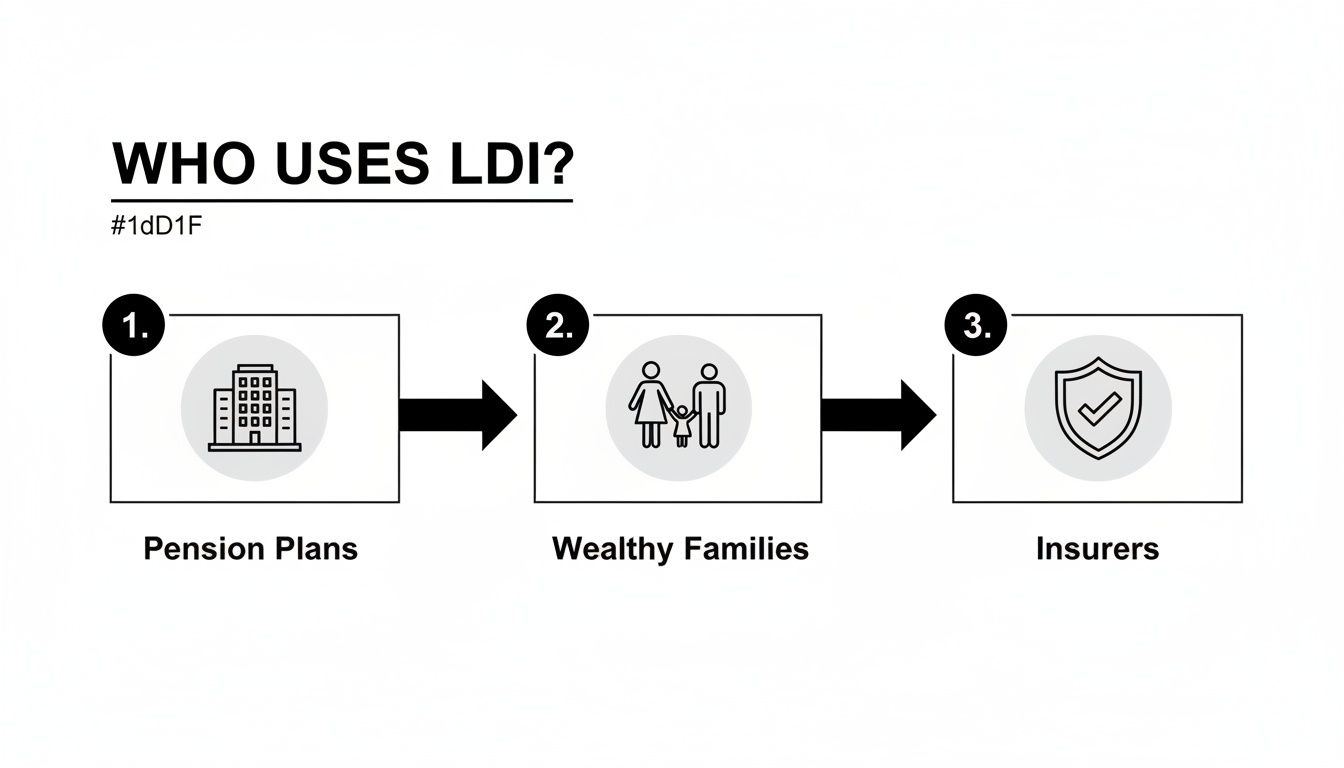
LDI is primarily used by defined benefit (DB) pension schemes and life insurance companies. These organizations have long-term, predictable, and legally binding future payouts that are sensitive to economic variables like interest rates.
2. Does LDI prevent a pension fund from losing money?
No. LDI is not designed to prevent asset values from falling; it is designed to prevent the funding ratio from deteriorating. In a rising interest rate environment, an LDI portfolio will lose market value, but because the value of the future liabilities is also falling, the plan remains solvent.
3. What is "leverage" in the context of LDI?
Leverage in LDI involves using derivatives (like swaps) or borrowing (like repos) to gain exposure to long-dated bonds without paying the full cash price upfront. This allows a fund to hedge its liabilities using only a portion of its capital, leaving the rest available for growth investments.
4. How did the 2022 market volatility change LDI?
The 2022 volatility highlighted the danger of "liquidity dry-ups." Modern LDI strategies now maintain much larger cash buffers and have more rigorous "stress testing" protocols to ensure they can meet collateral calls without selling off other assets.
5. Is LDI still relevant in 2026?
Yes, LDI remains the standard for pension risk management. While the specific tactics have evolved to be more conservative regarding liquidity, the core principle of matching asset sensitivities to liability sensitivities remains the most effective way to manage a defined benefit plan.
Practical Recommendation for Stakeholders
For pension trustees and corporate sponsors, the most critical next step is a Liquidity Stress Test. Ensure that your investment manager has a clearly defined "collateral management policy" that specifies exactly which assets will be sold and in what order if interest rates rise sharply. In the current 2026 regulatory environment, the focus has shifted from "maximum hedge" to "maximum resilience." Review your journey plan to ensure that your hedge ratios are appropriate for your current funding level and that you have sufficient "dry powder" to maintain your hedges during periods of market dislocation.
Disclaimer: This article is for informational purposes only and does not constitute financial, legal, or investment advice. Liability-driven investment involves complex financial instruments and risks, including the risk of capital loss. Consult with a qualified professional before making investment decisions.
Image Gallery