Accruing Dividends: Why Most Investors Should Reinvest for Long-Term Wealth
Accruing dividends refers to the accumulation of a company's earnings distributed to shareholders. Most investors should reinvest these dividends because doing so triggers the power of compounding, allowing you to purchase additional s...
Accruing dividends refers to the accumulation of a company's earnings distributed to shareholders. Most investors should reinvest these dividends because doing so triggers the power of compounding, allowing you to purchase additional shares that, in turn, generate their own dividends. This cycle exponentially increases your total share count and portfolio value over time without requiring additional out-of-pocket capital.
Contents
Understanding Dividend Accrual and the Reinvestment Mechanism
In the world of equity investing, dividends represent a portion of a company’s profit paid out to its "owners"—the shareholders. When we speak of accruing dividends, we are looking at the period between when a company declares a dividend and when it is actually paid out. For the individual investor, the strategic decision is not just about identifying high-yield stocks, but determining what happens to that cash once it hits the brokerage account.
The vast majority of retail investors operate with a long-term horizon, typically aiming for retirement or multi-decadal wealth building. In this context, treating dividends as "extra spending money" is often a strategic error. Instead, treating them as a fuel source for further investment is the hallmark of successful wealth accumulation. By opting into a Dividend Reinvestment Plan (DRIP), an investor instructs their brokerage to automatically use the cash distribution to buy more shares (or fractional shares) of the issuing company. This process is seamless and, as of 2026, is a standard feature offered by nearly every major global brokerage firm without additional commission fees.
The Mathematical Engine: Compounding and the Snowball Effect
The primary reason to reinvest accrued dividends is the mathematical phenomenon of compounding. While many investors focus on capital appreciation—the hope that a stock price will rise from $100 to $150—they often overlook the fact that dividends have historically accounted for a significant portion of the total return of the equity markets.
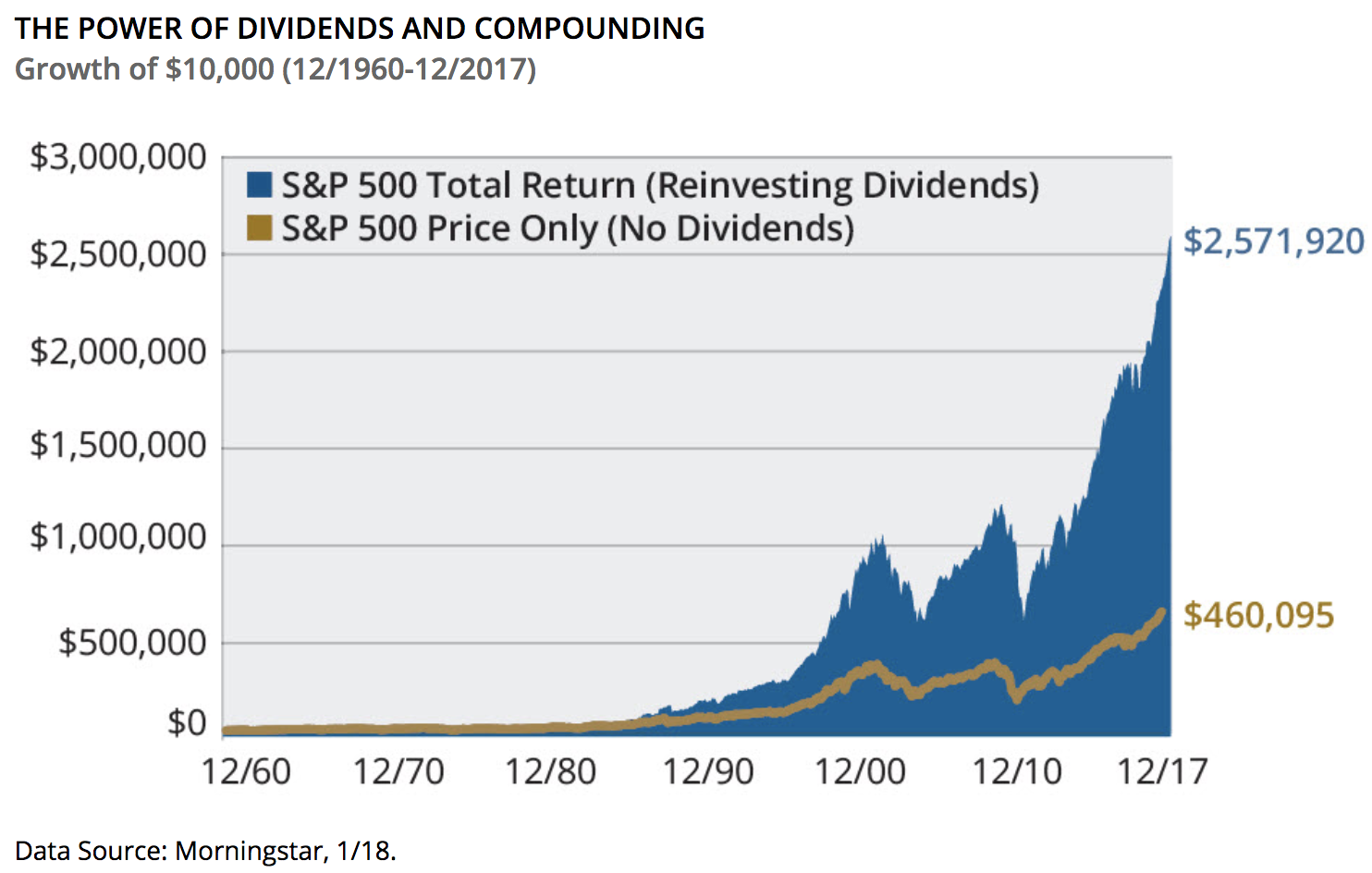
According to historical data from Standard & Poor’s, dividends have historically contributed roughly 32% of the total return for the S&P 500. When you reinvest those dividends, you are moving from a linear growth model to a geometric growth model.
Consider an investor who owns 1,000 shares of a company trading at $50, which pays a 4% annual dividend ($2.00 per share).
- Year 1: The investor receives $2,000 in cash.
- If Reinvested: That $2,000 buys an additional 40 shares (assuming the price remains $50).
- Year 2: The investor now owns 1,040 shares. The dividend is now paid on the original 1,000 shares plus the 40 new shares.
Over 20 to 30 years, this "snowball effect" creates a massive divergence between the investor who took the cash and the investor who reinvested. The reinvesting investor ends up with a significantly larger share count, which means that even if the stock price remains stagnant, their total wealth and annual income stream continue to grow.
Strategic Advantages of Automatic Reinvestment
Beyond the raw mathematics, reinvesting dividends offers several structural advantages that align with modern portfolio theory and behavioral finance.
1. Systematic Dollar-Cost Averaging
Dividend reinvestment is a form of dollar-cost averaging (DCA). Because dividends are usually paid on a fixed schedule (quarterly or monthly), the reinvestment happens regardless of market conditions. When the market is down and stock prices are "on sale," your fixed dividend payment buys more shares. When the market is high, it buys fewer shares. This automated discipline ensures that you are consistently accumulating more equity during market downturns, which is often the hardest time for human investors to click the "buy" button manually.
2. Elimination of Market Timing Risks
Many investors who take dividends in cash intend to reinvest them "when the time is right." In practice, this often leads to "cash drag," where the money sits in a low-interest settlement account while the investor waits for a market dip that may not come for months. By the time they reinvest, the stock price may have risen significantly, negating the benefit of waiting. Automatic reinvestment removes the temptation to time the market, ensuring that capital is always "working" in the market.
3. Psychological Discipline
The greatest enemy of the long-term investor is often their own emotion. Seeing a cash balance increase in a brokerage account can trigger a desire to spend that money on non-essential consumer goods. By automating the reinvestment process, the money never enters the "spendable" mental bucket. It remains part of the investment engine, reinforcing the habit of long-term thinking.
Comparing Reinvestment vs. Cash Payouts
The following table illustrates the conceptual differences between these two paths over a long-term investment horizon.
| Feature | Cash Payout (Withdrawal) | Automatic Reinvestment (DRIP) |
|---|---|---|
| Primary Goal | Immediate supplemental income | Long-term wealth maximization |
| Share Count | Remains constant (unless manual buys occur) | Increases every distribution period |
| Compounding Potential | Limited to capital gains on original shares | Exponential; gains on original + new shares |
| Market Entry | Requires manual execution/timing | Automated; functions as Dollar-Cost Averaging |
| Tax Treatment | Taxed in the year received | Taxed in the year received (in taxable accounts) |
| Volatility Impact | Portfolio value fluctuates with price only | New shares provide a buffer via lower average cost |
Tax Considerations and Cost Basis Management
One of the most critical aspects of accruing and reinvesting dividends is understanding the tax implications. It is a common misconception that if you don't "touch" the money because it was reinvested, you don't owe taxes on it.
In the eyes of the Internal Revenue Service (IRS), a reinvested dividend is treated as if you received the cash and then immediately used it to buy shares. Therefore, in a standard taxable brokerage account, you are liable for taxes on those dividends in the year they are paid.
- Qualified Dividends: These are taxed at the lower long-term capital gains rates (0%, 15%, or 20% in 2026, depending on income).
- Ordinary (Non-Qualified) Dividends: These are taxed at your standard marginal income tax rate.
Cost Basis Tracking: When you reinvest dividends, each new purchase creates a "lot" with its own cost basis. In 2026, most brokerage platforms automate this tracking, but it is vital for the investor to realize that their total cost basis increases with every reinvestment. This is actually a benefit: when you eventually sell the stock, your taxable gain will be lower because your "investment" (the cost basis) includes all those reinvested dividends.
Note: For investments held within a Roth IRA or 401(k), dividend reinvestment occurs tax-free, making these vehicles the most efficient place for dividend-growth strategies.
When Should an Investor NOT Reinvest?
While reinvesting is the mathematically superior choice for most, there are specific scenarios where cashing out the accrued dividends is the more prudent move.
1. Portfolio Rebalancing
If a single stock or sector has grown to represent an oversized portion of your portfolio, reinvesting dividends into that same stock further increases your concentration risk. In this case, an investor might take the dividends in cash and manually use that money to purchase shares in an underrepresented sector, effectively rebalancing the portfolio without selling existing winners.
2. Income Requirements in Retirement
For retirees, dividends often serve as the primary source of living expenses. At this stage of the lifecycle, the goal shifts from accumulation to distribution. Accruing dividends provides a "natural" yield that allows the investor to pay for their lifestyle without being forced to sell shares during a market downturn.
3. Extreme Overvaluation
If a company’s valuation has reached irrational levels (e.g., a P/E ratio significantly higher than historical norms or industry peers), automatically buying more shares might be poor capital allocation. An astute investor might collect the cash and wait for the valuation to normalize or move the capital to a more attractively valued opportunity.
How to Set Up Dividend Reinvestment in 2026
Implementing this strategy is simpler than ever. Most major platforms—including Fidelity, Vanguard, and Charles Schwab—allow you to toggle reinvestment settings at either the account level or the individual security level.
- Log in to your brokerage portal.
- Navigate to "Account Settings" or "Positions."
- Locate the "Dividend Reinvestment" or "DRIP" section.
- Select "Reinvest" for all eligible securities.
- Review your choices quarterly to ensure new holdings are also set to reinvest.
By 2026, the rise of fractional share trading has made DRIPs even more effective. Previously, if your dividend was $20 but the stock cost $100, that $20 would sit in cash. Today, brokerages can buy 0.2 shares for you, ensuring that every cent of your accrued dividend is immediately put back to work.
Frequently Asked Questions
Does reinvesting dividends increase my risk?
Reinvesting dividends does not inherently increase the risk of the underlying company, but it does increase your concentration risk in that specific stock. If the company fails, you lose both your original principal and all the wealth you "re-locked" into that company via dividends. Diversification remains essential.
Do I have to pay commissions on reinvested dividends?
In 2026, the vast majority of online brokerages offer commission-free dividend reinvestment. It is one of the most cost-effective ways to build a position over time. However, always check your specific broker’s fee schedule for "specialty" foreign stocks or ADRs (American Depositary Receipts), which may still carry small processing fees.
Is it better to reinvest dividends or buy a different stock?
For most, automatic reinvestment is better because it ensures consistency. However, if you are a sophisticated investor who closely monitors valuations, taking the cash to buy an undervalued stock elsewhere (tactical allocation) can lead to higher returns than blindly reinvesting into an overvalued one.
Can I reinvest dividends from Mutual Funds and ETFs?
Yes. Both Mutual Funds and Exchange-Traded Funds (ETFs) offer reinvestment options. For ETFs, this is usually handled at the brokerage level, while for Mutual Funds, it can be handled by the fund provider or the brokerage.
What is the "Ex-Dividend Date" and why does it matter?
The ex-dividend date is the day on which a stock begins trading without the subsequent dividend value. To receive the accrued dividend, you must own the stock before this date. If you buy on or after the ex-dividend date, the previous owner receives the payment.
Final Recommendation
For the average investor looking to build a secure financial future, automatic dividend reinvestment is the single most effective tool for wealth creation. It removes the need for perfect market timing, enforces a disciplined savings habit, and utilizes the unstoppable force of compound interest. Unless you are currently in your retirement phase and require the cash for living expenses, you should ensure your brokerage accounts are set to "reinvest" by default. This simple "set it and forget it" action can be the difference between a modest nest egg and true financial independence over a 20-year period.
Image Gallery