Why Does Stitch! The Movie Look Different? An Insider Look
Stitch! The Movie looks different because it was produced by Disney Television Animation (DTVA) rather than the flagship Walt Disney Feature Animation (WDFA) studio. Created as a pilot for the television series, it utilized a smaller b...
Stitch! The Movie looks different because it was produced by Disney Television Animation (DTVA) rather than the flagship Walt Disney Feature Animation (WDFA) studio. Created as a pilot for the television series, it utilized a smaller budget, simplified background painting techniques, and outsourced character animation to overseas studios, sacrificing the original film’s lush watercolor aesthetics for production speed.
Contents
The transition from the 2002 theatrical masterpiece Lilo & Stitch to the 2003 direct-to-video (DTV) release Stitch! The Movie remains one of the most jarring visual shifts in Disney’s "Sequel Era." While casual viewers may simply notice the characters look "flatter" or "stiffer," an insider look at the production reveals a calculated shift in technology, artistic medium, and corporate strategy. As we look back from 2026, the technical gap between these two projects highlights the distinct workflows of the early 2000s animation industry.
The Institutional Divide: Feature Animation vs. Television Animation
The primary reason for the visual discrepancy is the change in the production house. The original Lilo & Stitch (2002) was a product of Walt Disney Feature Animation Florida, a prestigious studio that operated out of Disney’s Hollywood Studios. Feature animation teams were given years of development time, massive budgets (approximately $80 million for the original), and access to the industry’s top "clean-up" artists and supervisors.
In contrast, Stitch! The Movie was handled by Disney Television Animation. In the early 2000s, Disney’s TV division was tasked with producing "cheapquels"—direct-to-video movies that doubled as pilots for upcoming TV shows. These projects operated on a fraction of the theatrical budget. The goal was not cinematic immortality but brand expansion and the creation of a repeatable visual style that could be sustained across dozens of weekly television episodes.
The Impact of Outsourcing
While Feature Animation kept its core production in-house, DTVA relied heavily on overseas outsourcing. For Stitch! The Movie, much of the heavy lifting was performed by studios like Toon City in the Philippines. While these studios were highly skilled, they were bound by tight deadlines and rigid "style guides." This resulted in a loss of the idiosyncratic, fluid movement seen in Chris Sanders’ original character designs. The "on-model" requirements for TV are often more concerned with consistency than the expressive, rubbery squash-and-stretch that defined the theatrical Stitch.
The Watercolor Crisis: Background Technicalities
The most significant visual hallmark of the 2002 film was its use of watercolor backgrounds. This was a deliberate artistic choice by directors Chris Sanders and Dean DeBlois to mimic the style of Disney’s Dumbo (1941). Watercolor is notoriously difficult to master because it is transparent; once a stroke is placed, it cannot be painted over. This requires master-level planning and prevents the use of digital "patching" common in modern animation.
For Stitch! The Movie, the production shifted away from these traditional watercolors to gouache and digital painting.
- Transparency vs. Opacity: Gouache is opaque, making it much faster to produce because mistakes can be painted over. However, it lacks the soft, bleeding edges and "glow" that characterized the original film’s depiction of Kauai.
- Simplified Geometry: The backgrounds in the sequel are noticeably more geometric. Trees, waves, and volcanic rock formations are rendered with sharper lines and less texture.
- Digital Integration: By 2003, the industry was leaning harder into digital ink and paint systems. While the original film used the CAPS (Computer Animation Production System) for high-end compositing, the sequel used more streamlined, cost-effective digital pipelines that lacked the complex lighting layers seen in the theatrical release.
Character Rigidity and Linework
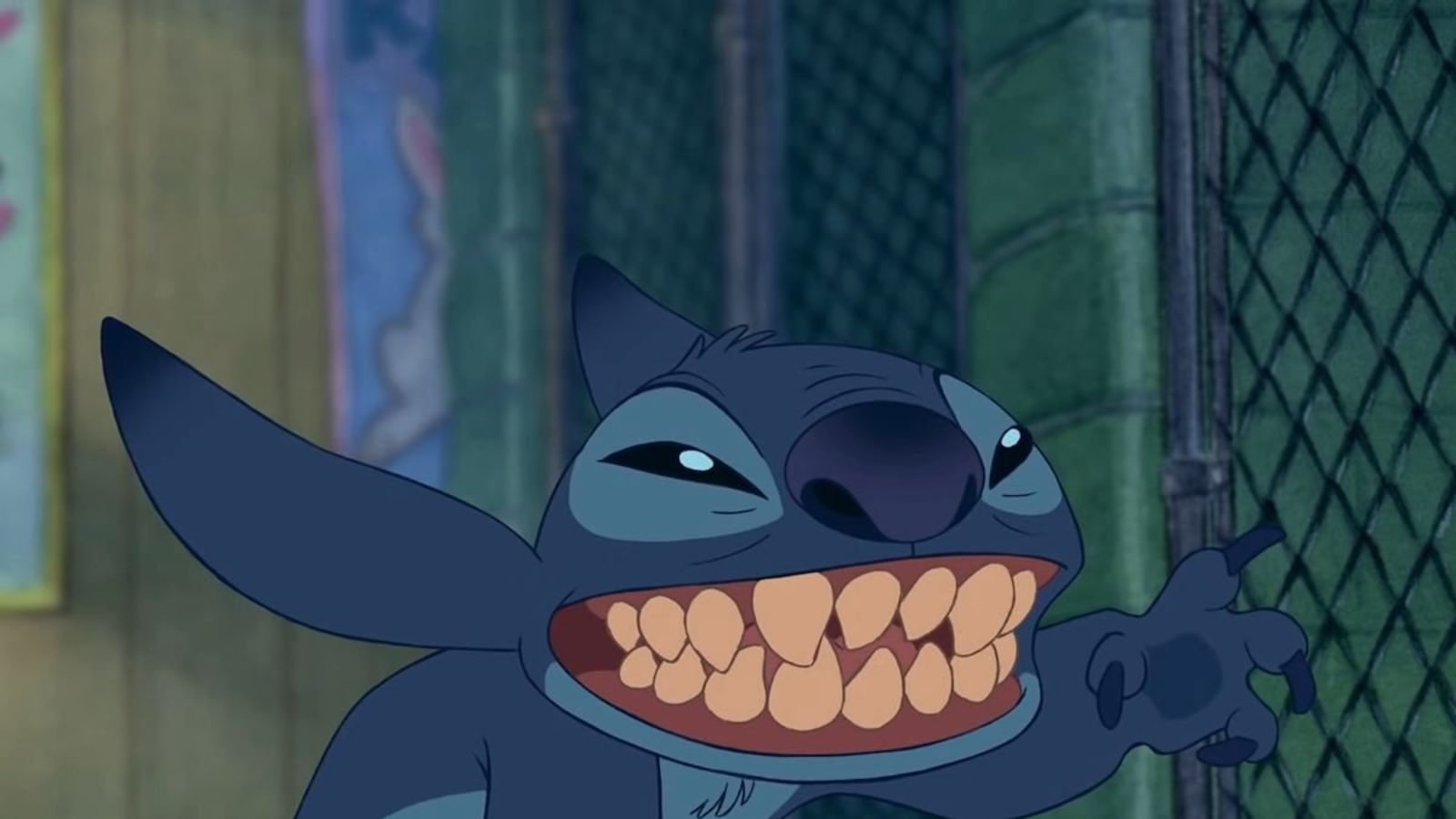
If you pause Stitch! The Movie and compare it to the original, the character linework tells a significant story. In the 2002 film, the lines are delicate and vary in thickness (tapering), which gives the characters a sense of weight and organic life. This is the result of a labor-intensive "clean-up" phase where artists hand-trace the rough animation.
In the sequel and subsequent series, the line weight is uniform. A uniform line is much easier for overseas studios to replicate and for digital coloring software to process. However, this "thick" line style often makes the characters feel like they are floating on top of the background rather than existing within it.
Furthermore, the frame rate often differs in perception. Feature films are traditionally animated "on ones" (one drawing per frame) for high-action sequences. Stitch! The Movie frequently animates "on twos" (one drawing for every two frames) or even "on threes" to save time and money. This leads to the "staccato" or jerky movement that fans often associate with the television look.
Comparison of Production Specifications
The following table outlines the technical differences that contributed to the "insider" look of the two projects.
| Feature | Lilo & Stitch (2002) | Stitch! The Movie (2003) |
|---|---|---|
| Production Studio | Walt Disney Feature Animation | Disney Television Animation |
| Primary Medium | Hand-drawn (Cell) / CAPS | Hand-drawn / Digital Ink & Paint |
| Background Style | Transparent Watercolor | Opaque Gouache / Digital |
| Animation Location | Florida & California, USA | Outsourced (e.g., Philippines) |
| Budget (Estimated) | $80 Million | $3 - $10 Million |
| Frame Rate Target | Mostly 24 fps (On Ones/Twos) | Mixed (On Twos/Threes) |
| Intent | Theatrical Cinematic Release | TV Series Pilot / Direct-to-Video |
The "Stitch Has a Glitch" Exception
It is important to disambiguate Stitch! The Movie from another sequel: Lilo & Stitch 2: Stitch Has a Glitch (2005). Interestingly, Stitch Has a Glitch looks significantly closer to the original 2002 film than Stitch! The Movie does.
This happened because Stitch Has a Glitch was produced by DisneyToon Studios in Australia, which was given a higher budget and a mandate to replicate the theatrical watercolor look as closely as possible. If you are confused about why some sequels look "good" and others look "cheap," it usually boils down to whether the project was intended to be a standalone film (Stitch Has a Glitch) or a pilot for a low-budget TV show (Stitch! The Movie).
Digital Composition and Lighting
In the original film, the lighting was a character in itself. The Florida team used sophisticated shadowing and highlights that shifted dynamically as Stitch moved through the dappled sunlight of the Hawaiian forests.
In Stitch! The Movie, the lighting is largely static. Characters often have a simple, "flat" fill color with a single layer of "cel shading" (a hard-edged shadow). This lack of complex gradients and environmental lighting is one of the "insider" reasons the film feels less immersive. The compositing—the process of layering the characters over the backgrounds—is also less refined, often resulting in a lack of "atmospheric perspective" (the way objects further away appear more blue or hazy).
FAQ
Why did the voices stay the same if the animation changed?
Disney prioritized vocal continuity to maintain the brand's value. Daveigh Chase (Lilo) and Chris Sanders (Stitch) returned because their voices were essential for the upcoming TV series. Keeping the original cast is generally less expensive than the animation process, making it a high-priority investment for sequels.
Was Stitch! The Movie ever intended for theaters?
No. Unlike Return to Never Land or The Jungle Book 2, which were moved from video to theatrical release, Stitch! The Movie was always designed as a transitionary product to bridge the gap between the film and Lilo & Stitch: The Series.
Did the change in look affect the storytelling?
Yes. The simplified animation style necessitated simpler action sequences. The complex, multi-plane camera movements used in the original ship-chase sequences were largely abandoned for flatter, side-scrolling action that was easier and cheaper to animate.
Is the watercolor style still used in animation today?
As of 2026, watercolor-style backgrounds have seen a resurgence in independent and "prestige" animation, often aided by digital tools that simulate the bleed of wet paper. However, for mass-produced television series, the opaque digital style used in Stitch! The Movie remains the standard due to its efficiency.
Does the "different" look mean it is lower quality?
"Quality" is subjective, but from a technical labor standpoint, yes. The sequel involves fewer man-hours, fewer frames of animation, and less expensive artistic mediums. However, for many fans, the charm of the characters and the expanded lore of the "626 experiments" outweigh the technical downgrades.
Recommendation for Viewers and Collectors
If you are looking to experience the Lilo & Stitch franchise in its highest visual fidelity, prioritize the 2002 Original and the 2005 sequel Stitch Has a Glitch. These projects represent the peak of the franchise's hand-drawn technical achievements.
When viewing Stitch! The Movie, it is best to treat it as "Episode 0" of the television series rather than a cinematic sequel. By adjusting your expectations to the standards of early-2000s television animation, you can better appreciate the writing and character expansion without being distracted by the shift from watercolors to gouache. To see the true evolution of the style, compare the 2003 pilot to the final episodes of the series; you will notice that the production team actually became more efficient and polished at the "new" look over time.
Image Gallery