How the LinkedIn Algorithm in 2026 Shapes Your Feed
The LinkedIn algorithm in 2026 shapes your feed through a multi-stage artificial intelligence pipeline that prioritizes professional relevance, creator expertise, and authentic conversation. Rather than favoring viral clickbait, the sy...
The LinkedIn algorithm in 2026 shapes your feed through a multi-stage artificial intelligence pipeline that prioritizes professional relevance, creator expertise, and authentic conversation. Rather than favoring viral clickbait, the system evaluates your explicit network connections, historical topic preferences, content dwell time, and meaningful discussion signals to deliver actionable knowledge from trusted professional sources.
Contents
The Multi-Stage Architecture of the LinkedIn Feed
Understanding how LinkedIn determines what appears on your homepage requires looking at its underlying content distribution engine. The platform does not simply broadcast every post from your connections in chronological order. Instead, every piece of content undergoes a systematic evaluation process designed to balance user engagement, professional utility, and feed diversity.
- Content Created
- Quality & Safety Filter
- Rejected / Spam
- Micro-Testing Distribution
- Dwell Time & Signals
- AI Relevance Scoring
- Dynamic Re-ranking
- Personalized Feed
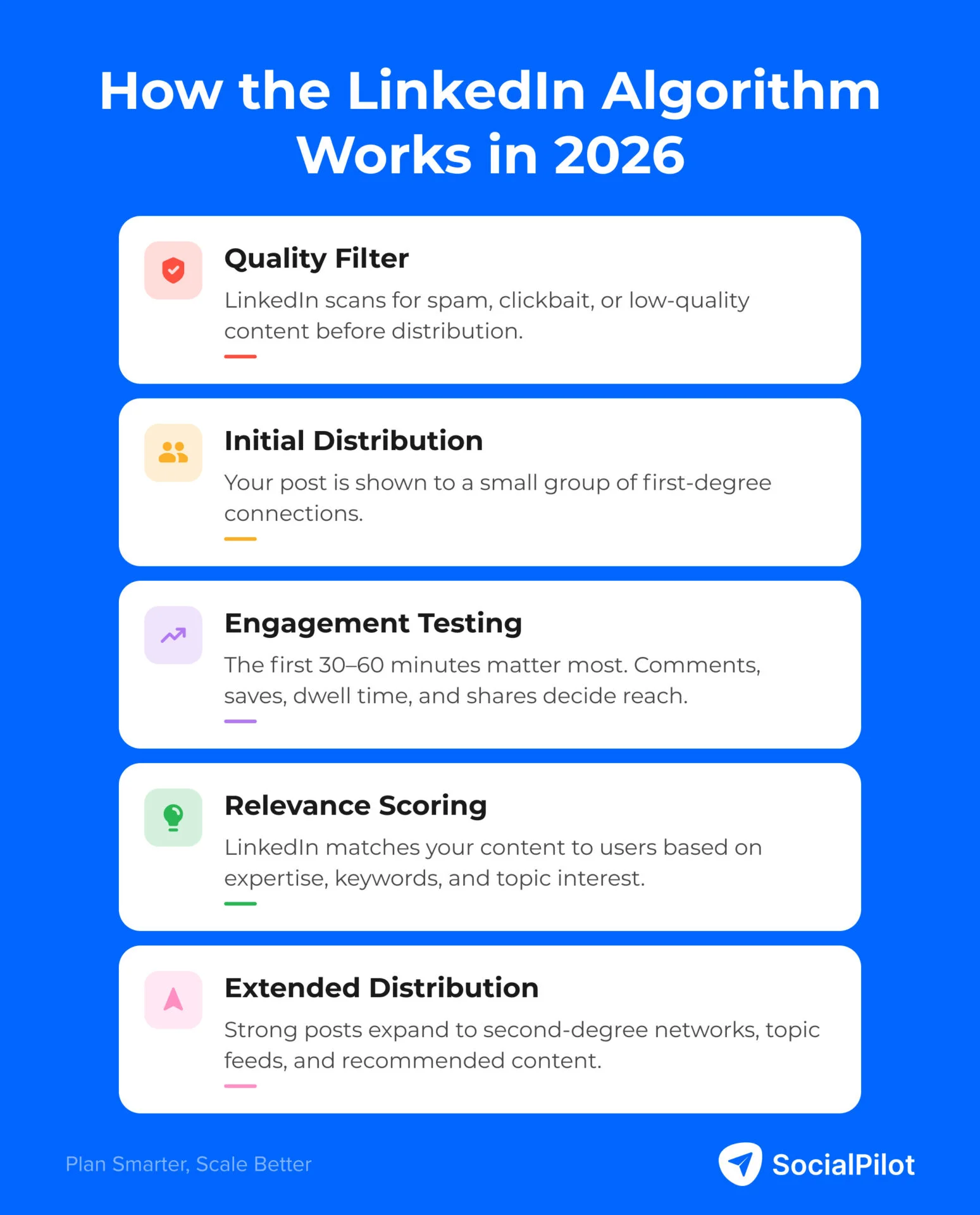
Stage 1: Initial Quality and Safety Screening
The moment a user or company page publishes a post, natural language processing (NLP) models and computer vision tools inspect the material. This stage checks for policy violations, outright spam, misleading titles, low-quality automation, and repetitive templates. Content passing this initial filter is classified into one of three categories: low quality, high quality, or potential spam. Posts categorized as high quality move directly into the distribution testing phase.
Stage 2: Micro-Testing and Early Distribution
Once classified, the algorithm displays the post to a small, targeted cohort of your immediate network (first-degree connections) and users who frequently engage with your specific topic niche. During this initial exposure window, the system monitors immediate reactions:
- Dwell time: How many seconds users pause to read the post before scrolling past.
- Engagement depth: Whether users click "see more," leave thoughtful comments, or share the content.
- Negative feedback: Whether test viewers click "I don't want to see this" or mute the creator.
Stage 3: Artificial Intelligence Relevance Scoring
If the early performance metrics cross defined quality thresholds, LinkedIn’s AI models calculate a personalized relevance score for broader distribution. This score connects three distinct vectors:
- Creator affinity: How often a viewer interacts with the author through messages, profile visits, or previous post engagements.
- Topical alignment: The overlap between the post's core subject matter and the viewer's explicit skills, job title, industry sector, and historical reading habits.
- Probability of interaction: The machine learning model's prediction of whether a specific user will find the post valuable enough to read or discuss.
Stage 4: Dynamic Re-Ranking and Feed Assembly
Finally, as you open the LinkedIn app or web interface, the system assembles your feed. It re-ranks candidate posts to ensure variety. The algorithm intentionally prevents your feed from becoming homogenous by alternating between text updates, carousel documents, native video, industry news, and updates from your close colleagues.
Key Signals Driving Feed Distribution
The 2026 LinkedIn algorithm relies on specific signals to determine which content deserves extended reach. These signals fall into distinct operational categories.
1. Connection Strength and Network Proximity
LinkedIn continues to anchor feed generation in your personal graph. However, direct connection status alone does not guarantee visibility. The algorithm measures proximity through active interactions:
- Direct messaging history and mutual profile views.
- Shared employment history or current organization membership.
- Consistent mutual commenting on each other's posts.
- Interaction with shared groups or event pages.
Posts from close contacts receive a systemic boost, ensuring that critical updates from colleagues and active partners remain visible even if those posts do not achieve high global engagement.
2. Dwell Time and Consumption Depth
Passive consumption patterns play a major role in content ranking. Dwell time measures the exact duration a post remains active on a user's screen during an active session. A user spending 45 seconds reading a detailed text post or analyzing an embedded chart provides a strong positive signal to the algorithm—even if that user does not click the "Like" button. This mechanism ensures that high-value analytical content is recognized, counterbalancing low-friction clickbait that receives fast, superficial reactions.
3. Knowledge-Sharing and Value Density
LinkedIn places structural priority on posts that impart professional knowledge, actionable insights, or industry analysis. The algorithm evaluates text structure, identifying whether a post offers clear takeaways, structured explanations, or specialized technical context. Posts containing original insights, industry breakdowns, or step-by-step methodologies receive higher evaluation scores than generic motivational statements or brief status updates.
4. Meaningful Conversation Velocity
The quality of interaction matters significantly more than raw engagement volume. The algorithm distinguishes between low-effort commentary (such as single-word responses or automated emoji replies) and constructive professional discourse.
Key engagement factors include:
- Comment length and depth: Long-form, thoughtful responses signal strong reader interest.
- Creator responsiveness: When creators actively reply to comments within the first few hours of posting, the algorithm interprets the interaction as a healthy discussion thread and expands post visibility.
- Sub-thread formation: Conversations where multiple users reply to one another within the comment section trigger additional distribution boosts.
Content Formats and Distribution Dynamics
Different media formats are evaluated using customized metrics within the algorithm. Understanding how each format behaves helps professionals select the right medium for their message.
| Content Format | Primary Signal Evaluated | Ideal Length / Structure | Feed Distribution Characteristics |
|---|---|---|---|
| Document Carousels (PDF) | Slide completion rate & swipe depth | 5 to 12 slides with concise visual pointers | High dwell time potential; favored for educational breakdowns and frameworks. |
| Native Text + Image | Reading dwell time & image zoom/click | 150–300 words with 1–2 high-resolution visuals | Stable baseline distribution; works best when visuals directly illustrate text concepts. |
| Native Video | Watch completion percentage & audio-on engagement | 30 to 90 seconds with burned-in subtitles | High priority in mobile feeds; requires strong hooks within the first 3 seconds. |
| Long-Form Newsletters | Subscription conversions & read completion | 800+ words published on a predictable schedule | Strong off-feed notification push; high audience retention for specialized topics. |
| External Link Posts | Click-through rate vs. return time | Contextual summary (100+ words) accompanying link | Distribution reduced if post lacks standalone contextual value prior to the link. |
Document Carousels and Visual Slidedecks
Document uploads (PDF carousels) continue to perform well because they naturally encourage high dwell time. As users swipe through individual slides, the platform registers continuous interaction events. To maximize this format, creators present one self-contained concept per slide, concluding with a clear discussion prompt on the final slide.
Native Video Integration
Short-to-medium native video updates capture significant feed real estate, particularly on mobile devices. The algorithm measures watch completion rates and audio toggles. Videos that include clear, burnt-in captions perform better, as a large percentage of professional users consume feed content in sound-off environments.
The Handling of External Links
A common question involves how the algorithm treats posts containing outbound web links. Historically, social platforms suppressed outbound links to keep users on-site. The current LinkedIn algorithm permits external links without arbitrary penalties, provided the post itself contains substantial context. A post that simply drops a URL with a brief tagline receives limited reach. Conversely, a post that summarizes key takeaways, analyzes the linked material, and provides standalone value receives standard distribution regardless of the external link.
Consumer Controls: Customizing Your Feed
While the algorithm works automatically, individual users retain direct controls to shape what appears on their screens. Exercising these controls trains the personal recommendation model to better match your immediate professional needs.
Explicit Signals You Can Influence
- Following vs. Connecting: You can stay connected to colleagues for networking purposes while choosing to unfollow their public posts if their content does not match your professional interests.
- The "I Don't Want to See This" Feature: Clicking the three dots on any post to select this option explicitly tells the model to reduce similar topics, content formats, or creator profiles from your feed.
- Top vs. Recent Feed Toggles: Users can switch between the default "Top" feed—sorted dynamically by AI relevance scores—and the "Recent" feed, which presents posts chronologically from your network.
- Bell Notifications: By clicking the notification bell on specific creator profiles or company pages, you send a direct signal prioritizing their future content in your daily feed feed updates.
Common Mistakes That Reduce Content Reach
Many professionals inadvertently trigger algorithmic suppression by adopting outdated tactics or low-quality publishing habits.
1. Participation in Engagement Pods
Attempting to game the system through automated engagement pods or organized mutual-commenting groups is counterproductive. LinkedIn’s pattern-detection systems identify synchronized engagement networks quickly. Accounts caught participating in artificial engagement loops suffer silent distribution suppression (shadow demotion) across their entire output.
2. Publishing High-Frequency, Low-Value Text
Posting multiple times per day does not multiply your total reach; in fact, it often achieves the opposite. When a creator publishes a second post while an earlier post is still actively moving through micro-testing, the algorithm frequently caps the reach of the first post to prevent feed cannibalization. For optimal performance, creators generally focus on one high-quality post per day or 3–4 detailed updates per week.
3. Relying Entirely on Unedited AI Text
The proliferation of automated writing tools has led to an influx of generic professional commentary. LinkedIn’s content analysis models evaluate structural originality, tone, and phrase repetition. Posts that rely entirely on generic, unedited AI output struggle to secure high dwell time or genuine comments, leading to early distribution drop-offs in Stage 2 micro-testing.
4. Ignoring the Comment Section Post-Publication
Publishing a post and immediately logging off forfeits a primary driver of organic reach: creator-led conversation. The first 60 to 120 minutes following publication are critical for establishing discussion density. Creators who actively monitor their posts and reply with thoughtful follow-up questions signal to the algorithm that the content is generating a live, valuable discussion.
Actionable Strategy to Optimize Your LinkedIn Content
To align your content strategy with how the algorithm evaluates authority and relevance, execute the following four-step workflow:
Step 1: Define Your Core Topical Niche
The algorithm categorizes creator accounts based on historical posting patterns, profile keywords, and engagement demographics. Establish 2 to 3 core topics related to your professional domain. Consistently publishing within these parameters helps the algorithm accurately route your posts to users interested in those specific subjects.
Step 2: Write for Dwell Time and Scannability
Structure text updates to invite comprehensive reading:
- Use compelling opening lines that state the post's main value clearly.
- Break dense paragraphs into 2–3 sentence blocks for clear mobile reading.
- Incorporate bold headers, concise bullet points, or visual diagrams to keep readers engaged.
- Avoid clickbait tactics; deliver on the promise of your headline within the body of the post.
Step 3: Prompt Specific, Meaningful Discussions
Instead of closing posts with generic questions like "What do you think?", ask targeted questions that invite specialized perspectives. For example:
"How is your team handling this shift in compliance standards? Are you updating your internal audits this quarter or waiting for official guidance?"
Specific prompts lead to structured, industry-relevant responses, which the algorithm rewards with expanded distribution.
Step 4: Analyze Content Performance via Native Analytics
Regularly review your LinkedIn creator analytics dashboard to identify patterns in your audience reach. Pay attention to:
- Demographic breakdowns: Confirm that your content reaches your target job titles, seniority levels, and geographic regions.
- Top-performing formats: Identify whether your audience engages more with slide carousels, text-heavy analysis, or short videos.
- Engagement-to-impression ratios: Track which topics reliably turn view impressions into comments and bookmarks.
Frequently Asked Questions
How does the LinkedIn algorithm view hashtags in 2026?
Hashtags serve primarily as organizational tags rather than reach multipliers. Using 2 to 4 focused, highly relevant hashtags helps the platform categorize your content's topic accurately. Overloading posts with dozens of generic hashtags adds visual clutter and does not improve distribution.
Why do I see posts from people I am not connected to in my feed?
You see content from outside your immediate network primarily when your first-degree connections comment on, re-share, or engage with those posts. Additionally, if the algorithm identifies a post as highly popular within your specific industry vertical, it may recommend that content to your feed based on your topical interests.
Does updating or editing a post right after publishing hurt its reach?
Minor edits to fix typos or formatting errors within the first few minutes will not penalize your post. However, making substantial structural edits or removing links after early engagement has accumulated can trigger a secondary safety re-check, briefly pausing distribution while the updated text is re-analyzed.
What is the ideal posting frequency for individual LinkedIn profiles?
For most industry professionals and executives, publishing 3 to 5 well-researched posts per week yields optimal results. Quality, depth, and comment management matter substantially more than raw daily output.
How are saved posts evaluated by the algorithm?
When a user clicks "Save" on a post to reference it later, the algorithm registers this action as an exceptionally strong signal of high-value utility. Posts with high bookmark-to-impression ratios often receive extended distribution shelf-life, appearing in feeds for several days after publication.
Next Steps for Content Optimization
To immediately improve how your content moves through the LinkedIn algorithm, review your last 5 published posts against current evaluation standards. Identify updates that lacked clear structural organization, visual assets, or discussion prompts.
Beginning with your next post:
- Select one focused topic directly aligned with your primary industry expertise.
- Format the update for high readability, using bullet points and short paragraphs to maximize dwell time.
- Conclude with a precise question tailored to experienced professionals in your field.
- Dedicate 30 minutes after publishing to actively answer incoming comments and foster ongoing discussion.
By consistently delivering clear professional value and fostering genuine dialogue, you align your content strategy with the algorithmic principles shaping the LinkedIn feed.
Image Gallery