Why a Solid Product Development Strategy Matters for Growth
A solid product development strategy aligns software or hardware engineering, market research, and commercial objectives to minimize financial risk, accelerate time-to-market, and deliver repeatable customer value. It transforms reacti...
A solid product development strategy aligns software or hardware engineering, market research, and commercial objectives to minimize financial risk, accelerate time-to-market, and deliver repeatable customer value. It transforms reactive product builds into scalable growth engines by ensuring capital and talent focus exclusively on high-impact innovations that solve validated user problems.
Contents
Strategic Clarity vs. Tactical Execution
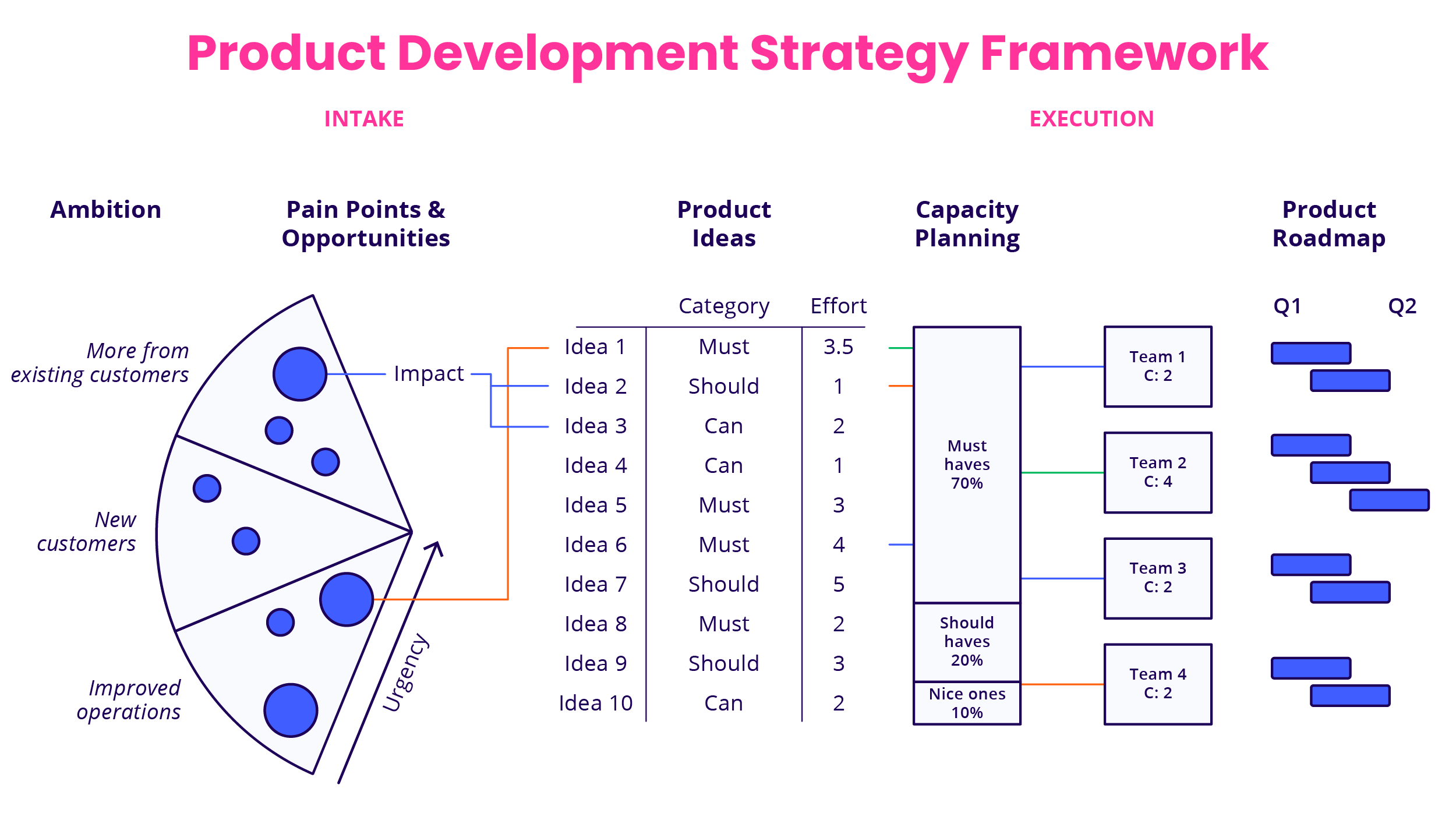
Many organizations confuse product roadmaps with product strategy. A roadmap lists features, release dates, and technical milestones; a product development strategy outlines why those features should exist, how they position the company within the competitive landscape, and what specific business outcomes they must produce.
Without strategic grounding, product development defaults to a reactive feature factory. Sales teams demand custom builds for individual client prospects, executives pivot based on unvalidated market noise, and engineering resources become fragmented. A formal product strategy establishes a North Star framework, forcing leaders to evaluate every proposed feature, enhancement, or pivot against long-term growth objectives.
Product Vision -> Strategic Objectives -> Portfolio Prioritization -> Tactical Roadmap -> Engineering Execution
In modern business environments, product development strategy links high-level corporate goals—such as market expansion, net retention improvement, or margin optimization—with daily operational choices. It ensures that every line of code written or physical component manufactured directly supports enterprise valuation and customer retention.
How Product Development Strategy Directly Drives Business Growth
Sustainable revenue expansion relies on predictable market acceptance and capital efficiency. A structured product development strategy influences growth across several operational vectors.
1. Capital Allocation and Risk Reduction
Building products is inherently expensive and risky. Research across technology and manufacturing sectors consistently demonstrates that a significant percentage of new product launches fail due to lack of market need. A solid strategy enforces disciplined validation gates long before heavy development expenditures occur.
By applying customer discovery models, prototype testing, and value proposition design early in the lifecycle, organizations avoid sunk-cost traps. Rather than spending millions of dollars on a fully built solution that falls flat, strategic frameworks mandate low-cost experiments to verify demand. This capital efficiency allows companies to deploy funds into proven growth drivers rather than speculative bets.
2. Accelerated Time-to-Market and Execution Velocity
Speed to market is a critical competitive moat. However, speed without direction leads to rework, technical debt, and team burnout. Strategic product frameworks streamline decision-making by setting explicit boundaries around product scope.
When engineering and design teams understand the strategic constraints and primary buyer personas, they do not waste time deliberating out-of-scope features. Cross-functional teams operate with high autonomy because the strategic intent is clear. This alignment reduces governance overhead, shortens release cycles, and allows companies to capture market share before competitors react.
3. Customer Retention and Lifetime Value (LTV) Optimization
Acquiring new customers is substantially more expensive than retaining existing ones. Growth strategies reliant solely on top-of-funnel acquisition face steep decline if the underlying product fails to yield persistent value.
A product development strategy prioritizes post-launch lifecycle management. It forces product teams to monitor usage telemetry, churn metrics, and customer friction points. Continuous improvement focused on core product utility enhances retention rates, expands net revenue retention (NRR), and maximizes customer lifetime value. High LTV provides the financial margin needed to outspend competitors on customer acquisition.
4. Cross-Functional Alignment Across the Enterprise
A product strategy serves as an operational contract between product management, engineering, sales, marketing, and customer success teams. Misalignment among these departments creates severe friction:
- Sales promises features that engineering cannot deliver on schedule.
- Marketing promotes value propositions that do not align with actual product capabilities.
- Customer Success struggles to onboard users due to poor usability or missing baseline features.
When a unified product development strategy governs the company, marketing builds campaigns around validated differentiators, sales targets ideal customer profiles (ICPs) designed for the product's current capability, and customer success feeds structured user feedback directly back into the development backlog.
Strategic Frameworks for Product Growth
Selecting the right development methodology depends on market maturity, capital constraints, and product complexity. The table below compares the primary strategic frameworks used by growth-stage and enterprise organizations.
| Strategic Framework | Primary Objective | Best Suited For | Risk Profile | Direct Impact on Growth |
|---|---|---|---|---|
| Product-Led Growth (PLG) | Drive acquisition, retention, and expansion directly through the product experience. | SaaS, digital platforms, freemium software. | Low capital risk; high product-experience dependency. | Lowers Customer Acquisition Cost (CAC) and enables rapid viral expansion. |
| Stage-Gate / Phase-Gate | Control risk through formal decision gates before advancing capital investment. | Hardware, medical devices, enterprise hardware/software integrations. | Very low downside risk; risk of slower time-to-market. | Prevents costly product recalls and massive capital write-offs. |
| Continuous Discovery & Agile Strategy | Adapt to changing market needs through rapid iterative testing and weekly customer interviews. | Fast-moving markets, early-to-mid stage tech startups. | Moderate risk of strategic drift if vision is weak; high adaptation. | Maximizes product-market fit speed and immediate response to user feedback. |
| Value-Based / Horizon Framework | Balance short-term core product enhancements with long-term disruptive bets. | Established enterprise companies managing multiple product lines. | Balanced portfolio risk across short and long time horizons. | Protects core revenue while securing future expansion engines. |
Core Components of an Actionable Strategy
An effective product strategy is not an abstract slides deck; it is a tactical blueprint that informs daily trade-offs. To deliver measurable growth, a strategy must incorporate four foundational elements:
Deep Market and Customer Intelligence
A viable strategy starts with rigorous research rather than executive intuition. Organizations must map customer pain points using methodologies like the Jobs-to-be-Done (JTBD) framework. This process uncovers the underlying task a customer is trying to accomplish rather than focusing merely on feature requests.
Market intelligence must also account for TAM (Total Addressable Market), SAM (Serviceable Addressable Market), and SOM (Serviceable Obtainable Market), along with macro-economic conditions, regulatory requirements, and technological shifts.
Clear Value Proposition and Differentiation Moat
To capture market share, a product must offer a distinct economic or operational advantage over existing alternatives. Strategy explicitly defines this differentiation:
- Cost Leadership: Delivering equivalent value at a lower price point through superior unit economics or operational automation.
- Differentiation: Providing unique features, integration ecosystems, or performance capabilities unavailable elsewhere.
- Focus / Niche Specialization: Tailoring a product to the hyper-specific workflows of a underserved vertical market.
Objective Prioritization Frameworks
Resource scarcity affects every organization. A solid strategy establishes standard prioritization criteria to evaluate incoming ideas objectively. Common frameworks include:
- RICE Scoring: Evaluates Reach, Impact, Confidence, and Effort to rank features mathematically.
- Kano Model: Categorizes features into Basic Expectations, Performance Features, and Delighters to ensure baseline functionality is not sacrificed for novel features.
- Eisenhower Matrix adaptation: Separates urgent market demands from long-term strategic enhancements.
Measurable KPIs and Feedback Loops
Strategy requires quantifiable verification. Clear Key Performance Indicators (KPIs) track whether product development efforts translate into enterprise growth. Essential strategic metrics include:
- Feature Adoption Rate: The percentage of active users engaging with newly launched capabilities.
- Product-Led CAC Payback Period: Time required to recoup customer acquisition costs through product-driven conversion.
- Net Revenue Retention (NRR): Percentage of recurring revenue retained from existing customers over a given period, including expansions and upsells.
- Product Quality Metrics: Defect density, system uptime, and latency standards that preserve user trust.
Common Pitfalls of Executing Without Strategic Strategy
Failing to establish a rigorous product development strategy exposes businesses to operational inefficiencies that undermine corporate growth.
The "Feature Factory" Trap
When growth stalls, unstrategic organizations often react by shipping more features. This creates product bloat, confuses users, increases maintenance costs, and degrades core product performance. Features are added to satisfy individual legacy clients rather than systematically solving problems for the broader target market.
Premature Scaling
Investing heavily in marketing, sales headcount, and enterprise distribution before validating product-market fit is a primary cause of startup failure. Without a strategy that mandates validation gates, companies spend aggressive growth capital promoting products that suffer from high churn rates.
Technology-Driven Over-Engineering
Engineers may build complex technical architectures or adopt trendy frameworks that do not yield tangible value for end users. A solid strategy grounds technical investments in commercial outcomes, ensuring platform redesigns or technical debt remediation directly support reliability, scale, or feature delivery speed.
Step-by-Step Implementation Guide for Business Leaders
To construct or refine a growth-focused product development strategy, executive leadership and product leaders should follow a structured execution workflow.
Step 1: Conduct a Portfolio and Market Audit
Evaluate your existing product portfolio against current financial outputs and market dynamics. Categorize products into growth drivers, cash cows, or margin drags. Assess competitive positioning and gather raw churn data to pinpoint product deficiencies.
Step 2: Define Core Business Goals and Strategic Pillars
Establish clear, time-bound corporate objectives for the next 12 to 36 months (e.g., expanding into enterprise mid-market segments or reducing customer churn by 15%). Formulate 3 to 5 strategic product pillars that directly support these business targets.
Step 3: Establish Customer Discovery and Validation Protocols
Standardize the process for gathering user feedback and validating strategic hypotheses. Implement weekly or bi-weekly customer interview cadence across product teams. Require low-fidelity prototypes or minimum viable tests before committing engineering resources to major initiatives.
Step 4: Implement Strategic Prioritization and Roadmap Tooling
Transition team backlogs into a centralized management platform. Establish an objective scoring matrix (such as RICE) and apply it to every prospective feature. Map validated initiatives onto a outcome-based roadmap focused on delivery targets rather than rigid feature lists.
Step 5: Align Go-To-Market (GTM) Operations
Meet with sales, marketing, and customer support leaders to review strategic product priorities. Ensure marketing campaigns align with upcoming product releases and sales incentive structures support selling strategically aligned product lines.
Step 6: Review, Measure, and Iterate
Establish quarterly strategic review sessions to assess key performance metrics against strategic goals. Adapt the roadmap based on real-world usage data, competitive movements, and shifting economic conditions while maintaining consistency in core vision.
Frequently Asked Questions
What is the difference between a product strategy and a product roadmap?
A product strategy defines the high-level vision, target market, competitive positioning, and business goals of a product. A product roadmap is the tactical timeline and execution schedule detailing specific features, enhancements, and milestones designed to achieve that strategy.
How often should an executive team update its product development strategy?
While the overarching product vision remains stable for 3 to 5 years, the underlying strategic strategy should be formally reviewed quarterly. This frequency allows leadership to adjust to competitive shifts, emerging technologies, and user telemetry while avoiding mid-sprint pivots that disrupt engineering execution.
How does a product development strategy impact customer acquisition costs (CAC)?
A well-defined product strategy targets specific user personas with high intent and tailored value propositions. By building features that directly address core pain points, products achieve organic user adoption, higher conversion rates, and positive word-of-mouth, directly reducing overall customer acquisition costs.
What is the role of technical debt in product development strategy?
Technical debt refers to the implied cost of additional rework caused by choosing an easy solution now instead of a better approach that takes longer. A solid product strategy allocates a dedicated percentage of engineering capacity (typically 15% to 20%) to resolving technical debt, ensuring the product remains scalable, secure, and adaptable for future features.
Can a small business or startup benefit from a formal product development strategy?
Yes. Early-stage businesses benefit significantly from strategic discipline because their resources are tightly constrained. A formal strategy prevents small teams from wasting capital on non-essential features, ensuring every hour of development directly contributes to validating product-market fit and generating revenue.
Actionable Next Steps for Strategic Product Growth
To build a product development organization capable of driving scalable growth, executive teams must move beyond passive tracking and establish structured strategy management:
- Perform a Feature Audit: Audit your current product backlog to identify initiatives lacking direct strategic alignment with core business outcomes. Deprioritize or eliminate unaligned items immediately.
- Conduct 10 Targeted Customer Interviews: Schedule direct qualitative interviews with recently churned customers and recently closed-won accounts to validate your value proposition.
- Formalize Decision Gates: Establish formal discovery and validation checkpoints before approving engineering resources for new product lines.
- Align Product Metrics with Revenue Objectives: Transition product team evaluation metrics from output volume (features shipped) to outcome performance (adoption rates, NRR impact, and reduced payback periods).
Image Gallery