How to Set Up a Solo 401k for the Self-Employed: A Complete 2026 Guide
To set up a solo 401k, you must first verify your eligibility as a business owner with no employees. Then, obtain a Federal Employer Identification Number (EIN), choose a plan provider, sign a formal written adoption agreement, and ope...
To set up a solo 401k, you must first verify your eligibility as a business owner with no employees. Then, obtain a Federal Employer Identification Number (EIN), choose a plan provider, sign a formal written adoption agreement, and open a dedicated investment account to begin making tax-advantaged contributions.
Contents
The solo 401k remains one of the most powerful retirement vehicles available to the self-employed in 2026. Often referred to as an Individual 401k or a One-Participant 401k, this plan allows consultants, freelancers, and small business owners to contribute as both an employer and an employee. This dual capacity significantly increases the total annual contribution limit compared to a traditional IRA or even a SEP IRA in many scenarios. However, the complexity of federal regulations and IRS compliance requires a methodical approach to setup and maintenance.
Determining Your Eligibility for a Solo 401k
Before initiating the setup process, you must confirm that you meet the two primary eligibility criteria established by the Internal Revenue Service (IRS). Failing to meet these requirements can lead to plan disqualification and significant tax penalties.
The Presence of Earned Income
You must have a legitimate business that generates "earned income." This generally excludes passive income sources like rental properties (unless you are a real estate professional) or dividend portfolios. Whether you operate as a sole proprietorship, an LLC, a S-Corporation, or a C-Corporation, the business must demonstrate the intent to generate profit. In 2026, the IRS continues to look for active participation and self-employment tax filings (Schedule SE) as proof of valid self-employment.
The "No Employees" Rule
The defining characteristic of a solo 401k is that it is designed for a business with no full-time employees other than the business owner and their spouse. If you hire a full-time employee who is not your spouse, you generally must convert the plan to a standard 401k and offer it to them, which involves significantly higher administrative costs and nondiscrimination testing.
An "eligible" employee is typically defined as someone who is 21 years of age or older and has worked more than 1,000 hours in a 12-month period. Under the SECURE Act 2.0 provisions that are fully mature in 2026, long-term part-time employees who work at least 500 hours per year for two consecutive years may also gain eligibility, potentially disqualifying you from maintaining a "solo" status.
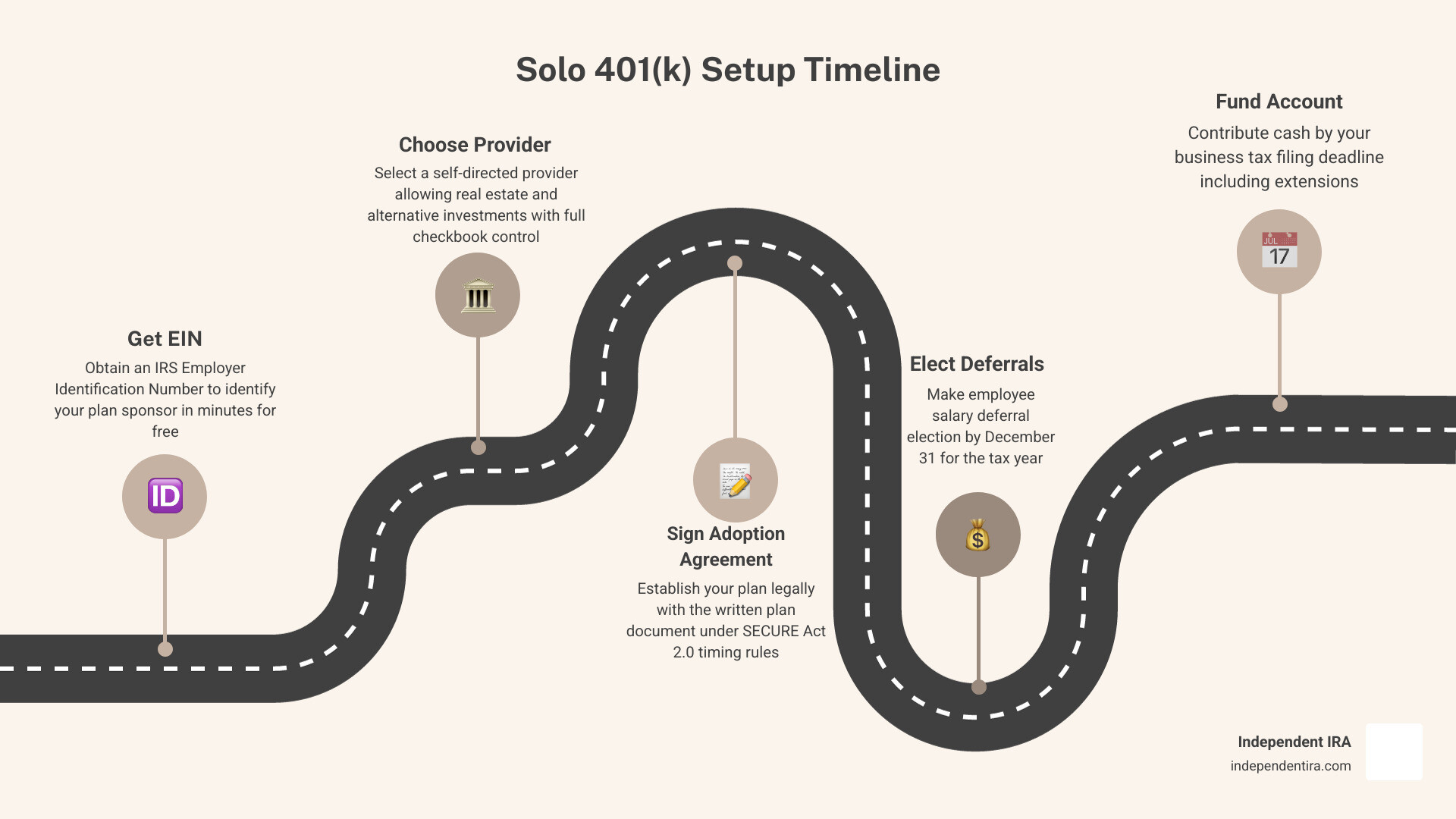
Step 1: Obtain a Federal Employer Identification Number (EIN)
Even if you are a sole proprietor who normally uses your Social Security Number for tax purposes, you should obtain a dedicated EIN for your solo 401k plan. The EIN acts as the tax identification number for the retirement trust itself, separate from your personal or business identity.
- Application: Visit the IRS EIN Assistant to apply online.
- Purpose: When prompted for the reason you are applying, you should indicate that you are creating a retirement plan.
- Documentation: Keep the CP 575 confirmation letter provided by the IRS, as most financial custodians will require a copy of this letter to open your brokerage account.
Step 2: Choose a Plan Provider and Custodian
There are two primary ways to structure a solo 401k: through a traditional brokerage (often called a "prototype plan") or through a self-directed provider (a "non-prototype plan").
Traditional Brokerage Providers
Large financial institutions like Fidelity, Charles Schwab, or Vanguard offer prototype solo 401k plans. These are generally low-cost or free to maintain. They provide the "Plan Document" and handle the basic reporting. However, these plans often limit your investment choices to stocks, bonds, and mutual funds available on their platform. They may also lack "Roth" components or the ability to take participant loans.
Self-Directed Solo 401k Providers
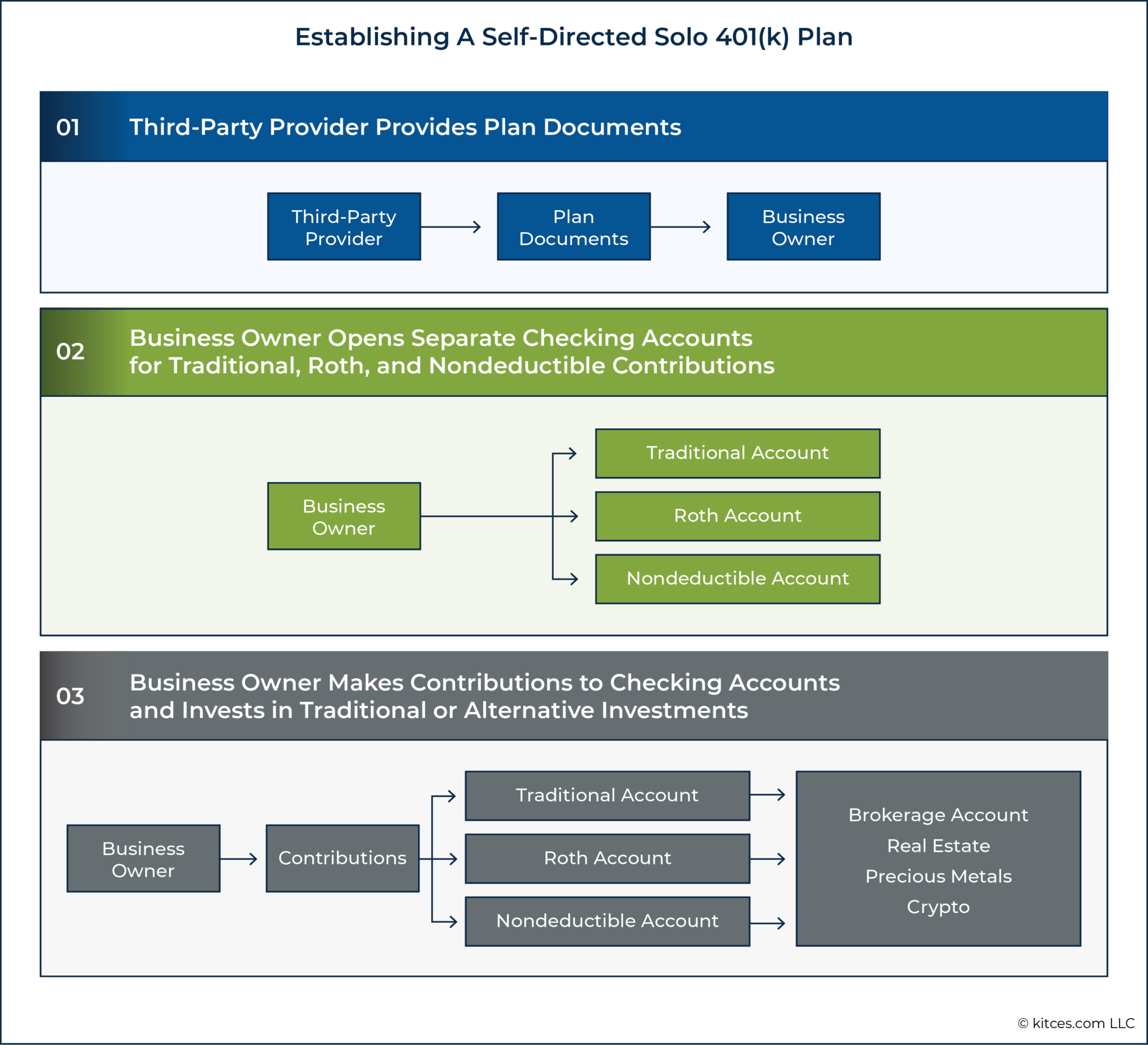
If you want "checkbook control" to invest in alternative assets such as real estate, private equity, or precious metals, you will need a self-directed solo 401k provider. These firms provide a more robust plan document that allows for customized features like the "Mega Backdoor Roth" and participant loans. These providers typically charge a setup fee and an annual maintenance fee, but they do not hold your funds; you open a bank or brokerage account in the name of the 401k trust.
Step 3: Execute the Required Legal Documents
A solo 401k is not merely an account; it is a legal trust. To establish it, you must sign several key documents provided by your chosen administrator.
- Adoption Agreement: This is the primary document where you select the specific features of your plan, such as contribution types, vesting schedules (usually 100% immediate for solo plans), and loan provisions.
- Basic Plan Document: A lengthy technical document that outlines the rules of the 401k as required by the IRS.
- Trust Agreement: This establishes the 401k as a separate legal entity and names you as the trustee.
- Summary Plan Description (SPD): A plain-language explanation of the plan's rules that must be kept on file.
In 2026, many providers utilize digital signatures for these documents, but you must ensure they are dated on or before December 31 of the tax year for which you want to make employee elective deferrals.
Step 4: Open the Investment Account
Once the legal documents are executed, you must open the actual financial account where the money will reside. This account should be titled in the name of the trust, for example: "John Doe, Trustee of the Acme Consulting Solo 401k Trust."
Ensure the custodian understands this is a 401k account, not a personal brokerage account or an IRA. This distinction is critical because 401ks fall under different sections of the tax code (Section 401) than IRAs (Section 408), and they have different contribution and reporting rules.
Comparing Solo 401k Features to Alternatives
| Feature | Solo 401k (2026) | SEP IRA | SIMPLE IRA |
|---|---|---|---|
| Max Contribution | Up to $70,000+ (Age dependent) | 25% of compensation | Up to $16,000 + Catch-up |
| Catch-up Contributions | Yes (Ages 50+ and 60-63) | No | Yes |
| Participant Loans | Yes (up to $50,000) | No | No |
| Roth Option | Yes (Elective & Employer) | Yes (since SECURE 2.0) | Yes |
| IRS Reporting | Form 5500-EZ (if > $250k) | None | None |
| Investment Control | High (including Real Estate) | Limited to Brokerage | Limited to Brokerage |
Step 5: Determine Your Contribution Strategy
As a self-employed individual, you play two roles in a solo 401k, and you can contribute in both capacities.
The Employee Role (Elective Deferrals)
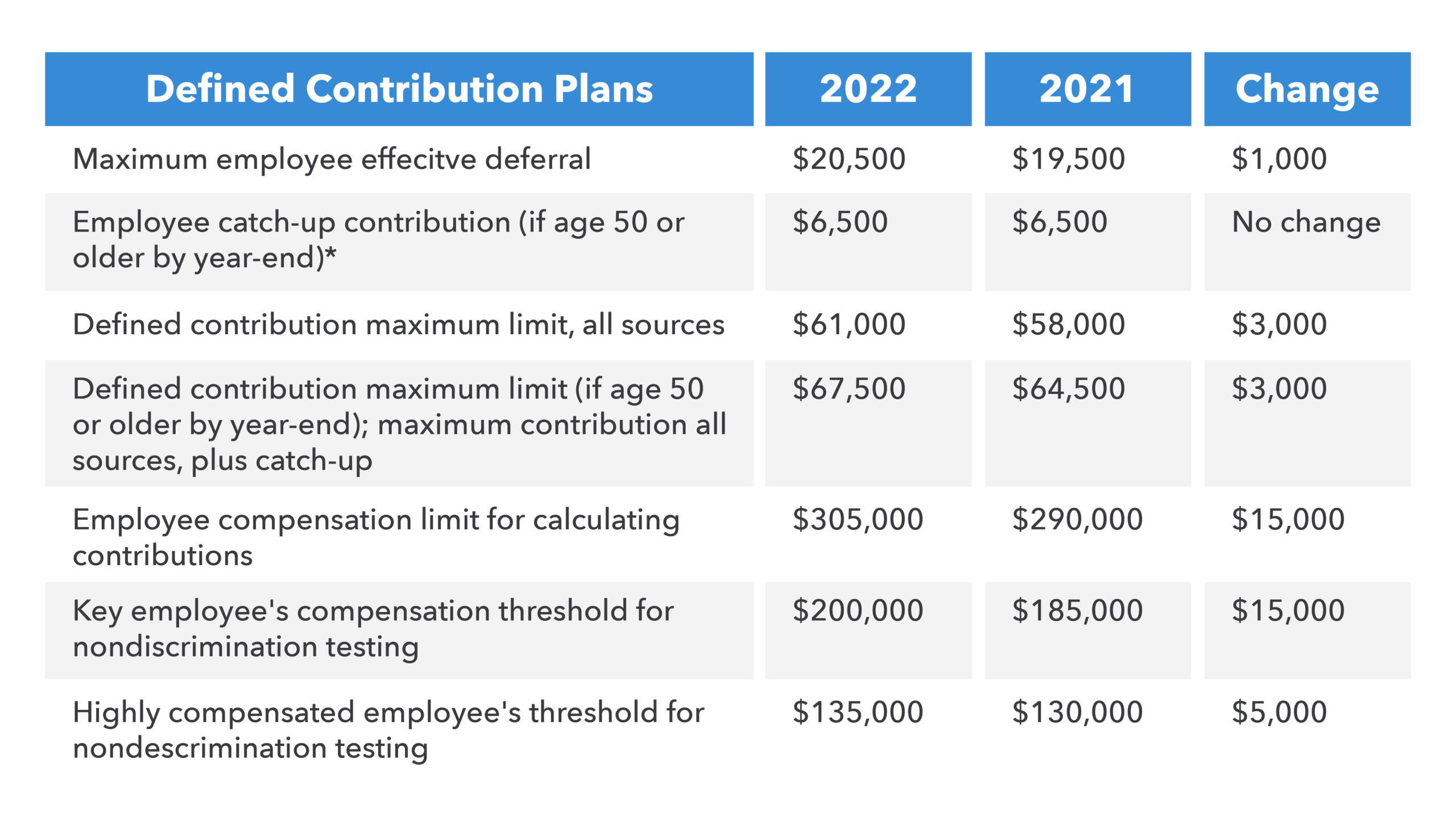
You can defer 100% of your self-employment compensation up to the annual limit. For 2026, the base limit is generally $23,500 (adjusted for inflation). If you are age 50 or older, you can add a catch-up contribution. Under the SECURE Act 2.0, participants aged 60, 61, 62, and 63 are eligible for an even higher "super catch-up" limit, which provides a significant boost to retirement savings for those nearing the end of their careers.
The Employer Role (Profit Sharing)
Your business can contribute up to 25% of your net self-employment income (compensation). For sole proprietors, this calculation is slightly more complex, effectively resulting in about 20% of net adjusted profit after subtracting the deductible portion of self-employment tax.
The total combined contribution from both roles cannot exceed the annual limit set by the IRS, which is $70,000 for 2026 (excluding catch-up contributions).
Ongoing Compliance and IRS Reporting
While the solo 401k is simpler than a corporate plan, it is not entirely "set it and forget it." Compliance is essential to avoid penalties from the Internal Revenue Service and the Department of Labor.
Form 5500-EZ Filing
If your total solo 401k assets (including any assets in a spouse's account within the same plan) exceed $250,000 at the end of the year, you must file Form 5500-EZ. This is an informational return that discloses the plan’s value and activity to the IRS. Even if your balance is below $250,000, you must file a final Form 5500-EZ in the year you terminate the plan.
Prohibited Transactions
As the trustee, you must avoid "prohibited transactions." You cannot use 401k funds to buy a house for yourself to live in, nor can you lend money to yourself outside of a formal, documented participant loan. Transactions between the plan and "disqualified persons" (you, your spouse, your parents, or your children) are strictly regulated to prevent self-dealing.
Common Mistakes to Avoid
- Missing the Deadline: While SECURE 2.0 allows some employer contributions to be set up as late as the tax filing deadline, the "employee" portion of the plan should ideally be established by December 31 of the plan year to ensure full compliance across all provider types.
- Exceeding Limits across Multiple Plans: If you have a W-2 job and a side business, your employee elective deferral limit ($23,500 in 2026) is shared across all 401k plans. You cannot contribute $23,500 to a corporate 401k and another $23,500 to your solo 401k.
- Forgetting the $250,000 Threshold: Many business owners forget to begin filing Form 5500-EZ once their investments grow, leading to substantial late-filing penalties.
FAQ
Can my spouse participate in my solo 401k?
Yes. If your spouse earns income from the business, they can participate. This effectively doubles the amount the household can contribute to the plan, as they are also entitled to their own employee deferral and employer profit-sharing contribution.
Is it possible to roll over an existing IRA into a solo 401k?
In most cases, yes. Most solo 401k plans allow "roll-ins" from traditional IRAs, 401ks, 403bs, and 457b plans. However, Roth IRAs cannot be rolled into a solo 401k according to current IRS rules.
What happens if I hire an employee later?
If you hire a non-spouse employee who meets the age and service requirements, your plan is no longer a "solo" 401k. You must either amend the plan to become a full ERISA-compliant 401k, which involves more complex filing and testing, or terminate the plan and move the assets to IRAs.
Can I have a solo 401k and a SEP IRA at the same time?
Technically, you can have both, but the IRS limits the total amount you can contribute to all "defined contribution" plans from the same employer. In most cases, the solo 401k provides higher limits on its own, making a SEP IRA redundant for the self-employed.
Do I need a lawyer to set up a solo 401k?
No, most people use a pre-approved prototype plan from a broker or a specialized solo 401k provider. These documents have already been reviewed by the IRS. However, consulting a tax professional is recommended to ensure your contribution calculations are correct.
Can I take a loan from my solo 401k?
Yes, if your plan document allows it. You can typically borrow up to 50% of the account balance or $50,000, whichever is less. The loan must be repaid with interest (usually Prime + 1%) over a five-year period.
Final Recommendation
For most self-employed individuals in 2026, the Solo 401k is the superior choice for retirement savings due to its high contribution limits and loan features. To get started, your next step should be to evaluate whether you need the investment flexibility of a self-directed provider or the simplicity of a major brokerage. Once decided, apply for your EIN immediately to ensure your plan is active for the current tax year.
Image Gallery