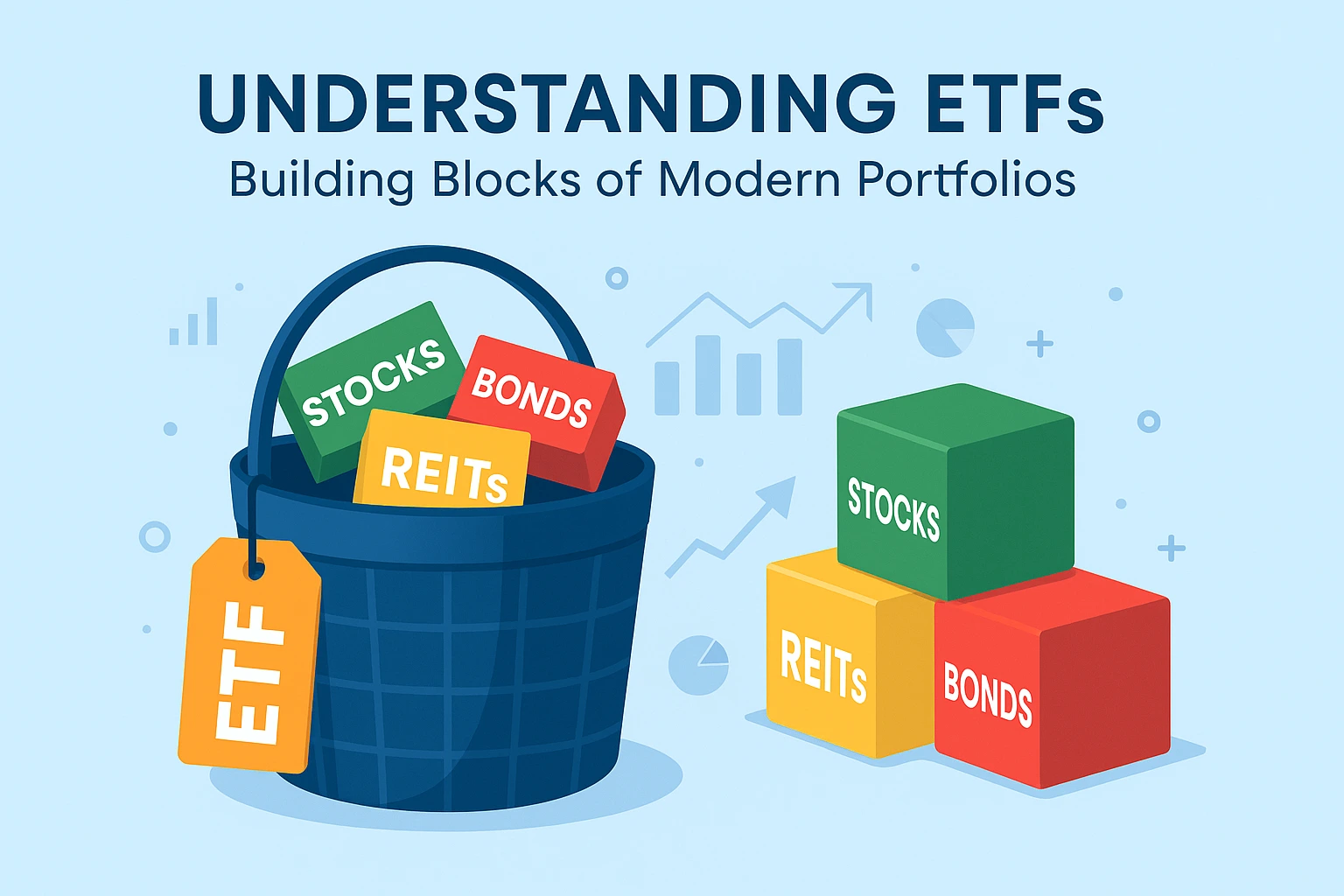
Understanding MBS ETFs: A Complete Guide to Mortgage-Backed Securities ETFs
Mortgage-backed securities exchange-traded funds (MBS ETFs) are pooled investment vehicles that hold portfolios of mortgage-backed securities, allowing individual and institutional investors to gain exposure to the U.S. residential and...
Mortgage-backed securities exchange-traded funds (MBS ETFs) are pooled investment vehicles that hold portfolios of mortgage-backed securities, allowing individual and institutional investors to gain exposure to the U.S. residential and commercial mortgage markets through exchange-traded shares. These funds offer regular monthly income, competitive yields over U.S. Treasuries, and high liquidity without requiring investors to purchase individual mortgage pools directly.
Contents
Disclaimer: This article is provided for educational and informational purposes only and does not constitute personalized financial, legal, or investment advice.
What Are MBS ETFs and How Do They Work?
Mortgage-backed securities (MBS) represent claims on the cash flows generated by pools of residential or commercial home loans. When a home buyer takes out a mortgage, the originating bank or lender often packages that loan together with thousands of similar mortgages into a single pool. This pool is structured into a debt instrument—a mortgage-backed security—which pays interest and principal to investors as homeowners make their monthly mortgage payments.
An MBS ETF is a specialized bond exchange-traded fund that buys these mortgage debt packages and holds them inside a single fund structure. Instead of buying individual bond lots, which often require minimum initial investments of $25,000 to $100,000, investors can buy a single share of an MBS ETF on major stock exchanges.
[ Individual Mortgages ] ➔ [ Pooled MBS Securitization ] ➔ [ MBS ETF Portfolio ] ➔ [ Investor Shares ]
The Structure of Pass-Through Securities
Most MBS ETFs invest heavily in pass-through certificates. In a pass-through structure, the underlying payments made by borrowers—comprising both principal repayment and interest charges—are collected by a mortgage servicer, packaged together, and "passed through" directly to the security holders after deducting servicing and administrative fees.
Because residential mortgage payments are collected on a monthly schedule, MBS ETFs typically distribute dividends to shareholders on a monthly basis. This makes them particularly popular among income-seeking investors, such as retirees or institutional pension funds seeking predictable liquidity.
Agency vs. Non-Agency MBS
Understanding the distinction between Agency and Non-Agency mortgage securities is critical when analyzing any MBS ETF prospectus:
- Agency MBS: Issued or guaranteed by U.S. government agencies or government-sponsored enterprises (GSEs). The primary issuers are the Government National Mortgage Association (Ginnie Mae), the Federal National Mortgage Association (Fannie Mae), and the Federal Home Loan Mortgage Corporation (Freddie Mac). Ginnie Mae securities carry the full faith and credit guarantee of the U.S. government, while Fannie Mae and Freddie Mac securities carry an implicit government guarantee (backed by federal support mechanisms). Consequently, credit default risk in Agency MBS ETFs is extremely low.
- Non-Agency MBS: Issued by private entities such as commercial banks, investment firms, and non-bank mortgage lenders. These securities carry no government guarantee and are subject to credit risk, default risk, and subprime underlying loan performance. Most benchmark MBS ETFs restrict their holdings primarily or exclusively to Agency MBS to minimize credit default exposure.
Core Mechanics: Prepayment Risk, Extension Risk, and Negative Convexity
While Agency MBS ETFs possess minimal credit default risk, they carry unique structural risks that set them apart from conventional government or corporate bond funds. The primary driver of this unique performance profile is prepayment risk.
Understanding Prepayment Risk
Unlike traditional fixed-coupon bonds, which repay their principal balance entirely at maturity, mortgage holders have the right to pay off their mortgage early at any time. Homeowners frequently prepay their mortgage balance due to:
- Refinancing: Lowering their interest rate when prevailing mortgage rates fall.
- Home Sales: Moving to a new residence and paying off the existing mortgage upon sale.
- Lump-Sum Repayments: Making extra principal payments or paying off the debt early.
When interest rates drop significantly, refinancing activity surges. Homeowners pay off high-yielding mortgages early, and the mortgage pool receives large principal repayments. The ETF manager must then reinvest this returned capital into new mortgage securities paying current, lower market yields. This phenomenon limits the capital appreciation potential of MBS ETFs during rate-cutting environments.
Extension Risk
Conversely, when market interest rates rise, mortgage refinancing drops sharply. Homeowners remain in their existing low-rate mortgages much longer than originally anticipated—a scenario known as the mortgage "lock-in effect."
When this happens, the effective duration (sensitivity to interest rate changes) of the MBS ETF lengthens. The investor is stuck holding lower-yielding mortgage assets for a longer time frame while prevailing market yields rise elsewhere. This dynamic is called extension risk.
The Concept of Negative Convexity
The dual pressures of prepayment risk and extension risk create a performance trait known as negative convexity:
- Standard Fixed-Income Convexity: For standard Treasury bonds, as interest rates fall, bond prices rise at an accelerating rate.
- MBS Negative Convexity: As interest rates fall, mortgage prepayment speeds accelerate, capping price gains because the underlying loans are paid off early at par value. Conversely, as rates rise, prepayments slow down, causing bond prices to fall faster than standard non-callable bonds.
Bond Price Response to Rate Changes: ---------------------------------------------------------------------- Rate Change Standard Bond Price MBS Price (Negative Convexity) ---------------------------------------------------------------------- Rates Fall ➔ Price Rises Accelerates Price Gains Capped (Prepayments) Rates Rise ➔ Price Falls Moderately Price Falls Faster (Extension) ----------------------------------------------------------------------
Comparing MBS ETFs with Treasuries, Corporate Bonds, and Direct MBS
To evaluate whether MBS ETFs belong in a portfolio, investors must compare their structural features against alternative fixed-income assets and direct bond purchases.
| Feature / Characteristic | Agency MBS ETFs | U.S. Treasury Bond ETFs | Investment-Grade Corporate Bond ETFs | Direct Mortgage Pool Purchases |
|---|---|---|---|---|
| Primary Credit Issuer | Fannie Mae, Freddie Mac, Ginnie Mae | U.S. Department of the Treasury | Private Corporations | Individual Pool Issuers |
| Default Credit Risk | Extremely Low (Implicit/Explicit US Backing) | Virtually Zero (US Sovereign Backing) | Low to Moderate (Corporate Credit Risk) | Low to High (Depends on Agency vs Private) |
| Yield Premium (Spread) | Yields higher than Treasuries; lower than Corporates | Lowest baseline yield | Higher yield to compensate for credit risk | Yields higher than Treasuries; illiquidity premium |
| Prepayment Risk | High (Driven by housing refinances) | None (Non-callable benchmark debt) | Low (Most corporate bonds have call protections) | High |
| Monthly Income Flow | Yes (Pass-through income distributed monthly) | Semi-annual or monthly distribution | Semi-annual or monthly distribution | Monthly direct cash flows |
| Minimum Investment | Price of 1 ETF share (~$50–$100) | Price of 1 ETF share | Price of 1 ETF share | Institutional Minimums ($25,000+) |
| Liquidity & Trading | High (Traded on stock exchanges intraday) | High | High | Low (Over-the-counter secondary market) |
| Tax Considerations | Interest taxable at Federal & State levels* | Federal taxable; Exempt at State/Local levels | Taxable at Federal & State levels | Taxable at Federal & State levels |
*Note: While U.S. Treasury interest is exempt from state and local taxes, interest income derived from Fannie Mae and Freddie Mac agency MBS is generally subject to federal, state, and local income taxes. Only the portion originating directly from Ginnie Mae securities may qualify for state tax exemptions in specific jurisdictions.
Benchmark Indexes and Major MBS ETFs
The majority of passive MBS ETFs track fixed-income benchmarks designed to capture the investment-grade, U.S. dollar-denominated Agency MBS market.
Primary Benchmark Indices
- Bloomberg U.S. Mortgage-Backed Securities Index: The dominant market-cap-weighted benchmark tracking Agency pass-through securities issued by Fannie Mae, Freddie Mac, and Ginnie Mae.
- ICE U.S. Agency Mortgage-Backed Securities Index: Tracks the performance of U.S. dollar-denominated Agency pass-through securities issued in the domestic market.
Prominent MBS ETFs in the Market
Several major asset managers provide index-tracking and actively managed funds in this category:
- iShares MBS ETF (Ticker: MBB): Tracks the Bloomberg U.S. MBS Index. It is one of the largest and most liquid mortgage ETFs, focusing almost entirely on investment-grade Agency pass-through securities.
- Vanguard Mortgage-Backed Securities ETF (Ticker: VMBS): Offers broad exposure to Agency MBS with an emphasis on low expense ratios, tracking the Bloomberg U.S. MBS Float Adjusted Index.
- SPDR Portfolio Mortgage Backed Bond ETF (Ticker: SPMB): A low-cost portfolio tracking the Bloomberg U.S. MBS Index, designed for core fixed-income allocations.
- Actively Managed MBS ETFs: Active portfolio managers aim to generate alpha by dynamically shifting allocation across coupon tranches, predicting prepayment velocity, and trading in the To-Be-Announced (TBA) forward market.
How ETF Managers Use the To-Be-Announced (TBA) Market
Unlike single equity stocks, individual mortgage pools are highly fragmented—millions of individual mortgage pools exist across different vintage years, loan sizes, and geographic regions. To manage liquidity and handle massive daily inflows and outflows, MBS ETF managers rely heavily on the To-Be-Announced (TBA) market.
In a TBA trade, the buyer and seller agree on basic parameters (such as issuer, maturity, coupon rate, price, and settlement date), but the exact individual mortgage pools delivered are specified shortly before settlement. Trading in the TBA market allows ETF managers to maintain tight bid-ask spreads, optimize cash management, and efficiently replicate index returns.
Macroeconomic Drivers Affecting MBS ETF Performance
The valuation and total returns of MBS ETFs depend heavily on broader macroeconomic conditions and central bank policies. Key factors influencing market performance include:
Macro Factors ➔ Fed Policy Rate Shifts ➔ Mortgage Rate Spreads ➔ Prepayment Velocity ➔ MBS ETF Total Return
1. Federal Reserve Monetary Policy and Balance Sheet Actions
The Federal Reserve is historically one of the largest holders of Agency MBS. During quantitative easing (QE) programs, the Fed purchased trillions of dollars in Agency MBS, depressing yields and driving bond prices higher. Conversely, when the Fed engages in quantitative tightening (QT) or lets mortgage holdings mature off its balance sheet without reinvestment, market supply increases, placing downward pressure on MBS prices and widening yield spreads.
2. Mortgage Rate Spreads and Interest Rate Volatility
The spread between standard 30-year fixed mortgage rates and benchmark 10-year U.S. Treasury yields reflects the market risk premium for prepayment and liquidity dynamics.
High interest rate volatility typically causes mortgage spreads to widen. When interest rates fluctuate unpredictably, prepayment model uncertainty rises, forcing institutional buyers to demand higher yields (lower prices) for holding MBS relative to risk-free Treasuries.
3. Housing Market Mobility and Refinancing Cycles
Mortgages prepay not only when rates fall, but also when homeowners move. Economic factors such as housing inventory, median home price affordability, employment conditions, and demographic shifts directly influence home turnover rates. Low turnover slows prepayment speeds, stabilizing cash flows for existing high-coupon pools.
Strategic Portfolio Roles and Allocation Guidelines
Incorporating MBS ETFs into a broad fixed-income portfolio can provide distinct structural advantages when executed appropriately.
Advantages of Holding MBS ETFs
- Yield Premium Over Treasuries: MBS ETFs historically provide an incremental yield spread over comparable-duration U.S. Treasury funds, rewarding investors for accepting prepayment risk without taking on corporate default risk.
- High Credit Quality: By focusing on Agency-backed securities, these funds maintain investment-grade portfolio characteristics, mitigating credit risk during recessions.
- Monthly Cash Flow Generation: The regular collection of pass-through interest and principal provides steady income distributions for cash-flow-focused accounts.
- Capital Efficiency and Liquidity: Real-time intraday trading, low bid-ask spreads, and lower expense ratios eliminate the complex logistics of analyzing individual mortgage pool performance.
Potential Drawbacks and Risks
- Underperformance During Rapid Rate Cuts: Due to negative convexity, when interest rates drop sharply and equity markets rally, MBS ETFs may lag traditional Treasuries because high-coupon mortgages prepay early.
- Price Volatility During Rate Hikes: Extension risk can amplify capital losses when rate hikes coincide with widening mortgage spreads.
- State Tax Exposure: Unlike pure Treasury funds, interest income generated by Fannie Mae and Freddie Mac holdings within the ETF is generally subject to state and local taxes.
Frequently Asked Questions
What primary assets are held inside an MBS ETF?
MBS ETFs primarily hold Agency mortgage-backed pass-through certificates issued by Ginnie Mae, Fannie Mae, and Freddie Mac. These packages contain thousands of bundled residential home loans. Some specialized or active funds may hold commercial mortgage-backed securities (CMBS) or private non-agency mortgage debt.
How do MBS ETFs differ from standard corporate bond ETFs?
While corporate bond ETFs carry corporate credit and default risk, Agency MBS ETFs carry virtually no default credit risk due to government agency backing. However, MBS ETFs carry prepayment risk and negative convexity, which standard fixed-coupon corporate bonds generally do not exhibit.
Do MBS ETFs pay monthly dividends?
Yes. Because homeowners make monthly mortgage payments containing both interest and principal repayments, mortgage servicers collect and pass through cash flows monthly. Consequently, most MBS ETFs distribute dividend payouts to shareholders on a monthly calendar schedule.
How does rising inflation affect MBS ETFs?
Rising inflation typically forces central banks to raise interest rates, which increases mortgage rates. As borrowing costs rise, refinancing activity slows to a standstill, triggering extension risk. The effective duration of the MBS ETF lengthens, causing the market price of existing lower-coupon ETF shares to decline.
Are dividends from MBS ETFs exempt from state taxes?
Not entirely. While interest income from direct U.S. Treasuries and Ginnie Mae securities is generally exempt from state and local income taxes, income from Fannie Mae and Freddie Mac securities is fully taxable at state and local levels. Investors should review their ETF's annual breakdown of tax-exempt income streams or consult a certified tax professional.
What happens to an MBS ETF when interest rates drop quickly?
When rates drop quickly, homeowners refinance their debt into cheaper mortgages. The older mortgages inside the ETF pool are paid off early at face value (par). The fund manager must reinvest those early principal payments into new mortgage debt that pays lower yields, which limits the capital gains of the ETF relative to non-callable Treasury bonds.
Actionable Next Steps for Investors
To determine if an MBS ETF fits your current wealth management or asset allocation plan, follow these standard evaluation steps:
- Assess Portfolio Credit vs. Duration Profile: Evaluate whether your existing fixed-income holdings are overly concentrated in credit-sensitive assets (like high-yield corporate bonds) or low-yielding short-term Treasuries. An Agency MBS ETF can bridge the gap by offering yield enhancement with low credit risk.
- Review the Underlying Fund Prospectus: Inspect the portfolio breakdown of candidate ETFs via their asset manager fact sheets (e.g., iShares or Vanguard). Verify whether the ETF invests 100% in Agency MBS or allocates a portion to non-agency private-label debt.
- Analyze the Weighted Average Coupon (WAC) and Duration: Examine the average duration and weighted average coupon of the fund's holdings. Funds holding lower-coupon pools may be more susceptible to extension risk, while funds holding higher-coupon pools carry elevated prepayment risk if mortgage rates drop.
- Evaluate Tax-Advantaged Account Placement: Given that a portion of Agency MBS yield may be subject to federal and state ordinary income taxes, placing MBS ETFs inside tax-deferred accounts (such as traditional IRAs or 401k plans) can help maximize net total returns.
- Consult a Qualified Advisor: Review your cash-flow needs, risk tolerance, and tax state residency with an independent financial advisory professional to ensure fixed-income allocations align with your long-term objectives.
Image Gallery