How to Get Online Auto Insurance Quotes in Virginia: A Step-by-Step Guide
Getting online auto insurance quotes in Virginia requires gathering your vehicle identification number (VIN), driver's license details, and driving history, then submitting this data to licensed carriers or comparison engines. Because...
Getting online auto insurance quotes in Virginia requires gathering your vehicle identification number (VIN), driver's license details, and driving history, then submitting this data to licensed carriers or comparison engines. Because Virginia mandates minimum liability coverage of 50/100/25 and no longer allows drivers to opt out via an uninsured fee, comparing online quotes ensures compliance while finding optimal rates.
Contents
Understanding Virginia Auto Insurance Requirements
Before requesting online quotes, you must understand the legal standards governing drivers in the Commonwealth of Virginia. Auto insurance regulations in Virginia are overseen by the Virginia State Corporation Commission Bureau of Insurance and enforced on the roads by the Virginia Department of Motor Vehicles (DMV).
The Elimination of the Uninsured Motorist Vehicle Fee
For decades, Virginia allowed motor vehicle owners to pay an annual $500 Uninsured Motorist Vehicle (UMV) fee at registration to drive legally without insurance. This option was permanently eliminated on July 1, 2024.
Today, every vehicle registered in Virginia must carry an active auto liability insurance policy issued by an insurer licensed to conduct business in the Commonwealth, unless the owner qualifies for approved self-insurance or posts an official surety bond.
Minimum Mandatory Liability Limits
Virginia state law establishes specific minimum coverage thresholds for bodily injury and property damage. Under Virginia Code § 46.2-472, the mandatory policy limits are:
- $50,000 for bodily injury or death of one person in a single accident.
- $100,000 for bodily injury or death of two or more persons in a single accident.
- $25,000 for property damage resulting from a single accident.
Insurance professionals often summarize these requirements as 50/100/25 coverage. When shopping online, any compliant policy quote generated for a Virginia address will automatically default to or exceed these minimum baseline amounts.
Mandatory Uninsured/Underinsured Motorist Coverage
By default, Virginia law requires that auto insurance policies include Uninsured Motorist (UM) and Underinsured Motorist (UIM) coverage matching your liability limits. This protection pays for medical expenses and property damage caused by a hit-and-run driver or an uninsured motorist.
Information Required Before Requesting Online Quotes
To obtain accurate, binding quotes rather than rough estimates, gather all relevant personal and vehicle data before launching online quote tools. Providing exact details prevents sudden price adjustments when the insurance company verifies your records.
1. Driver Information
- Full Legal Name and Date of Birth: Required for every household member of driving age.
- Driver's License Numbers: State-issued numbers for all listed drivers.
- Driving History: Details of any moving violations, at-fault accidents, comprehensive claims, or license suspensions over the past three to five years.
- Current Address: Your primary residential address where the vehicle is garaged overnight. Urban areas, suburban neighborhoods, and rural counties carry distinct risk ratings.
2. Vehicle Details
- Vehicle Identification Number (VIN): The unique 17-character alphanumeric code located on your vehicle registration card or driver-side dashboard.
- Estimated Annual Mileage: Your primary usage pattern (commuting to work, personal pleasure, or business use) and approximate annual miles driven.
- Safety and Anti-Theft Features: Factory or aftermarket installations such as automatic braking, blind-spot monitoring, dashcams, or tracking systems, which frequently trigger discounts.
3. Existing Policy Documents
- Current Dec Page (Declarations Page): If switching carriers, reference your existing declarations page to evaluate current coverage limits, deductibles, and endorsements against new online offers.
- Prior Insurance History: Insurers offer lower rates to drivers who maintain continuous coverage without gaps.
Step-by-Step Guide to Getting Quotes Online
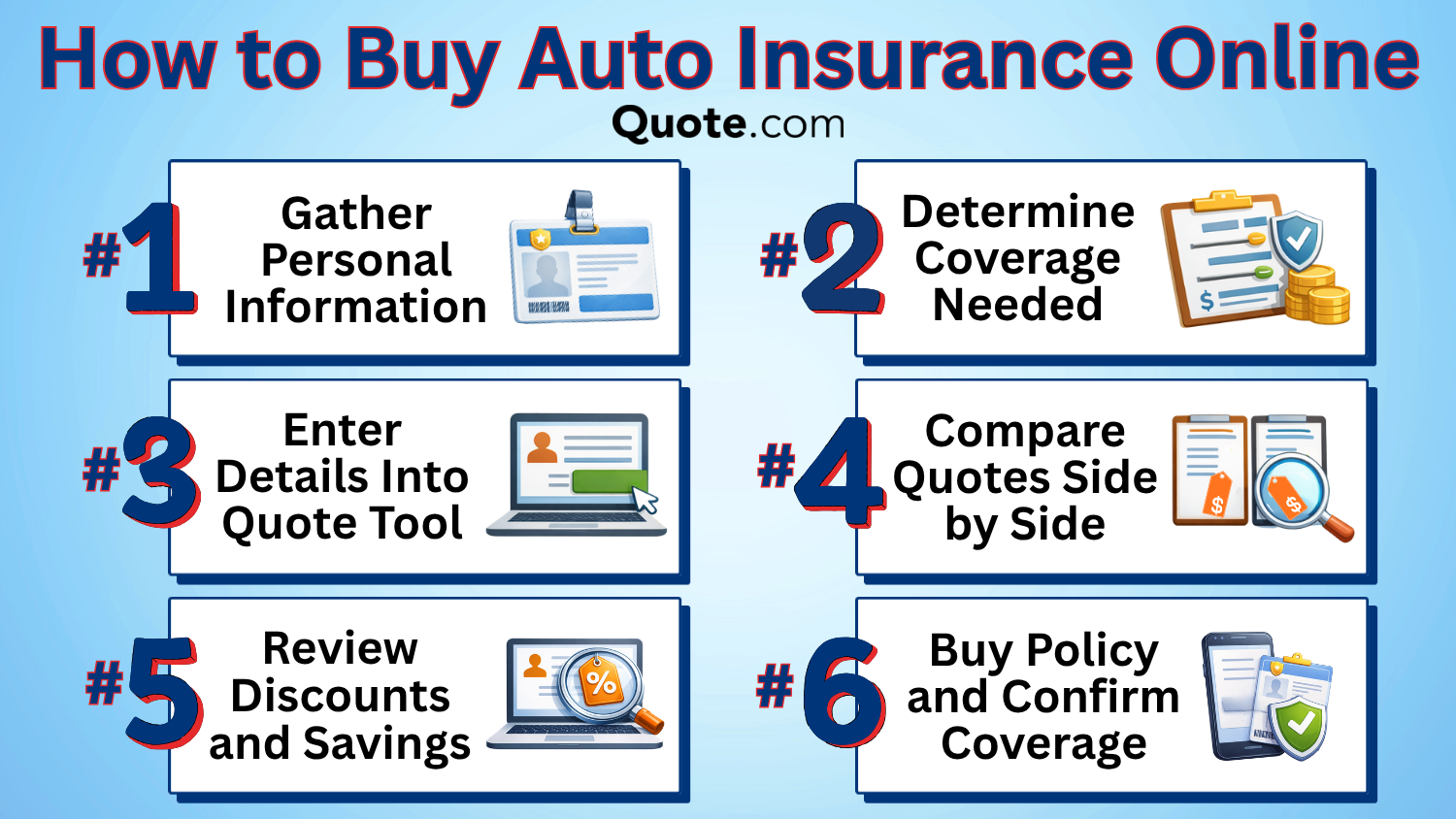
Obtaining online quotes takes 10 to 20 minutes per carrier or portal if you follow a structured workflow.
- Step 1: Gather Vehicle & Driver Information
- Step 2: Choose Direct Insurers or Aggregators
- Step 3: Select Coverage Limits & Deductibles
- Step 4: Review Discounts & Verify Information
- Step 5: Compare Quotes & Purchase Online
Step 1: Select Your Shopping Channel
You can gather online auto insurance quotes through two primary online formats:
- Direct Carrier Websites: Visiting the websites of individual national or regional insurers allows you to interact directly with their proprietary pricing engines. This approach provides exact pricing and customized discount options (such as proprietary telematics programs).
- Online Comparison Marketplaces: Independent comparison tools gather your information once and distribute it across multiple participating carriers to generate multiple side-by-side estimates. While convenient, ensure the marketplace is reputable and clear about privacy practices regarding your contact details.
Step 2: Input Personal and Vehicle Information Accurately
Complete the online questionnaire honestly. Online quote tools cross-reference the data you enter with commercial databases, such as state DMV driving records and C.L.U.E. (Comprehensive Loss Underwriting Exchange) claims history reports. Underreporting past claims or hiding household drivers will lead to revised—and usually higher—final premium quotes.
Step 3: Customize Coverage Limits and Add-Ons
Online tools usually default to either state minimum limits or standard recommended limits (such as 100/300/100). Adjust the coverage limits, collision deductibles, and comprehensive deductibles across all quote platforms so you compare equivalent coverage levels.
Step 4: Apply Eligible Discounts
Review all optional discount checkboxes during the application flow. Common discounts available to Virginia drivers include:
- Multi-Policy (Bundling): Combining auto insurance with homeowners, renters, or condo insurance.
- Telematics / Usage-Based: Opting into mobile app tracking that monitors braking, speed, and driving hours.
- Defensive Driving Courses: Completing a state-approved mature driver improvement course (often applicable to senior drivers in Virginia).
- Good Student: High school or college students maintaining a "B" average or higher.
- Paperless Billing and Auto-Pay: Enrolling in digital statements and electronic funds transfers.
Step 5: Compare and Save Quotes
Save official quote numbers or PDF summaries for every option you generate. Check whether the quoted price includes upfront payment discounts versus installment fees.
Key Auto Insurance Coverage Options in Virginia
When building your policy online, you will encounter basic and optional coverage selections. Understanding these components helps tailor protection to your personal financial risk profile.
- Virginia Auto Policy
- Liability (Req)
- Bodily Injury
- Property Dam.
- UM / UIM
- Physical Damage
- Collision
- Comprehensive
- Gap Insurance
- First-Party Med
- MedPay
- Income Loss Benefits
- Liability (Req)
Mandatory Protections
- Bodily Injury Liability: Covers third-party medical expenses, legal defense costs, and settlement claims if you cause an accident resulting in injury or death.
- Property Damage Liability: Covers repairs or replacement costs for another party's vehicle or property (such as guardrails, fences, or structures) damaged in an accident you cause.
- Uninsured/Underinsured Motorist (UM/UIM): Protects you, household members, and passengers if you are struck by a driver without insurance, a driver with insufficient insurance, or a hit-and-run vehicle.
Optional First-Party Protections
- Collision Coverage: Pays to repair or replace your vehicle after an accident involving another car or stationary object, regardless of fault. Subject to your selected deductible (typically $250, $500, or $1,000).
- Comprehensive Coverage: Pays for physical damage caused by events other than collisions, including theft, vandalism, glass damage, animal strikes (such as deer strikes, which are common in Virginia), fire, and extreme weather.
- Medical Payments Coverage (MedPay): Pays reasonable medical and funeral expenses for you and your passengers injured in an auto accident, regardless of fault.
- Income Loss Benefits: An optional endorsement in Virginia that provides partial wage reimbursement if an auto injury prevents you from working.
- Gap Coverage: Essential for leased or financed vehicles; pays the difference between your vehicle's actual cash value (ACV) and the remaining balance on your auto loan or lease following a total loss.
Virginia Auto Insurance Coverage & Requirements Breakdown
The table below summarizes Virginia's minimum legal requirements alongside typical standard and high-liability recommendations:
| Coverage Type | Virginia Minimum Requirement | Recommended Standard Coverage | High-Asset Protection Coverage |
|---|---|---|---|
| Bodily Injury Liability | $50,000 per person / $100,000 per accident | $100,000 per person / $300,000 per accident | $250,000 per person / $500,000 per accident |
| Property Damage Liability | $25,000 per accident | $100,000 per accident | $100,000 per accident |
| Uninsured Motorist (UM/UIM) | Matches liability limits ($50k/$100k/$25k) | Matches policy liability limits | Matches policy liability limits |
| Collision Deductible | Not mandated by state | $500 – $1,000 | $250 – $500 |
| Comprehensive Deductible | Not mandated by state | $500 – $1,000 | $250 – $500 |
| Medical Payments (MedPay) | Optional | $2,000 – $5,000 per person | $10,000+ per person |
Primary Factors Influencing Auto Insurance Rates in Virginia
Carriers use mathematical underwriting algorithms to calculate premiums. Understanding these variables helps clarify rate differences between quotes.
1. Geographic Location (ZIP Code)
Rates fluctuate across Virginia regions due to traffic density, accident statistics, repair labor costs, and vehicle crime rates. Drivers in high-traffic corridors like Northern Virginia (Fairfax, Prince William, Loudoun counties) or the Hampton Roads metro area (Norfolk, Virginia Beach) generally pay higher average premiums than drivers in rural counties in Southside or Southwest Virginia.
2. Driving Record and Claims History
Surcharges for speeding tickets, reckless driving convictions, or at-fault accidents remain on auto rating profiles for three to five years. Convictions for Driving Under the Influence (DUI) result in severe rate spikes and require filing an SR-22 or FR-44 financial responsibility certificate with the Virginia DMV.
3. Credit-Based Insurance Scores
Virginia permits insurance companies to evaluate credit-based insurance scores during underwriting. Statistically, individuals with higher credit scores file fewer claims. Maintaining strong credit history directly lowers your auto insurance quotes in Virginia.
4. Vehicle Type and Repair Costs
The vehicle's year, make, model, crash-test performance ratings, safety equipment, and repair costs influence comprehensive and collision rates. High-performance sports cars or luxury electric vehicles require higher premiums than practical midsize sedans.
How the Virginia DMV Verifies Insurance Coverage
When you purchase a policy online, the transaction does not occur in isolation. Virginia enforces mandatory coverage through an automated compliance system.
Electronic Insurance Verification Program (VIVP)
Virginia licensed auto insurers electronically report policy issuances, updates, cancellations, and non-renewals directly to the Virginia DMV Financial Responsibility System.
When you purchase a policy online:
- The insurer submits your policy details and VIN to the state database.
- The DMV automatically matches the insurer's record with your vehicle registration record.
Risks of Coverage Lapses
If your coverage lapses or you cancel a policy before a new one takes effect, your previous insurer reports the cancellation to the DMV. The DMV will issue an inquiry notice requiring proof of continuous coverage.
Failure to verify active insurance results in severe legal penalties:
- Suspension of your driver's license and vehicle registration privileges.
- A $600 non-compliance fee charged by the DMV.
- A $145 reinstatement fee.
- The requirement to file an SR-22 Certificate of Financial Responsibility for three consecutive years.
Common Mistakes to Avoid When Shopping Online
To ensure you get accurate pricing and complete protection, avoid these common online quote pitfalls:
- Selecting State Minimums for Financed Vehicles: If your vehicle is financed or leased, your lender will mandate comprehensive and collision coverage—often with maximum deductible caps (such as $500 or $1,000). Selecting state-minimum liability alone will not satisfy lease or loan agreements.
- Omitting Household Drivers: Failing to list licensed family members or household residents on your application can lead to claim denials if an unlisted household driver causes an accident.
- Comparing Dissimilar Deductibles: Comparing a policy quote with a $1,000 deductible against a quote with a $250 deductible distorts the actual price difference. Align all terms when making side-by-side comparisons.
- Misestimating Commute Distance: Underestimating your daily commute distance might save a few dollars initially, but claims adjusters cross-reference odometer readings during accident investigations.
- Canceling Prior Policies Early: Never cancel an existing auto policy until your new policy's effective start date is confirmed and binder documents are issued. Even a one-day lapse triggers DMV scrutiny.
Frequently Asked Questions
Can I buy an auto insurance policy online and get proof immediately?
Yes. Licensed online auto insurance portals issue digital binders and insurance identification cards immediately upon payment completion. You can download these documents, save them to your smartphone, or print paper copies for your glovebox.
What happens if I move to Virginia from another state?
You must register your vehicle and obtain a Virginia driver's license within 60 days of moving to the Commonwealth. Before registering your car at a Virginia DMV customer service center, you must update your insurance policy to meet Virginia’s coverage minimums (50/100/25) through an insurer licensed in Virginia.
Does Virginia allow digital proof of insurance during traffic stops?
Yes. Virginia law authorizes drivers to present electronic proof of coverage—such as a digital insurance card displayed on a smartphone—to law enforcement officers during traffic stops or accident investigations.
How does an FR-44 filing affect online quotes in Virginia?
An FR-44 is required for drivers convicted of certain severe offenses, such as a DUI or driving under suspension. In Virginia, an FR-44 mandates doubled liability minimums (100/300/50). Online quote tools will accommodate FR-44 requirements, but pricing will reflect the higher liability limits and risk profile.
Will checking online quotes affect my credit score?
No. Insurance carriers use a "soft pull" to review your credit-based insurance score when generating an online quote. Soft credit checks do not affect your credit score or show up on hard inquiry logs reviewed by lenders.
Next Actions for Virginia Drivers
To secure compliant auto insurance at competitive rates:
- Gather Documents: Locate your driver’s license, vehicle VIN, household driver information, and current declarations page.
- Determine Coverage Needs: Decide whether state minimum limits (50/100/25) provide sufficient asset protection or if higher liability limits with full coverage (Collision and Comprehensive) better suit your financial situation.
- Get Multiple Quotes: Request online quotes directly from at least three licensed carriers operating in Virginia.
- Review and Bind: Align coverage limits across all quotes, select your preferred plan, pay the initial installment, and print your digital binder.
- Notify Your Carrier and DMV: Confirm that your new insurer electronically transmits proof of coverage to the Virginia DMV before canceling your former policy.
Disclaimer: This guide is provided for educational and informational purposes only. Insurance regulations, minimum requirements, and legal statutes are subject to change by state legislatures. Consult the Virginia Department of Motor Vehicles or a licensed insurance professional in Virginia for formal advice regarding your specific coverage needs.
Image Gallery