Understanding the Structure of Jazz Music: Form, Head, and Improvisation
Jazz music is structured around a foundational framework known as the "head" (the main melody), which frames a series of improvised solos. Built upon repeating harmonic cycles—most frequently 32-bar AABA forms or 12-bar blues—jazz bala...
Jazz music is structured around a foundational framework known as the "head" (the main melody), which frames a series of improvised solos. Built upon repeating harmonic cycles—most frequently 32-bar AABA forms or 12-bar blues—jazz balances precise architectural guidelines with spontaneous real-time invention, allowing musicians to improvise within a shared song form.
Contents
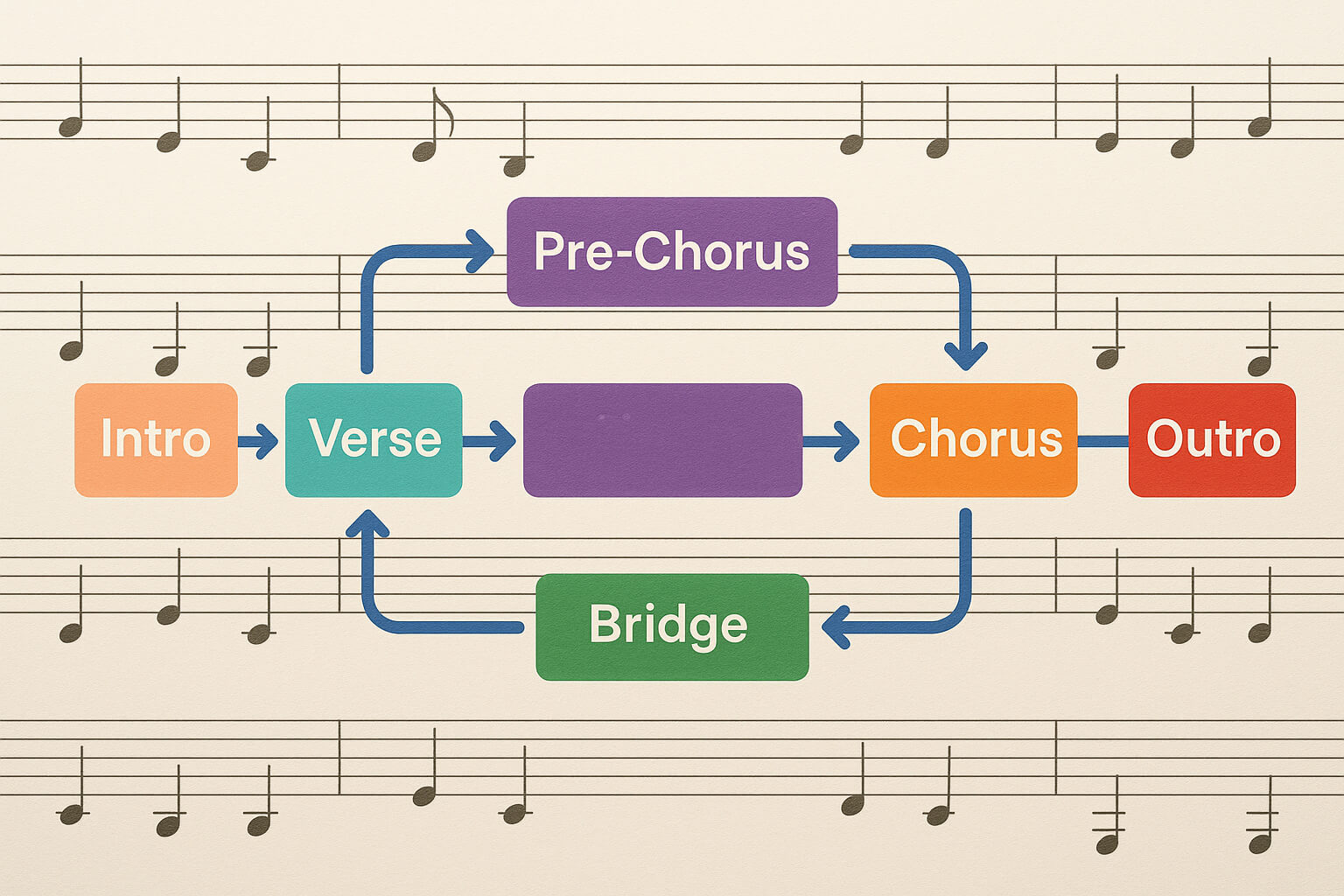
The Core Macro-Structure: The Head-Solos-Head Frame
To an untrained ear, a live jazz performance might sound like an unstructured, spontaneous jam session. However, the vast majority of traditional and modern jazz performances follow a strict architectural pattern known as the Head-Solos-Head format. This overall macro-structure provides both the musicians and the audience with a clear roadmap from the beginning of a piece to its conclusion.
- Intro
- Head In
- Solo Choruses
- Trading Fours/Eights
- Head Out
- Coda/Outro
1. Introduction (Optional)
Many jazz arrangements begin with an introductory passage ranging from 4 to 16 measures. The introduction sets the tempo, establishes the rhythmic groove, and introduces the key center of the piece. It may feature a solo piano or guitar cadenza, a drum vamp, or a rehearsed horn motif designed to prime the listener for the entry of the main melody.
2. Head In (Statement of the Melody)
The "head" is the primary written or composed melody of a jazz tune. During the "Head In," the ensemble plays the theme of the composition in its entirety. Horns (such as saxophones and trumpets) or vocalists typically state the melody while the rhythm section (piano, guitar, double bass, and drums) provides the harmonic accompaniment and rhythmic drive.
3. The Solo Section (Improvisation Over the Form)
Once the main melody has been stated, the band transitions into the solo section. During this phase, the underlying harmonic framework—the same progression of chords used during the head—repeats continuously in cycles called choruses. Individual musicians take turns constructing improvised melodies over these chord changes. While the soloist invents new melodic lines on the spot, the rhythm section continues to keep time, adjust dynamics, and react harmonically to the soloist's choices.
4. Trading Fours or Eights
Near the end of the solo section, the ensemble often engages in a conversational technique called "trading." The band splits the song form into equal measure segments—most commonly four or eight measures. The soloist plays an improvised phrase for four measures, followed immediately by the drummer or another instrument playing an improvised four-measure response. This back-and-forth exchange continues across one or more full cycles of the tune's form, heightening rhythmic intensity before returning to the main theme.
5. Head Out (Restatement of the Melody)
After all solos and trading segments are complete, the entire band returns to the main theme ("Head Out"). Playing the head a second time re-anchors the piece in its original composition, signaling to the audience that the musical journey is reaching its resolution.
6. Coda or Outro
To finish the performance, the ensemble adds a concluding section known as a coda or outro. This can take several forms, including a repeated harmonic phrase (a vamp) that fades out, a sustained final chord with an unmetered cadenza from the lead instrument, or a stylized rehearsed ending sequence.
Common Micro-Structures and Jazz Song Forms
While the Head-Solos-Head framework governs the overall flow of a performance, the internal structure of the song itself—its form—is measured in specific bar counts (measures) and harmonic groupings. Understanding these micro-structures is essential to recognizing how jazz musicians track their place in a song without written sheet music in front of them.
32-Bar AABA Form:
- A Section - 8 Bars
- A Section - 8 Bars
- B Section (Bridge) - 8 Bars
- A Section - 8 Bars
The 32-Bar AABA Form
The 32-bar AABA structure is arguably the most dominant song form in American jazz history. Originating in the early 20th century through Broadway musical theater and Tin Pan Alley songwriting, this form consists of four distinct 8-bar phrases:
- First A Section (8 Bars): Introduces the primary melodic motif and establishes the tonic key center.
- Second A Section (8 Bars): Repeats the original melody with minor variations or a adjusted final cadence leading into the next section.
- B Section / The Bridge (8 Bars): Delivers a complete departure from the main melody. The bridge introduces new harmonic territory—often modulating to a subdominant, relative minor, or dominant key—to create tension and contrast.
- Final A Section (8 Bars): Returns to the familiar opening melody and resolves the harmonic tension created by the bridge, finishing with a clear cadence.
Classic examples of the 32-bar AABA form include George Gershwin's "I Got Rhythm" (the structural foundation for hundreds of jazz tunes known as "rhythm changes") and Billy Strayhorn's "Take the 'A' Train."
The 12-Bar Blues Form
Rooted in African American traditional music, the 12-bar blues is a foundational structure across jazz, rhythm and blues, and rock. Unlike the AABA form, the blues consists of three 4-bar phrases that rely on a standard functional chord progression:
- Measures 1–4: Built primarily around the I (Tonic) chord, establishing the harmonic home base.
- Measures 5–8: Shifts to the IV (Subdominant) chord for two bars before returning to the I (Tonic) chord for two bars.
- Measures 9–12: Moves to the V (Dominant) chord, descends to the IV (Subdominant), returns to the I (Tonic), and ends with a turnaround progression on bar 12 that sets up the next chorus.
In jazz, musicians frequently elaborate on this basic structure by adding intermediate passing chords, diminished chords, and tritone substitutions. Duke Ellington's "C-Jam Blues" and Thelonious Monk's "Straight, No Chaser" showcase how much artistic variation can be built upon a simple 12-bar blues architecture.
The ABAC Form (32 Bars)
Another widespread 32-bar framework is the ABAC form, frequently utilized in standard jazz ballads and show tunes.
- A Section (8 Bars): States the main theme.
- B Section (8 Bars): Introduces a contrasting musical idea and moves away from the initial home key.
- A Section (8 Bars): Restates the initial theme to restore familiarity.
- C Section (8 Bars): Replaces the bridge with a completely unique melodic and harmonic resolution that brings the entire 32-bar structure to its final climax.
Prominent compositions using this structure include "On Green Dolphin Street" and "Someday My Prince Will Come."
Modal Jazz Structure
Pioneered in the late 1950s by artists like Miles Davis and John Coltrane, modal jazz simplified harmonic movement by removing dense chord changes in favor of sustained scalar modes.
Instead of moving through rapid chord progressions every measure, modal compositions might feature 8 or 16 bars of a single chord or scale (such as Dorian or Mixolydian). For example, Miles Davis's "So What" retains a 32-bar AABA layout metric length, but the A sections consist entirely of the D Dorian mode, while the B section shifts up a half-step to Eb Dorian before returning to D Dorian for the final A section.
Architectural Comparison of Standard Jazz Song Forms
The following table summarizes the key structural differences, bar lengths, and musical characteristics across the primary song forms found in jazz repertoire:
| Form Type | Total Bar Count | Phrase Breakdown | Primary Harmonic Characteristic | Notable Example |
|---|---|---|---|---|
| 32-Bar AABA | 32 Measures | Four 8-bar sections (A-A-B-A) | Contrasting bridge section (B) between repeating primary themes | "Take the 'A' Train" (Strayhorn) |
| 12-Bar Blues | 12 Measures | Three 4-bar phrases | Relies on I - IV - V dominant chord relationships and blues scales | "Straight, No Chaser" (Monk) |
| 32-Bar ABAC | 32 Measures | Four 8-bar sections (A-B-A-C) | Features two distinct thematic departures (B and C) | "On Green Dolphin Street" (Kaper) |
| 16-Bar Tune | 16 Measures | Two 8-bar phrases or four 4-bar phrases | Compressed form with rapid harmonic development | "Watermelon Man" (Hancock) |
| Modal Form | Variable (often 32) | Prolonged scalar blocks | Static harmony based on modes rather than functional chord progressions | "So What" (Davis) |
Roles within the Ensemble: Keeping the Form
Maintaining the structural integrity of a jazz composition during intense, spontaneous improvisation requires precise functional division among ensemble members. Every instrument in a jazz group performs a specific role designed to keep time, mark structural boundaries, and outline chord movements.
- THE JAZZ ENSEMBLE
- RHYTHM SECTION
- Double Bass
- Drums
- Piano / Guitar
- Roles:
- Timekeeping
- Harmony outline
- Structural cues
- FRONT LINE
- Saxophones
- Trumpets
- Trombones
- Vocalists
- Roles:
- State melody
- Improvise solos
- Counter-melodies
- RHYTHM SECTION
The Double Bass: The Structural Anchor
The double bass serves as the rhythmic and harmonic backbone of a jazz ensemble. In straight-ahead jazz styles (such as swing and hard bop), the bassist plays a walking bassline—a steady quarter-note pattern that outlines the root notes, chord inversions, and passing tones of the harmonic progression. By emphasizing the fundamental harmony on downbeats, the bassist ensures that soloists and listeners always know precisely where they are within the song form.
The Drums: Metric Framework and Structural Markers
Rather than simply beating out time, a jazz drummer uses dynamic accents to delineate the architecture of a piece. The ride cymbal maintains the core swing pattern, while the hi-hat clicks sharply on beats two and four. Crucially, drummers use drum fills, cymbal crashes, and rhythmic setups near the final measure of an 8-bar phrase or a 32-bar chorus to signal to the rest of the band that a new structural section is beginning.
Piano and Guitar: Harmonic Accompaniment ("Comping")
Chordal instruments provide the harmonic skeleton of the composition. Through a technique known as comping (short for accompanying or complementing), pianists and guitarists play synchronized rhythmic rhythms and chord voicings behind the soloist. Comping defines the underlying chord changes while offering real-time harmonic variations to inspire the soloist.
The Front Line: Melodic Direction
Saxophones, trumpets, trombones, and vocalists make up the "front line." Their main responsibility is to articulate the thematic melody during the Head In and Head Out, and to build cohesive narrative arcs during their respective solos. Because they do not need to maintain the metric grid continuously, front-line players are free to stretch rhythmic phrasing, accent off-beats, and push against the underlying structure.
Harmonic Glue: Cadences, Turnarounds, and Changes
The chord progression of a jazz song—often called the changes—is the primary engine driving its structure. Jazz music heavily relies on specific functional harmonic patterns to move smooth progressions toward satisfying resolutions.
The ii-V-I Progression
The ii-V-I (two-five-one) chord progression is the single most fundamental harmonic cell in jazz music. In a major key, this sequence moves from the minor supertonic chord (ii), to the dominant seventh chord (V), resolving to the major tonic chord (I).
- In the key of C Major:
- Dmin7 (ii)
- G7 (V)
- Cmaj7 (I)
Jazz compositions use ii-V-I patterns to establish key centers, modulate into new keys, and propel the listener through the structural phases of a song form. Soloists memorize these sequences to navigate complex chord charts fluently.
Basic Resolution:
- Dmin7 (ii)
- G7 (V)
- Cmaj7 (I)
Turnarounds
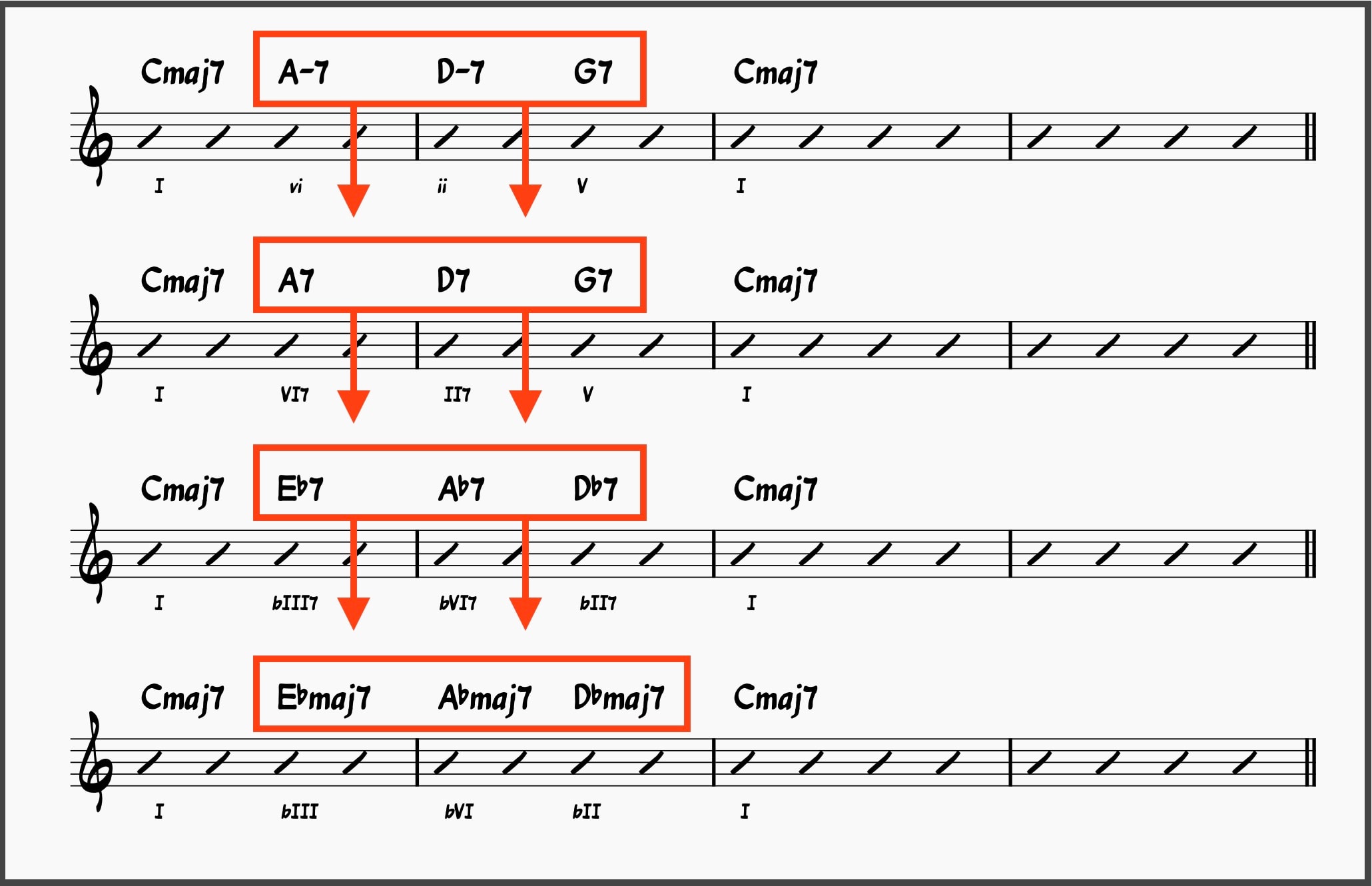
A turnaround is a short passage of chords situated in the final two measures of a song form (e.g., measures 31 and 32 of a 32-bar tune). Its primary purpose is to create a sense of harmonic instability that resolves smoothly when the band loops back to the very first chord of the next chorus. A classic turnaround pattern is the I-VI-ii-V progression (e.g., Cmaj7 - A7 - Dmin7 - G7).
Common Misconceptions About Jazz Structure
Despite the deep tradition of music theory underlying jazz, several persistent myths skew public perception of how the genre works.
Myth 1: "Jazz is Completely Random and Unrehearsed"
While jazz relies heavily on real-time improvisation, it is almost never random. Soloists are constrained by the underlying key, beat structure, chord progressions, and bar lengths of the composition. An improvised solo is an original, real-time composition created within the boundaries of a pre-existing architectural blueprint.
Myth 2: "Musicians Lose Track of Where They Are in the Song"
Experienced jazz musicians rarely lose their place within a chorus. They use a combination of mental counting, muscle memory, auditory recognition of chord progressions, and visual/rhythmic cues from the drummer and bassist to maintain absolute awareness of every measure in the form.
Myth 3: "Free Jazz Has No Rules or Structure"
Even in Free Jazz—a subgenre developed in the late 1950s and 1960s that purposefully abandoned standard song forms and traditional chord charts—musicians still operate under self-imposed structural guidelines. These may include listening for dynamic shifts, thematic motifs, textural density, or physical cues to shape the performance organically without relying on cyclic bar counts.
Frequently Asked Questions
What does "the head" mean in jazz music?
In jazz terminology, "the head" refers to the primary composed melody or main theme of a piece of music. It serves as the thematic anchor played at the beginning (Head In) and end (Head Out) of a performance, framing the improvised solo section in the middle.
What is a "chorus" in a jazz context?
In jazz, a chorus is not a repeated vocal refrain as found in pop music. Instead, a chorus refers to one complete pass through the entire structural form of a tune (e.g., one full 32-bar cycle or one full 12-bar cycle). Soloists typically play over multiple consecutive choruses during their performance.
How do jazz musicians know when a solo is finished?
Musicians signal the end of a solo through both musical cues and physical eye contact. A soloist will typically bring their improvised melodic lines to a clear harmonic resolution near the final bar of a chorus, looking directly at the next soloist or the rhythm section to hand off the performance seamlessly.
What does "rhythm changes" mean?
"Rhythm changes" refers to a specific 32-bar AABA chord progression adapted directly from George Gershwin's 1930 song "I Got Rhythm." It became one of the most widely used harmonic frameworks in bebop and modern jazz, serving as the basis for hundreds of classic compositions such as Charlie Parker's "Anthropology" and Sonny Rollins' "Oleo."
Is every jazz performance structured the same way?
While the Head-Solos-Head structure is the dominant model in traditional, swing, bebop, and hard bop styles, modern jazz compositions frequently experiment with non-traditional forms. Big band arrangements, modern fusion, and through-composed works often feature multi-part suites, dynamic metric changes, and non-repeating structures.
Practical Action: How to Listen for Jazz Structure
To deepen your active listening skills and train your ear to recognize jazz structures in real time, follow this step-by-step framework during your next listening session:
- Identify the Form: Choose an iconic standard, such as Miles Davis's version of "Autumn Leaves" or Duke Ellington's "Take the 'A' Train."
- Count the Measures during the Head: Count along with the beat (1-2-3-4) during the main melody to determine if the song follows a 32-bar form, a 12-bar blues, or an alternate structure.
- Track the Solo Entry: Listen for the exact moment the main melody finishes and the first soloist begins improvising. Notice how the drums and bass maintain the same tempo and rhythmic grid.
- Listen for the Bridge: If listening to a 32-bar AABA tune, pay attention to measure 17 (the start of the B section). Listen for shifts in harmony, key changes, or dynamic contrasts introduced by the rhythm section.
- Spot the Head Out: Notice how the band signals the return of the written main melody after the solo section concludes, bringing the composition back to its original musical theme.
By recognizing these structural components, you transform your experience from passive listening into an active appreciation of how discipline, memory, and spontaneous creativity merge in jazz music.
Image Gallery